-
-
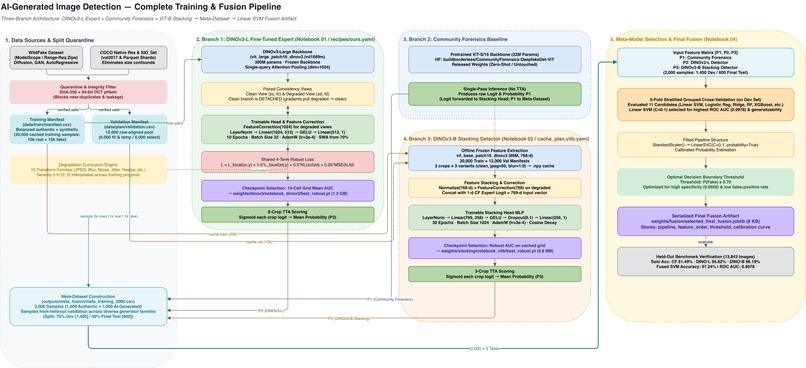
Multi-branch training, consistency regularization, and meta-fusion pipeline
-
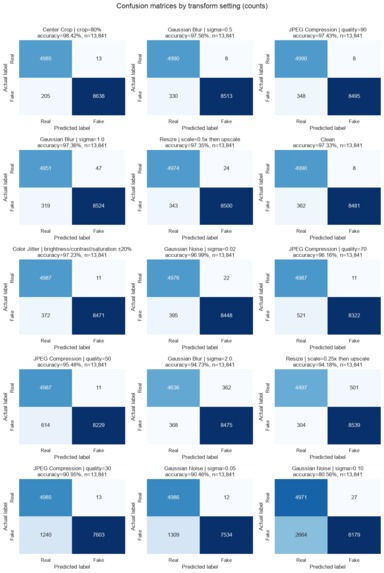
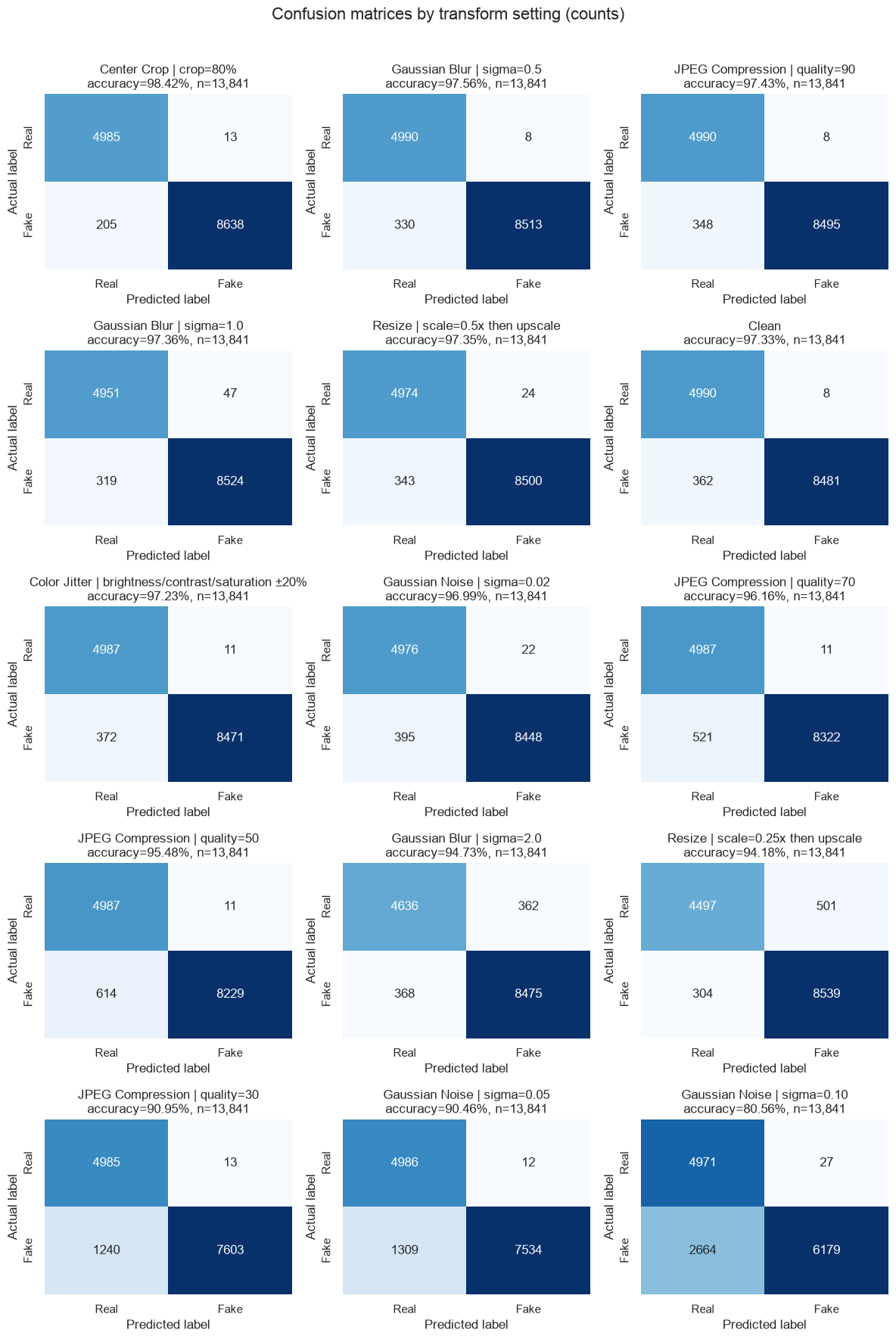
Confusion matrices across 15 transformation settings show how the detector performs on 13,841 images.
-
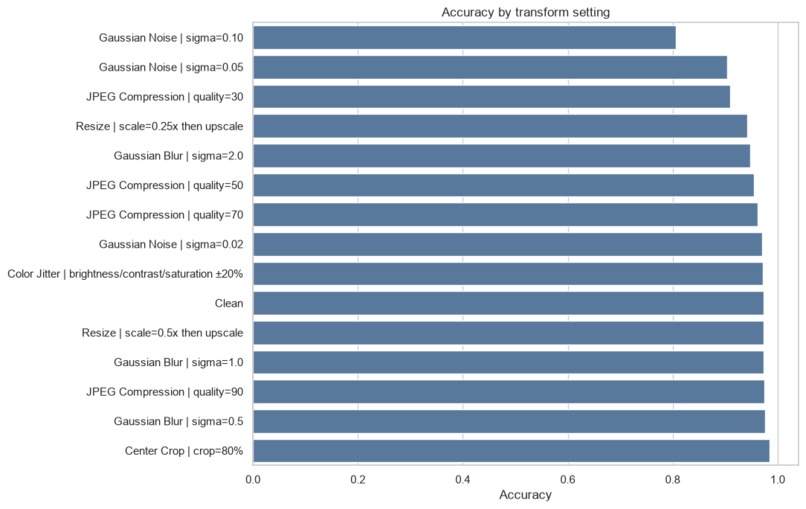
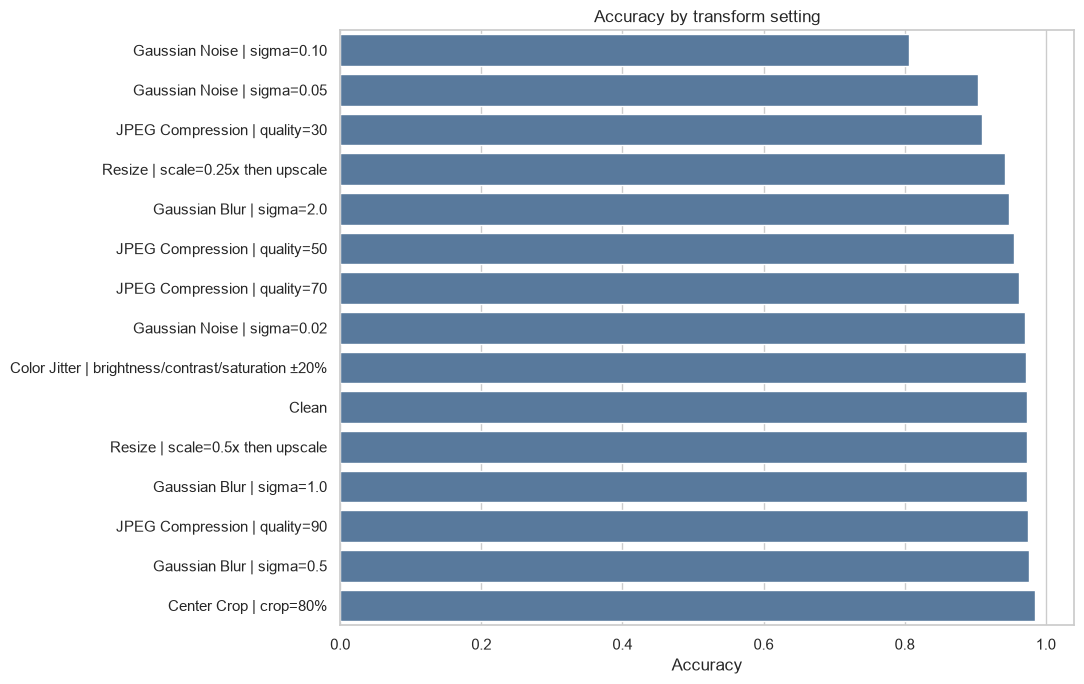
Our AI-image detector maintains strong accuracy across transformation, demonstrating robust performance under realistic conditions.
-
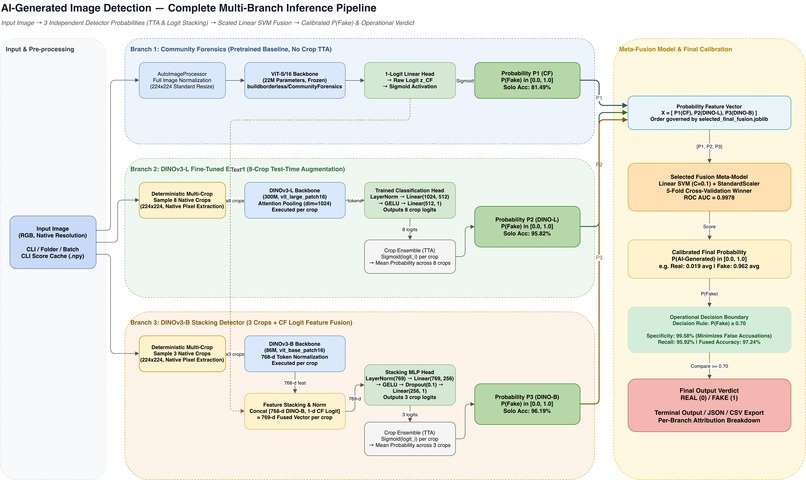
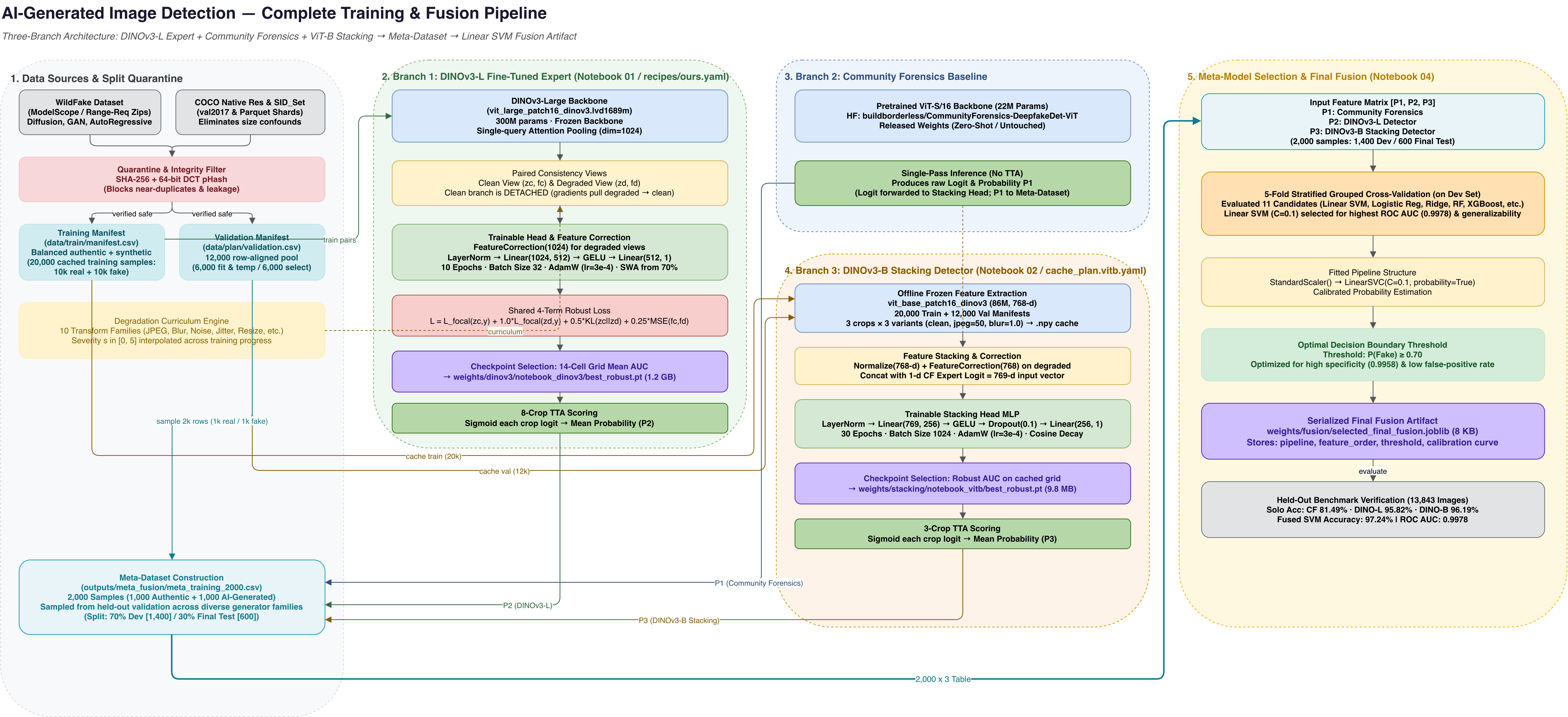
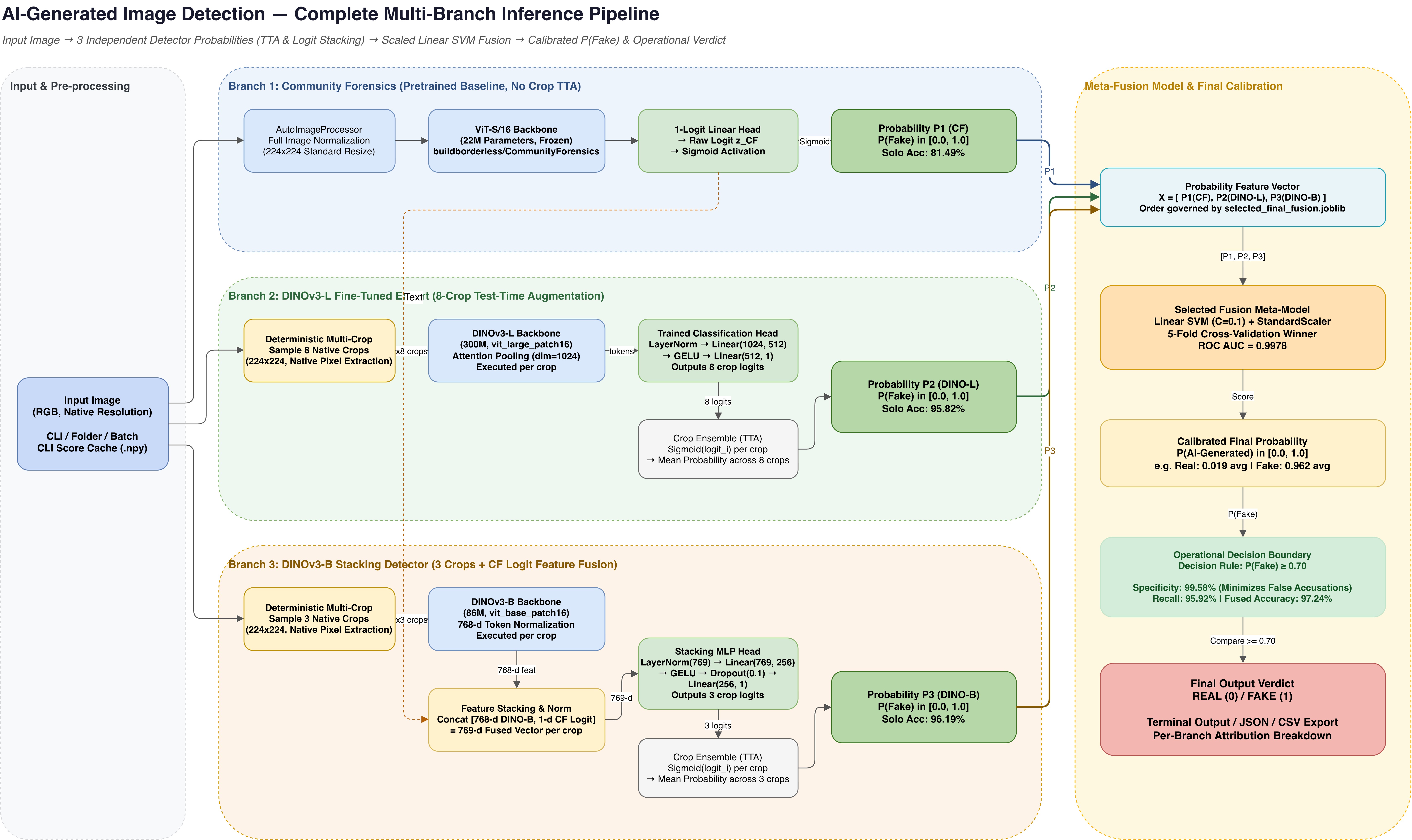
Complete multi-branch inference and linear SVM fusion pipeline.
-
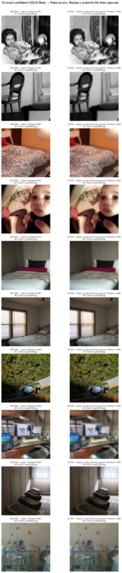
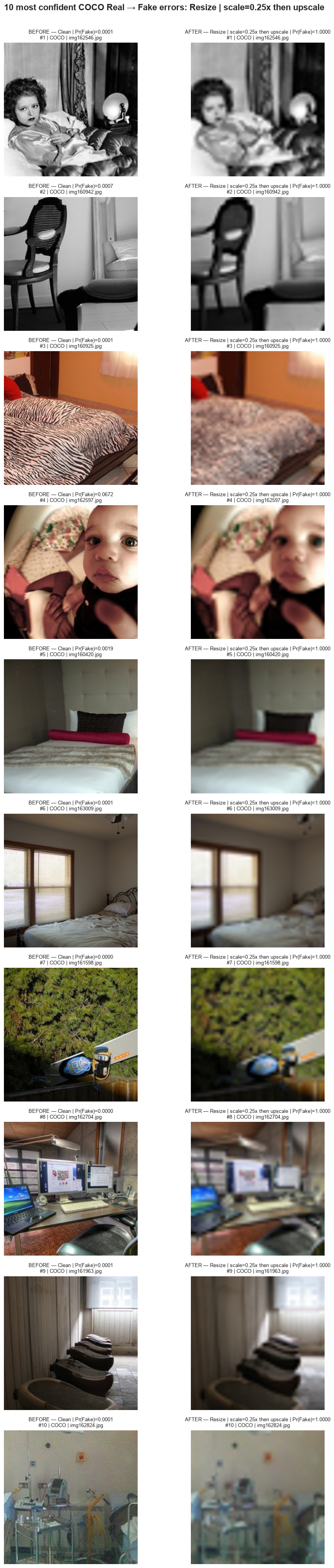
These examples demonstrate how reducing images to 25% of their original size and upscaling them again destroys fine visual evidence.
-
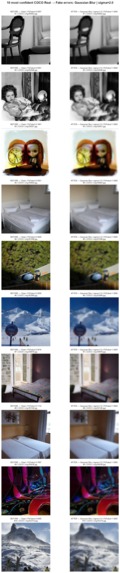
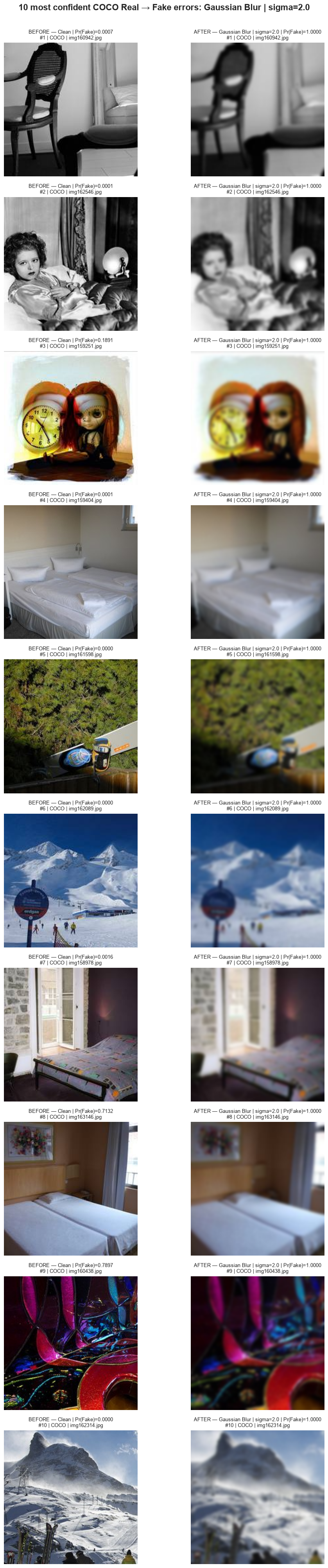
Before-and-after examples reveal how strong Gaussian blur can erase authentic image details.
-
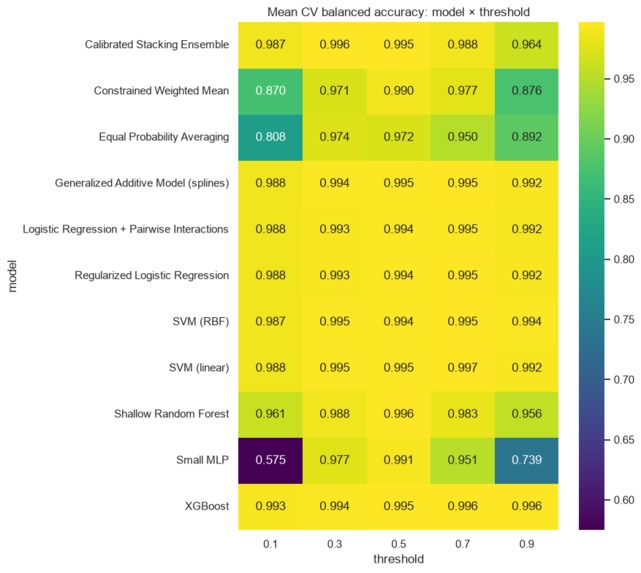
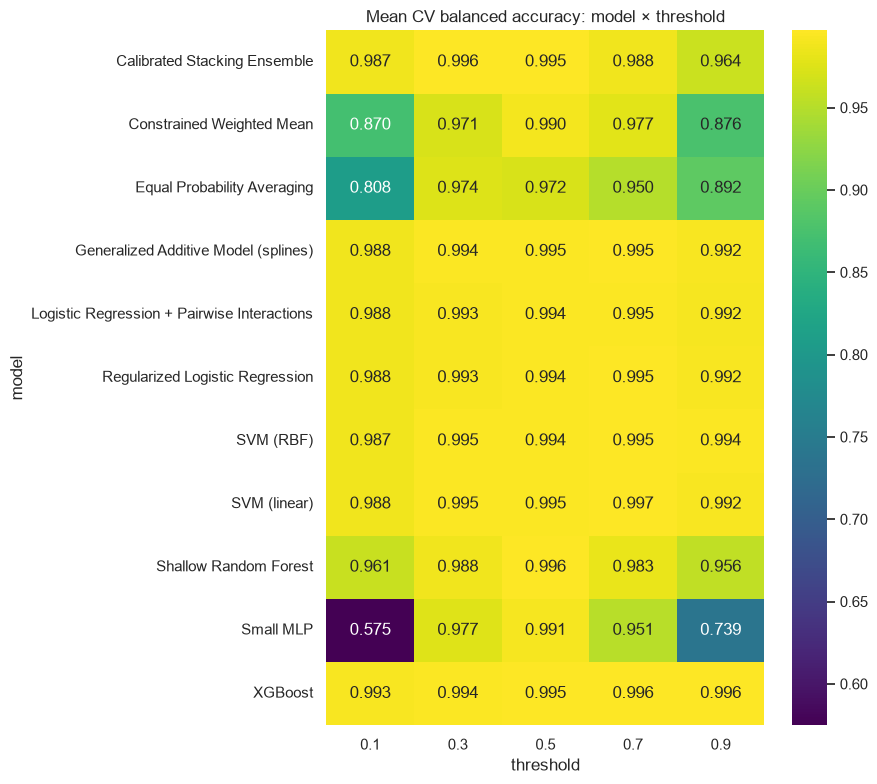
Cross-validation across multiple models and decision thresholds identifies the most reliable fusion strategy.
Inspiration
Existing vision models and AIGC detectors already understand real-world images. Tweaking their weights often ruins that knowledge and forces them to rely on fragile visual artifacts.
Base vision models are not broken. Instead of updating pre-trained weights, we froze the vision backbones completely and focused on making sense of the embeddings they produce by training a clean decision layer across multiple crops.
What it does
Point it at an image and it returns the probability that it is AI-generated, along with a Real or Fake verdict.
Three frozen vision backbones analyze the image, and a linear fusion model makes the final call:
- Community Forensics (22M ViT): Evaluates low-level digital synthesis traces in a single pass.
- DINOv3-B Stacking (86M): Extracts features across 3 crops, incorporating the forensic score.
- DINOv3-L Detector (300M): Extracts deep semantic features across 8 crops.
- Linear SVM Fusion: Fuses all branch outputs and flags any image with \(P(\text{fake}) \ge 0.70\) as fake.
The system runs locally via CLI, inside a notebook, or as a Kaggle GPU kernel. Inference spans 423M total parameters across the three frozen branches and classifier heads, completing well within standard cloud GPU budgets.
How we built it
A single model represents a single point of failure, and variants of a single architecture tend to share blind spots. Combining an untouched off-the-shelf forensic detector with two multi-crop frozen backbones decorrelates error distributions, making late fusion highly effective.
The results across 13,843 held-out validation images:
| Branch | Solo Accuracy |
|---|---|
| Community Forensics | 0.8149 |
| DINOv3-L detector | 0.9582 |
| DINOv3-B stacking | 0.9619 |
| Fused (SVM) | 0.9724 |
Paired consistency training. Every training sample passes through the model head twice: once pristine and once through a stochastic degradation chain. A combined focal loss and KL-divergence consistency loss penalizes divergence between the two views:
- The clean representations are detached from the computational graph during backpropagation.
- Gradients flow strictly toward the degraded view, preventing the model from minimizing consistency loss by degrading its clean representations.
Curriculum augmentation. Ten transform families scale in intensity from severity level 0 to 5 across training epochs. Mild perturbations dominate early training, while moderate and severe corruptions ramp up over time. A 10% floor on pristine samples prevents the classifier heads from drifting away from clean baseline distributions.
Robustness validation. Checkpoints are selected using mean AUC evaluated across a fixed grid of 14 discrete degradation benchmark conditions, rather than raw clean accuracy.
Test-time augmentation and fusion. DINOv3-L aggregates predictions across 8 crops, while DINOv3-B averages over 3 crops. A linear-kernel Support Vector Classifier (\(C=0.1\)) trained with probability scaling fuses the predictions.
Datasets and Assets Used
- Training and Evaluation Datasets:
- hy2628982280/WildFake: A collection spanning GAN, diffusion and other generator families. We ignored the coco and DALLE splits as they would be used for evaluation for the Hackathon.
- saberzl/SID_Set: A collection of Real and AIGC-generated images from social media.
- hy2628982280/WildFake's COCO val2017: Non-AIGC data for evaluation.
hy2628982280/WildFake's DALLE Advanced: AIGC data for evaluation.
Model Weights and Artifacts:
- DINOv3-L Detector Weights (
best_robust.pt): Multi-crop classifier head checkpoint selected on the 14-cell degradation grid. - DINOv3-B Stacking Head (
best_robust.pt): Lightweight classifier head integrating frozen DINO representations and forensic scores. - Linear SVM Fusion Model (
selected_final_fusion.joblib): Serialized linear decision pipeline with the 0.70 operational decision threshold.
- DINOv3-L Detector Weights (
Integrity and Split Validation:
- SHA-256 and 64-bit DCT pHash Blocklists: Precomputed hash tables used during data ingestion to prevent exact and near-duplicate leakage between training and validation splits.
Challenges we ran into
The resolution shortcut confound. Evaluating raw dataset splits initially produced a 0.995 AUC. Metadata inspection revealed real images were downscaled to \(200 \times 200\) while AI-generated samples were \(1024 \times 1024\). The classifier was learning dimension artifacts rather than generative synthesis traces. Replacing downscaled reals with native-resolution COCO images dropped the score to a genuine 0.972.
Near-duplicate leakage. Re-encoded samples bypassed exact SHA-256 checks. Enforcing 64-bit DCT perceptual hash checks caught near-duplicates across splits.
Multi-crop determinism. Test-time crop sampling originally tied to batch index positions produced slight score variances across batch sizes. Keying crop generation to fixed per-image seeds resolved this variance.
Storage limits on cloud environments. Extracting features on the fly from streamed archive shards prevented out-of-memory and disk exhaustion errors on ephemeral instances.
GPU compute quotas. Freezing the vision encoders turned multi-hundred-million parameter training into a single forward feature-extraction pass, allowing SVM fusion optimization to run on a CPU in under two minutes.
What we learned
- Inspect raw data distributions first: Resolution discrepancies can easily masquerade as state-of-the-art model performance.
- Feature extraction dominates compute: Forward passes through frozen backbones account for the computational overhead; linear classifier convergence is negligible by comparison.
- Calibrate thresholds to operational costs: Setting the operational boundary to \(\tau = 0.70\) yields 0.9958 specificity and 0.9592 recall, strictly minimizing costly false-positive accusations on authentic media.
- Directional consistency matters: Robustness requires anchoring degraded representations to detached clean baselines during paired training.
Built with
Development tools
- IDE: Visual Studio Code.
- Programming Language: Python 3.11 using scripts
.pyfor CLI usage and Jupyter notebooks.ipynbfor visual demonstration. - Hardware: 2x NVIDIA Tesla T4 (Kaggle Free Weekly Quota) using kaggle CLI.
- Hosting: GitHub.
Libraries and frameworks
- Core ViT models training and inference:
torch>=2.13,torchvision>=0.28,timm>=1.0.29,transformers>=5.4.0. - Core fusion model training and testing:
sciki-learn>=1.9,xgboost(candidate fusion method),joblib>=1.5. - Source connection:
huggingface_hub,modelscope,kaggle. - Data streaming and manipulation:
requests,datasets,pandas,numpy. - Image processing:
pillow,scipy. - Visualization:
matplotlib,seaborn,tqdm.
License
What's next
- Resolution-matched evaluation across emergent generator architectures (GigaGAN, GALIP, MAGE, Midjourney v6+).
- Temperature scaling and Platt calibration for strictly reliable absolute probability estimates.
- Out-of-distribution robustness benchmarking against unseen post-processing pipelines.
Built With
- dinov3
- ensemble-learning
- huggingface
- joblib
- jupyter-notebook
- kaggle
- modelscope
- numpy
- pillow
- python
- pytorch
- scikit-learn
- svm
- timm
- torchvision
- tqdm
- transformers

Log in or sign up for Devpost to join the conversation.