-
-
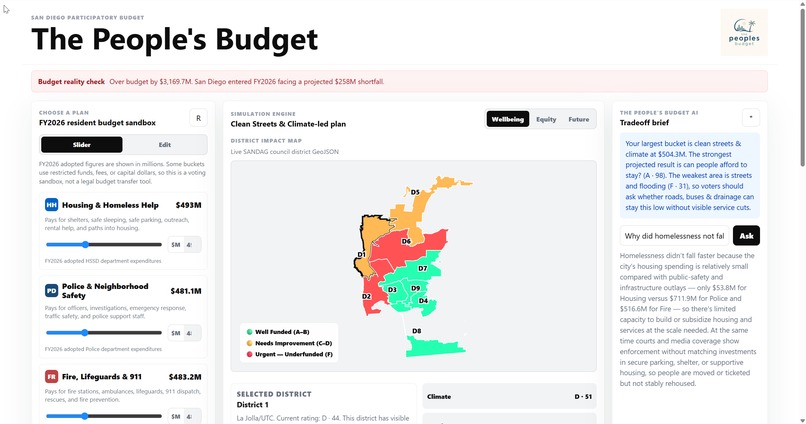
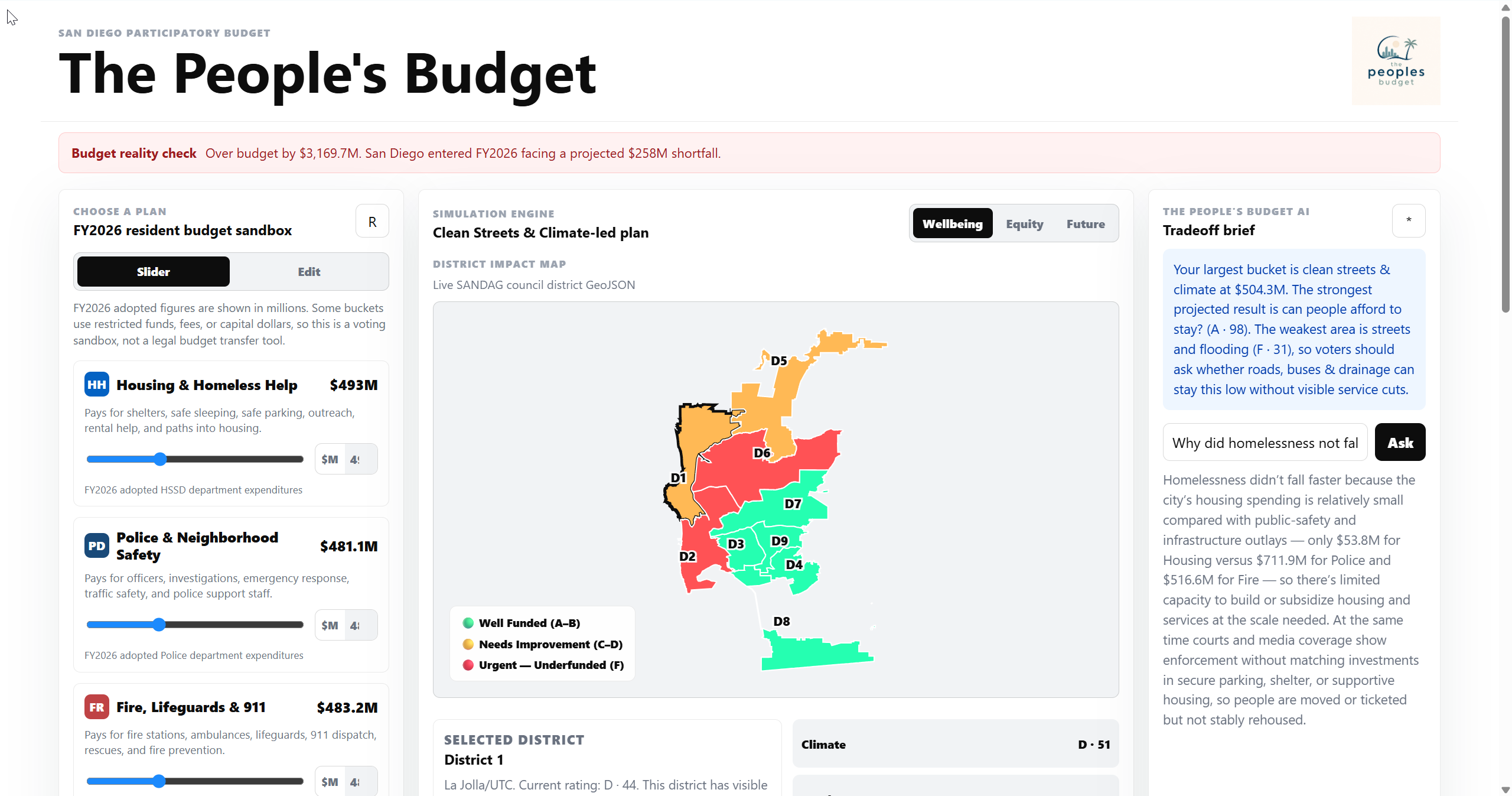
GIS Live Mapping + Home Page
-
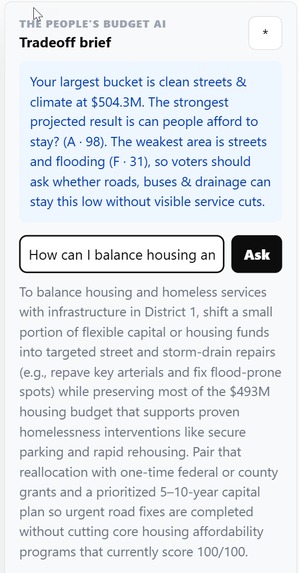
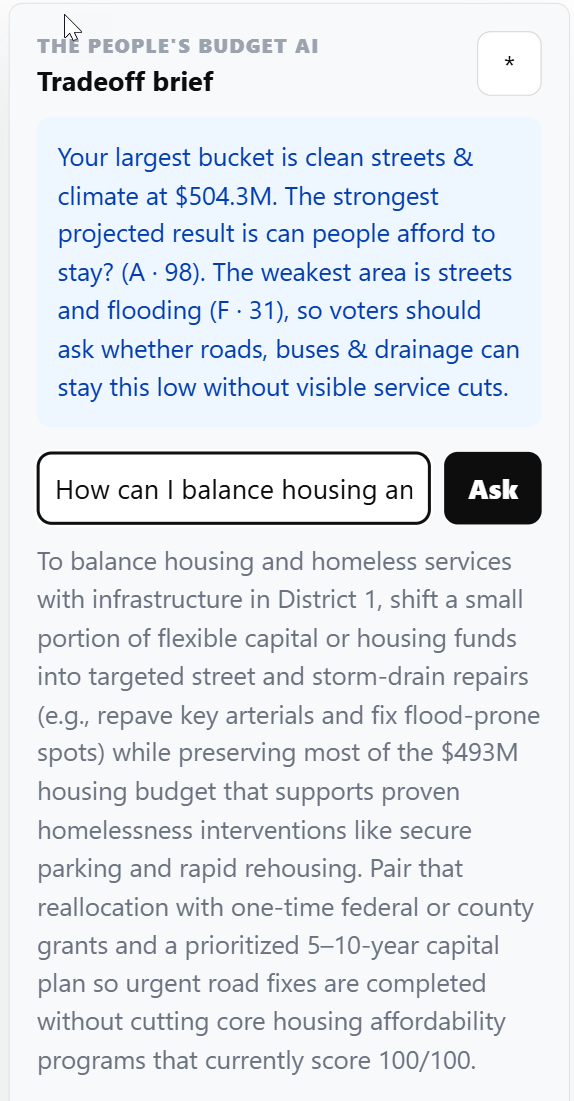
AI Assistant - People's Budget Info Retrieval
-
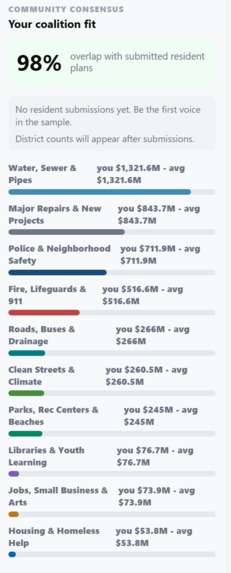
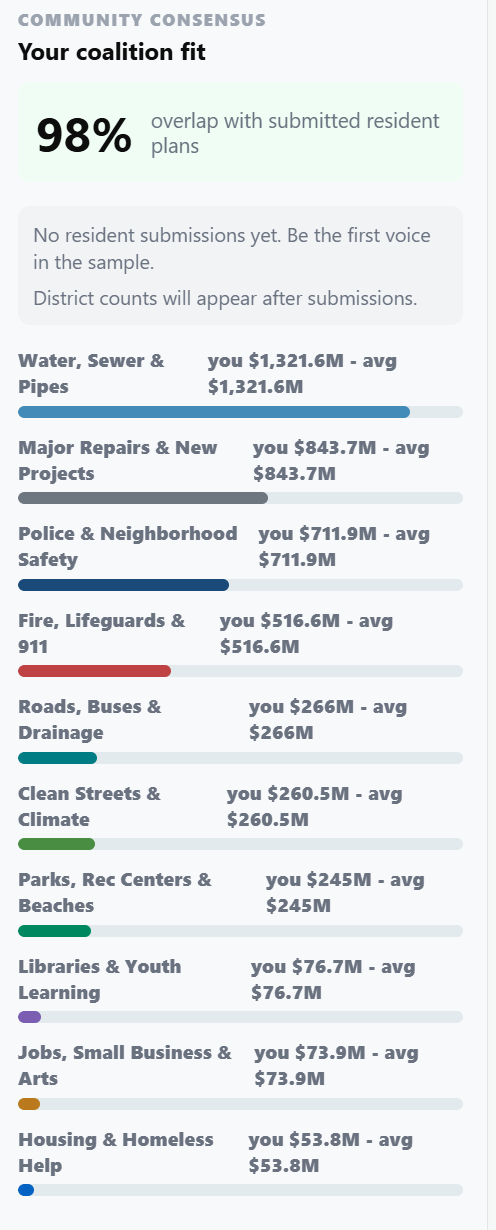
Community Bar
-
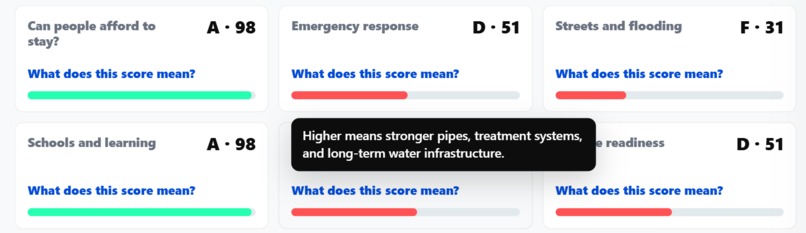
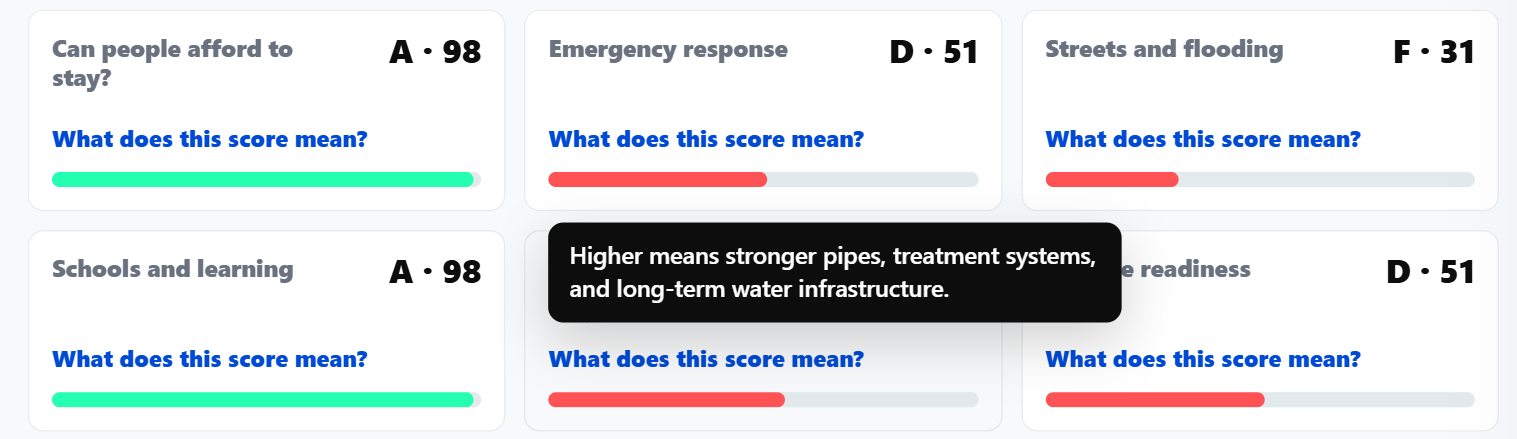
Letter Grade Scoring of core city life categories
-
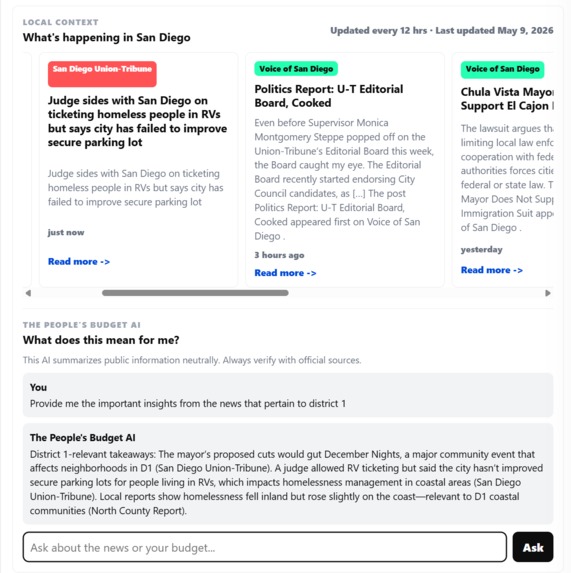
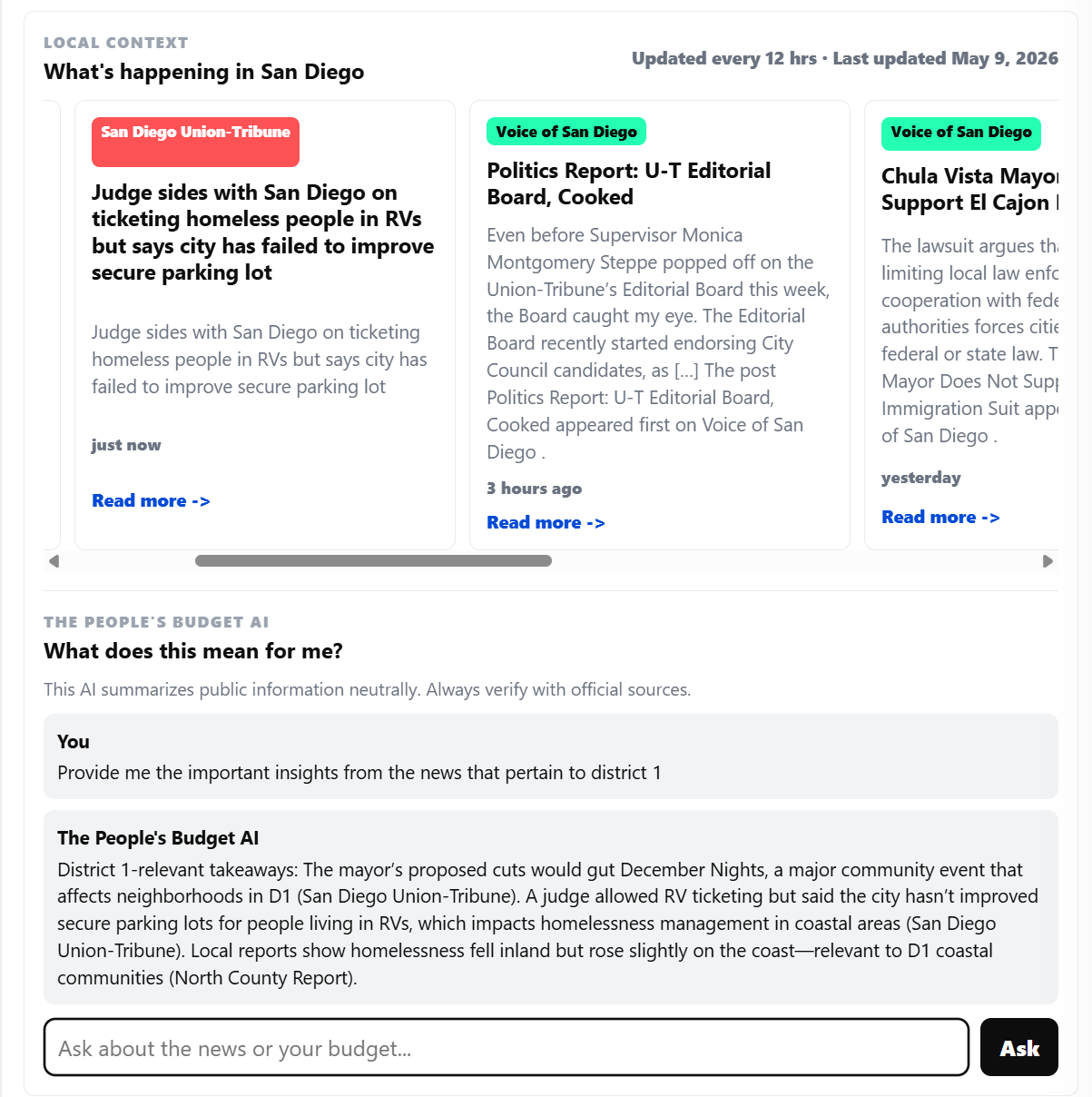
AI Assistant - informs constituents about updated news
Inspiration
The People’s Budget helps residents understand local government by letting them allocate a real city budget and immediately see how those choices shift outcomes such as: housing, transit, emissions, and public safety. By making tradeoffs visible and explaining them with clear, neutral AI reasoning, it reduces the risk of misinformation and makes complex policy choices harder to manipulate. Given that every submission is aggregated into anonymized community priorities, more voices are surfaced rather than drowned out, improving overall constituent representation. Transparent simulation assumptions and private, non-identifiable participation help build trust while preventing misuse. We made this to make civic engagement more informed, equitable, and resistant to distortion.
What it does
The platform lets residents allocate a real city budget and instantly see how those choices shift outcomes across housing, transit, emissions, and public safety. Every adjustment comes with transparent, AI‑generated reasoning that cites the underlying data and assumptions. It turns abstract policy debates into concrete, verifiable tradeoffs.
How we built it
We prototyped the interface using Codex and integrated Esri GIS mapping to visualize San Diego’s nine council districts in a realistic civic layout. We refined prompts and language with Claude and Gemini, while writing the fairness, bias, and limitations sections ourselves. The build focused on clarity, transparency, and accessibility from the start.
Challenges we ran into
Modeling civic systems without oversimplifying them was a major challenge, especially when real‑world impacts are nonlinear and interconnected. We also had to address fairness concerns to ensure the interface remained accessible to non‑technical users. Preventing misuse such as ballot‑stuffing or skewed submissions requires intentional system design, and we’re expanding the platform to address exactly that.
Accomplishments that we're proud of
We built a full-stack AI-driven platform that is transparent, verifiable, and grounded in real city data, something residents rarely access, in a few hours. We also created a system that elevates community priorities without letting any single group skew the results. Most importantly, we made civic engagement feel understandable and empowering.
What we learned
We learned how difficult it is to balance simplicity with accuracy when modeling public systems. We also saw firsthand how design choices, like readable sliders or clear assumptions, can dramatically improve trust and accessibility. Building for fairness requires deliberate design at every layer of the system.
What's next for The People's Budget
Next, we plan to add authentication protections to prevent manipulation of results which could affect community maps. We also want to collaborate with the Mayor’s Office and local advocacy groups to expand our tool to real outreach settings. Furthermore, expanding to inter‑city comparisons will help residents understand how priorities differ across regions and help policymaking more effective.
Built With
- beautiful-soup
- claude
- css
- gemini
- html
- openai
- python


Log in or sign up for Devpost to join the conversation.