-
-
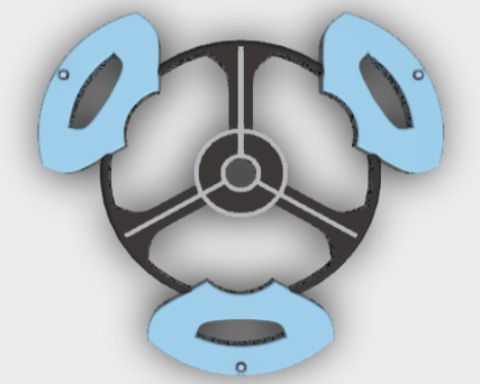
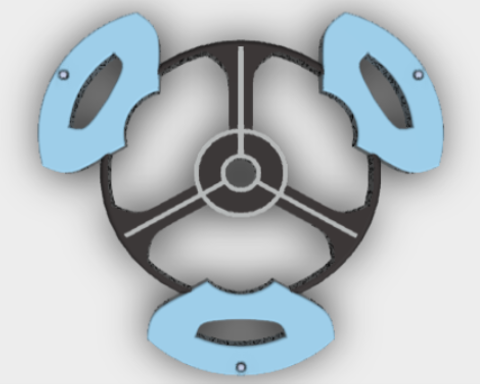
Exploded View
-
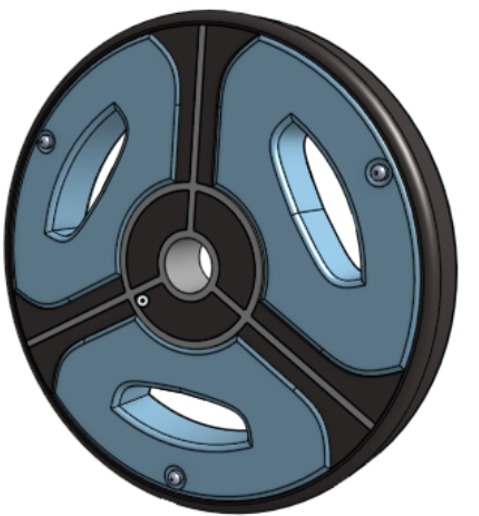
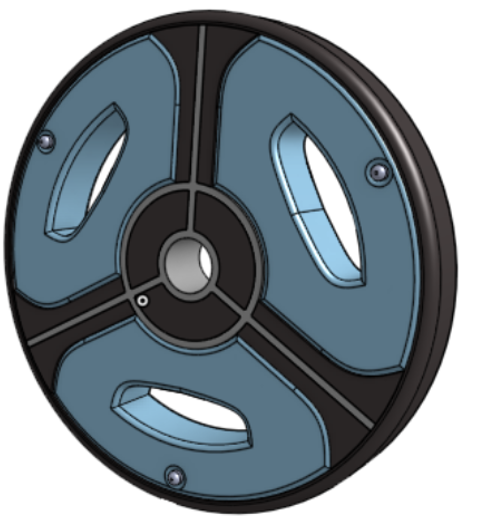
Full View
-
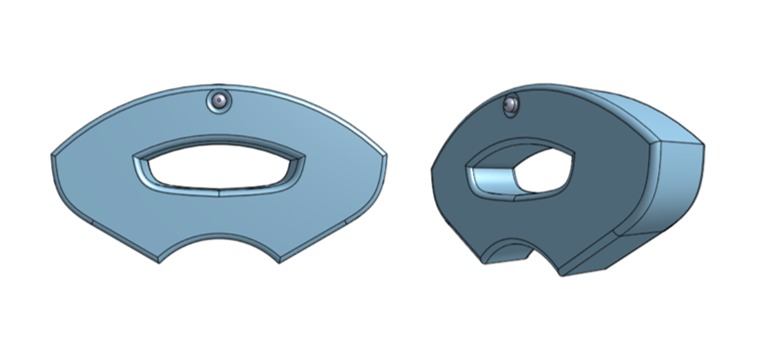
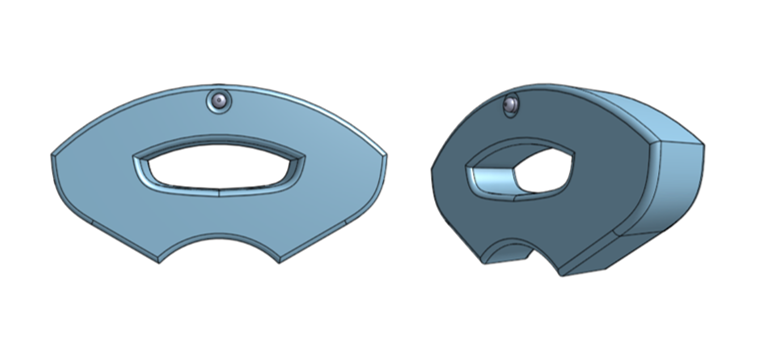
5kg Segment
-
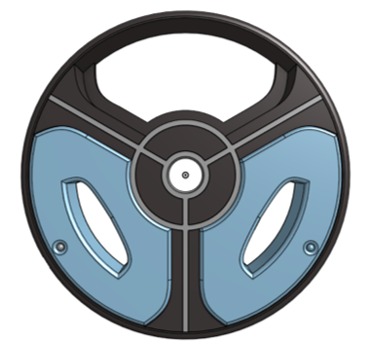
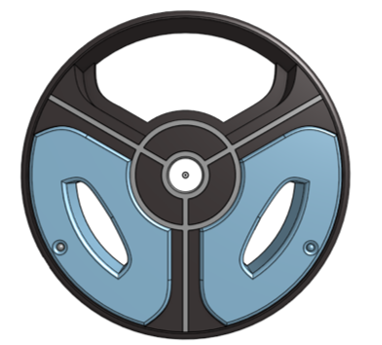
Absent Segment View
Inspiration for The ORBOS
The ORBOS was derived from my own personal pain point experienced during lockdown. My inability to access free weight training equipment prompted me to go online in search of compact, home friendly solutions as a remedy. It quickly became apparent that there was a dearth of free weight training equipment which had been adapted sufficiently for home usage. The industry's approach thus far has been to translate traditional gym equipment directly into the home, often without consideration of the space restrictions and unique needs in this location. This inspired me to explore this problem in more detail.
Having conducted market research it became apparent that three major pain points created a barrier to participation in home free weight training. The first was the storage space occupied by bulky gym equipment, second was price and third was the time involved in free weight training. Each of these pain points resonate deeply with me particularly the pain point of time as it transcends the home environment and is ever more prevalent in the traditional gym environment with 80% of memberships going unused (Hoffman, 2020). I identified the incompatibility of current offerings with the home environment as the challenge I wanted to solve. Weight plates are a staple of the gym environment, but they are bulky, single weighted and expensive. The single weighted nature of offerings currently on the market means that they do not translate well into the home. Users are required to purchase 2 of each weight to achieve equilibrium during their movements. Weight plates tend to increase in increments of 5kg with gyms being populated with an abundance of 5kg, 10kg, 15kg and 20kg plates. My ambition was to create a product that encompasses each of these weights while simultaneously alleviating all of the pain points mentioned previously.
In my video you will see that I have opened with a quote by Goutam Challagalla; ‘Effort is the best predictor of customer loyalty.’ Amid the age of immediacy, companies like Uber, Amazon & Netflix are transmogrifying the landscape of society by satiating this desire for expediency. The success of these companies is denominated by their innate ability to reduce the level of effort in the lives of people. Convenience catalyses their business models with their success embodying their ability to placate this need which permeates civilisation. This phenomenon is replicated within the fitness industry with Peloton becoming a billion-dollar company by reducing the time lag between the point of thought and point of action. My product intends to alleviate this pain point by addressing the external involvement levels endemic within free weight training which induces the high churn rates experienced by gyms, the lack of participation by the public in exercise and the forfeiture of money on unused gym memberships.
The ORBOS aligns with the WHO #HealthyAtHome Campaign and the iterations of (Chen et al, 2020; Denay et al, 2020; Schwendinger & Pocecco, 2020) who express the strong health rationale for continuing physical activity in the home to stay healthy. Although this was a solution born out of the correlation between diminishing activity levels and the pandemic, I wanted to design the ORBOS with the intention of reducing the barriers created by time, storage and capital to ensure that physical activity participation is sustainable post-recovery and into the future. With levels of physical activity dropping even before the pandemic, with more than 80% of youth leading sedentary lifestyles (UNESCO, 2021), it is important that the innovations we create are not a temporary palliative for the pandemic, but instead provide the infrastructure necessary to ensure the longevity of increased exercise participation in a sustainable fashion. Additionally, resistance exercise is important for the maintenance of musculoskeletal health in society. Resistance training has been found to be the optimal strategy in improving the muscle and bone mass in postmenopausal women, middle-aged men and the older population making weight training paramount regardless of age or ability (Ram Hong & Sang Wan Kim, 2018).
What it does
The ORBOS is an innovative adaptation of the gym weight plate making it more suitable for home usage. The product contains 3 internal segments (of weight 5kg) that can be added or subtracted to a semi-hollow base (of weight 5kg) to increase or decrease the weight according to the user's ability. The product provides a 4-in-1 weight solution enabling the user to select a weight of 5kg, 10kg, 15kg or 20kg. The product is designed to be used in conjunction with an Olympic Barbell, EZ Barbell or any other barbell variation to complete over 50 different exercises. The product alleviates 3 major pain points inherent with bulky gym equipment which is the storage space they occupy, the time involved with free weight training and the cost of conventional single-weighted plates.
The ORBOS is designed specifically to be used in enclosed spaces making it an ideal solution for people seeking an effective work out at home. The product directly alleviates the pain point of storage space which is posited by (Business Research Company, 2020) to be responsible for halting the continued growth of the home fitness equipment. 'People living in cities are confined to small homes or apartments to manage their expenses, which limits the amount of space for fitness equipment.' The product reduces a user's weight requirements by 150% and their plate ownership requirements by 300% (8 single weighted plates can be incorporated into 2 ORBOS plates) mitigating the extra storage space required without compromising weight selection.
The ORBOS provides users with a more efficient workout by reducing the extra time required engaging with gyms and fitness centres. Additionally, the product provides significant speed benefits as it allows users to mitigate the 'loading and unloading' phase required with mounting conventional single weighted plates onto barbells. The weight of the ORBOS can be changed easily by the by pressing the button on any of the segments which subsequently releases the weight. This allows the user to change the weight in under 5 seconds. Conversely, the traditional loading and unloading method using single weighted plates takes circa 25 seconds to complete. I have demonstrated this traditional 25 second process here: link
The product is also a more cost-effective alternative to purchasing single weighted plates. The retail value of purchasing 2 sets of 5kg, 10kg, 15kg and 20kg conventional cast iron single weighted plates is €400 from McSport, a leading Irish fitness equipment supplier. In contrast, 2 ORBOS plates will have a retail price of between €300 - €350 making it a more affordable solution while providing the same functionality, with a fraction of the storage space.
How it Works
The ORBOS works by harnessing the counterforce of gravity to derive its benefits of providing a multi-weight solution. The product is subdivided into 3 equiangular internal segments (blue in pictures) of 120 degrees which fit securely into the semi-hollow base. To use the ORBOS, the user mounts the plate onto a barbell. When the user is doing this, they are mounting the product in a direction that is perpendicular to the ground. When the user alters the weight of the ORBOS they must remove one of the 5kg segments. This action causes a momentary imbalance within the ORBOS which causes the product to rotate around the barbell to a new point of equilibrium in response to the force of gravity. This occurs because when the user removes one of the segments, they are altering the centre of mass of the object. Due to gravity always acting downward, this causes a natural rotation of the object independent of human involvement allowing it to automatically reestablish equilibrium, enabling the user to perform a variety of barbell exercises as normal. The centre of mass will always be located along the line of gravity regardless of how many segments are in place within the ORBOS thus ensuring the stability of the user is unaffected throughout the course of their exercises. The homogenous motion of barbell related exercises (bench press, military press, deadlift, barbell rows, squats, lunges etc.) being performed vertically, in a perpendicular direction to the ground means that the need for a plate to be entirely symmetrical was false as gravity would cause the plate to naturally rotate around the barbell to new points of equilibrium if asymmetries (ie missing segments) existed in the plate. The product will rotate as required for the user when they need to change the weight. This is where the name 'ORBOS' is derived. 'Orbis' is the Latin for 'Orbit' in English. I have adopted ORBOS as the name because the product orbits around the barbell when the weight is changed as required by the user.
How It Was Designed & Design Challenges
A human centred design process was utilised when creating the ORBOS. It was imperative that the product was created to alleviate the pain points identified to offer a desirable solution. Several iterations were developed using Onshape CAD software to create multiple digital prototypes. Ergonomics was at the centre of the design process with particular focus being placed on the size of the segment holes to maximise handheld comfort and thorough analysis of the exercises/movements performed by the user with the product. Designing the segments accordingly to account for the hand size of humans was one of the main challenges of the project. Constructing the shape of the hole in a lightly curved fashion was essential for the functionality of the project, but it took some time to create it in a manner that was aesthetically pleasing. The project went through several iterations to achieve the desired segment shape to enable it to be easily held. The design of this curve was essential to allow for the comfortable removal of the segments to mitigate the likelihood of the product being dropped which may cause accidental injury.
The most challenging aspect was finding a method of offering a multi-weighted plate variation in safe, stable and user friendly manner. The design process was centred around the use of gravity as a method of achieving stability. The 'Eureka' moment as such was identifying the homogenous pattern of movements involving barbell exercises. For the vast majority of free weight exercises, the user is exerting a pushing or pulling force that is perpendicular to the ground with the barbell positioned parallel to the ground. The equiangular design of the ORBOS ensures that the product can rotate freely around the barbell readily adjusting its own stability in response to the movements of the user. This enables segments to be removed from the plate without a user's balance and safety being effected.
Accomplishments that we're proud of
The aspect I am most proud of regarding this project is that I can incorporate complex elements such as gravity and the changing of the centre of mass into a solution that will be so simple to use for the user. The user only has to remove a segment through the push of a button to change the weight with the ORBOS then naturally availing of the force of gravity to achieve stability for the user. Even if they are oblivious to the physics involved with the product they will still be able to use the product.
The implications of this product in making free weight training more accessible to the public by reducing the time involved was a central ambition of mine. The time constraints caused through engaging with gyms in terms of preparation and commuting means that they are not a viable option for many people. People who work full time jobs or have families cannot afford to forfeit the time to consistently visit the gym 2 or 3 times a week making gyms a poor financial commitment. Designing a solution that is ideal for the home environment is an integral focus of this project and I believe it is an aspect that will improve the participation of the public in free weight training. The effort involved with training is the barrier which prevents people from becoming more involved in frequent exercise. If the equipment is sufficiently adapted and already present in the home users can then commence their workout within seconds of having the thought, thus removing the barrier of effort.
What we learned
Through the course of this project, I have autodidactically acquired new skills in Computer Aided Design. Previous to commencing this project I had never used this software to develop any other products.
The market research aspect of the project provided me with a firm appreciation and thorough understanding of the pain points uncovered. Speaking to Personal Trainers within the fitness industry verified the potential of this novel solution. These conversations also allowed me to uncover their concerns with the hesitancy of people to return to gyms and fitness centres as a result of the pandemic.
What Is Next For The ORBOS
The next stage of development is to establish the correct mechanism for the product. We must account for user safety, speed and aesthetics when designing this mechanism. Once this has been completed, several low fidelity prototypes will be created and trialed with customers.
References
UNESCO. (2021). Making the Case for Inclusive Quality Physical Education Policy Development: A Policy Brief. United Nations Educational, Scientific and Cultural Organization, France.
WHO (2021). #HealthyAtHome. World Health Organisation. https://www.who.int/campaigns/connecting-the-world-to-combat-coronavirus/healthyathome
Chen, P., Mao, L., Nassis, G.P., Harmer, P., Ainsworth, B.E., & Li, F. (2020). Coronavirus disease (COVID-19): The need to maintain regular physical activity while taking precautions. Journal of Sport and Health Sciences 9, 103-104.
Hoffman, K., 2019. Noobgains. [Online] Available at: https://noobgains.com/gym-membership-statistics/ [Accessed 24 June 2021].
Business Research Company, 2020. Home Fitness Equipment Global Market Report 2020-2030: Covid 19 Implications and Growth, Hyderabad: Business Research Company.
Endocrinol Metab (Seoul). 2018 Dec; 33(4): 435–444. Published online 2018 Nov 30. doi: 10.3803/EnM.2018.33.4.435
Freeletics, 2019. Freeletics research reveals barriers to fitness among Americans, where 2 in 5 feel 'too old' to work out at 41, Munich: Freeletics.
Rense, S., 2017. Esquire. [Online] Available at: https://www.esquire.com/lifestyle/health/news/a54143/missing-gym-workouts/ [Accessed 25 June 2021].
Built With
- onshape

Log in or sign up for Devpost to join the conversation.