-
-
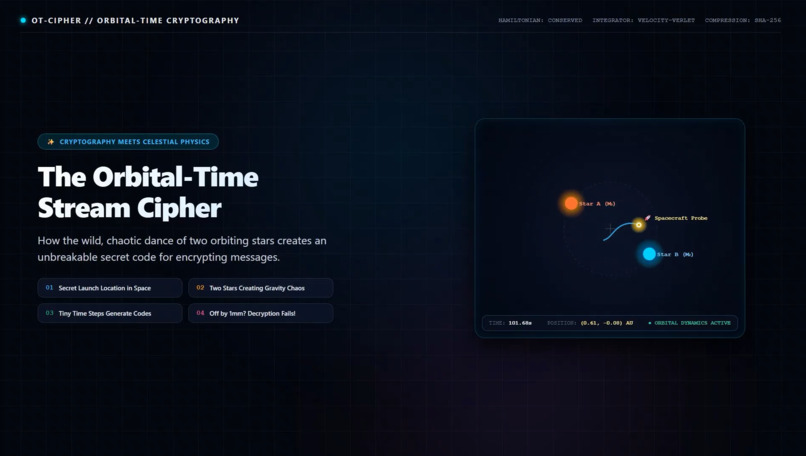
The Orbital-Time Stream Cipher
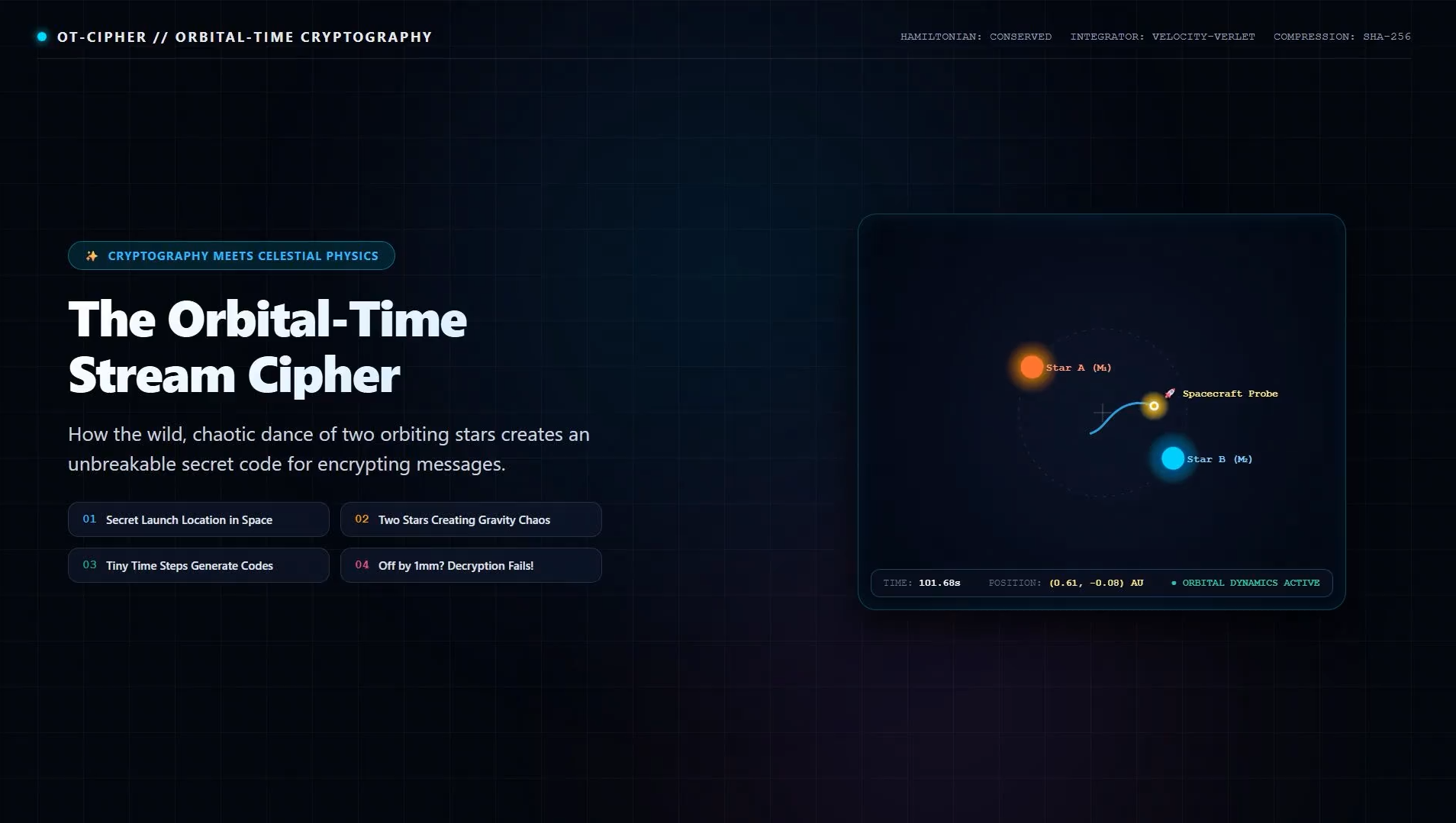
The Orbital-Time Stream Cipher
A Physics-Inspired Cryptographic System Using Orbital Dynamics and Time-Based Key Generation
Track: Cryptographer Track
Hackathon: Mathematics for Systems Security
Overview
The Orbital-Time Stream Cipher (OT-CIPHER) is a novel, physics-inspired cryptographic approach that explores the use of celestial orbital dynamics to generate a sequence of secret values for message encryption.
Instead of relying on conventional character-based passwords, the system uses a shared set of initial conditions, including spacecraft position, velocity, launch timestamp, and time-step interval, to initialize a mathematical simulation of a spacecraft moving under the gravitational influence of two orbiting stars.
The changing gravitational forces produce complex orbital trajectories. Using a Velocity-Verlet integration method, the system advances the simulation in small time intervals, generating a new sequence of numerical states for successive message bytes.
These states are processed through a cryptographic derivation pipeline to produce a keystream, which is used to encrypt and decrypt messages. Both communicating parties must possess matching secret initial conditions and reproduce the same sequence to recover the original message.
Core Mechanism
The system consists of five primary stages:
- Secret Initialization: Establishes shared secret parameters, including initial position, velocity, launch time, and time-step interval.
- Orbital Dynamics Simulation: Models two orbiting stars and calculates their changing gravitational influence on a spacecraft.
- Time-Step Evolution: Advances the spacecraft's state using the Velocity-Verlet integration method, producing a new numerical state for each message byte.
- Keystream Generation: Transforms the evolving simulation states into cryptographic values used for message encryption.
- Precision-Based Decryption: Recreates the same sequence using matching parameters. Any mismatch in the required initial conditions or simulation parameters results in a different keystream and unsuccessful decryption.
Mathematical Foundation
The orbital simulation is based on gravitational acceleration and numerical integration. The spacecraft's position and velocity evolve under the combined gravitational influence of two moving celestial bodies.
The Velocity-Verlet method is used to maintain numerical stability and better preserve the system's energy characteristics over successive simulation steps.
The resulting numerical states form the input to the cryptographic derivation process, which generates the keystream used by the encryption mechanism.
Security Approach
OT-CIPHER explores a different source of key-sequence generation by combining shared secret parameters with deterministic orbital simulation.
Its intended security considerations include:
- Sensitivity to initial conditions and parameter precision.
- Reproducibility between communicating parties.
- Protection against unauthorized reconstruction of the keystream.
- Resistance to parameter-guessing and tampering attempts.
- Numerical stability and consistency during encryption and decryption.
Intended Applications
The approach can be explored in secure communication systems, experimental stream-cipher research, and environments where deterministic mathematical simulations are used as part of cryptographic key generation.
OT-CIPHER aims to connect celestial mechanics, numerical mathematics, and cryptographic engineering into an alternative approach to generating message-encryption sequences.
Built With
- 3-body-language
- cryptography
- gravitation
- orbit-theory
- science
- space

