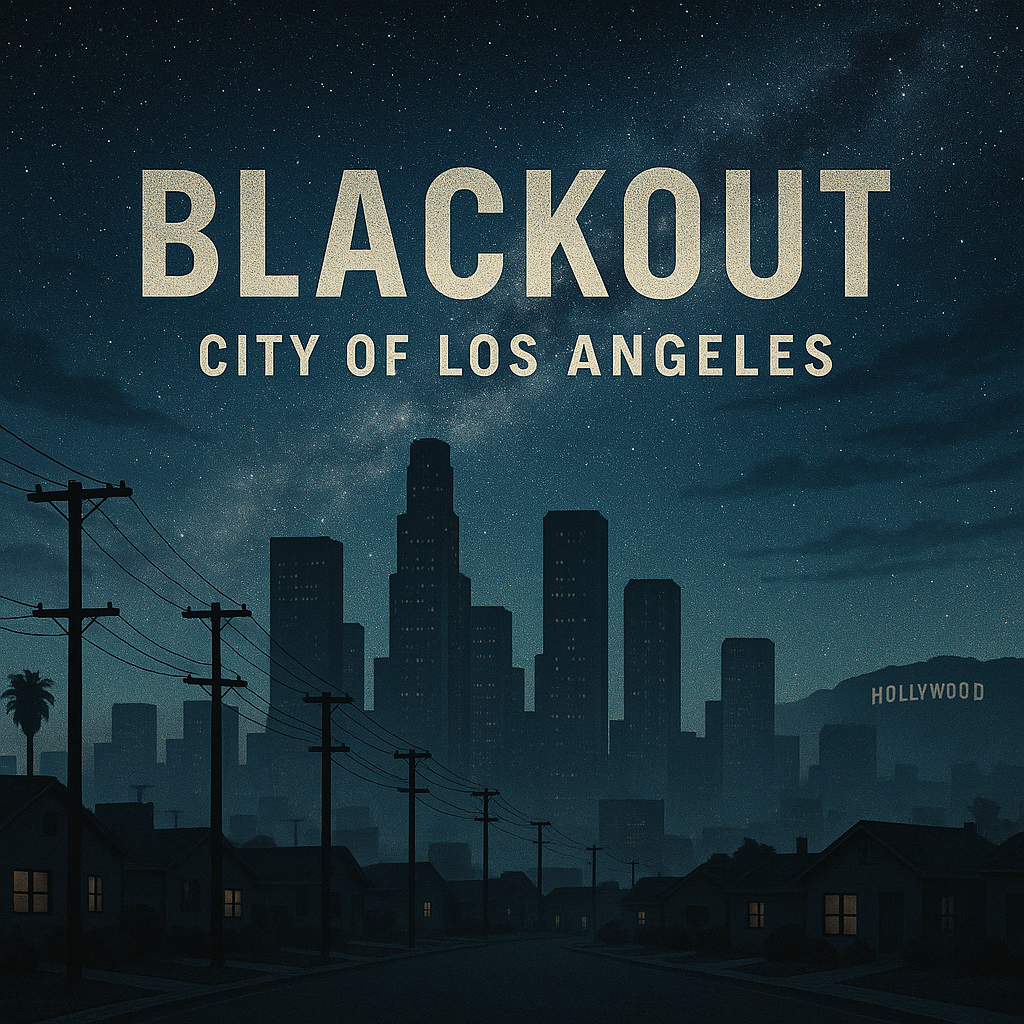
⭐ 1994: The Night the Sky Came Back
“Light pollution hides the Universe. But one night in 1994… the sky finally came back.”
This project is an AI-assisted cinematic short film recreating a real and extraordinary historical moment: after the 1994 Northridge earthquake, Los Angeles experienced a total blackout. For the first time in decades, the Milky Way — its core, its dust lanes, its full luminosity — became visible to millions. People panicked, confused by the glowing band across the night sky. Emergency services received calls asking whether the bright structure was an alien threat.
The truth: the city wasn’t in danger — it was finally dark enough to see its own galaxy. This moment inspired me to blend science, emotion, and AI storytelling into one project.
🎬 Inspiration
⭐ 1. A real scientific phenomenon This film is based on a well-documented incident. The earthquake instantly triggered a cascade of failures across LA’s power grid:
substation overloads → line trips → citywide shutdown substation overloads→line trips→citywide shutdown
With skyglow reduced to nearly zero, the Milky Way appeared in full clarity — a perfect example of how artificial light blocks natural night visibility.
⭐ 2. Pixar-style emotional storytelling
Short films like Umbrella and HOPE inspired the emotional tone: warm lighting, soft animation style, minimal dialogue, and deep meaning.
⭐ 3. Environmental message
Light pollution is a global issue. One blackout revealed what decades of artificial light had erased.
⭐ 4. Luma and Nox Two time-traveling cosmic guides:
Luma — soft, warm, defensive, hopeful
Nox — sarcastic, logical, future-tech shadow guardian
They give the story a magical layer while keeping scientific truth intact.
🛠️ How I Built the Project
Image Creation Used AI image generation tools - ChatGPT, Google Gemini to produce all scenes in a Pixar + Umbrella + HOPE blended style. Scenes include: normal LA evening life earthquake moment blackout city radio confusion Milky Way reveal Luma & Nox appearance
Voice Work Generated character voices using ElevenLabs, including: Narrator Scientist 911 caller Luma Nox Each voice was mixed with ambience and reverb for natural feel.
Sound Design Used Pixabay: earthquake rumble radio static soft wind magical star shimmer emotional ambient music
Editing & Assembly Used Clipchamp for: cinematic slow zooms crossfades timing around narration audio layering
Image-to-video used a luma AI
💡 What I Learned ✔ The science behind night sky visibility
I learned how Rayleigh scattering, skyglow, and urban lighting change perceived brightness:
Star Visibility↑whenLight Pollution↓ A blackout acts like a natural experiment showing the true night sky.
✔ Storytelling with still images
I discovered that still frames can feel alive using: gentle movement sound cues pacing emotional pauses
✔ Voice direction I learned how tone, timing, and breath shape cinematic narration.
✔ Environmental awareness The project deepened my understanding of how we’re losing our night sky — and how easily it can return.
⚠️ Challenges I Faced ❗ Consistency Keeping characters (especially Luma and Nox) consistent across scenes required many revisions. ❗ Balancing science and emotion I wanted it emotional like a Pixar short but factual enough for real-world accuracy. ❗ Time Pressure The film had to be built scene-by-scene, fast, but still at high quality. ❗ Light pollution realism Matching real 1994 sky visibility without exaggeration took careful design.
🌠 Final Message This project is more than a film — it is a reminder: Nature still belongs to us. We don’t need to turn off all lights… just use them wisely. With smarter, softer lighting, the sky can return — and the stars can find their way back to us.
Built With
- chatgpt
- clipcamp
- elevenlabs
- google-gemini
- lumaai


Log in or sign up for Devpost to join the conversation.