Inspiration
Most Twitch streams have a handful of viewers. When you stream to an almost empty chat you end up talking to yourself, and the one person who drops in has nothing to do. I wanted something that makes a small stream feel like a show from the first minute and gives even a single viewer something fun to do with it. It also had to cost nothing to run, because small streamers aren't going to pay for AI by the hour.
What it does
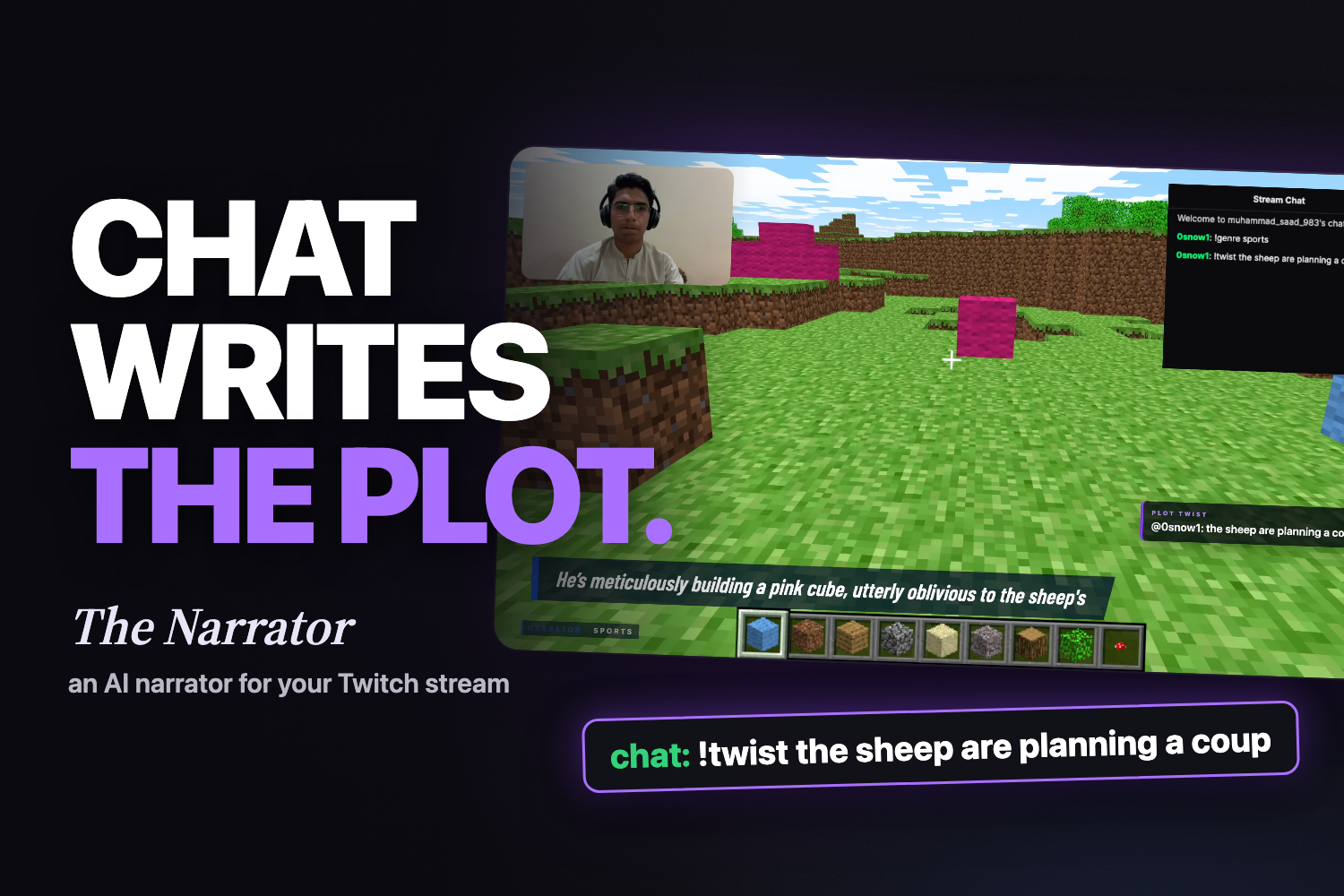
The Narrator is a voice that tells your stream as a story while you play, with you as the main character.
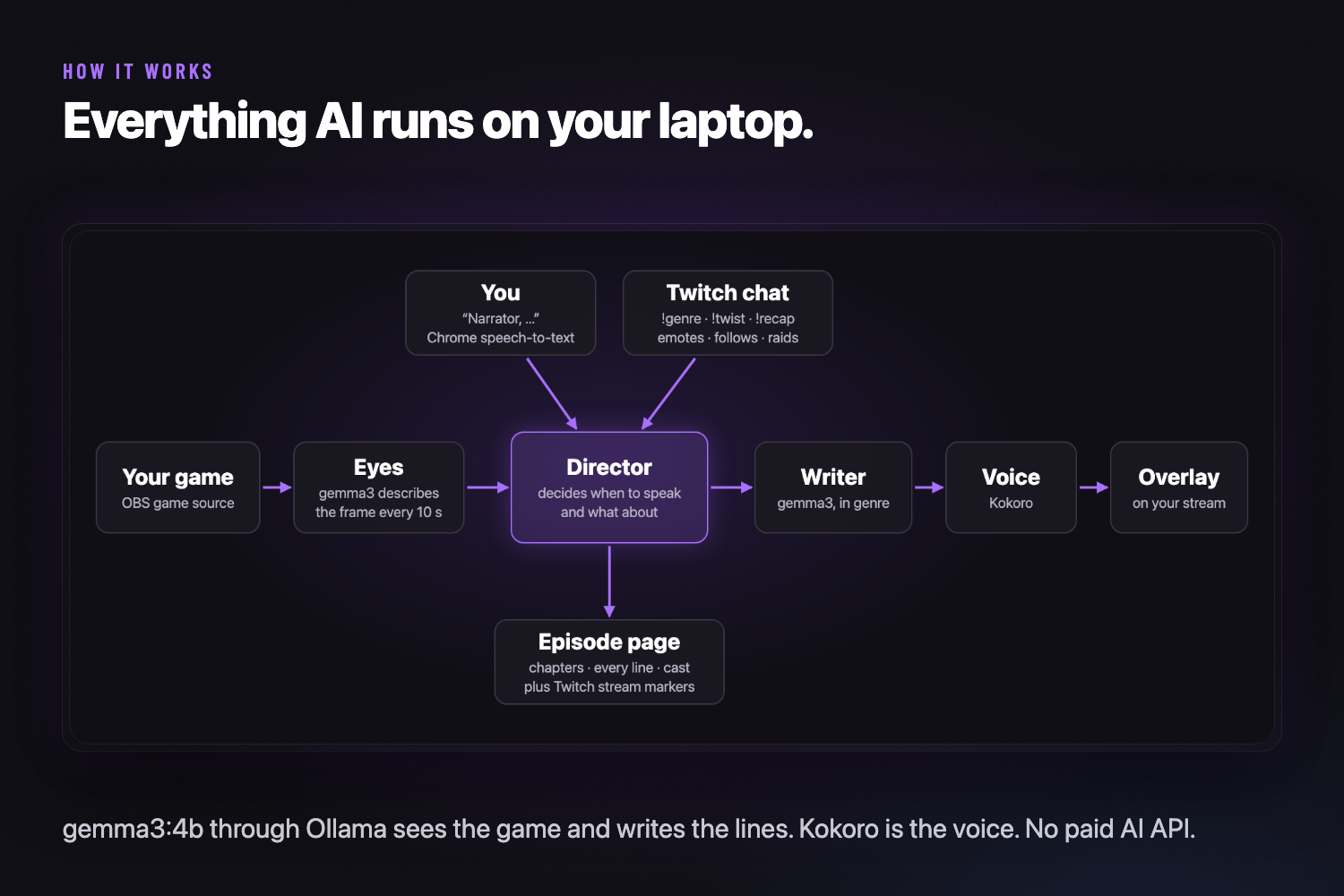
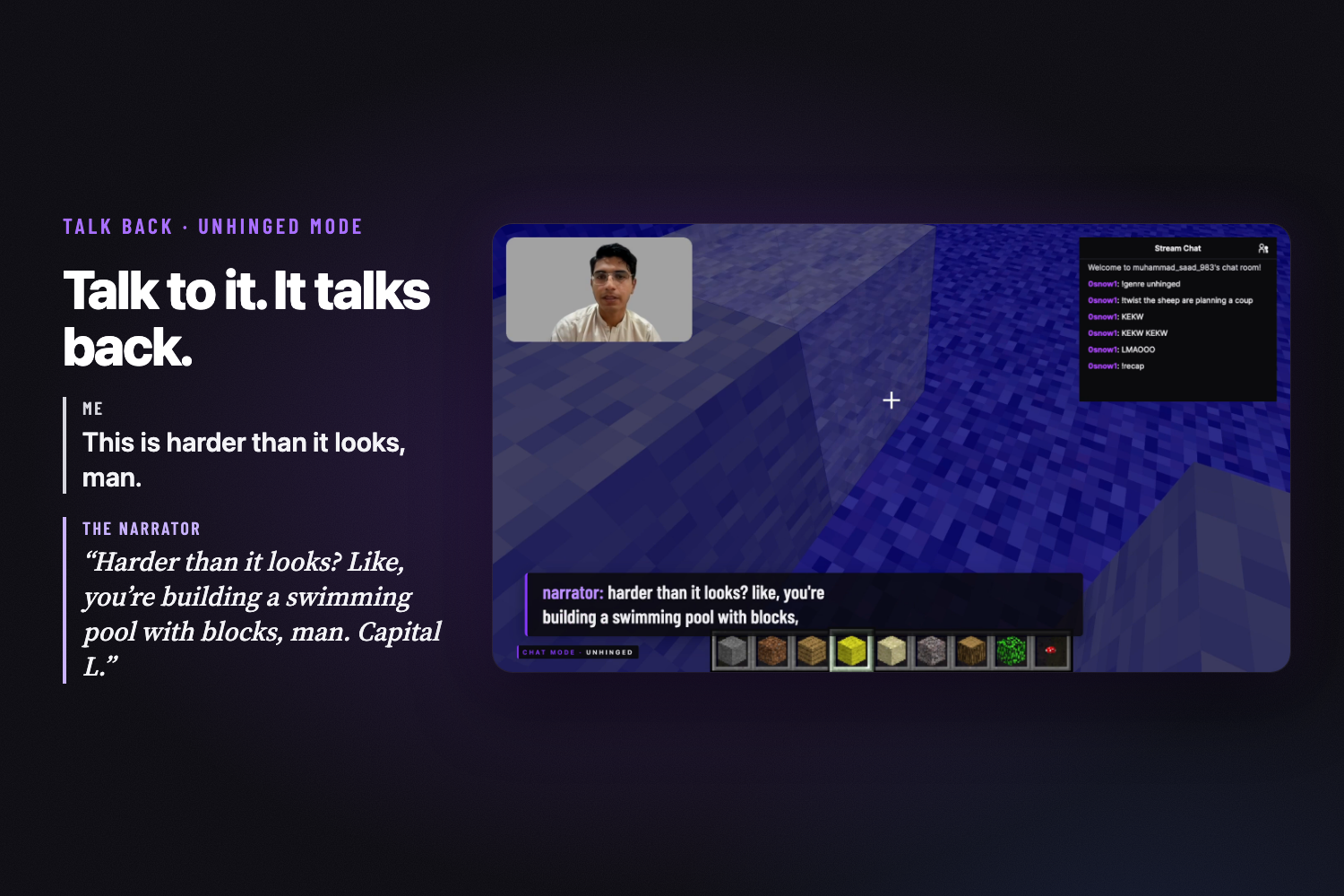
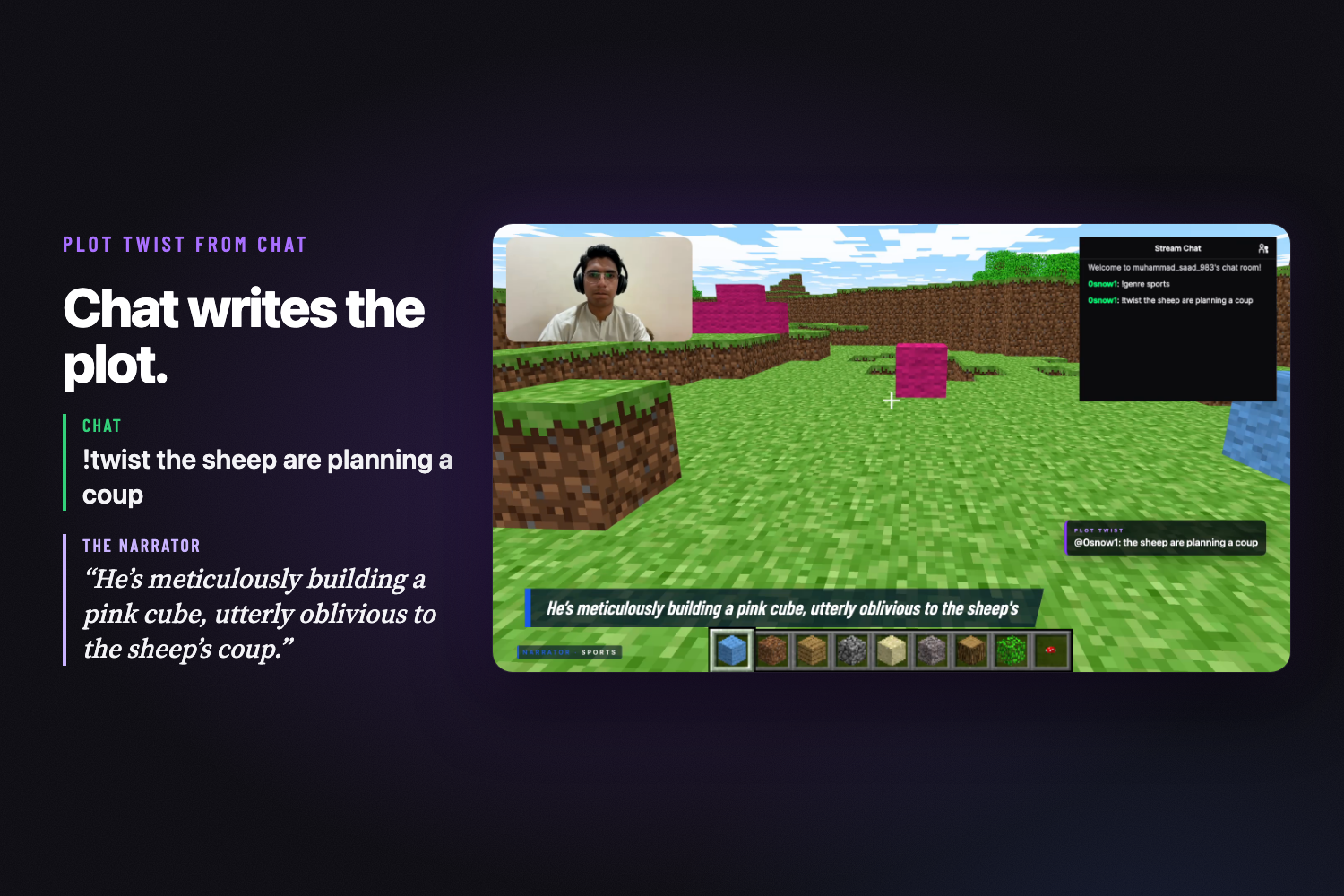
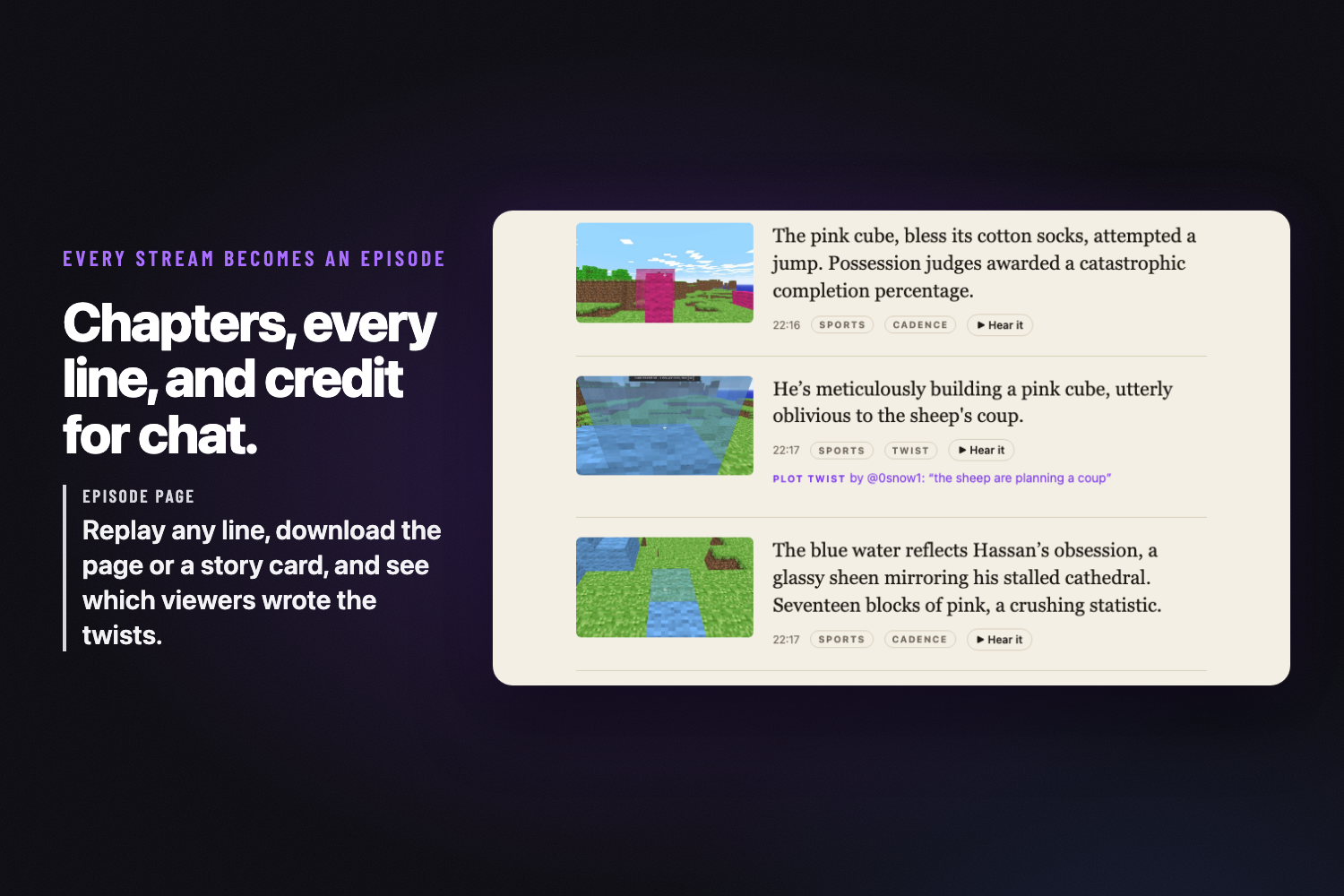
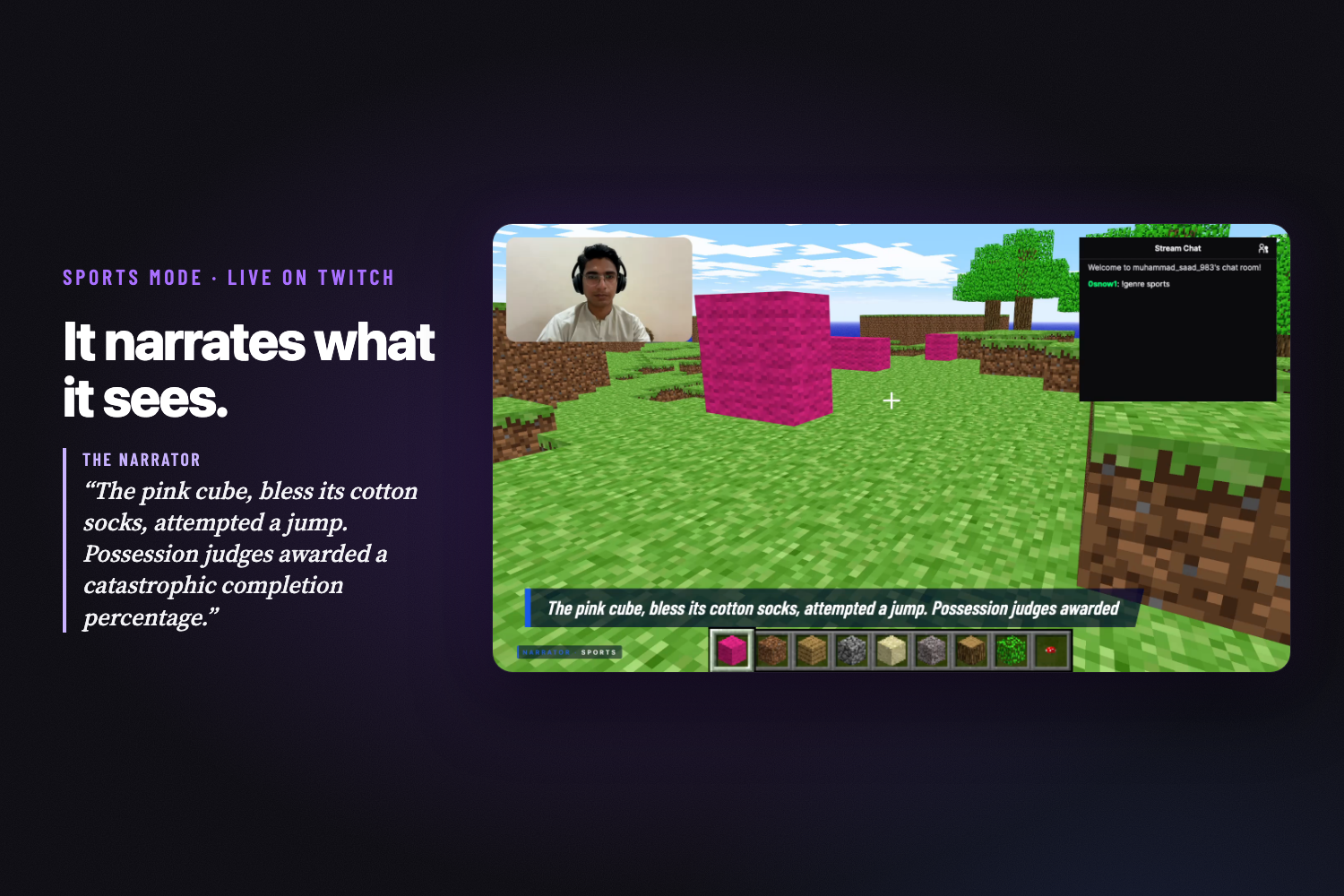
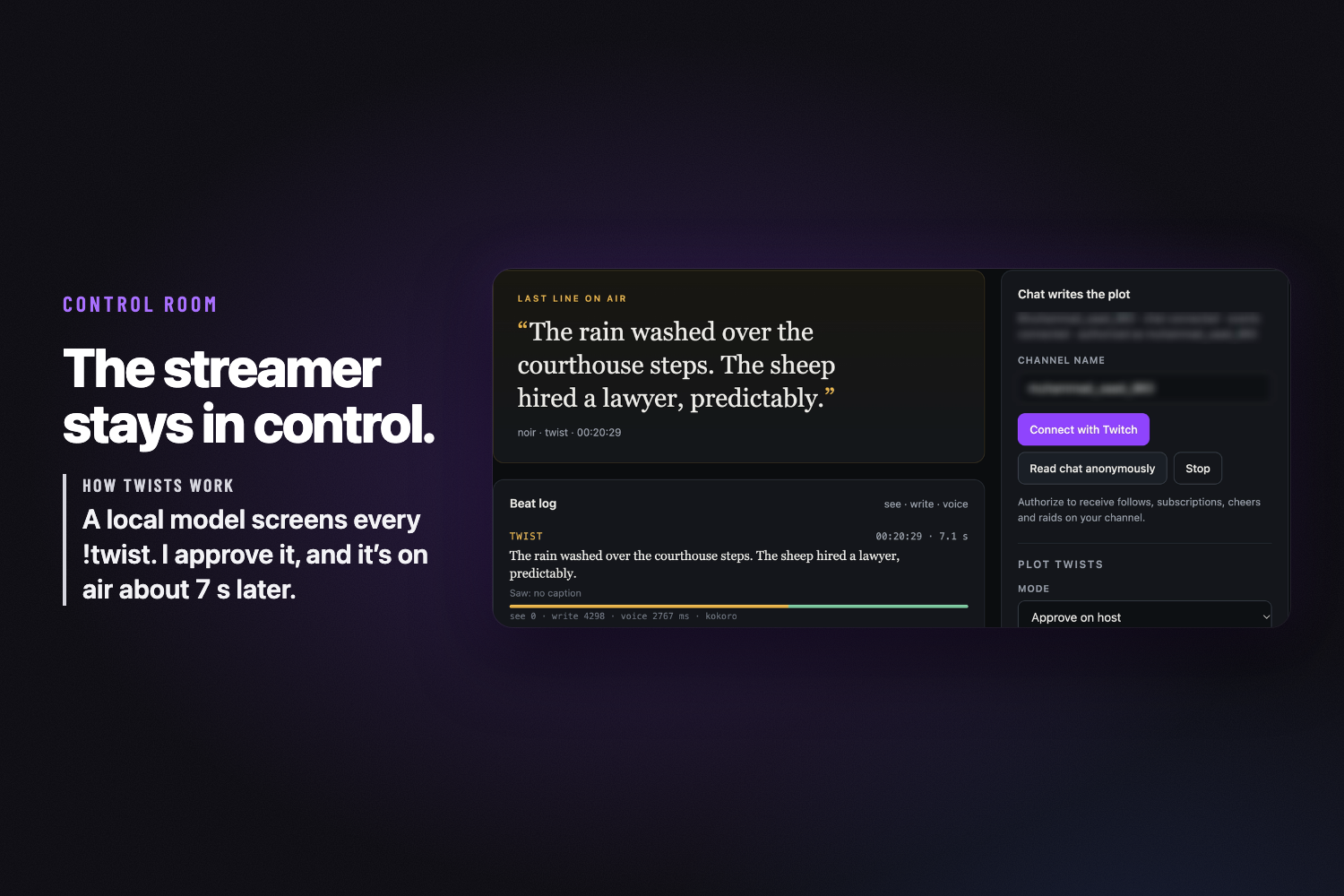
It watches the game and narrates in one of seven genres: noir, nature documentary, epic legend, sports play-by-play, horror, heist, and unhinged. Each has its own voice and overlay style. Unhinged writes like a chat message, with real 7TV, BTTV and Twitch emotes on screen ("Chat, is this real? He's still saying he's new. LMAO."). You can talk back. Say "Narrator, …" and it answers in character. Chat writes the plot. !genre switches the genre, by vote if several people try at once. !twist suggests a plot twist: a local model screens it, the streamer approves it, and the next line uses it with a PLOT TWIST by @viewer card on stream. !recap gives the story so far. When chat spams KEKW, F, Pog or "clip it", the narrator reacts to chat. Only a fixed list of emotes and phrases ever reaches the model. Follows, subs, gift subs, cheers and raids become story beats. New chapters become stream markers, so the VOD has story chapters. Every stream becomes an episode page: chapters, the frame behind each line, every line playable, plot-twist credits and a cast list of the viewers who shaped it. It exports as a PNG card and an HTML page. It runs on the streamer's computer. The vision, writing and voice models are local (Ollama and Kokoro), so there's no paid AI API and no per-hour cost. With OBS set up it reads only the game source; without OBS it reads whatever window the streamer shares.
How we built it
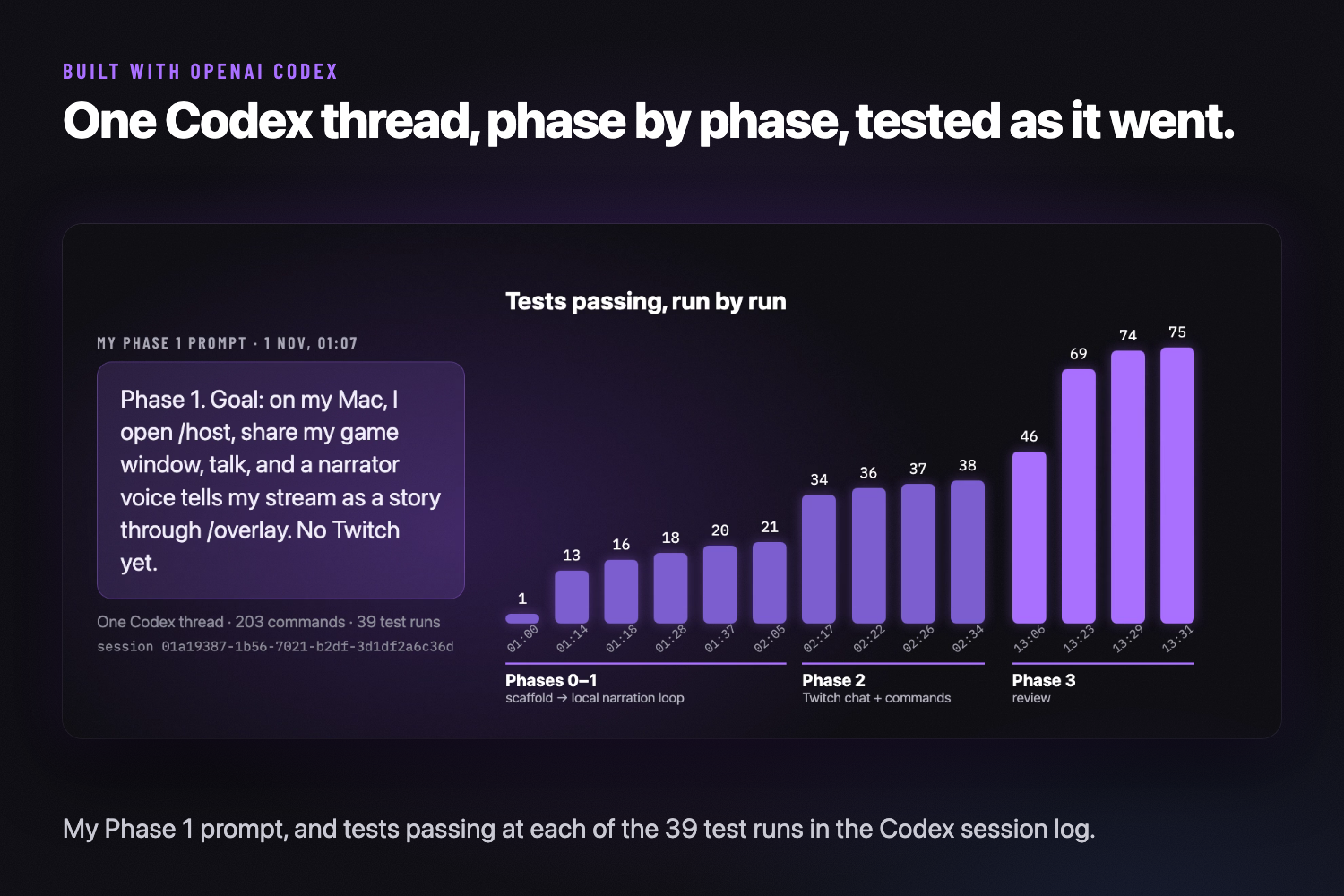
I wrote docs/SPEC.md and an AGENTS.md (repo rules, my usage budget and a definition of done), then gave Codex one phase at a time from PROMPTS.md. In a single thread, between about 1 and 3 a.m. on 1 November, Codex built the scaffold, then the local narration loop with latency measured per stage, then Twitch IRC and EventSub with device-code login, shared-chat dedupe and twist moderation. It ran the test suite 32 times in those two hours, and 7 more in the Phase 3 review. Each phase's summary and verification is in codex-log/.
Then I tested it on real streams, and a lot of the product came out of that: the OBS game-source integration, unhinged mode, chat reactions, emotes, the episode page and the replay demo. Every change made outside Codex is listed in codex-log/FIXES_2026-11-01_outside-codex.md. Codex reviewed the first 21 in Phase 3. It corrected the demo's provenance labels, fixed the seven-genre check, and added regression tests for OBS, exports, emotes, twist credit and EventSub retries (codex-log/PHASE_3_REVIEW.md).
Stack: Node and TypeScript; Vite pages for the control room, OBS overlay, episode and demo; the openai SDK pointed at Ollama's OpenAI-compatible API; Kokoro for the voice; Chrome's Web Speech API for the streamer's voice; obs-websocket for game frames. The unit tests use fake AI clients, and npm run check:local runs real local-model lines for every genre and logs how long each stage takes.
Challenges we ran into
Speed on a laptop that's also running the game. A 12B model under memory pressure missed a 15 s budget, so I moved frame captioning to the background, cut the model's output down to the line and a chapter title, and switched to a 4B model. Lines now land 4 to 10 s after the moment in my live takes.
Small models copy what they see: the example lines, their own previous lines, even their own subtitles when the whole screen was captured. I now use examples for tone only, never show recent lines, and capture only OBS's game source. Small models leak JSON and HTML into fields, so chapter titles are cleaned before they reach the overlay or Twitch markers.
Accomplishments that we're proud of
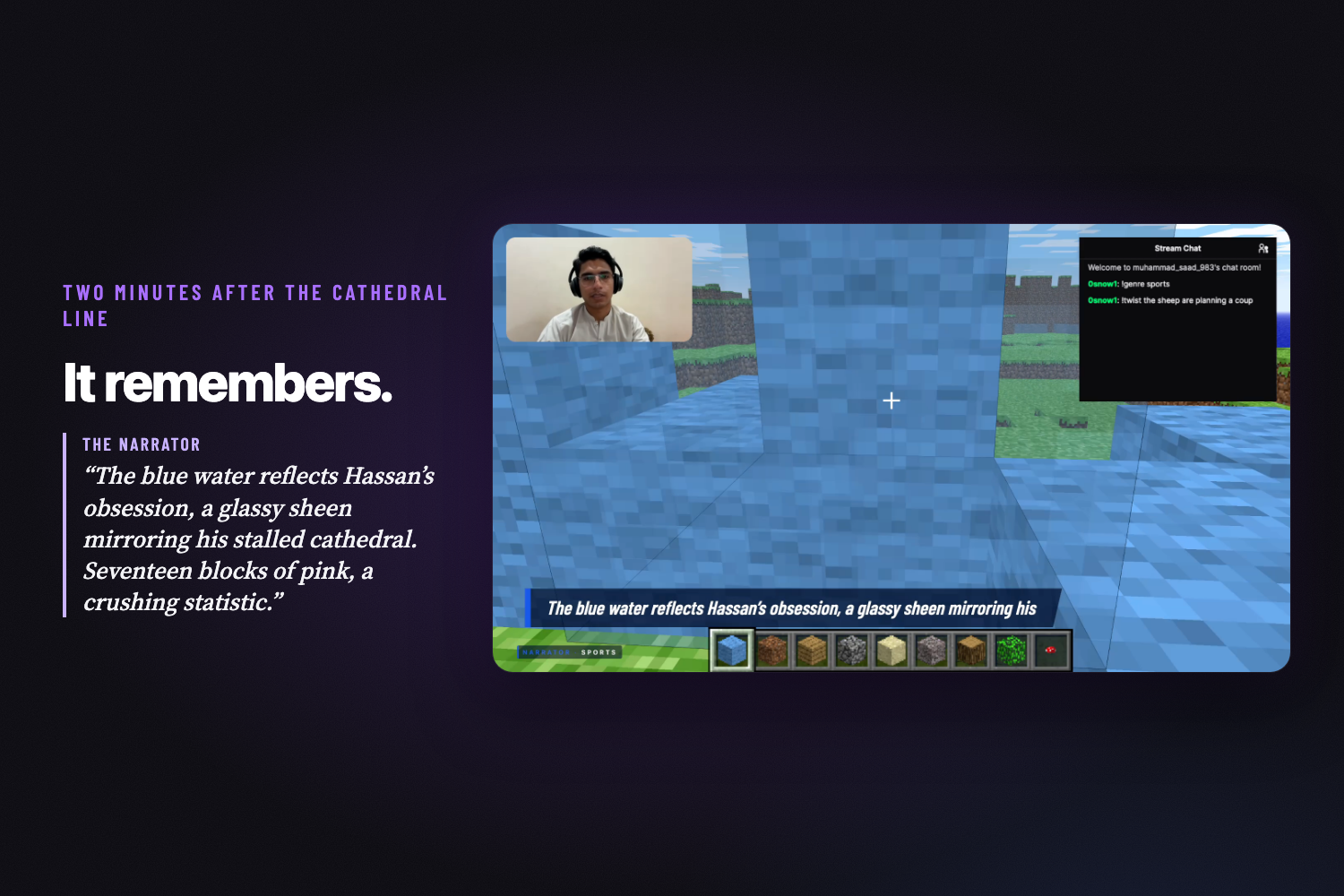
It's actually funny. In one live take it described my purple glass blocks as "a stained glass cathedral", and two minutes later it brought the cathedral back on its own. A viewer's twist is safety-checked in about 5 seconds, and once I approve it, it's on air about 7 seconds later with the viewer's name on screen. The AI needs no API key or account, so anyone with a decent laptop can run it.
What we learned
My first live takes taught me more than the tests did. Speech-to-text heard "narrator" as "Nader" every time, so talk-back never fired. A small model will happily say it used a plot twist without using it. A safety screen that's too strict rejects "change the ending" as off-story. The fixes were small (fuzzy wake words, checking the line really contains the twist, a clearer rubric for the screen), but finding them took watching real footage.
What's next for The Narrator
Season continuity ("Previously on…" from the last stream), more genres voted in by communities, and a co-op mode where two streamers share one narrator.

