Inspiration
There's a scene in "My Neighbour Totoro" where Satsuki holds everything together. School, chores, her little sister, her unwell mother with quiet resilience and a grace the world around her doesn't fully see. We thought that's a working mother. That's exactly her.
HackHers gave us a Ghibli lens, and we found the theme everywhere in maternal care. Ghibli worlds are defined by characters who carry enormous emotional weight while still showing up, still nurturing, still moving forward. The working mother sometimes navigating a demanding career in male dominated fields like tech, where managing a pregnancy or a newborn is Satsuki in real life.
But unlike Ghibli protagonists, she rarely has a magical guide. The maternal health tools available to her are either too clinical, too generic, or simply not designed for someone who has a standup at 9am and a feeding at 2am. The Mother Suite is that guide. The Totoro in the rain. A platform that says: 'you're not doing this alone'.
What it does
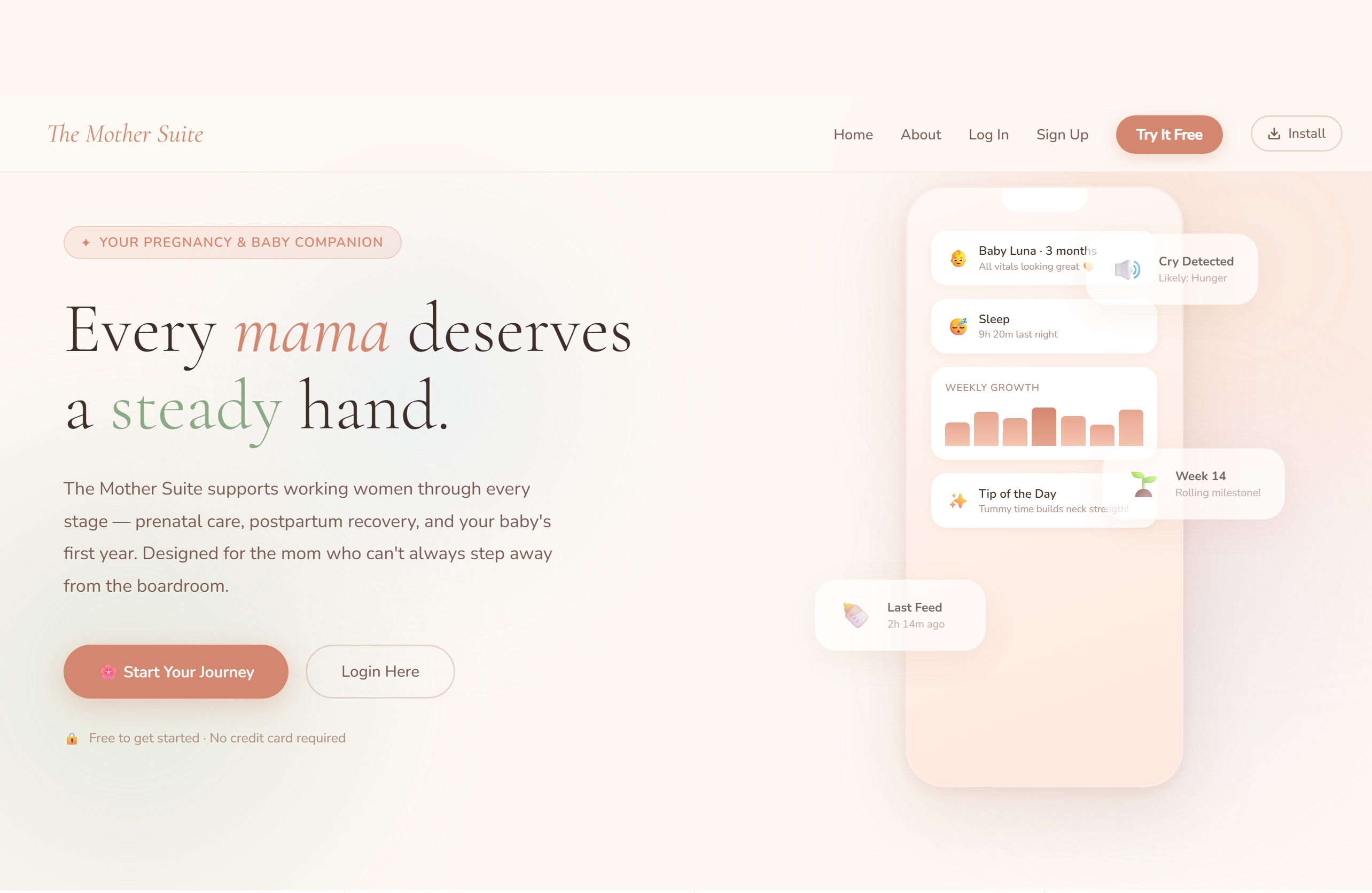
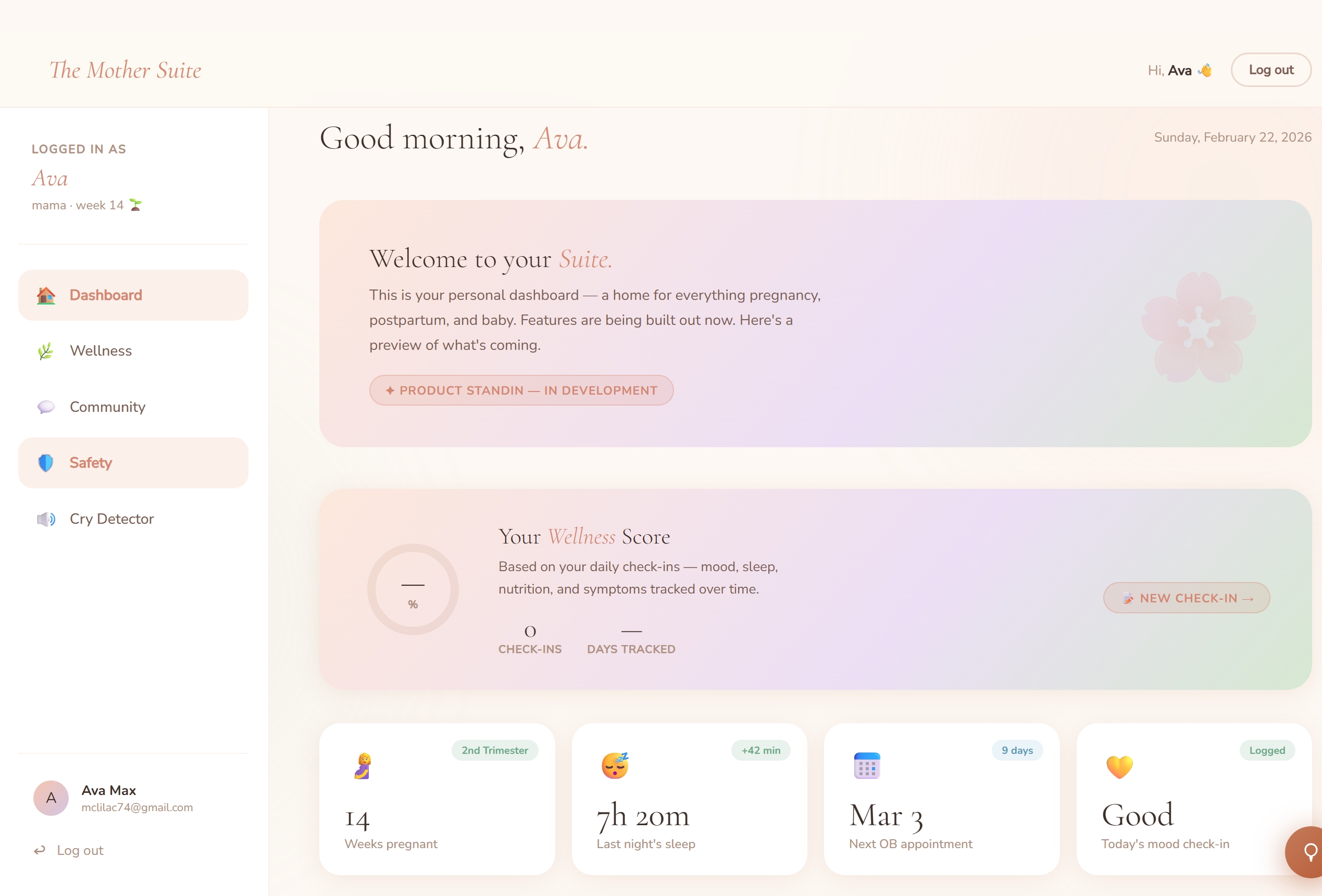
The Mother Suite is a whole-care platform for working mothers, covering three life stages that are too often treated in isolation: prenatal care (week-by-week tracking, kick counter, OB notes, birth plan builder), postnatal and postpartum recovery (mood journal, PPD check-ins, fitness plans, return-to-work guidance), and baby's first year (sleep log, feed timer, milestone tracker, growth charts).
Beyond the personal tools, the platform features a fully interactive community feed where mothers can post, reply, like, and filter conversations by topic such as: Sleep, Feeding, Back to Work, Mental Health, Milestones, and Cry Help. It's the kind of candid peer support that usually lives in private group chats, brought into one safe and structured home. All data as well are sensitized to protect their people's data.
Also the main finale: a Cry Detector, an audio-based feature that classifies a baby's cry in real time and builds a personalized pattern profile the more it's used. Think of it as a Kodama. Small, quiet, but always listening.
How we built it
We built the frontend using vanilla JavaScript, HTML, and CSS, structured modularly with separate files for shared styles, authentication, the dashboard, and the community feed. The Ghibli theme shaped every visual decision such as the soft cream-and-blush gradients, floating card animations, gentle blob backgrounds, and typography that feels warm rather than clinical.
Authentication was scaffolded with Firebase, including email and password signup, Google SSO, a forgot password flow, and a full friendly error message system. The data layer was designed with Firestore's document model in mind, with community posts, user profiles, baby logs, and milestone data all ready for connection. On the backend, we used Node.js to lay the groundwork for the Cry Detector's audio processing pipeline and future API endpoints. React was used for the migration path, with the frontend architecture kept deliberately compatible with React Router for a smooth transition.
Challenges we ran into
The hardest challenge was connecting the frontend to the backend. Getting Firebase to talk cleanly to our vanilla JS frontend, managing authentication state across pages, handling async flows gracefully, and ensuring the right data reached the right components at the right time was significantly more complex than building either side in isolation. There were moments where a user could appear logged in on one page and later would be logged out once redirected to another section. Tracking down those state inconsistencies required patience and a lot of console logs.
Beyond the technical side, the tonal challenge was real too. Maternal health is an emotionally sensitive space, and every design decision: color, clothing labels, a piece of microcopy. Carries weight for a user who may be exhausted or anxious. Getting that right took more iteration than any piece of code.
Accomplishments that we're proud of
We're proud of building something that genuinely feels like it was made for the intended audience, not just a generic health app dressed in pink. The community feed is fully functional with live post creation, replies, likes, and topic filtering, all in vanilla JS with no external dependencies. The Firebase authentication layer is cleanly scaffolded and production ready. The post-signup dashboard communicates the full product vision even before real data is connected. And the Ghibli theme lives in the product not as decoration, but as the emotional DNA of the entire experience, warmth, resilience, and quiet magic threaded through every interaction.
What we learned
We learned that Miyazaki's most important lesson isn't really about animation, it's about attention. His worlds feel alive because every detail was considered with care. The Mother Suite became a better product every time we stopped to ask 'does this serve her? ' Rather than 'can we build this?'
We also learned that the hardest part of any full-stack project isn't the frontend or the backend in isolation, it's the seam between them. Managing authentication state, syncing real-time data, and handling errors in a way that feels invisible to the user is where the real craft lives. We came out of this hackathon with a much deeper respect for that seam.
What's next for The Mother Suite
The immediate priority is completing the Firebase integration by connecting the existing auth scaffolding to live Firestore data, so community posts, baby logs, and user profiles persist across sessions. From there, we'll complete the React migration for a smoother single-page experience and begin work on the Cry Detector using an audio ML model with on-device processing for privacy. Longer term, we want to bring verified experts; OBs, lactation consultants, and mental health specialists into the community feed and build out a native mobile app so The Mother Suite is always in a mother's pocket, wherever the day takes her. Another feature is to have a licensed AI chatbot that these women can rely on to talk too while keeping them safe.
The vision is simple: become the platform every working mother reaches for: from the first positive test to her child's first birthday and beyond.


Log in or sign up for Devpost to join the conversation.