Inspiration
As two students who are passionate about teaching financial literacy and video games, this project seemed perfect to us after reading the prompt. Avin is a founder of SEED (Student Entrepreneurship Educational Development Program), a program that is partnered with two local middle schools that host 8-week-long programs that teaches the basics of entrepreneurship to students. Franklin is a video game developer interested in educating financial literacy through the games he creates. We combined our interests to develop a game tailored to introduce financial planning fundamentals to low-income first-generation students.
What it does
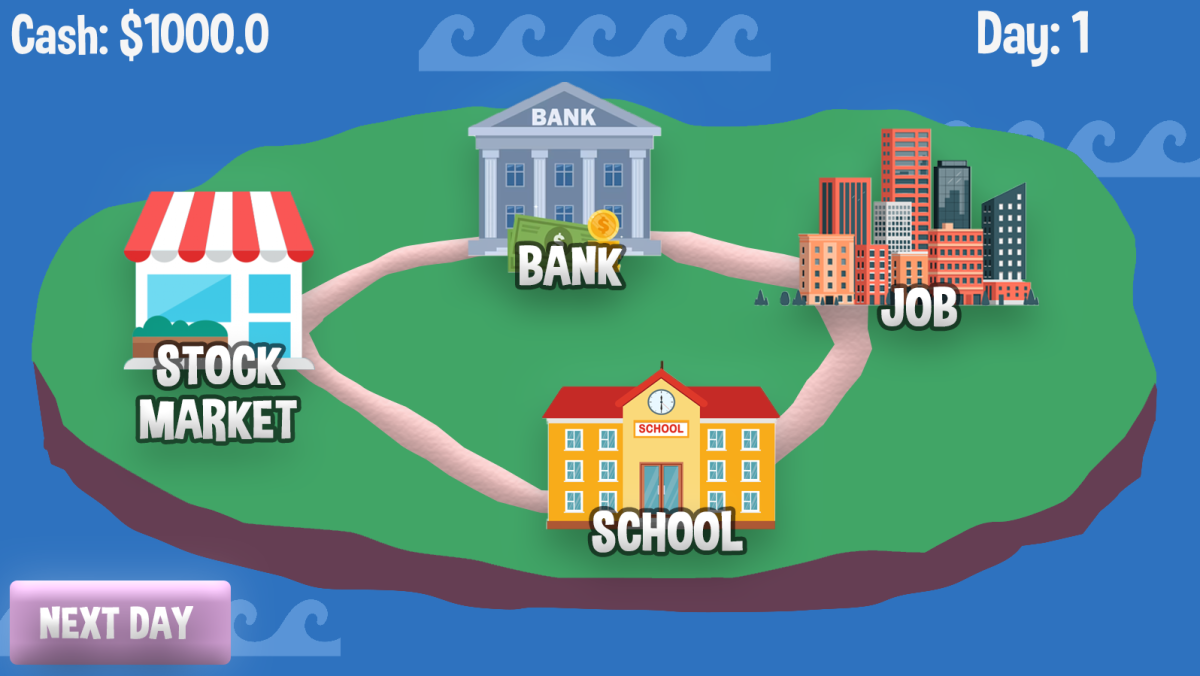
The Money Game is a video game that lets the user explore the basics of personal finance. On opening the program, the player is sent to a title screen that lets the user either start the game or read the instructions. The instructions give all the information needed to play the game, but there is also a complementary handbook containing all the important details of financial planning. The player can then return to the main menu and start the game. From here, the player is brought to a simulation of a student worker. Starting with $1000, the player can access 4 locations: school, job, the stock market, and the bank. By clicking on the school, the player increases their knowledge multiplier (randomly selected from a range), increasing their income from their job. By clicking on job, the player increases their balance by their income. The player may only go to school and their job once per day. The player can buy and sell six different stocks by clicking on the stock market. Each stock, alongside its ticker symbol and name, has a randomly generated performance, stock price, and graph. If the player clicks on the bank, they can access their checking and savings accounts. All the money they start with and create goes to their checking account. They can transfer money between their checking and savings accounts by increments of $100. While savings accounts generate 1% interest daily, the player must balance their money between their accounts as they can only pay their expenses through the money they have in their checking account. The player can also view the stocks they own through the bank. Once the player is happy with what they have done for the day, they can click the "Next Day" button on the bottom left of the screen. Once clicked, the player automatically pays expenses, depending on their income. They see how much they pay for each section: taxes, needs, wants, and emergencies (which occur randomly). On every new day, stock prices change, and the player can go to work and school again. The goal of this game is for the player to live as long as they can or achieve financial freedom (which is making enough money not to have to worry about losing).
How we built it
We built this game through IntelliJ IDEA Community Edition 2023.2 using Java language. We only used two classes: main and a Company class or each stock. Within main, we utilized the PApplet framework to display graphics. We used a lot of edge detection and clicking if statements to allow the user to navigate throughout the game. We also had to use a lot of calculations to get random numbers for variables requiring them, such as stock prices, knowledge gains, and emergencies. We also relied heavily on Photoshop to create the many graphics we used within the game. All other images we used are non-copyrighted vector images we collected online.
Challenges we ran into
We encountered many minor challenges that only took a little time to fix, which we did by debugging and searching online. However, the biggest problem we faced was displaying each stock's price charts. We found that the points we plotted were out of order and not in the correct coordinates. It took us quite some time to find out that we were putting the prices in the array in the wrong order, which made the chart completely wrong.
Accomplishments that we're proud of
We're really proud that we created this working game as we are relatively new programmers. We are happy with how we developed this idea, created our plan, and executed and implemented the different features we came up with. We are happy with how we made it both engaging and educational, as well as learning more about programming along our journey.
What we learned
We learned quite a lot throughout this hackathon. We learned how to use images with our code and create detailed graphics. We also improved our planning and debugging skills. At the end of our coding, we also learned how to use GitHub and create the README and License files. We also learned how to work as a team and communicate our ideas and thought processes with each other.
What's next for The Money Game
We plan to continue working on The Money Game and hopefully offer it to students to introduce these essential financial concepts to them. If possible, I would like to build upon this idea and publish it to teach financial literacy and planning to students worldwide.


Log in or sign up for Devpost to join the conversation.