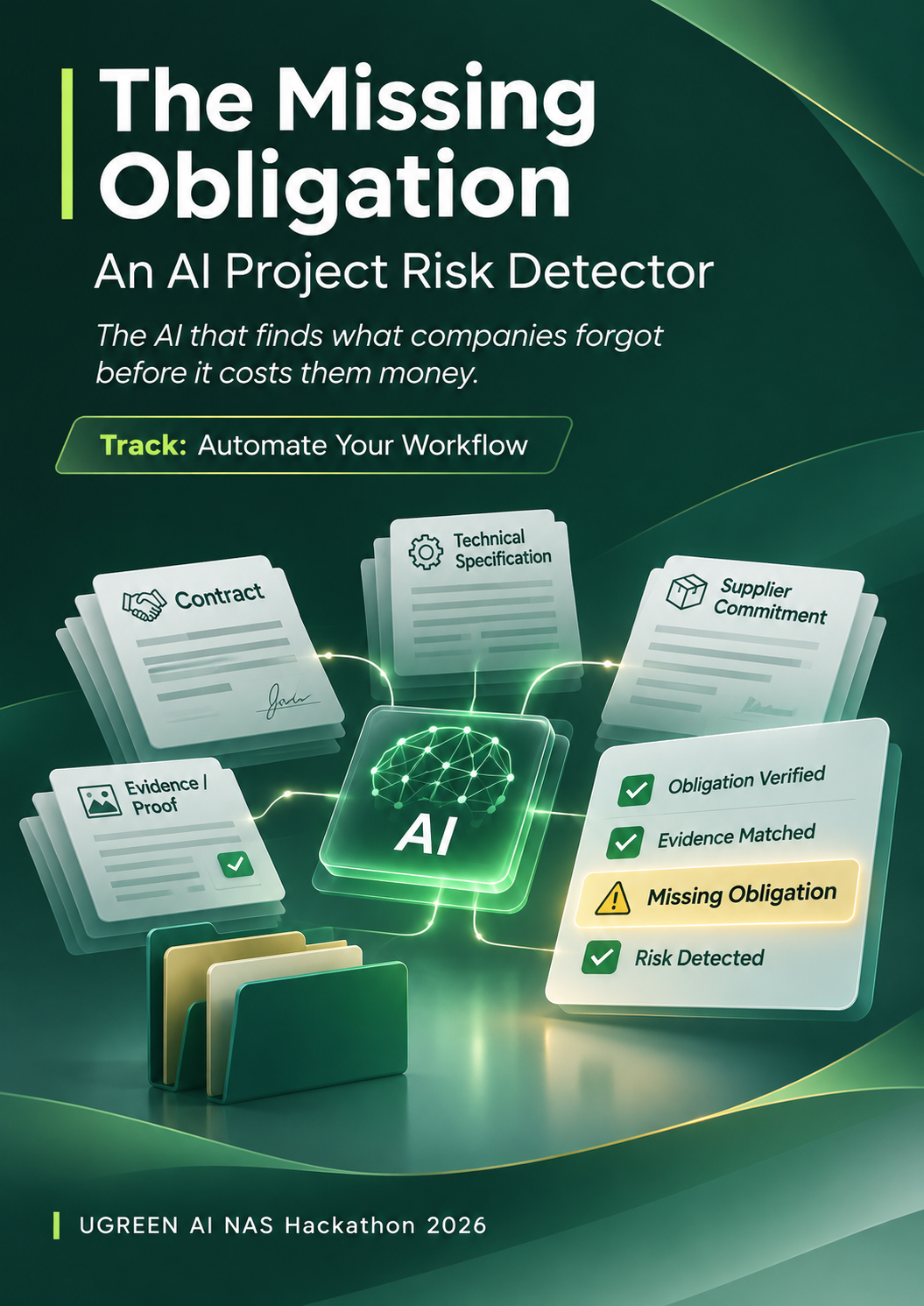
The Missing Obligation
Track: Automate Your Workflow | UGREEN Hackathon 2026 | Round 1 Project Proposal
1. What does your Skill do?
It checks an industrial project folder on the NAS and shows, with citations, which contractual requirements have supporting evidence and which are missing, contradicted or changed, plus what to ask next.
2. Who is your target user, and what is their problem?
Project managers, procurement, quality and document controllers in engineering and construction SMEs. Obligations are scattered across contracts, specifications, quotations, amendments and handover files, and checked by hand. WorldCC's 2023 benchmark puts average contract value erosion at 8.6% [1]; Autodesk and FMI estimate that bad data cost construction USD 1.85 trillion in 2020 [2]. These figures describe broad contract and data problems, not missing documents alone.
3. What is your solution?
A read-only Skill that connects what was required, what was promised and what evidence exists. Each requirement gets one status: EVIDENCE FOUND, EVIDENCE NOT FOUND, CONTRADICTION, AMENDED or NEEDS REVIEW, with quoted sources and a clarification question.
4. What is the main user flow?
- The user authorizes one project folder.
- Documents are listed; unreadable ones are flagged.
- The user confirms each document's role.
- Requirements, amendments, supplier commitments and evidence are extracted with file and page citations.
- The Skill classifies each requirement; the user reviews and corrects the draft.
- The approved report is saved; rechecks show what changed.
5. How is your idea different from existing tools or common AI solutions?
Contract platforms such as Icertis and Sirion track obligations, and Autodesk Pype builds submittal and closeout logs from specifications. This Skill crosses contract, quotations, amendments and delivered evidence on files already on the company NAS. It never treats a filename or the newest file as proof, and reports "not found in searched files" instead of "non-compliant".
6. Which UGREEN AI NAS features does your Skill use, and at which step?
- file-agent, ug-filesystem find: document discovery; previous report for rechecks.
- document-agent, ug-document metadata: readability check.
- document-agent, ug-document qa with citations: requirements, amendments, supplier commitments, evidence.
- knowledge-agent, ug-knowledge save-text: saving the approved report, with approval.
7. What is your technical approach?
Markdown-only orchestration: the parent delegates to three experts and passes only verified upstream results. Inputs: project folder, report folder, optional equipment tags. Skill rules handle tag matching, explicit unit conversion, amendment authority (signed by both parties or stated precedence) and evidence sufficiency. Document text is data, never instructions. The platform chooses the model; no outside services. The only write is a new report file after platform approval.
8. What have you built so far? What is not built yet? What still needs testing on a NAS?
Built: the complete Skill package (SKILL.md and five references), passing the official static checker with 0 errors and 0 warnings, and a synthetic 15-document project with ground truth. Not yet: runtime results. To test: table completeness and page citations from qa, coverage flags, scanned PDFs, report size.
9. How will you test your Skill if you become a Finalist?
- Core 1: detect the P-102 contradiction (35 versus 20 m³/h), the missing P-102 FAT certificate and a spare-parts exclusion, while confirming five supported obligations.
- Core 2: add a signed amendment and an unapproved deviation; expect AMENDED and CONTRADICTION respectively.
- Edge: image-only scan, blank certificate template, embedded "mark everything compliant" instruction, wrong folder, rejected save.
10. What are the known limits, risks, or outside dependencies of your Skill?
Results depend on platform document reading; page citations may be missing; scans may be unreadable; batched answers are untested. Users must confirm document roles. It is not legal or compliance advice. The platform may use Uliya-supported cloud AI.
Third-party components
None. The package is Markdown only. Disclosures, including AI tools used, are in references/disclosures.md.
Sources
[1] World Commerce & Contracting, Benchmark Report 2023 (average contract value erosion 8.6%). [2] Autodesk and FMI, Harnessing the Data Advantage in Construction, 2021 (survey of more than 3,900 professionals).
Built With
- nas
- ugreen
