-
-

logo
-
poster
## Inspiration
The Mind Share was born not from a spark of commercial insight, but from a deeply personal struggle. For years, despite a history of academic success, I found myself battling severe memory and concentration problems. These cognitive gaps began to profoundly affect my life, my work, and my ability to learn new things. The breaking point came during my professional career; I failed multiple job interviews due to an inability to recall key details under pressure, and in the rare instances I was hired, my tenure lasted only a few days.
Facing this reality, I decided I had to act. I couldn't find a job that could accommodate my challenges, so I resolved to create my own. My goal was to build the very tool I needed—a solution not just for me, but for anyone else feeling adrift in a sea of mental fog. This project is my answer to that struggle.
## What it does
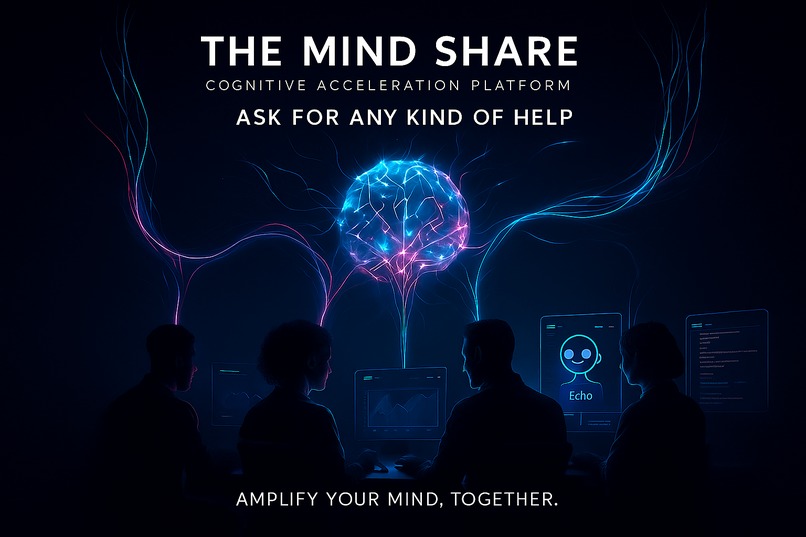
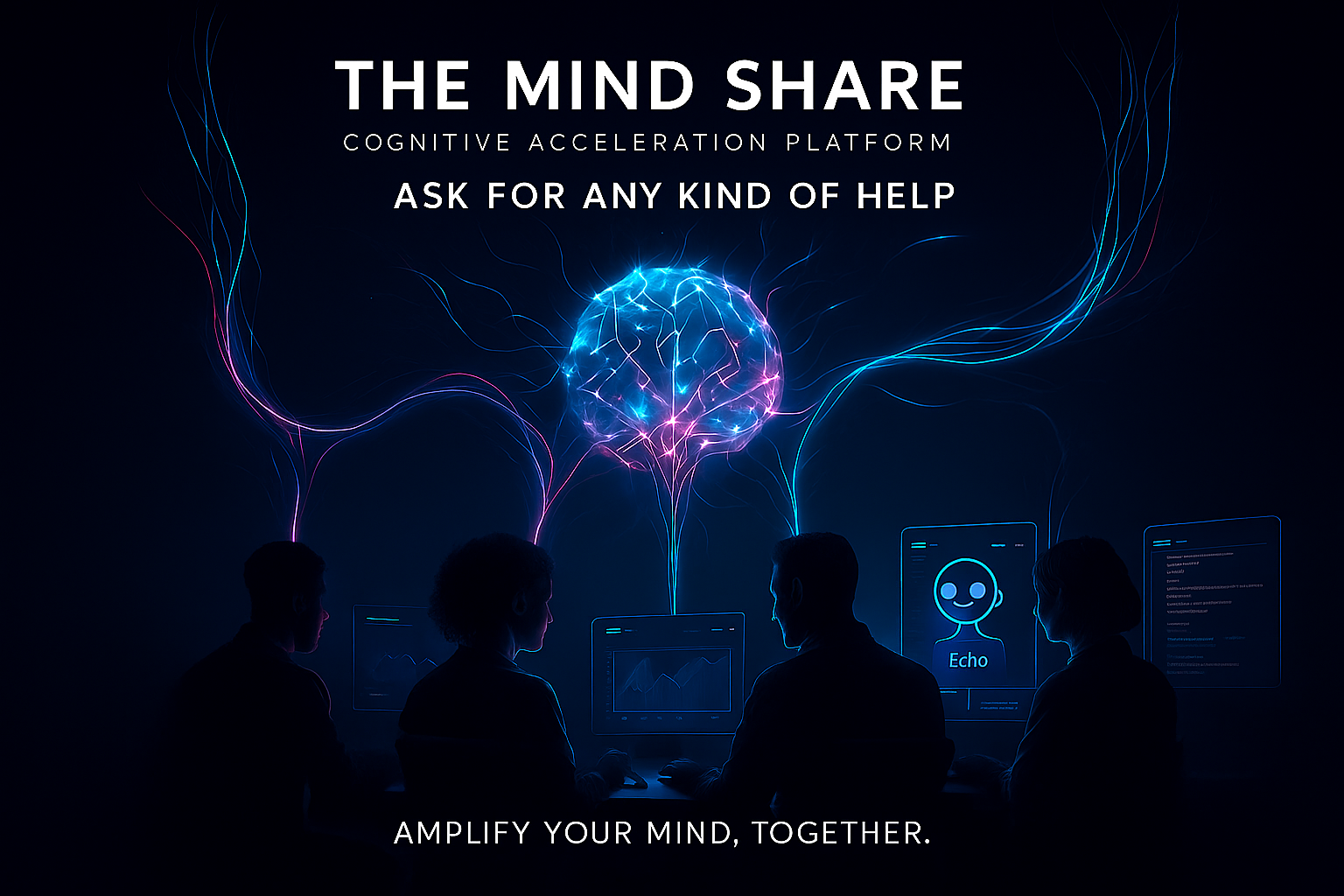
The Mind Share is a cognitive acceleration platform designed to function as an "exocortex"—an external, artificial brain that assists and augments your own. It's built on two core pillars:
Écho - The Real-Time Cognitive Co-Pilot: This is the heart of the application. Écho is a live, conversational AI agent you can "call" for instant help. Using technologies like Tavus, it engages in real-time audio and video conversations. It's designed to be multimodal, audio, live video from your camera, and even your screen share to understand your context and provide immediate assistance. Whether you need to remember a detail, focus on a task, or solve a complex problem, Écho is there to bridge the gap.
Collective Intelligence & Community: The platform is designed to facilitate mutual aid.
- Shared Knowledge: It anonymously collects and analyzes interaction patterns, reasoning techniques, and prompting strategies from its users. This creates a unique, living knowledge base that the AI draws from, allowing it to provide solutions based on real, effective human intelligence.
- AI Chat: Users can engage with various AI providers (like Gemini, Mistral, Claude, and more) by adding their own API keys. These interactions also contribute to the anonymized pattern database.
- Groups & Channels: To foster community, users can create and join groups based on shared interests or institutional affiliations (e.g., colleagues in a company, students in a class). By joining a group, users consent to contribute their anonymized conversation data, powering the collective intelligence engine and helping everyone on the platform become more effective thinkers.
## How we built it
The first week of the hackathon was dedicated to brainstorming how to turn this vision into a viable product using cutting-edge AI. I decided to leverage the resources provided by the bolt.new hackathon, including Tavus for conversational AI, 21st.dev for the ui and animations, lingo.dev for multilingual support, and Entri for domain services.
I started by using bolt.new to generate the initial application structure, providing it with detailed prompts like:
Build a sophisticated application called The Mind Share... I want to establish mutual help between users by collecting their know-how and ways of thinking... this will be automated through AI... The app will provide AI chats where users can use their own API keys for providers like Gemini, Mistral, Claude, OpenAI... Anonymized data will form a shared knowledge base for the AI to provide personalized responses through a live conversational agent...
My journey began with a React Native and Expo stack, aiming for a mobile-first experience. For two weeks, I worked on this version, but hit a major wall. The project pivoted in the final week to a React and TypeScript web application, which proved to be the right decision.
## Challenges we ran into
This project was a marathon of overcoming technical hurdles, many of which were captured in my development history with Bolt:
The Mobile Roadblock: The biggest initial challenge was my two-week struggle with the React Native app. I could not get the Tavus video integration to work, despite my best efforts. This forced the critical decision to pivot to a web stack, losing time but ultimately finding a viable path forward.
Database Recursion: When implementing the Groups feature, my initial Row Level Security (RLS) policies in Supabase created an infinite recursion loop, crashing any query to the
group_memberstable. The fix required a complete teardown and rebuild of the RLS rules, architecting them carefully to avoid circular dependencies.Deployment Gauntlet on Netlify:
- Build Failures: My first deployment failed because my
netlify.tomlhad the wrong build command. - Broken Assets: After fixing the build, the site deployed with a broken logo, which I traced to incorrect asset pathing.
- Connection Errors: A later deployment to a new Netlify URL failed on login with a
Failed to fetcherror. This was due to forgetting to configure the Supabase environment variables for the new site instance.
- Build Failures: My first deployment failed because my
Internationalization (i18n): Using lingo.dev was powerful but tricky. I had to debug Unicode escape sequence errors, wrap JSX elements correctly to allow the compiler to extract strings, and manually translate hardcoded French text in my Settings and Groups pages into English keys so the i18n system could take over.
Domain Purchase Failure: I attempted to use Entri to purchase a domain, but was unable to complete the process because my country was not on the accepted list for payment information.
## Accomplishments that we're proud of
Despite the challenges, I'm incredibly proud of what was achieved:
- The Successful Pivot: Rebuilding the entire application on a new tech stack (React/Vite) in the final week and getting it to a functional state was a huge accomplishment.
- Integrating Écho: My first major victory was successfully integrating the Tavus video AI, the core feature of the app, after failing to do so on mobile.
- A Complete, Functional App: I didn’t just build a demo. I implemented a full-stack application with a robust backend, authentication, real-time chat, group functionalities, and a complex, multi-provider AI system.
- Full-Cycle Transcription: I successfully implemented the entire pipeline for capturing audio from Écho sessions, transcribing it using AI, storing it in Supabase, and making it available to the user for review and sharing.
## What we learned
This hackathon was a powerful learning experience:
- Agility is Key: Knowing when to abandon a failing approach and pivot (from mobile to web) is one of the most valuable skills in development.
- AI-Assisted Development is Iterative: Building with an agent like Bolt is a collaborative dance. It requires clear, detailed prompting, constant testing, and a willingness to refine and correct course.
- The Devil is in the Details: A single incorrect build command, a missing environment variable, or a recursive database policy can bring an entire project to a halt. DevOps and security configurations are not afterthoughts; they are foundational.
- Personal Growth: This project forced me to confront the very cognitive challenges that inspired it. In doing so, I had to be more meticulous, more organized, and more resilient than ever before. I didn't just build a tool; I sharpened my own mind.
## What's next for The Mind Share
This is just the beginning. The roadmap for The Mind Share includes:
- Refining the Collective Intelligence Engine: Further develop the algorithms that analyze and surface insights from anonymized user data.
- Expanding Écho's Capabilities: Integrate more advanced features, such as proactive suggestions and deeper contextual understanding during live sessions.
- Onboarding Beta Users: Begin building the community and populating the collective intelligence database with real-world interaction patterns.
- Revisiting Mobile: With a stable web platform, I plan to revisit the native mobile app, possibly using a different approach or leveraging tools like RevenueCat for subscriptions as originally intended.
Built With
- 21st.dev
- css
- html
- javascript
- lingo.dev
- plpgsql
- supabase
- tavus
- typescript

Log in or sign up for Devpost to join the conversation.