-
-
Testing the final product
-
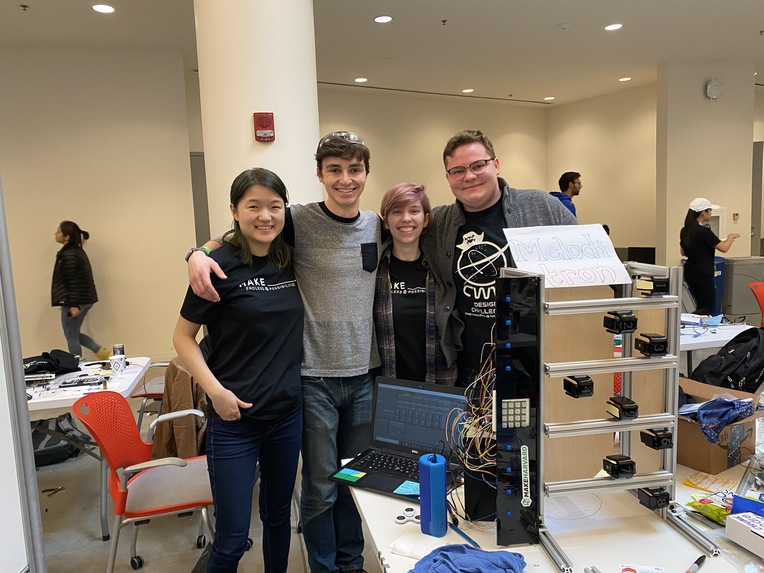
The Meloditron Team
Inspiration
Upon forming our team, we realized there was one passion we all shared: creativity in music. Well, all but one of us. He had never quite fully understood the world of music, and so we wanted to create an instrument that was impossible to play badly. That's where the Melodicon comes in.
What it does
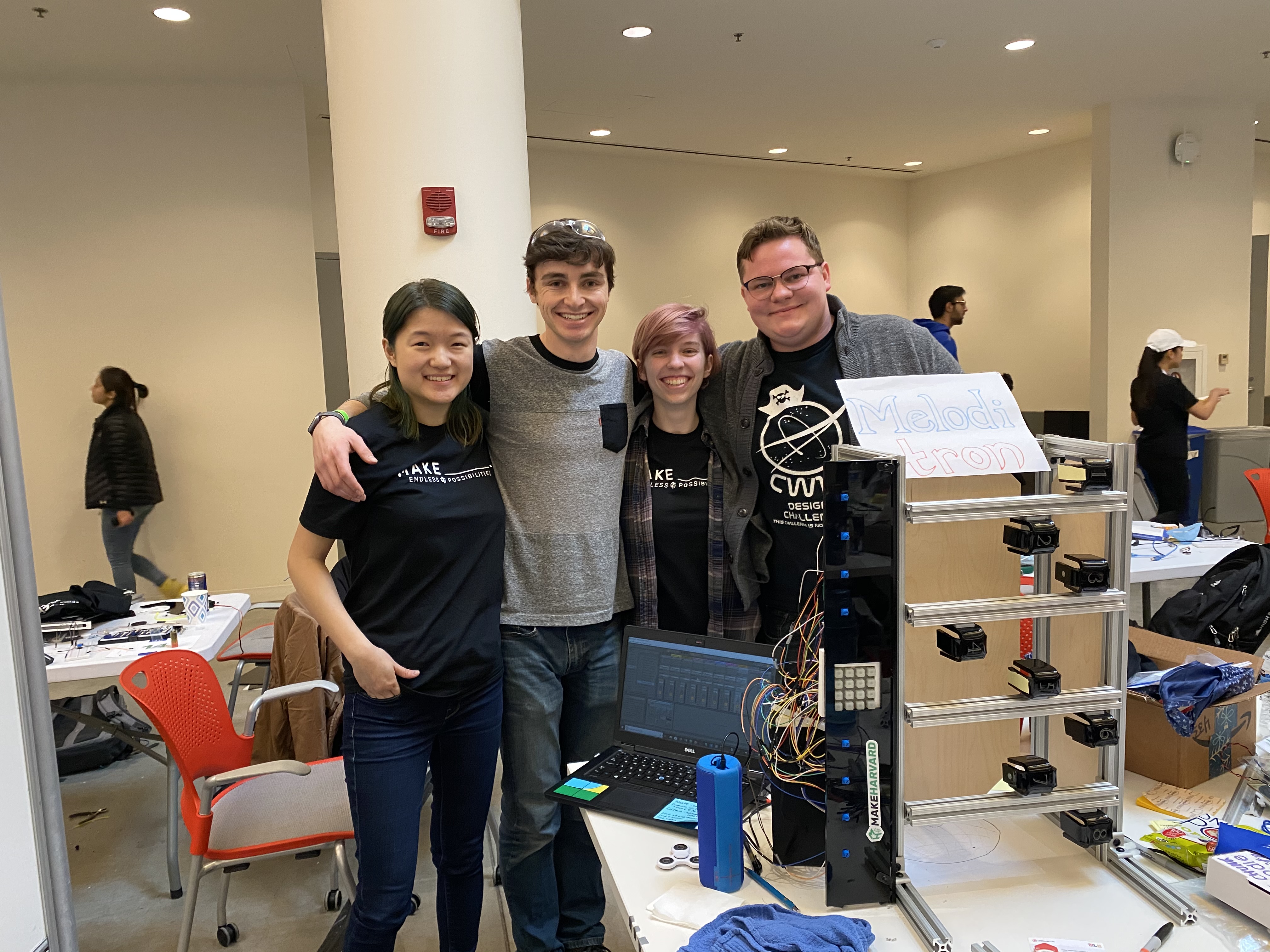
The Melodicon is the love child between a theremin and an abacus: just as a theremin senses the position of your hand to create different notes, the sliding blocks on the Melodicon control the pitch of its notes. There are eight slidable blocks that each control a different note. You can adjust the duration of these notes and play back the melody in a live loop. In addition, you can easily control the key the melody plays in using a button pad.
How we built it
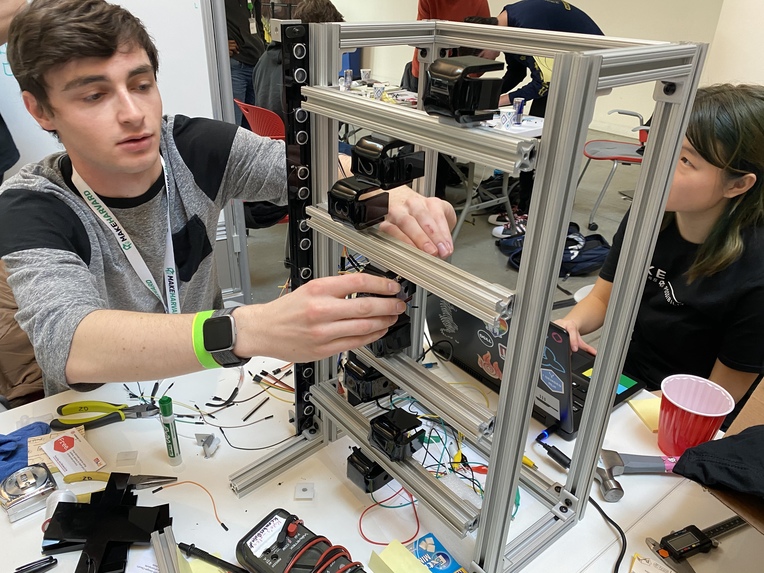
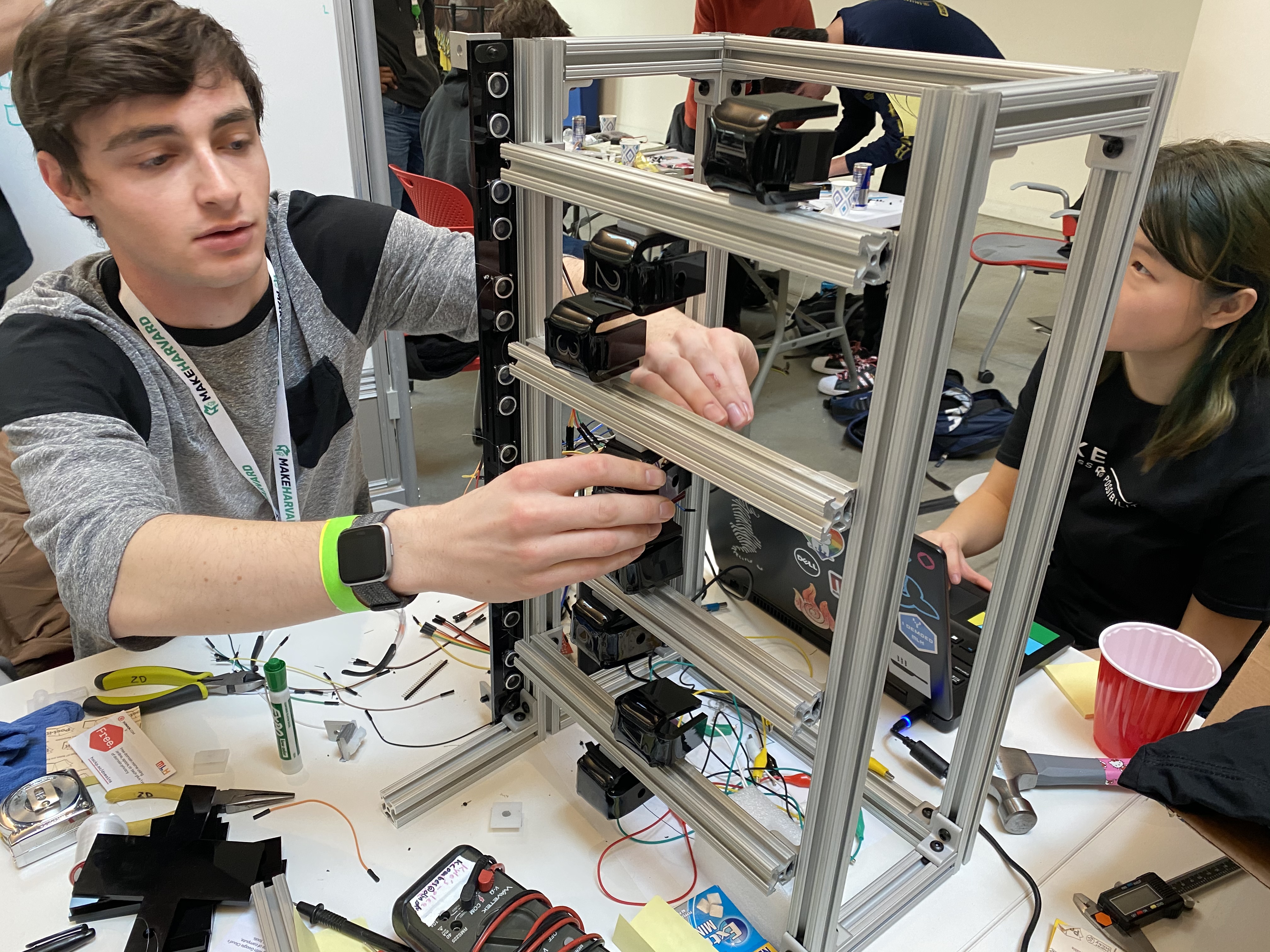
Thanks to our good friends at 80/20, we built a big frame for the Melodicon using T-track rails. We then availed ourselves of Harvard's awesome fab spaces to cut some slick mounting for our 8 ultrasonic sensors and casing for the 80/20 structure. We are running all of our sensors and control systems off of a single Arduino Mega board to produce 8-note melodies, loops, and chords. The Arduino loops through each sensor, collects the distance data, and assigns that value to the nearest note in a major scale. When all your notes are in the same scale, your notes will almost certainly sound amazing. Potentiometers mounted next to the sensors can be turned to dial in the duration of the note, and a separate button allows the user to tap the tempo for their melody. Finally, a 16-button keypad adds set values to the note values in the code to change the key.
Challenges we ran into
It was quite difficult to accumulate 8 ultrasonic sensors, and even more difficult to get them all precisely positioned on the rack. We didn't have any hardware small enough to attach the sensors to our mounting plate, so we used nylon thread to attach them. Additionally, we had to get creative with our wiring to attach all eight sensors and potentiometers to our Arduino board. This project also required that we develop a working understanding of MIDI. There's not a ton of documentation on the Hairless MIDI app that converts Arduino to Ableton MIDI inputs, so there was quite a but of trial and error.
Accomplishments that we're proud of
We're quite proud of the Melodicon's robustness and aesthetics, as well as all the coding hurdles we jumped over to get it up and running.
What's next for The Melodicon
If we had more time, we would continue refining the chord input and tweak some of our controls to make them more intuitive.
Built With
- ableton
- arduino
- hairlessmidi


Log in or sign up for Devpost to join the conversation.