-
The Market That Moves
Inspiration
India’s markets are more than places to buy food. They are social spaces, economic lifelines, and essential parts of everyday urban life. But cities are changing faster than their infrastructure. A market may be crowded in the morning, empty in the afternoon, and needed somewhere completely different the next day.
That led us to one simple question:
Why should a market stay in one place when the city doesn’t?
The Market That Moves reimagines the traditional Indian market as a flexible urban infrastructure that can go where people need it.
What it does
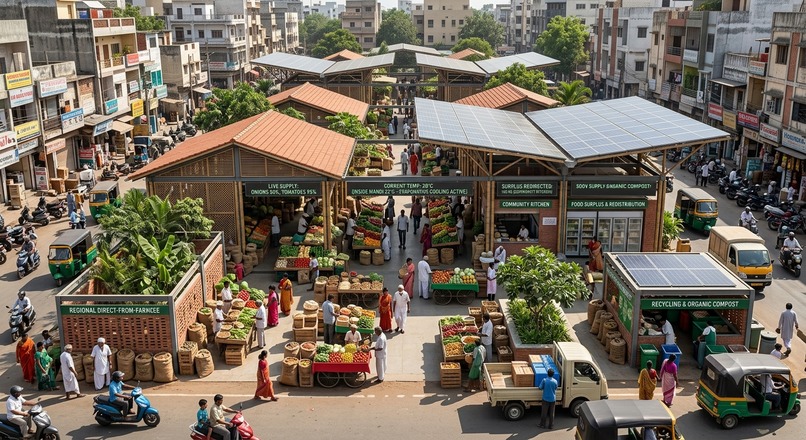
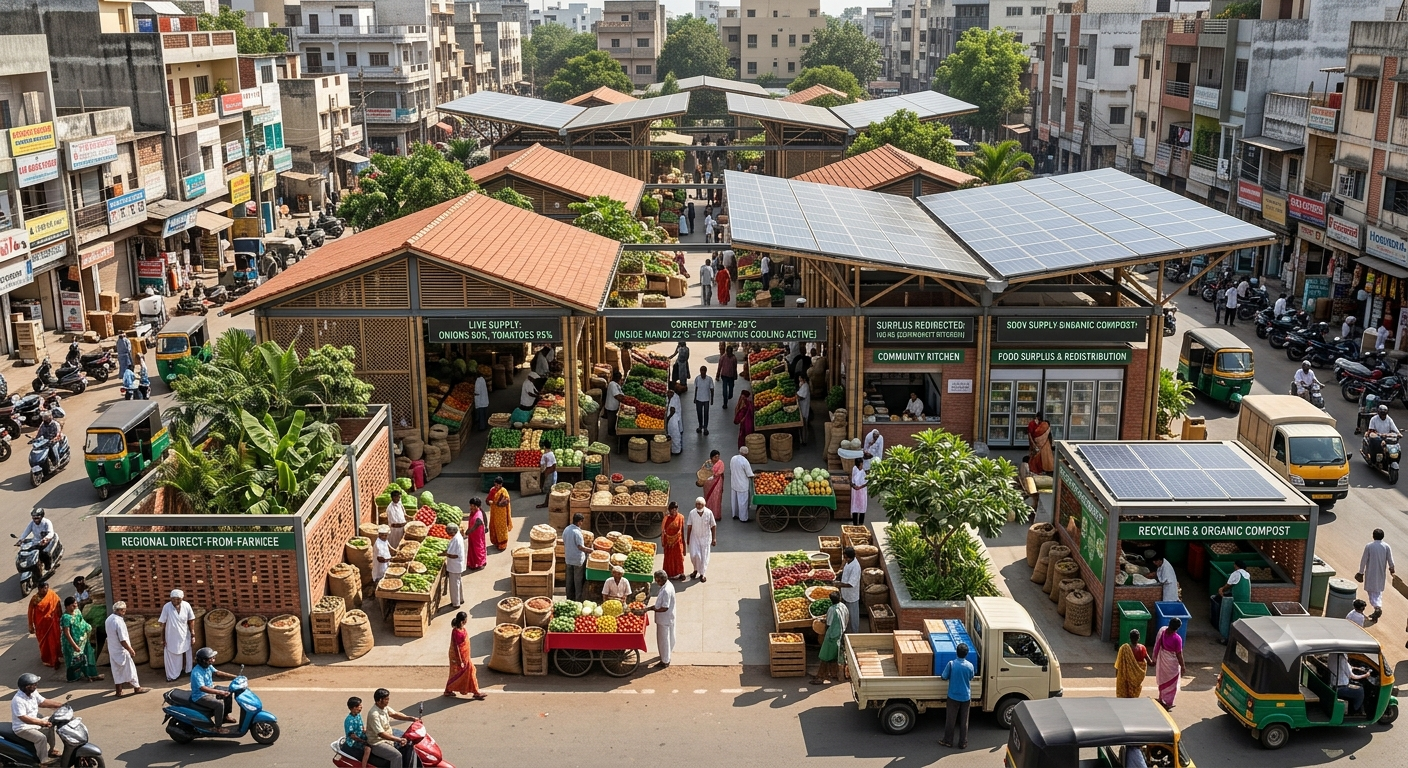
The Market That Moves is a network of modular market units that can be deployed, assembled, reconfigured, and relocated according to local demand.
The same infrastructure can serve as a fresh-produce market, street-food area, community space, local delivery hub, or temporary market in an underserved neighborhood.
Instead of forcing people to travel to a fixed market, we bring essential commerce closer to where people live, work, study, and travel.
How we built it
We used Gemini as a creative and visual co-designer to explore the concept, test different configurations, and visualize how the system could work in a real Indian city.
We focused on modular structures, lightweight materials, passive cooling, solar canopies, rainwater collection, storage, and simple logistics.
We deliberately avoided science-fiction technology. The goal was to create something that feels futuristic in its idea, but realistic in its construction.
Challenges we ran into
The biggest challenge was avoiding the trap of creating “just another smart market.”
We had to ask what truly needed to change.
The answer was not adding more screens or AI. It was changing the fundamental relationship between the market and the city.
We also had to balance flexibility with practicality: the modules must be easy enough to move and assemble while remaining safe, durable, accessible, and useful for real vendors.
Accomplishments that we're proud of
We are proud that a simple question became a completely different way of thinking about urban commerce.
The project connects several everyday needs — food access, local entrepreneurship, public space, mobility, and adaptable infrastructure — through one physical system.
Most importantly, it keeps people at the center. The technology supports the market; it does not replace the people who make the market alive.
What we learned
We learned that meaningful urban innovation does not always require inventing something completely new.
Sometimes the biggest innovation is changing the role of something that already works.
We also learned that designing for the future means designing for uncertainty. Cities will continue to change, so their infrastructure should be able to change with them.
What's next for The Market That Moves
The next step is to test the concept as a small-scale pilot in an Indian neighborhood.
We envision starting with a limited number of modular units, measuring foot traffic, vendor income, operating costs, food access, and community satisfaction, then improving the system based on real-world data.
If the pilot works, the model could expand into a city-wide network of adaptable markets.
The ultimate vision is simple: a city where essential commerce does not wait for people to find it — it moves with them.

Log in or sign up for Devpost to join the conversation.