Inspiration
Film production decisions are connected. Moving one shoot day can affect cast rest periods, dependencies, equipment, overtime, completion dates, and the remaining budget. These consequences are often discovered through spreadsheets, messages, and meetings after the decision has already become expensive.
We wanted to build a control room where directors and producers can explore those consequences before changing the approved plan.
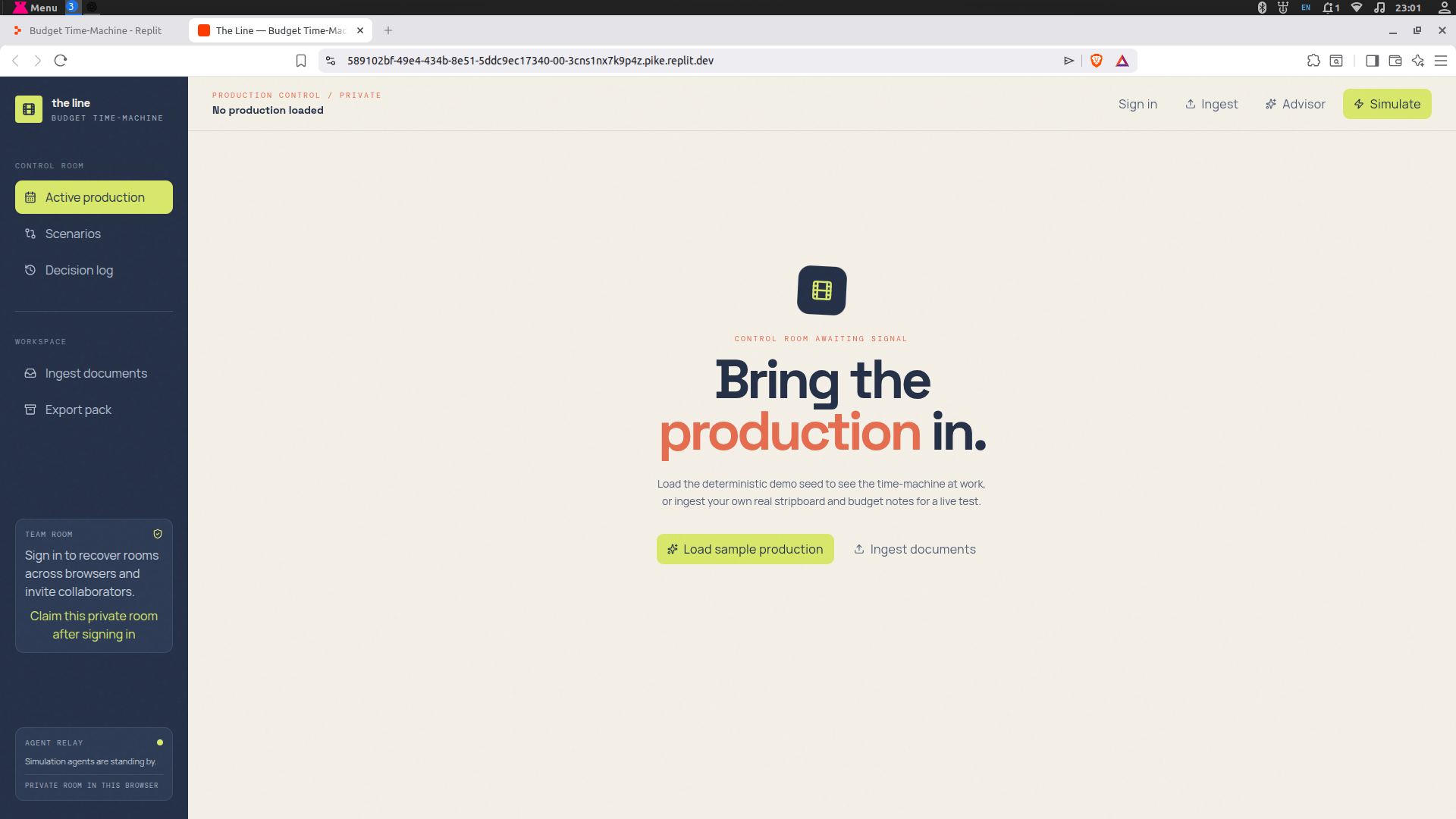
The Line — Budget Time-Machine turns a production schedule and budget into a living decision model. It helps a producer ask, “What happens if we move this day?” and see the schedule, dependency, risk, and financial consequences before committing anything.
What it does
The Line lets producers:
- Load a deterministic sample production for a repeatable demo
- Ingest real schedule and budget information from text, CSV, JSON, Markdown, PDF, and image inputs
- View shoot days, locations, cast, crew, timing, dependencies, and day-level costs
- Run what-if schedule simulations
- Identify cascading effects across dependent shoot days and shared cast members
- Review turnaround, equipment, overtime, and production risks
- See deterministic financial deltas based on server-controlled production rules
- Ask an Advisor Agent for high-leverage production recommendations
- Require explicit confirmation before applying a revised plan
- Maintain a decision history with agent reasoning and producer actions
- Save and compare production scenarios
- Export a ZIP handoff pack containing the schedule, applied plan, decision log, scenarios, and production artifacts
- Use private browser rooms or claim a room for authenticated cross-browser collaboration
The system separates agent reasoning from financial authority. Gemini can explain dependencies, risks, and recommendations, but it cannot invent financial values. Financial deltas are calculated and controlled by the server.
How we built it
The frontend is a React and Vite producer control room with a deliberately focused visual design for directors and producers.
The backend is an Express and TypeScript API connected to PostgreSQL through Drizzle ORM. Production rooms, memberships, applied plans, decision logs, and scenarios are persisted server-side.
Gemini runs through Google Cloud Vertex AI. The agent flow supports document understanding, schedule reasoning, impact analysis, plan explanations, advisor recommendations, and scenario comparisons.
The application uses a staged workflow:
- Ingest or load a production
- Build the schedule and budget graph
- Simulate a proposed change
- Present the cascade and financial impact
- Wait for explicit producer confirmation
- Apply the plan
- Record the decision
- Generate the handoff pack
The demo uses deterministic Coldwater Creek seed data so the main workflow is repeatable. Real document ingestion uses the live Vertex AI path.
Challenges we ran into
The hardest challenge was making an agentic workflow useful without allowing the model to make unsupported financial decisions. We solved this by keeping financial calculations in server-side rate-card rules while using Gemini for reasoning, explanations, dependency analysis, and recommendations.
Another challenge was representing production consequences clearly. A schedule change can affect multiple downstream days and shared cast members, so the interface needed to show both the direct change and the cascade.
We also had to design strong confirmation boundaries. A simulation is only a proposal; it cannot change the production graph until the producer explicitly confirms the plan.
Finally, we built private room isolation, claiming, memberships, invite codes, and cross-browser recovery so that production data does not leak between anonymous browser sessions or teams.
Accomplishments that we're proud of
- Built a working end-to-end production decision system instead of a static mockup
- Connected live Gemini reasoning through Vertex AI
- Kept all financial deltas deterministic and server-controlled
- Added a clear simulation-to-confirmation-to-commit workflow
- Made agent reasoning and affected schedule nodes visible to the producer
- Added persistent decision history and exportable producer handoff packs
- Added real document ingestion for schedule and budget materials
- Added room isolation, claiming, memberships, and collaboration support
- Created a repeatable demo production for reliable judging
- Recorded a real 1920×1080 demo using the working application
What we learned
We learned that an agentic production tool needs governance as much as intelligence. A useful system must explain why it recommends something, show which schedule elements are affected, and clearly separate exploration from irreversible changes.
We also learned that deterministic rules are important in AI-assisted financial workflows. The model is valuable for interpreting production context and explaining consequences, but the application must remain the authority for money, permissions, and plan application.
What's next for The Line
Next, we would expand the rate-card and production rule system for different regions and crew agreements, add richer calendar and call-sheet integrations, improve multi-user collaboration, and support more detailed location, cast, and equipment constraints.
We would also add stronger visual timeline editing, approval workflows for larger production teams, and integrations with existing production management and budgeting tools.
Built With
- agent
- ai
- cloud
- drizzle
- express.js
- gemini
- node.js
- openapi
- orm
- orval
- pnpm
- postgresql
- react
- replit
- typescript
- vertex
- vite
- zod

Log in or sign up for Devpost to join the conversation.