-
-
-
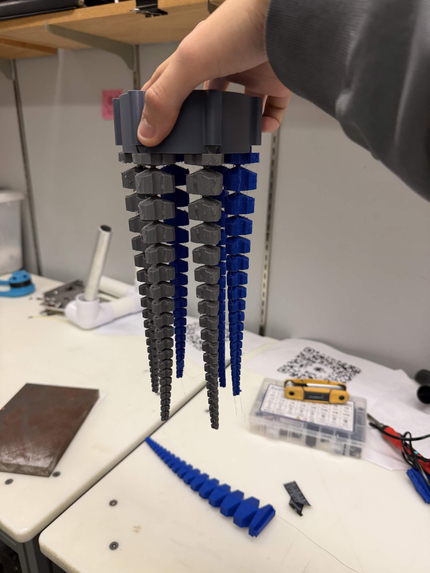
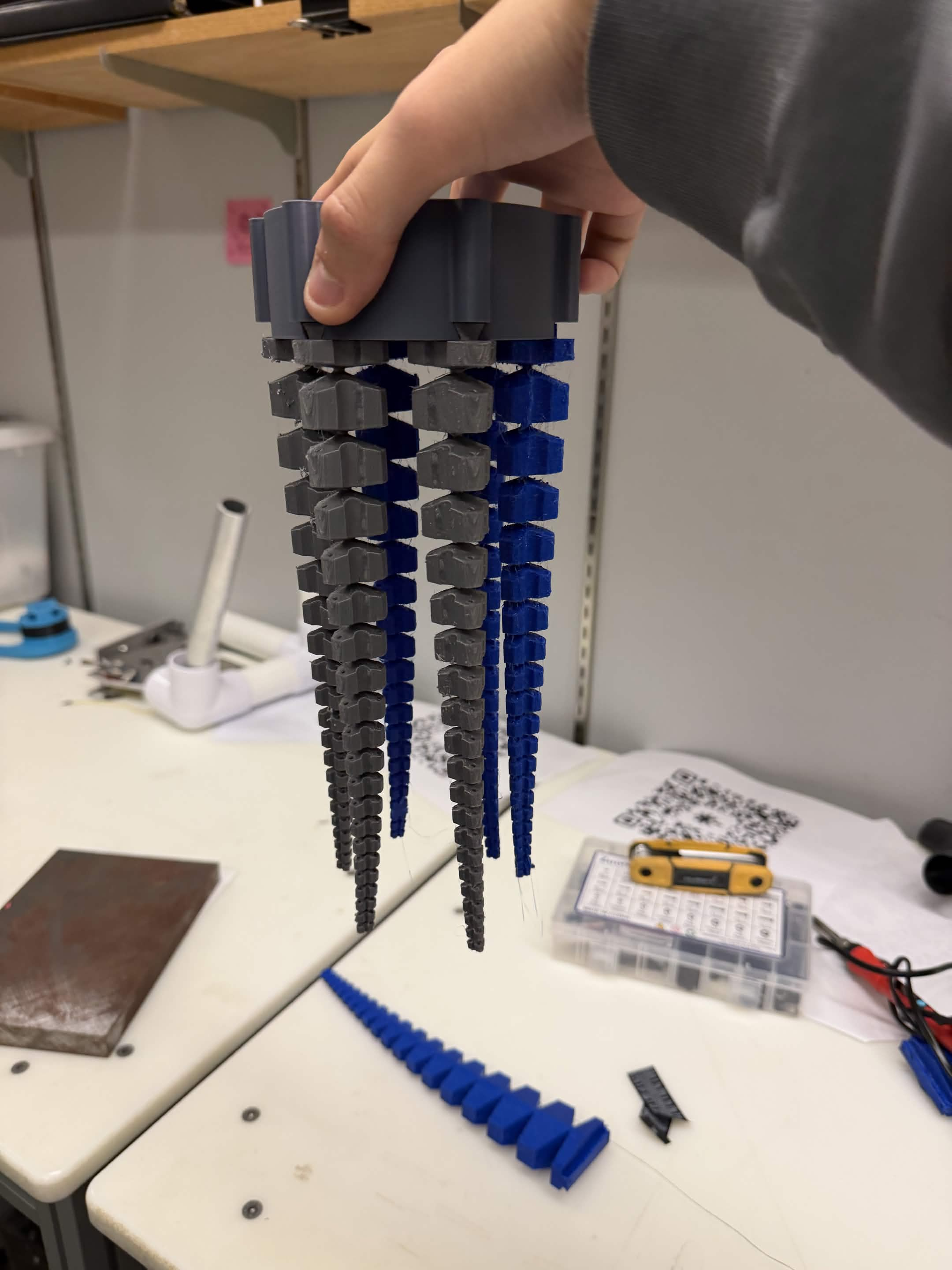
Spirals attached to the spiral mount
-
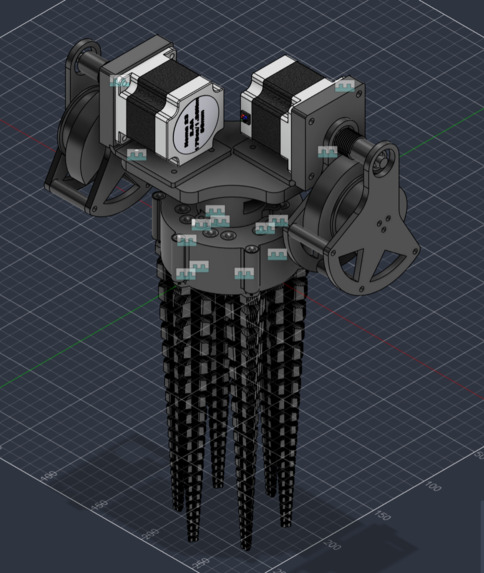
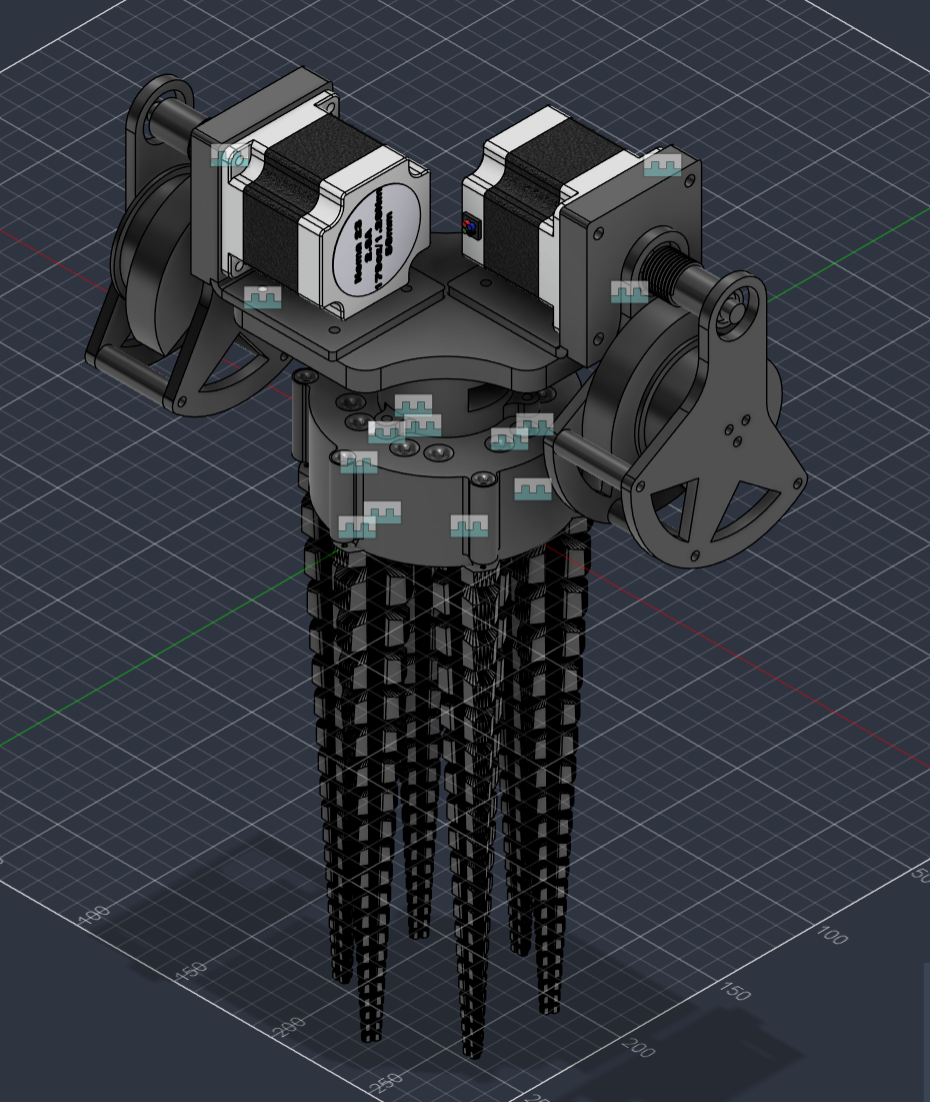
Whole Leviathan Assembly in Fusion 360
-
-
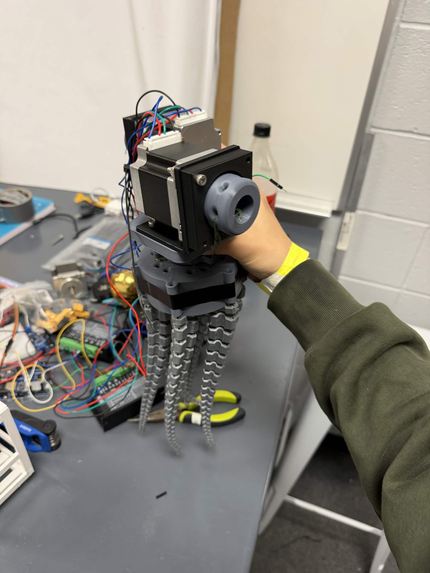
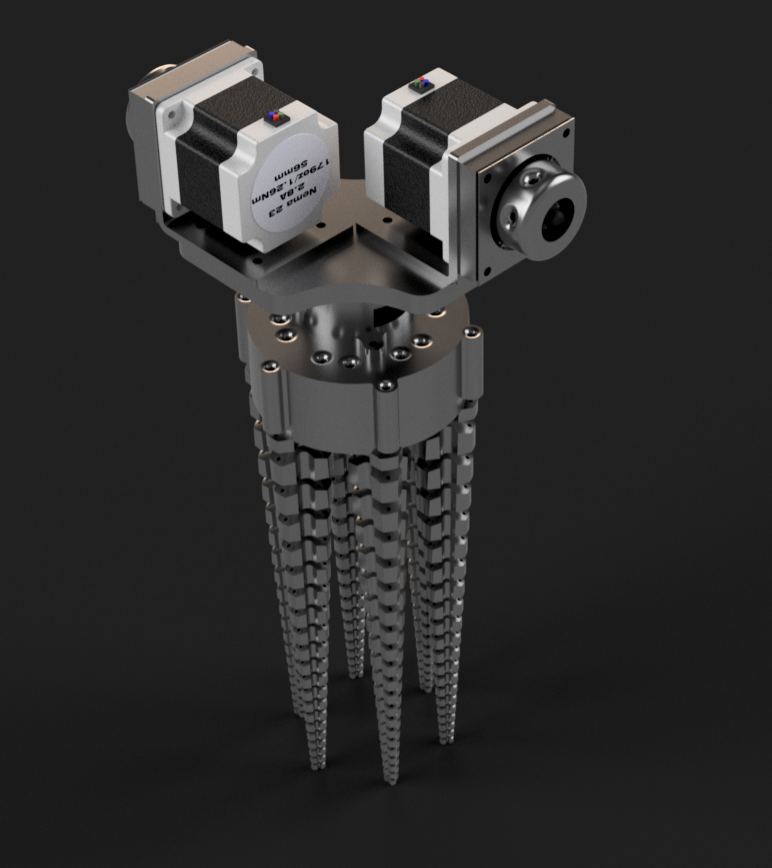
Inspiration
Our team builds robotic arms for UB Space Bulls, our Mars rover team, so we spend a lot of time on how a gripper copes with objects it wasn't designed for. Space debris is the extreme version of that problem. Dead satellites, spent rocket stages and loose fragments come in every shape and size, and a rigid gripper tuned to one geometry can't handle them all.
Then we found SpiRobs, soft robots shaped like logarithmic spirals. They were developed by Zhanchi Wang, Nikolaos Freris and Xi Wei at the University of Science and Technology of China (paper). A SpiRob curls around an object the way an octopus arm does. Because a logarithmic spiral
$$r(\theta) = a\,e^{b\theta}$$
looks the same at every scale, one design can wrap objects across a huge range of sizes. We wanted to see if that idea could become a practical end effector for capturing debris.
What it does
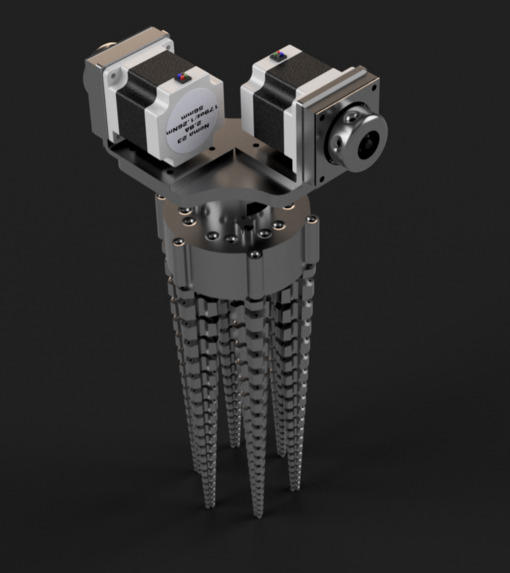
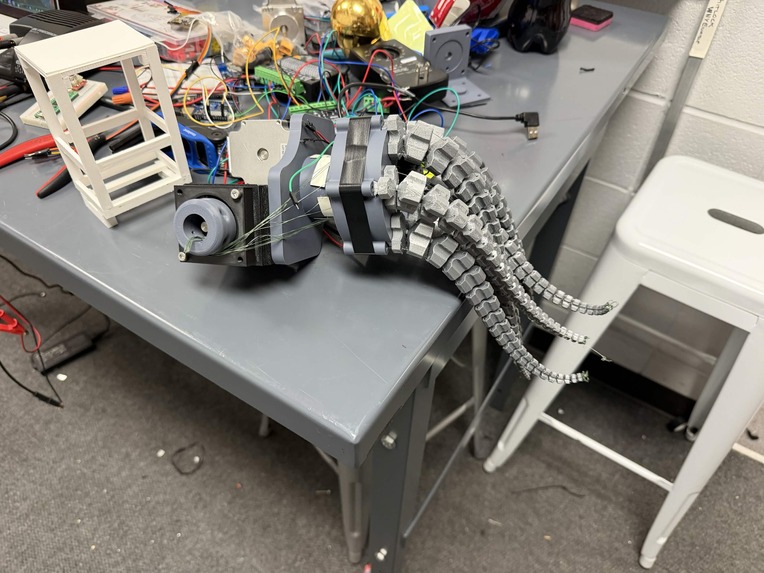
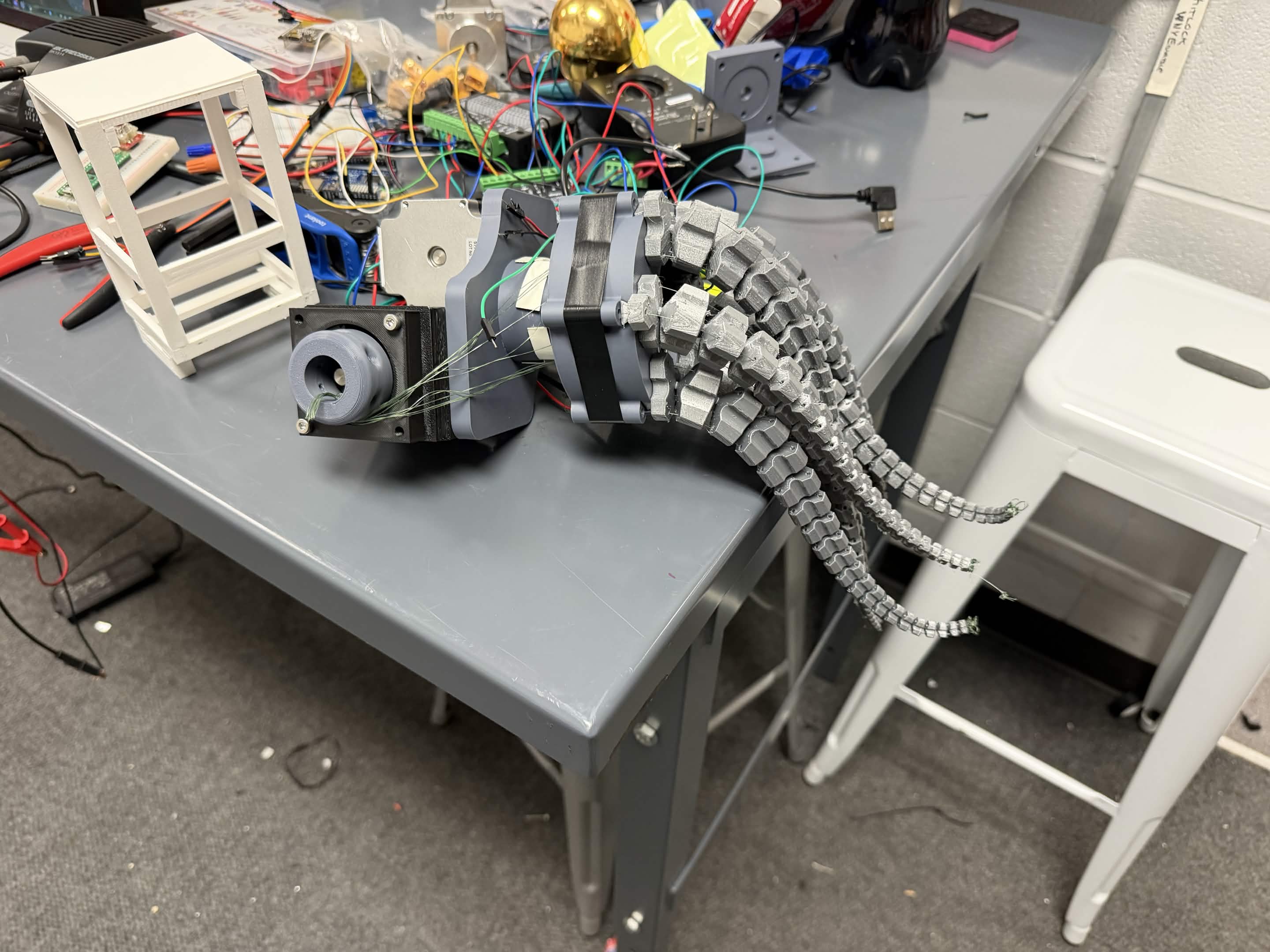
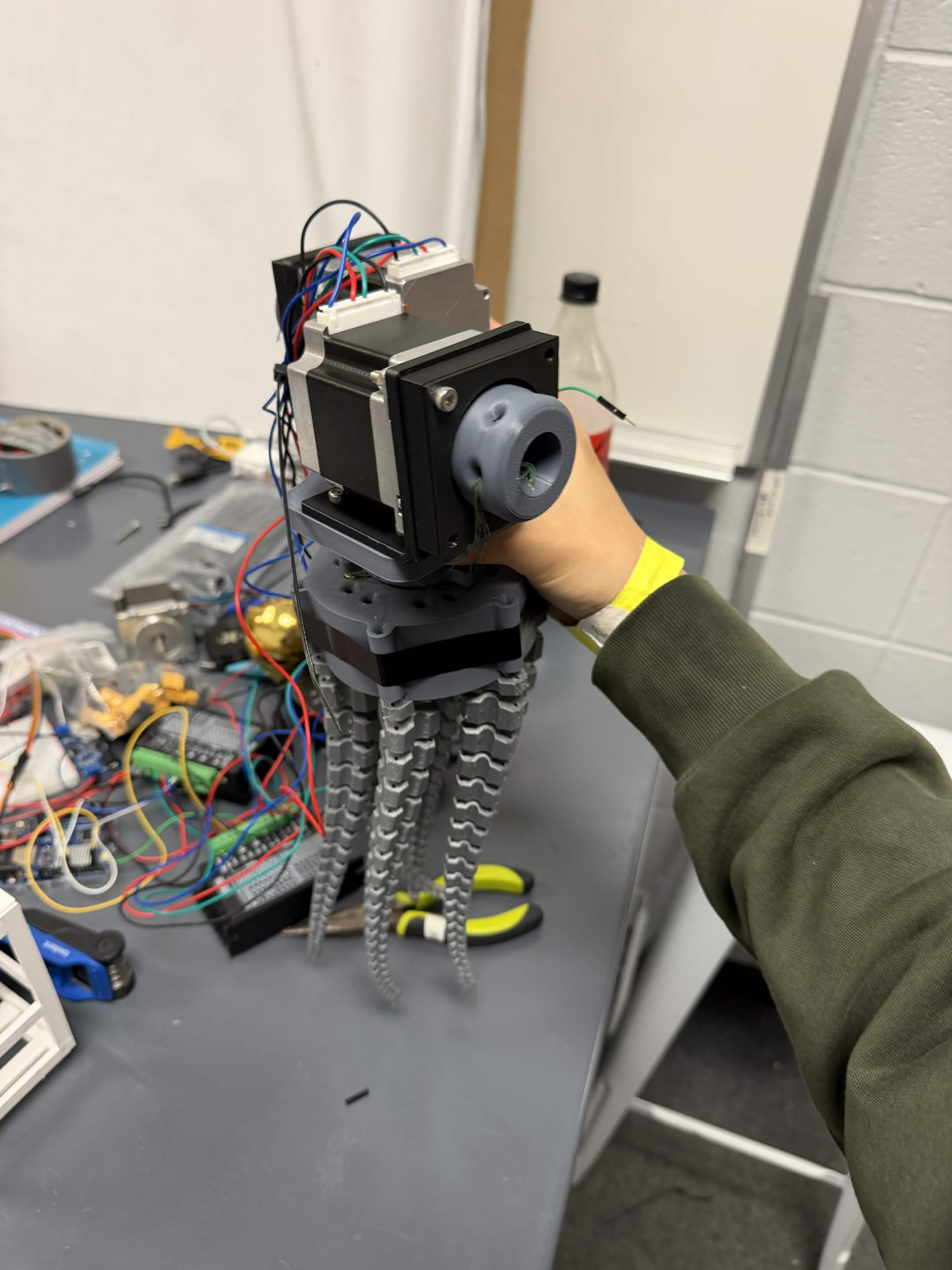
The Leviathan Space Debris Collector is an end effector (the gripper at the end of a robotic arm) built from cable-driven, logarithmic-spiral tentacles. Pulling a tentacle's cable makes it curl from tip to base and conform to whatever it touches. The gripper can wrap irregular objects without knowing their shape in advance and without per-object programming.
It also finds its own targets. A camera and a distance sensor locate an object and tell the gripper when it's in reach. OpenCV detects the object, the Gemini API identifies it, and an Arduino Uno R4 WiFi times the approach and the grab.
How we built it
Mechanical
- Modeled the full assembly in Fusion 360: tentacle mounts, motor housing, planetary gearbox and cable spools.
- 3D printed the tentacles from the open-source SpiRobs geometry, sliced in PrusaSlicer.
- Each tentacle is driven by a fishing-line cable. Pulling the cable curls the spiral, and releasing it lets the elastic spine uncurl.
- Two NEMA 23 steppers wind the cables onto spools through a 5:1 planetary gearbox we designed and printed.
Electronics and software
- An Arduino Uno R4 WiFi drives both steppers and reads the distance sensor.
- A camera streams to a laptop (or a Raspberry Pi 5) running Python. OpenCV detects and tracks the target, and the Gemini API classifies it.
- The vision side sends grab commands to the Arduino, which turns them into stepper motion and uses the distance reading to time the close.
Sizing the drivetrain We sized the gearbox with hand calcs before printing it. A tentacle isn't a rigid finger, so the motor doesn't react the load moment directly. The cable resists the moment through its offset $$e$$ from the tentacle's bending axis, and the spool (radius $$r_s$$) turns that cable tension back into torque.
Worst case: a 1.5 kg object held 150 mm out, with a safety factor of 2:
$$M = SF \cdot W \cdot r_m = 29.4\ \text{N} \times 0.150\ \text{m} = 4.41\ \text{N·m}$$
$$F_c = \frac{M}{e}, \qquad G = \frac{M}{\eta\,T_{motor}} \cdot \frac{r_s}{e}$$
Challenges we ran into
- Capstan drive vs. planetary gearbox. We started with a capstan drive because it has no backlash. Under load, though, the fishing line cut into our 3D-printed capstan drum. A capstan also needs almost zero slack and careful pretension. With limited time, we switched to a planetary gearbox, which was simpler to print and assemble reliably.
- Cable loads were the real limit. The hand calcs showed the cables carry far more force than the motor torque suggests. Spreading that load across the tentacles mattered as much as picking the motor.
Accomplishments that we're proud of
- Designed, printed and assembled a working end effector using new research within the hackathon.
- Automatic object detection worked better than we expected, and the full pipeline from camera to Gemini to stepper motion ran end to end.
- Grasped objects of clearly different shapes with the same gripper and no per-object programming.
- Sized the drivetrain from first principles instead of guessing a gear ratio.
What we learned
- Soft robotics is still an emerging field. There wasn't much to build on, so we had to work out a lot ourselves, from cable routing to how to size the motor.
- In a cable-driven gripper, spool radius trades grasp speed against the gear ratio you need. Cable tension is set by the tentacle's geometry, not by the spool.
- Material pairing matters. A thin, loaded line will cut into a soft printed surface, which is what pushed us away from the capstan.
- Designing for print tolerances from day one saves reprints later.
What's next for the Leviathan
- Test on a wider range of shapes, sizes and materials, and measure the maximum payload.
- Train the vision model on more object types.
- Revisit the capstan with a harder drum (a metal sleeve or insert) to get zero backlash back.
- Close the loop on the grasp using sensor feedback, not a timed close.
Built With
- arduinoide
- autodesk-fusion-360
- esp32
- geminiapi
- opencv
- picharm
- prusaslicer

