-
-
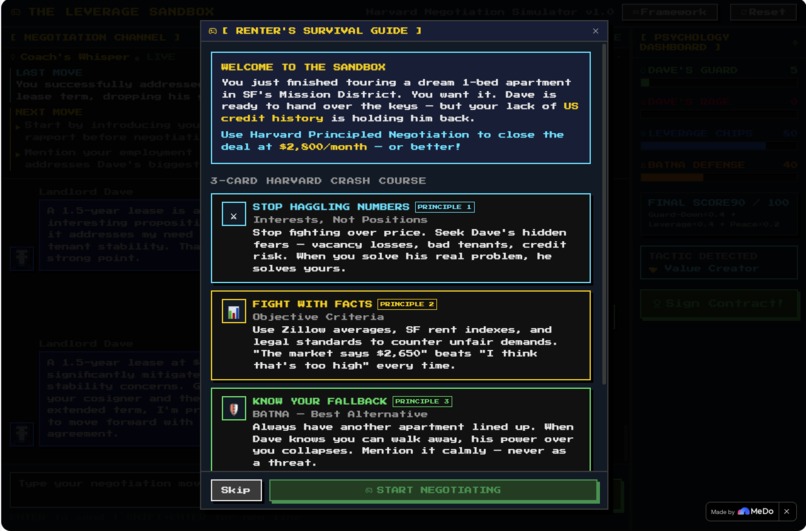
framework of the rpg game
-
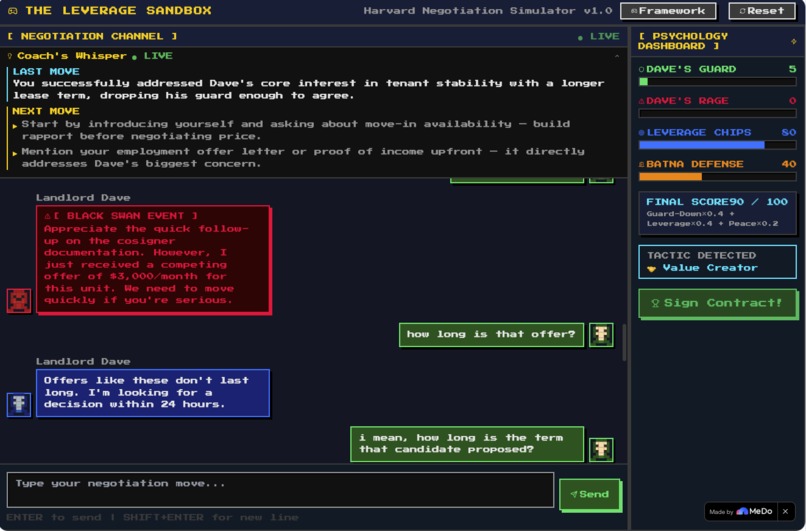
showcase of the conversations
💡 Inspiration: From an $800K Silicon Valley Blunder to a Harvard Solution
The inspiration for this project didn't come from a textbook; it came from a real-world, deeply frustrating experience I had right here in San Francisco.
As an AI researcher, tech founder, and a landlord managing co-living spaces for tech entrepreneurs in the SF Bay Area, I frequently rent vacant properties to newly arrived founders. I know firsthand how incredibly brutal it is for international professionals to navigate the SF housing market with zero US credit history.
Recently, a group of brilliant 18-year-old founders who had just raised their VC angel round approached me to rent a property. They were execution machines in computer science, but when it came to human-to-human negotiation, their strategy was a disaster. The group leader treated a high-stakes rental negotiation like aggressive haggle-marketing at a flea market—shouting demands, forcing hard price cuts, and completely ignoring my underlying operational risks as a landlord. It left such a bad taste in my mouth that I ultimately refused to lease them the space.
Reflecting on that incident, I looked back at the formal negotiation frameworks I mastered during my time studying at Harvard. I realized a glaring flaw in modern Tech Education: We are training a generation of brilliant engineers who can build complex neural networks, but who completely fail at the fundamental social protocol of deal-making. Learning negotiation isn't just an elective; it is a critical, life-or-death socialization course for survival in the real world. That is why we built The Leverage Battle—to bridge the gap between hard tech skills and real-world commercial intelligence.
🕹️ What it does
The Leverage Battle is an experiential, web-based gamified sandbox engineered specifically for active skill acquisition. It drops learners into the exact, high-stakes scenario I witnessed: an international tech expat with a blank US credit profile negotiating with a highly paranoid landlord (Landlord Dave).
Instead of reading dry PDFs, learners must actively apply Harvard Negotiation principles to survive:
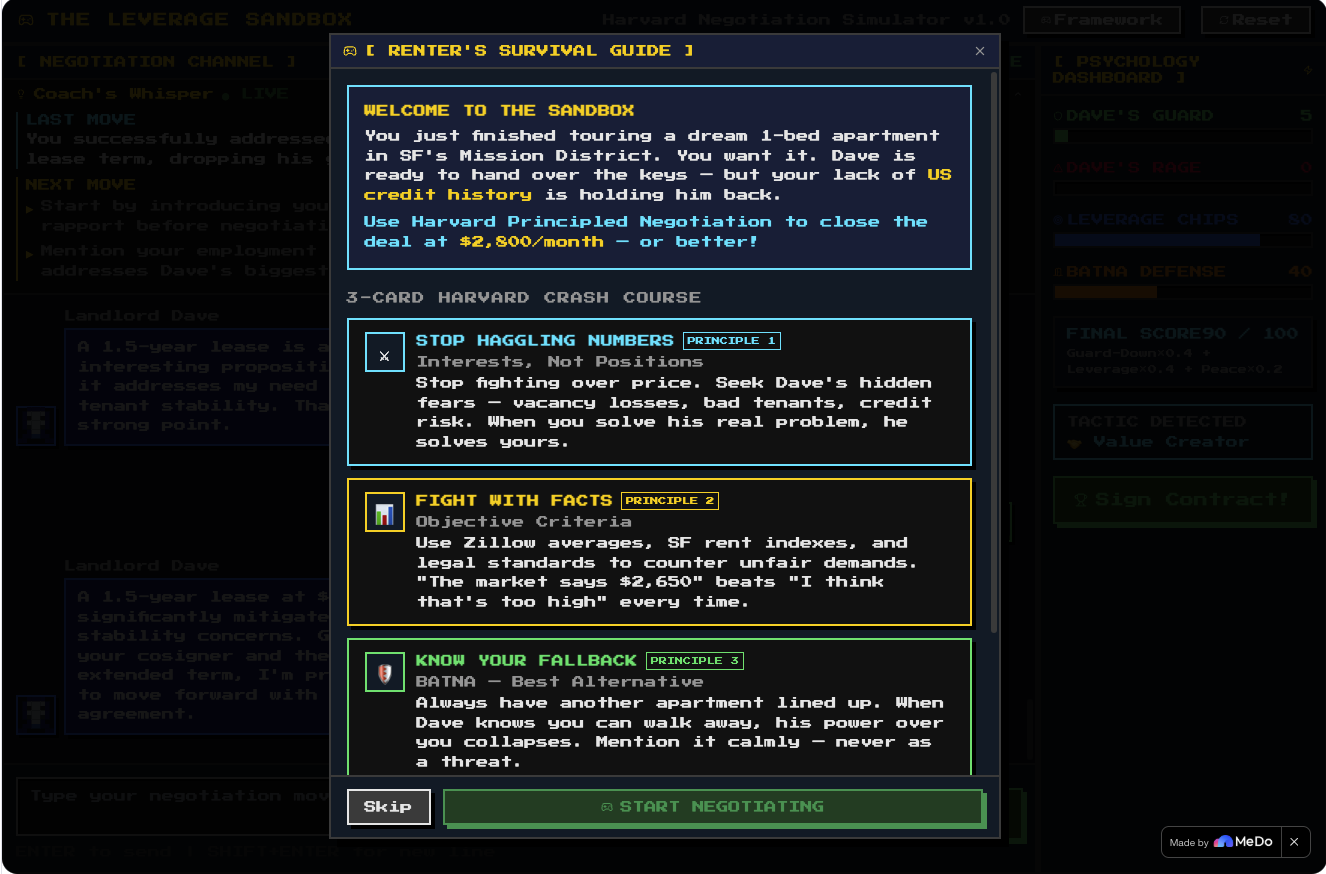
- The Onboarding Theory Gate: Before entering combat, learners undergo a mandatory 3-Card Arcade Crash Course establishing the academic baselines: Interests vs. Positions, Objective Criteria, and BATNA.
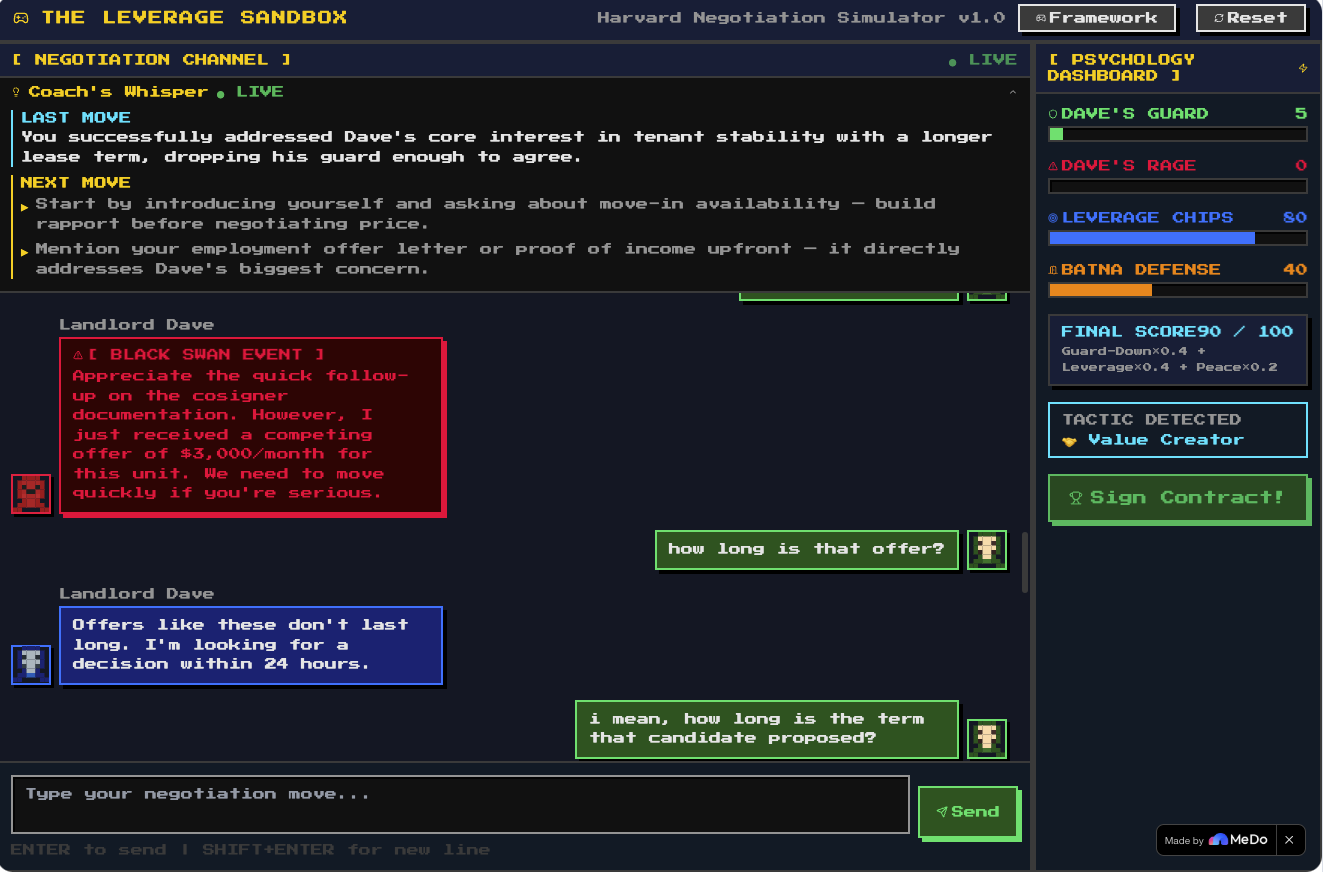
- Pedagogical Telemetry Engine: We discarded abstract text feedback and mapped core Harvard pillars onto visual cognitive gauges:
- Focus on Interests $\rightarrow$ Dave's Guard (A mental defense shield that only melts when the learner addresses underlying human needs like vacancy fears).
- Avoid Positional Deadlocks $\rightarrow$ Dave's Rage Meter (A volatile penalty bar tracking relationship decay caused by raw, unsubstantiated haggling).
- Use Objective Criteria $\rightarrow$ Leverage Chips (A rewarding physical gold stack tracking the deployment of real market data like Zillow district medians).
- The Black Swan Stress-Test: At Turn 5, standard inputs freeze, forcing a high-pressure Quick-Time Event (QTE) where a competing high-rent bidder drains the learner's leverage chips unless they instantly deploy their BATNA Defense Card.
- Post-Match Behavioral Evaluation: Generates a data-driven 2D Arcade Radar Chart analyzing the user's proficiency across 4 distinct behavioral vectors, mapped alongside an ironic social personality rank to maximize viral learning loops.
🛠️ How we built it
To deliver a zero-latency, highly pedagogical feedback loop, we engineered an edge-optimized architecture:
- Frontend Knowledge Interface: Next.js & React styled with custom retro 8-bit components and
Rechartsfor absolute precision in post-match performance mapping. - State Management Pipeline: Supabase (PostgreSQL) paired with Vercel Edge Functions to validate turn-based learning inputs and update cognitive metrics in real-time.
- LLM Middleware Alignment: Structured JSON schemas processed through a custom-built Aggressive Backend Parser Guard that extracts sanitized conversational nodes, ensuring Landlord Dave reacts realistically based on the learner's dynamic metrics.
⚡ Challenges we faced & Conquered
- The Cognitive Duplication Loop: Early iterations suffered from conversational looping where the AI landlord would repeat phrases, breaking the immersion of situational learning. We solved this by implementing a server-side
sequence_idsequencing array paired with a frontend Render-Mutex Lock. The client strictly blocks subsequent dialogue injection until the active typewriter animation finishes, ensuring pristine delivery of educational content. - Real-time Visual vs. Stateless Backend Sync: Syncing a real-time behavioral stress-test (the Black Swan chip drain) with a stateless, turn-based API backend was a major hurdle. We engineered a hybrid sync system: the frontend handles the visual countdown locally to maintain high-retention panic, then forces an absolute SQL
UPDATEstate override upon user macro-card execution.
🎓 What we learned
We proved that complex game theory and psychological modeling do not require dry, academic user interfaces. By embedding strict educational rubrics into reactive game mechanics, we achieved what traditional EdTech struggles with: immediate feedback, high cognitive retention, and genuine behavioral modification. We realized that game mechanics can teach soft skills faster than any corporate seminar.
🚀 What's next for The Leverage Battle
Expanding this situational learning engine into a comprehensive B2B EdTech SaaS platform for corporate sales onboarding, procurement training, and university business courses. We plan to introduce multi-agent generation modules allowing educators to upload localized historical negotiation case studies and automatically compile interactive arcade-style boss fights within seconds.
Built With
- llm-apis
- next.js
- postgresql
- react
- recharts
- supabase
- tailwind
- typescript
- vercel-edge-functions

Log in or sign up for Devpost to join the conversation.