-
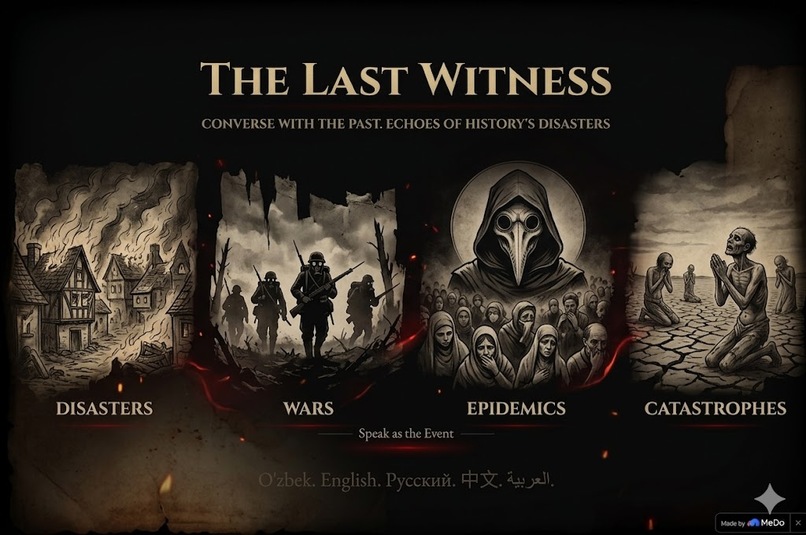
Converse with history's darkest disasters, wars, and epidemics in 5 languages. An immersive AI experience built on Medo.dev.
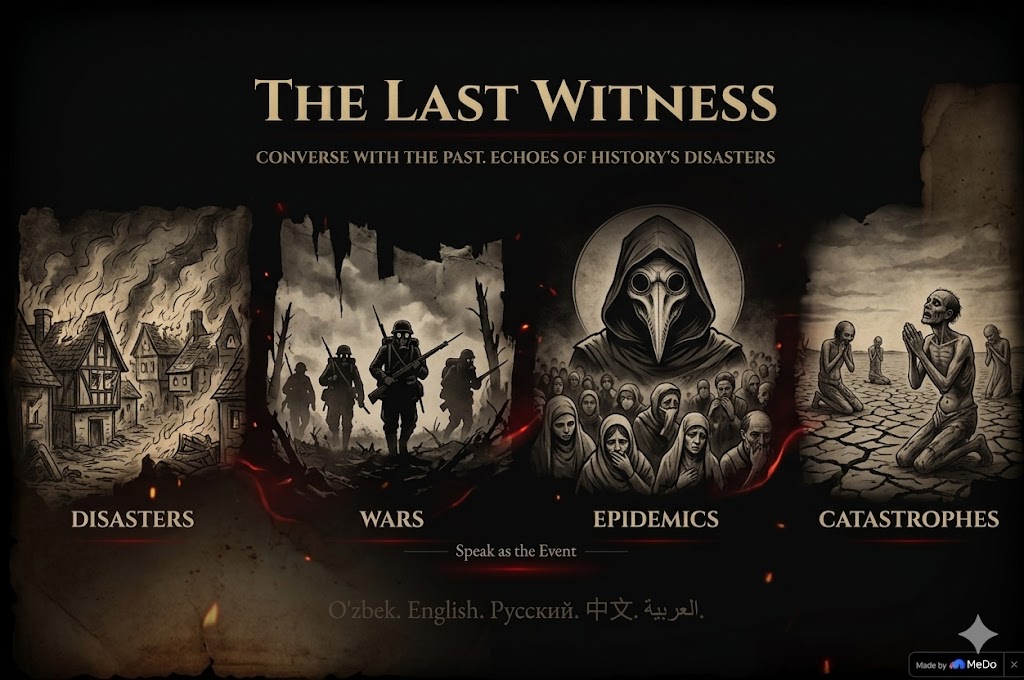
Inspiration
History is often viewed through dry statistics and distant dates. [cite_start]We felt that the true weight of historical catastrophes—the human element—was being lost[cite: 3]. [cite_start]The Last Witness was born from a desire to create a bridge between factual history and emotional immersion, allowing users to confront the past not just as observers, but as active participants in a conversation with history itself[cite: 1, 10].
What it does
[cite_start]The Last Witness is a dark, atmospheric web application developed on Medo.dev that enables users to engage in deep conversations with historical disasters[cite: 1]. [cite_start]Users select a year and explore filtered catastrophic events such as wars, epidemics, and famines sourced via Wikipedia[cite: 3, 6]. [cite_start]The core experience allows users to "Speak as the Event" or "Speak as a Witness," creating a personalized, first-person narrative in five different languages: Uzbek, Russian, English, Chinese, and Arabic[cite: 2, 8, 10].
How we built it
The application was built with a focus on atmospheric design and real-time data processing:
- [cite_start]Frontend: Designed with a "black void" aesthetic, utilizing heavy serif fonts and candlelight glow effects[cite: 10].
- [cite_start]Data Integration: We integrated a Wikipedia Plugin to dynamically fetch and filter events from specific years[cite: 6, 9].
- [cite_start]Localization: A Translator Plugin ensures the UI and all generated content are fully localized[cite: 4, 7].
- [cite_start]AI Persona: We used specialized LLM system prompts to embody either the nature of a disaster or the raw emotion of a human survivor[cite: 8, 10].
Challenges we ran into
[cite_start]One of the primary challenges was ensuring the Wikipedia filtering logic accurately isolated catastrophic events without including general historical facts[cite: 13, 14]. [cite_start]Additionally, maintaining a consistent "haunting" tone across five distinct languages required precise prompt engineering and careful UI localization[cite: 10, 15].
Accomplishments that we're proud of
[cite_start]We successfully created a seamless transition from raw historical data to an immersive, first-person storytelling experience[cite: 17, 18]. [cite_start]Achieving a consistent visual and emotional atmosphere while providing high-quality translations in multiple languages was a significant milestone for our team[cite: 4].
What we learned
Building this project taught us the power of AI in transforming educational content into emotional experiences. [cite_start]We also gained technical insights into building multi-agent personas and the complexities of real-time plugin integration for dynamic data retrieval[cite: 8, 10].
What's next for The Last Witness
We aim to expand the project by adding:
- Voice synthesis for audio interactions with witnesses.
- An interactive historical timeline for better global context.
- Integration with deeper archival databases beyond Wikipedia.
Built With
- css3-(custom-dark-theme)
- gemini-api
- medo.dev
- next.js
- react
- translator-plugin
- wikipedia-plugin

Log in or sign up for Devpost to join the conversation.