## About the Project

This project explores a simple but unsettling image:
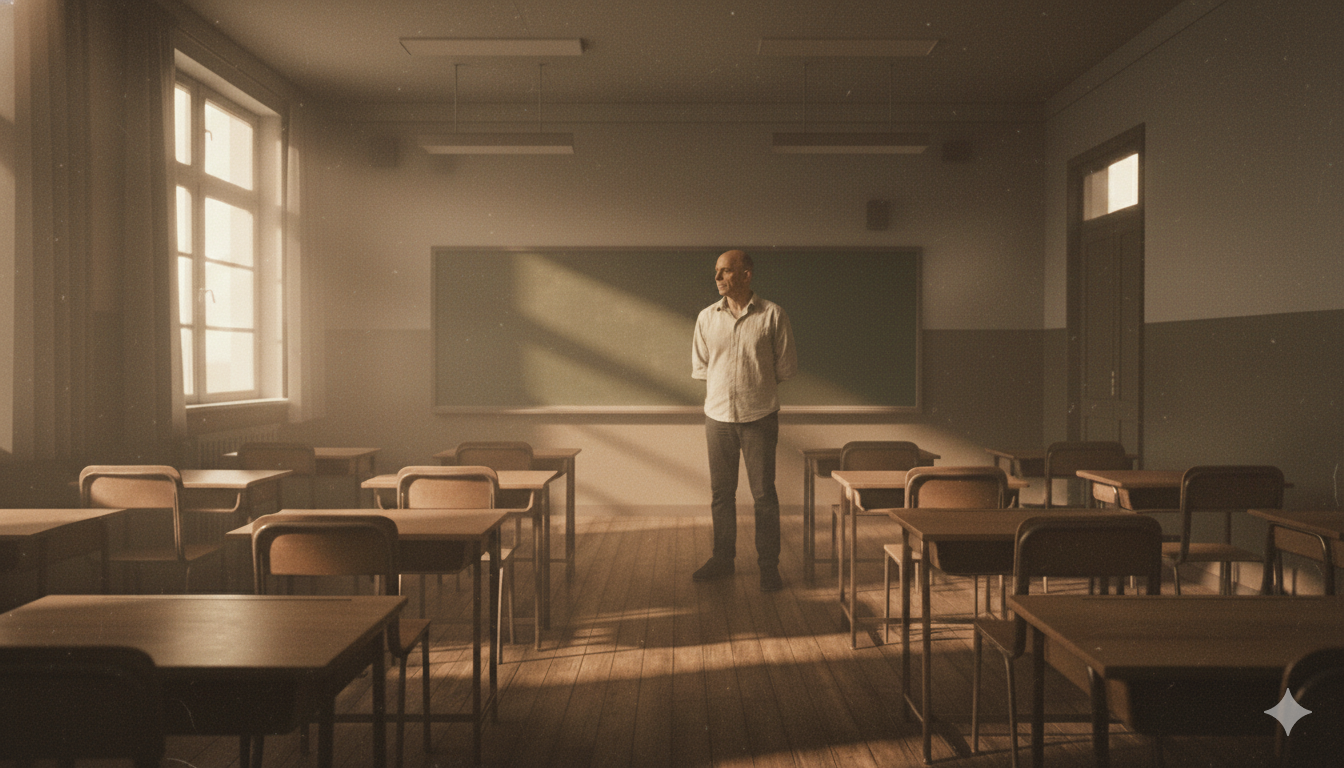
A teacher standing alone in an old classroom, with no students. Chalk dust, old desks, silence. Around this emptiness, there are quick flashes of modern technology – hints of a world that has already moved on. The film asks a direct question: **what happens to teaching when learning changes, but teachers don’t?**

It is intentionally quiet and a little sad. The teacher we see is frustrated, lonely, and emotional. That feeling is meant to touch the viewer and raise a deeper question: *is this just sad, or is it also a warning?*

---

## Inspiration

The inspiration came from my experience in education and learning technologies:

- Seeing teachers who still teach as if nothing has changed in the last 30 years.
- Noticing how students are already “somewhere else” – in digital spaces, interactive environments, and on-demand content.
- The growing gap between **traditional teaching** and **modern learning**.

At the heart of the film is a simple equation written on the board:

$$
\text{Learning} = \text{Change}
$$

If learning is change, then teaching must also change. A teacher who refuses to change is, in a way, refusing learning itself.

---

## A Film to Spark Discussion

One of the main goals of this short film is **to open a meaningful conversation**.

The sadness of the empty classroom is not there just to depress the viewer, but to provoke questions such as:

- Is this scene sad?
- Is it too harsh, or just realistic?
- What is the teacher’s place in a world of rapid technological change?
- Do we really want to stay the same as educators?
- If not, **how** do we want to change – in our role, our tools, our relationship with students?

The film is meant to be a starting point for dialogue among teachers, students, and decision-makers about the *new role* of the teacher in an evolving learning ecosystem.

---

## What I Learned

While creating the film, I learned that:

- A single strong visual metaphor (an empty classroom) can say more than many words about relevance and disconnection.
- Emotion matters: the sadness and frustration of the teacher help viewers connect personally before they start thinking conceptually.
- Technology is not the “hero” of the story – the teacher is. The film isn’t about replacing teachers, but about inviting them to evolve.

I also deepened my understanding of how to **communicate educational ideas through visual storytelling**, rather than through lectures or slides, and how to design a piece that not only delivers a message but also invites questions and discussion.

---

## How I Built the Project

I built the project in a focused, minimalistic way:

1. **Concept Development**
   I started from one core image: a teacher alone in an old classroom. From there, I defined the key beats of the story – frustration, confusion, flashes of technology, and the final message.

2. **Writing the Script & Visual Plan**
   I wrote a short, almost wordless script, where most of the narrative comes from body language, framing, and editing. I then created a visual plan (a simple storyboard and shot list) emphasizing contrast between:
   - Analog vs. digital
   - Stillness vs. motion
   - Past vs. present

3. **Designing the Technological “Flashes”**
   I planned short inserts of technology: screens, interfaces, digital learning platforms – appearing as brief “interruptions” in the old classroom reality.

4. **Production & Filming**
   I chose an old-looking classroom and filmed with a single actor (the teacher). We focused on subtle expressions: tiredness, frustration, stubbornness, and a quiet kind of sadness.

5. **Editing & Final Message**
   In the edit, I played with rhythm: slow, empty shots of the classroom contrasted with quick, sharp flashes of technology. The film ends with a zoom-in on the board, where the teacher has written:

   $$
   \text{Learning} = \text{Change}
   $$

---

## Challenges Along the Way

The main challenges were both creative and practical:

- **Simplicity vs. Clarity**
  I wanted the film to stay very simple and minimal, but still carry a clear and powerful message. Finding the right balance between subtle emotion and a direct idea was not easy.

- **Limited Resources**
  With a short time frame and limited equipment, I had to be very intentional about every shot: one location, one actor, few props – but maximum impact.

- **Representing Technology Without Overcomplicating**
  I needed to show “the future” and modern digital learning without turning the film into a tech demo. The flashes of technology had to feel like a presence, not a tutorial, and leave room for viewers to interpret and discuss.

---

## In the End

This short film is a visual warning **and** an invitation.

It suggests that if teachers don’t change their mindset, methods, and tools, they will slowly become invisible – not because they don’t care, but because students will simply stop showing up, physically or mentally.

In a world where:

$$
\text{Learning} = \text{Change}
$$

teaching that refuses to change becomes disconnected from learning itself.

The film is designed to open a meaningful conversation about the teacher’s new place:
Do we want to stay exactly the same?
If not, in what ways **do** we want to change – and how can technology become a tool that supports, rather than replaces, the human role of the teacher?

Log in or sign up for Devpost to join the conversation.