-
-
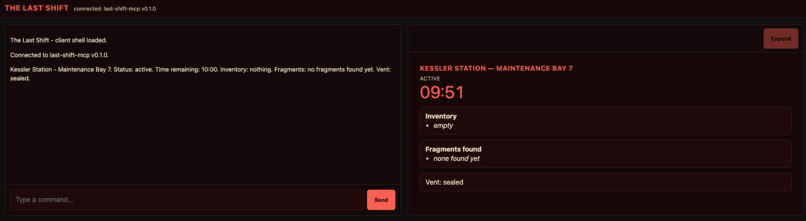
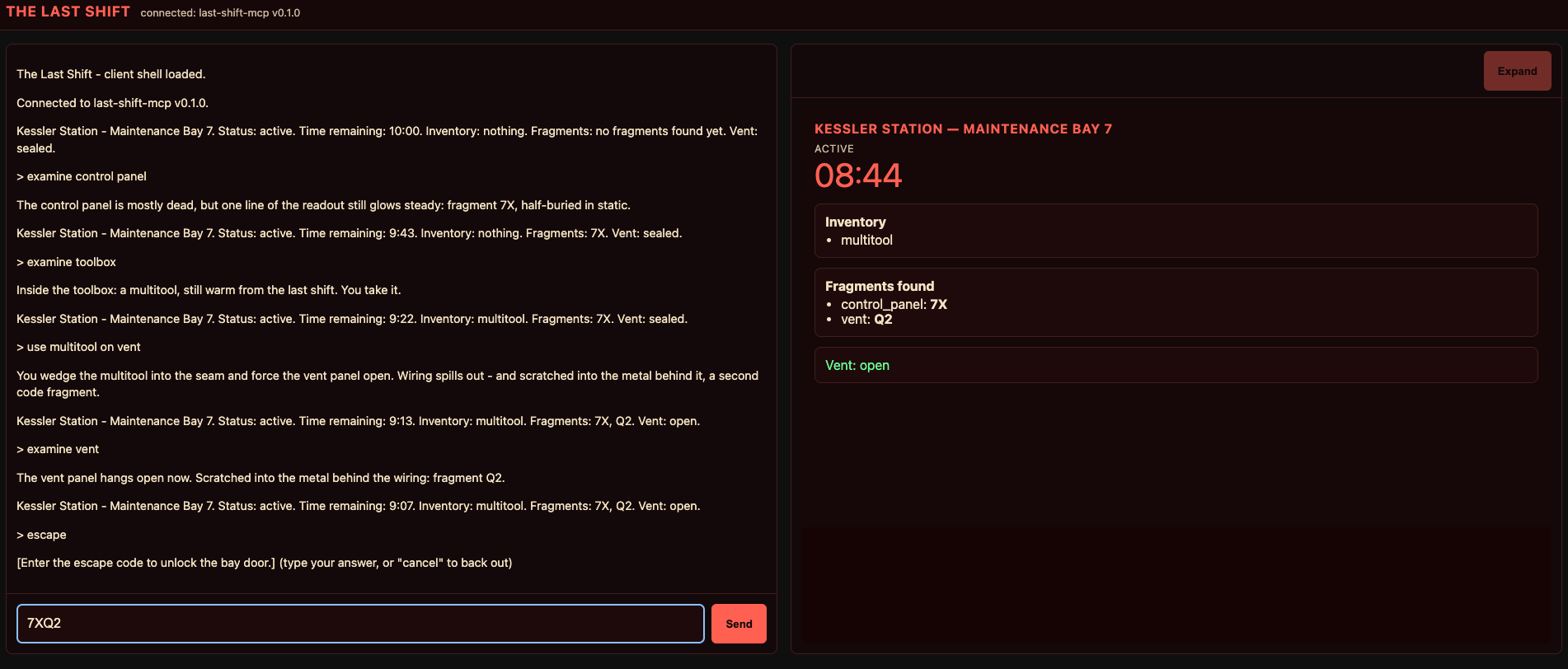
The room map: an MCP Apps view with the live 600-second countdown.
-
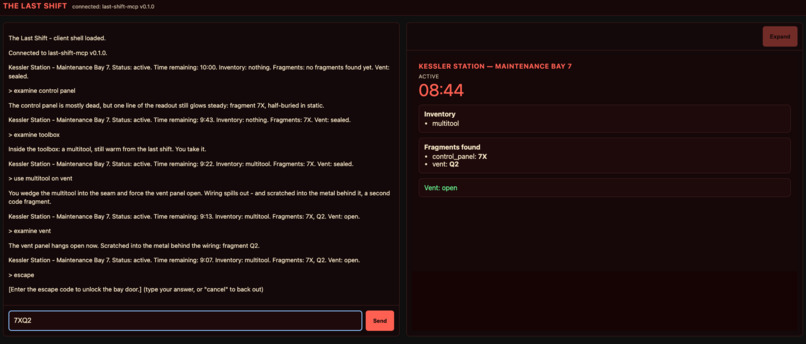
attempt_escape asks for the escape code through MCP elicitation, shown by the client as an inline prompt.
-
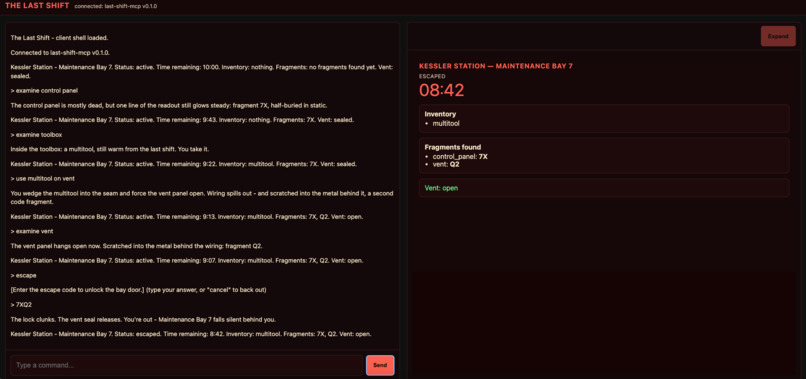
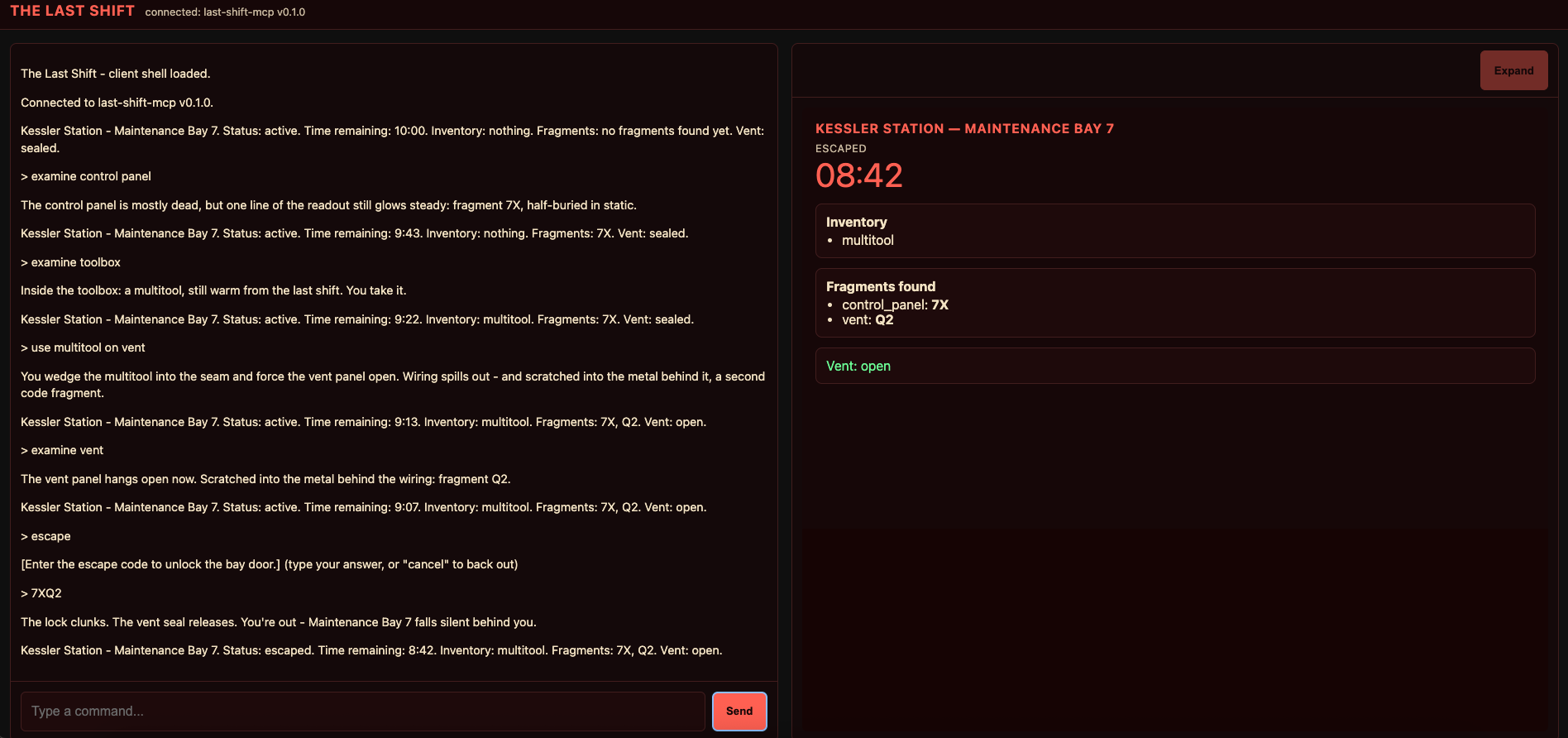
A successful escape: status ESCAPED, clock stopped at 08:42.
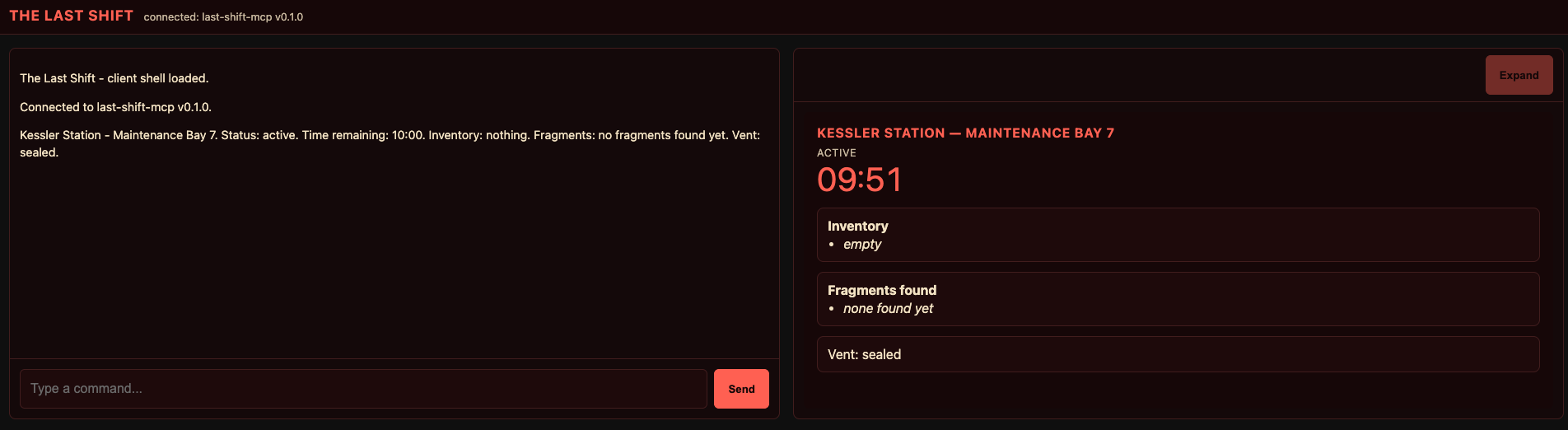
What it does
The Last Shift is a self-hosted MCP server (MCP spec 2025-11-25, Streamable HTTP) built for the Alexa+ track. It runs a time-pressured escape-room game: the player is locked in Maintenance Bay 7 on Kessler Station with a 600-second clock, and has to examine the room, find two code fragments, and escape before time runs out.
The server exposes three MCP tools (examine_room, use_item, attempt_escape) and two resources (room://state, a structured JSON view of the game; ui://room-map, an MCP Apps resource rendering a live room map with a ticking clock in a sandboxed iframe). The decisive action, attempt_escape, is gated by MCP elicitation - the server asks for the escape code as a structured input before deciding success or failure. Room narration tries MCP sampling first, and otherwise calls Amazon Bedrock directly - which is the path that actually fires for Alexa+, since, according to Amazon's documentation (mcp-toolkit-client-lifecycle.html, last updated Jul 10, 2026; checked 2026-09-17), Alexa+'s own initialize never declares sampling.
Features and functionality
- Three MCP tools, two MCP resources, one MCP elicitation flow, over a real Streamable HTTP transport (session lifecycle, Origin/CORS validation).
- An MCP Apps view (
ui://room-map) with a realui/initializehandshake and a live-updating room panel - no reload needed between tool calls. - Two narration paths: MCP sampling (for hosts that declare it) and direct Amazon Bedrock calls (the actual Alexa+ path).
- A deterministic demo mode (
DEMO_MODE=recorded) for a reproducible video, alongside a verified, working live-Bedrock path (seeexamples/). - 99/99 server tests, 5/5 client tests.
- A friction log with five confirmed, reproducible findings in upstream MCP packages (the official SDK,
@modelcontextprotocol/express, andext-apps), each separating a confirmed mechanism from a proposed fix.
Potential impact
- For developers building Alexa+ MCP add-ons: a small, complete, MIT-licensed reference that combines pieces a real add-on needs and that are hard to find working together — Streamable HTTP session handling with Origin/CORS validation, an elicitation-gated action, an MCP Apps view updated live through the host↔view channel, and a narration path that still works when the client doesn't declare
sampling(the Alexa+ case). 104 tests document the expected behavior. - For MCP SDK maintainers: five reproducible friction findings, each separating a confirmed mechanism from a concrete proposed fix (see Product Feedback and
FRICTION-LOG.md). - For Alexa+ experiences: the same pattern — short, time-boxed, stateful interactive stories with a visual panel — could be adapted for screen devices. This was not tested on real Alexa+ devices: the Alexa+ MCP Toolkit is available to select partners only.
Protocol compliance (short)
We name known gaps instead of claiming full compliance. We have not audited the base spec requirement by requirement; one MUST we know is not met: elicitation state is tied to the MCP session, not to a user identity, because the server has no authentication. Details, including the MCP Apps extension status, are in the README's "Protocol compliance" section.
Technologies used
Node.js, TypeScript, the official MCP packages (@modelcontextprotocol/core, /server, /express, /node, /ext-apps, v2), Zod, Express, the AWS SDK for JavaScript v3 (@aws-sdk/client-bedrock-runtime), Amazon Bedrock (Claude Haiku, cross-region EU inference profile), Vite + vanilla TypeScript on the client, the MCP Inspector (open-source, @modelcontextprotocol/inspector) as a verification tool during development.
Developed with Claude Code (Anthropic's AI coding assistant) as a pair-programming tool; it appears as a co-author in the commit history.
Data used
No external or personal data. All game content (the station, the room, the puzzle) is original and self-contained. Narration text is either a pre-written fixture (DEMO_MODE=recorded) or generated live by Amazon Bedrock from a fixed prompt template describing the room - no user data is collected or stored beyond in-memory, per-session game state (inventory, discovered fragments, the countdown).
Challenges we ran into
- Alexa+ clients don't declare
sampling, so narration had to work without it: we added a direct Amazon Bedrock path and verified it live, including a deliberate failure case that falls back cleanly. - Origin validation and CORS for a real browser client weren't covered out of the box by the MCP packages we used; we wrote small middlewares and logged each gap (five friction-log entries).
- Our first MCP Apps view skipped the
ui/initializehandshake, which made a required host notification impossible to send. We found this by reading the extension spec and rebuilt the view around the full handshake. - Keeping claims honest: we name the requirements we don't meet instead of claiming full compliance.
What's next
- Authentication (OAuth 2.1), which would also let game state be bound to a user identity and close the known elicitation gap.
- SSE resumability (priming events) for unstable connections.
- A fullscreen control and an accessibility pass on the room panel.
- Filing the five friction findings upstream as issues or pull requests.
Built during the hackathon window
All code was written within the submission period (the repo's first commit is 2026-09-13, confirmed via git log --reverse; the Submission Period runs from August 31, 2026, 10:15 am PT to October 23, 2026, 12:00 pm PT per the Official Rules). No code predates the hackathon or was carried over from an earlier project.
Built With
- amazon-bedrock
- amazon-web-services
- claude-code
- express.js
- mcp
- mcp-apps
- model-context-protocol
- node.js
- streamable-http
- typescript
- vite
- zod

Log in or sign up for Devpost to join the conversation.