Inspiration
The main inspiration was The Last Stand, especially the contrast between surviving zombie attacks at night and then deciding how to spend a limited number of daytime hours preparing for the next attack.
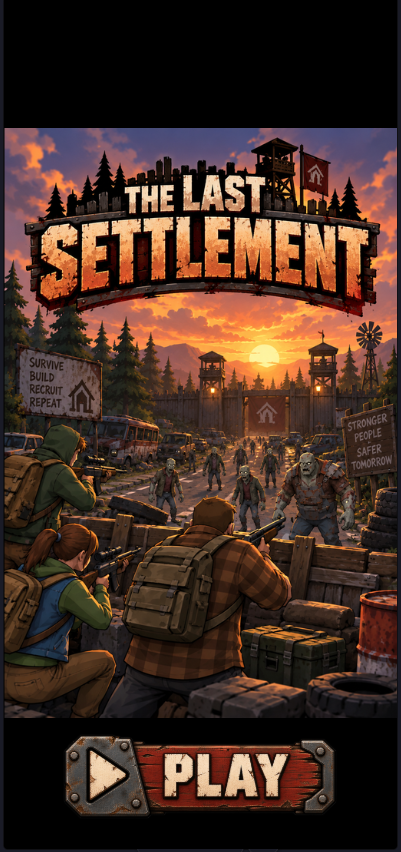
For The Last Settlement, I wanted to combine that survival loop with a stronger tower defense structure. Instead of placing traditional turrets, the player finds survivors, equips them with weapons, and positions them behind barricades along a road leading to the settlement.
The goal was to make every daytime decision directly affect the next night. Searching for another survivor, finding a better weapon, repairing a damaged barricade, or spending time scavenging supplies should all feel like meaningful tradeoffs.
What it does
The Last Settlement is a single-player, portrait-oriented 3D tower defense prototype built around a repeating night and day cycle.
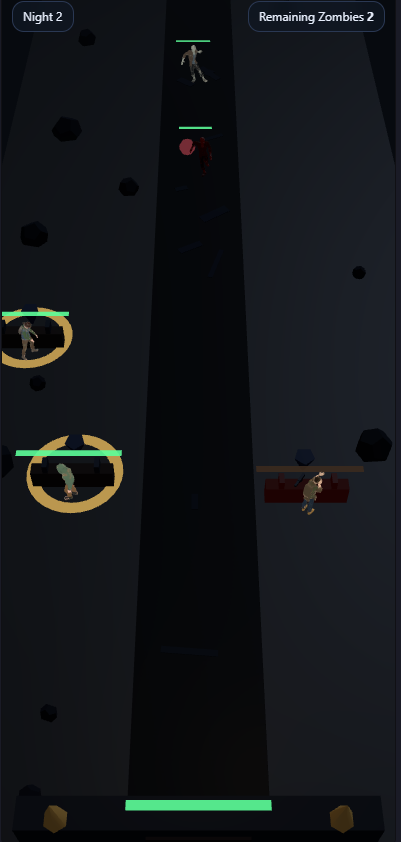
At night, zombies travel down the main road toward the settlement while survivors act as the player's defensive towers. Survivors can be positioned at barricades along the road and automatically attack enemies within range.
Some zombies continue toward the settlement, while others can break away from the road and attack survivor barricades directly. This creates pressure on individual defensive positions and gives the player a reason to maintain and protect each survivor instead of simply collecting more units.
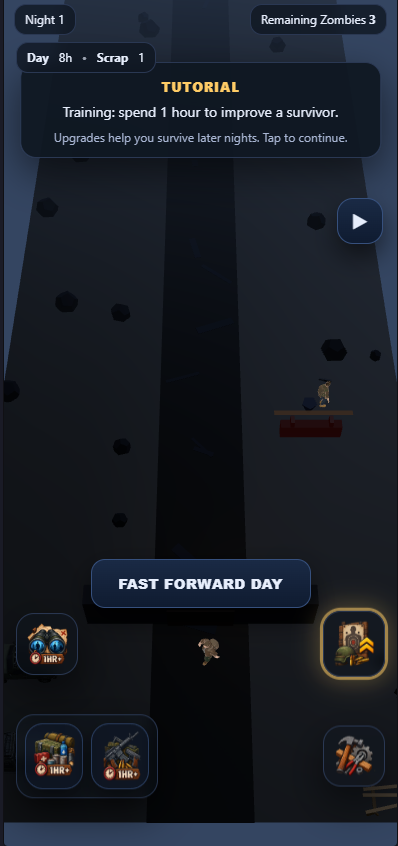
The game begins with a small tutorial night using one survivor and only a few zombies. After surviving, the player enters the daytime preparation phase with 12 hours to spend.
During the day, the player can:
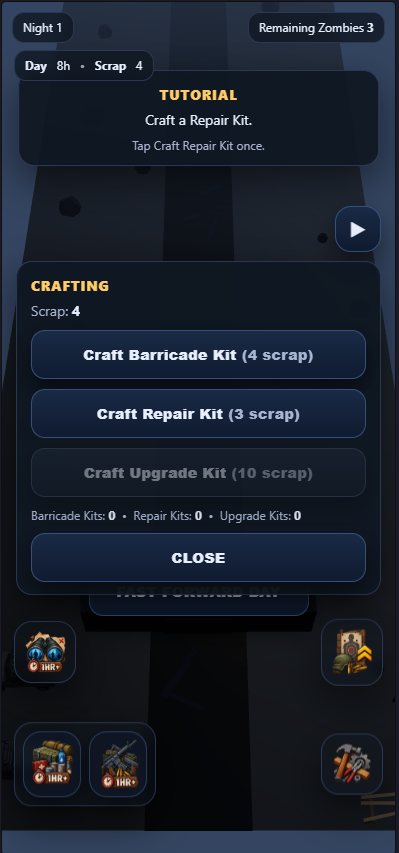
Search for Survivors Search for Weapons Scavenge for Supplies Repair Defenses Train Survivors Craft equipment and support items without consuming time
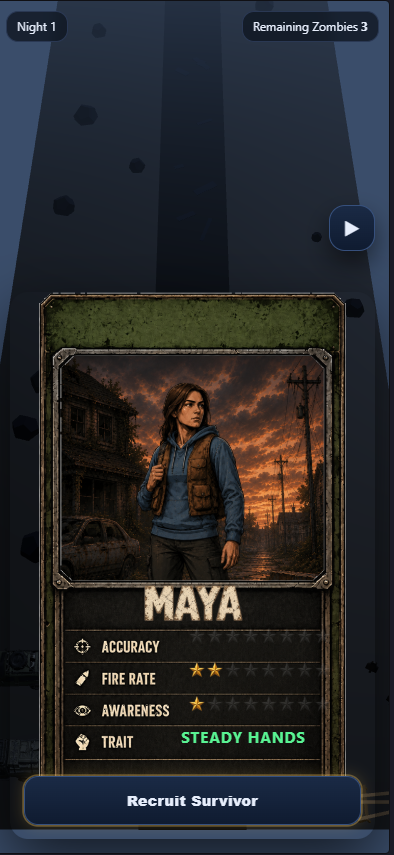
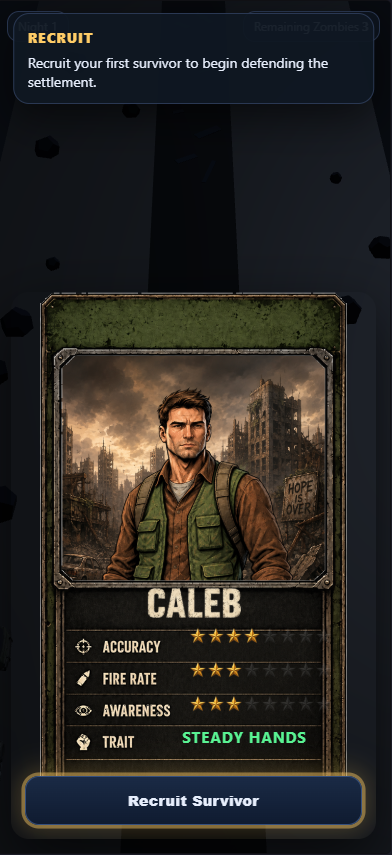
Survivors have different attributes and traits, so finding a new survivor is more than simply adding another tower. Weapons can be found directly, while scavenged supplies support crafting and future systems such as traps and stronger defenses.
The loop then repeats as nights become more difficult and new zombie types appear.
How we built it
The prototype was built with AI-assisted development in Devin / Windsurf using Three.js and HTML5.
The game was designed from the beginning around the competition requirements:
Single-player Portrait orientation Fully offline No external network requests Local Three.js libraries and assets Readable, unminified game code in index.html
The 3D world, zombie waves, survivors, barricades, weapons, crafting, daytime actions, and UI systems were developed iteratively through prompts and testing.
I used mobile-friendly drag interactions for placing barricades, assigning survivors, equipping guns, and applying repair or upgrade kits.
The final prototype uses custom 3D survivor, zombie, and environment assets along with a UI designed specifically for touch controls and portrait screens.
Challenges we ran into
One of the biggest challenges was making a 3D tower defense game feel readable and controllable on a phone in portrait orientation.
The battlefield needed to show the road, survivor positions, barricades, zombies, and settlement while still leaving room for touch-friendly UI.
I also spent a lot of time improving mobile drag controls. Survivor placement, barricade placement, equipment, and repair items all needed to work reliably without accidentally moving the camera or triggering other UI.
Another challenge was balancing the two halves of the game. The night needed to feel active and dangerous, while the daytime preparation had to stay simple enough that the player could make quick decisions without getting buried in menus.
Enemy behavior also became more complex over time. Basic zombies follow the road, tougher enemies can pressure barricades, Brutes increase the threat to defensive positions, and Witches attack from range and can summon additional enemies.
Accomplishments that we're proud of
The biggest accomplishment is creating a complete loop where the day and night systems actually depend on each other.
Damage taken at night creates problems the player must solve during the day. The player may need to repair a barricade, search for a new survivor, find a stronger weapon, or spend time gathering supplies for crafting.
I’m also proud of the idea that survivors are the towers. Each survivor can have different stats, traits, weapons, and defensive positions, making them feel more personal than traditional tower defense units.
The barricade system also helps keep survivor recruitment meaningful. A survivor can be put at risk if their position is overwhelmed, which means the player has to protect the people they have already invested in.
The prototype also includes multiple enemy behaviors, weapon equipment, survivor recruitment, crafting, repairs, upgrades, and a complete mobile-friendly preparation phase.
What we learned
One of the biggest lessons was that a good tower defense prototype does not need a large number of systems if the main systems interact with each other.
Survivors, weapons, barricades, daytime hours, and zombie behavior all became more interesting once they were connected.
I also learned how important it is to introduce mechanics gradually. Starting the game at night with one survivor and a few zombies made it much easier to teach the player the core combat before introducing the full daytime management system.
Mobile development also showed us that interaction design is just as important as the underlying game mechanics. Large touch areas, clear drag feedback, camera placement, and UI spacing made a major difference in how playable the prototype felt.
What's next for The Last Settlement
The next step would be expanding the world beyond a single settlement.
The player would eventually be able to move the settlement to different locations on a larger physical map. Each location could offer different advantages and risks, such as:
More weapons More supplies Higher chances of finding survivors Easy, medium, or hard zombie pressure
Scavenging would also expand beyond weapon parts into additional materials such as wood, screws, and other resources used to build traps and improve defenses.
The weapon system could grow into a larger crafting and equipment system, while survivor traits and perks could create more specialized defensive roles.
The long-term vision is a tower defense survival game where the player is not only defending a settlement, but gradually building, moving, and protecting a growing community across a dangerous zombie-filled world.
Built With
- chatgpt
- devin
- meshy


Log in or sign up for Devpost to join the conversation.