Inspiration
The Last Planet was inspired by the idea of making survival games feel alive, emotional, and reactive instead of purely mechanical.
Most survival and simulation games focus on building structures or optimizing resources, but rarely make players feel like they are shaping something truly living.
The game takes inspiration from ecosystem simulations, evolution systems, and mobile-friendly strategy games, but reimagines them through a single emotional lens: growth under pressure.
What it does
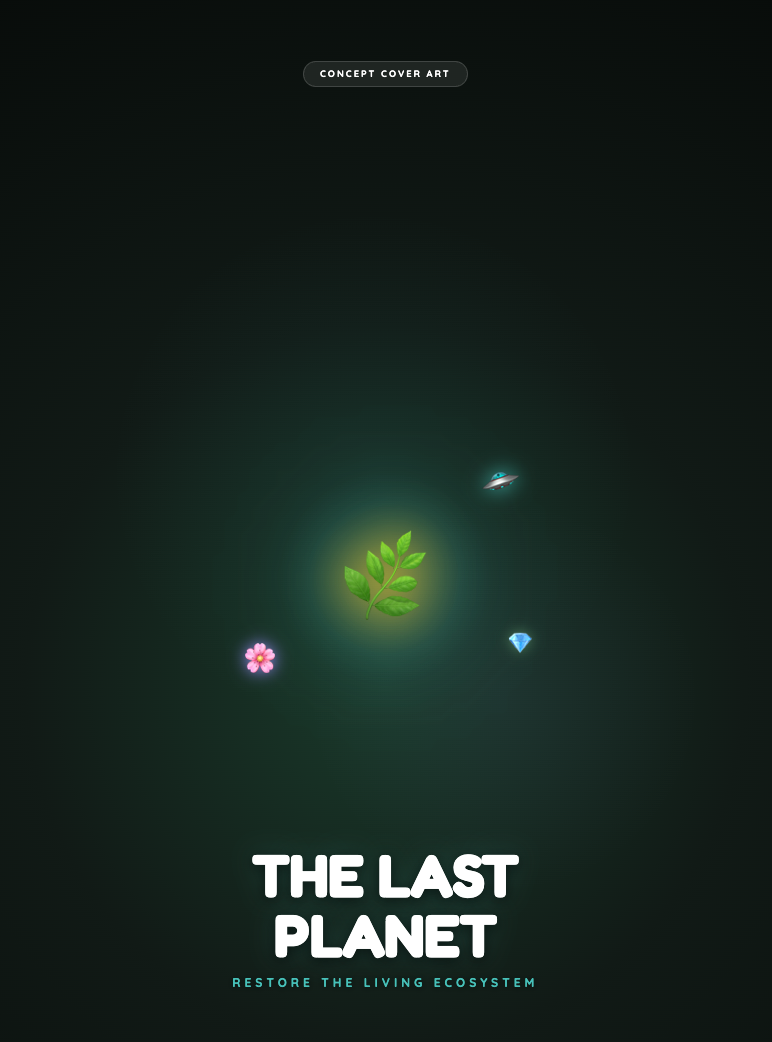
The Last Planet is a mobile survival and resource management game where players restore life on a dying alien world by evolving a living ecosystem.
The player begins with a single Life Core and limited resources. From there, they explore the planet, collect genetic materials, and evolve organisms that adapt to their choices.
Every decision shapes the ecosystem.
Plants may produce oxygen but consume energy Creatures may protect life but require rare resources Fast growth may destabilize the environment
Instead of building structures, the player builds life.
The world reacts dynamically to every choice, creating an evolving ecosystem that feels unique to each player.
How we built it
The game is designed as a modular simulation system centered around four core mechanics:
Exploration system (drone-based resource discovery) Resource management (Energy, Biomass, Genetic Material) Evolution system (trait combination mechanics) Event system (dynamic environmental survival challenges)
The experience is structured around a simple gameplay loop:
Explore → Collect → Evolve → Survive → Expand
All systems are designed for mobile-first interaction, focusing on short sessions (5–10 minutes) while maintaining long-term progression through persistent ecosystem evolution.
Challenges we ran into
The biggest challenge was balancing complexity with clarity.
Early versions of the design had too many systems interacting at once, which made the experience difficult to understand quickly. We had to simplify the core loop into a single readable action chain:
Send → Collect → Evolve → React
Another challenge was ensuring the evolution system felt meaningful without becoming overly complex or algorithm-heavy. The solution was to focus on clear trait combinations with visible outcomes, rather than abstract simulation depth.
Accomplishments that we're proud of
I'm most proud of creating a system where:
- Every player’s ecosystem becomes different
- Every decision has visible consequences
- The game evolves based on player behavior
- Complex systems remain understandable at a glance
I also successfully designed a full first-15-minute experience that clearly communicates onboarding, progression, and emotional payoff within a short mobile session.
What we learned
This project taught us how important clarity is in game design.
A strong idea is not enough — it must be:
- instantly readable
- visually consistent
- mechanically simple at the surface
- emotionally meaningful in execution
I also learned how progression systems are not just about content, but about pacing complexity over time in a way players can naturally absorb.
What's next for The Last Planet
Future development would expand the ecosystem into a larger simulation world with:
Multiple planet environments (frozen, volcanic, oceanic worlds) Advanced creature behaviors and relationships Deeper genetic evolution systems Shared global ecosystem events
The long-term vision is a universe where every player’s planet becomes a unique living system shaped entirely by their decisions.
Built With
- docs


Log in or sign up for Devpost to join the conversation.