Inspiration
What if your dream job depended on your ability to escape another world?
As computer science students, we're familiar with the pressure of technical interviews, coding challenges, and the constant pursuit of becoming better programmers. We wanted to transform that pressure into something more exciting: a fantasy adventure where your programming skills determine your fate.
Inspired by our love for gaming, storytelling, and computer science, we created The Last Commit, an immersive experience that combines coding challenges, artificial intelligence, and an enchanted world.
Our goal was simple: make practicing programming feel less like studying and more like an adventure worth surviving.
What it does
Welcome to Knight Hacks, a world you were never meant to enter.
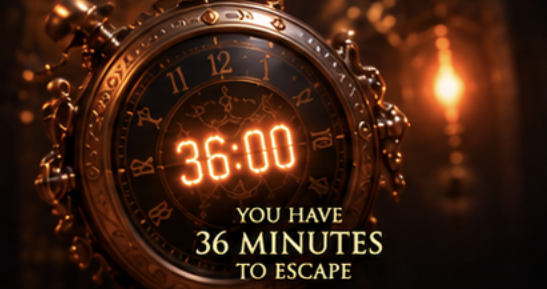
You awaken in a mysterious amber-crimson forest, surrounded by ancient ruins and an unfamiliar world. You have just 36 minutes to find your way home or become part of this world forever.
Fortunately, you're not entirely alone.
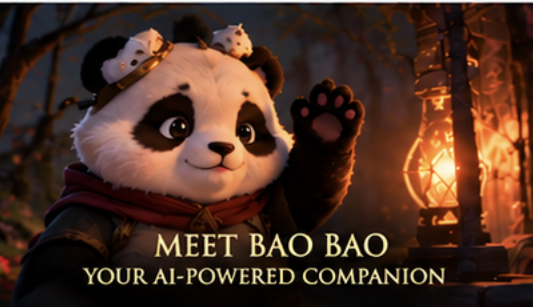
Meet Bao Bao, a friendly, AI-powered panda who becomes your companion throughout your journey. With the wisdom passed down through Grand Bao Bao's book, Bao Bao is ready to offer guidance when you need it most.
Deep within the ruins stand four broken pillars, each inscribed with mysterious ancient text. As an otherworldly computer scientist, you discover that these inscriptions conceal programming challenges.
Interacting with a pillar opens an in-game coding editor, where players must complete partially written programs, execute their solutions, and pass predefined test cases.
Each successfully completed challenge restores its broken pillar. Restore all four, and a magical portal appears, granting you passage back to your world and another chance to pursue your dream job.
But the clock never stops.
If the 36 minutes expire before you complete the trials, your journey ends, and you become one with the world of Knight Hacks.
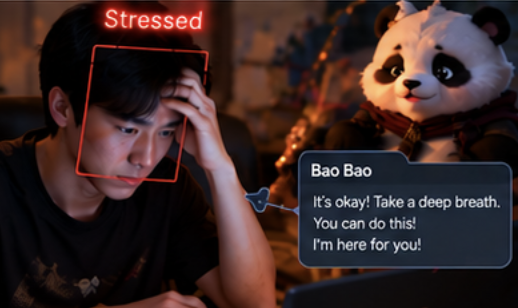
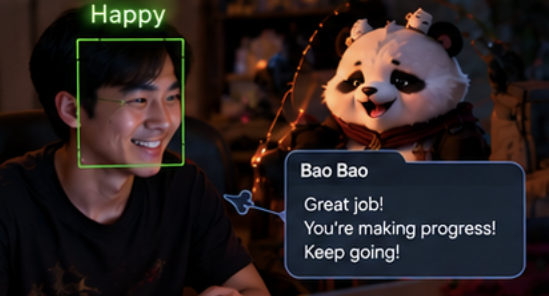
And Bao Bao does more than offer coding hints. Through facial-expression analysis, our game explores how an AI companion can recognize visible signs of difficulty and respond with encouragement, reminding players that help is always available.
The Last Commit turns algorithmic problem-solving into an immersive, time-sensitive adventure, making coding practice more interactive, engaging, and rewarding.
How we built it
We developed The Last Commit using Unity 6 as our game engine, with C# for game logic and Python for supporting functionality.
Our development process combined game development, artificial intelligence, computer vision, and 3D environment design.
Game Development & Environment
Using Unity 6 and Blender, we created an atmospheric fantasy environment featuring a crimson forest, ancient ruins, interactive pillars, and a portal that represents the player's escape.
We also used Aholo to generate high-quality 3D assets, helping us bring our fantasy world to life within the limited timeframe of the hackathon.
Interactive Programming Challenges
We implemented an in-game coding interface using HTML alongside our other development technologies. Players interact with partially completed programs, fill in missing code, execute their solutions, and receive feedback based on predefined test cases.
AI-Powered Companion
Bao Bao is powered by the OpenAI API, allowing him to assist players as they work through programming challenges.
Instead of leaving players to struggle alone, Bao Bao acts as a supportive companion who can provide hints and encouragement throughout the experience.
Facial-Expression Recognition
We incorporated MediaPipe and OpenCV to analyze players' facial expressions and explore more responsive AI interactions.
This allows Bao Bao to offer encouragement when the player's expressions suggest they may be experiencing difficulty, creating a more supportive learning environment.
Development Tools & Collaboration
Throughout development, we also used ChatGPT, Claude, Perplexity, and GitHub Copilot to support brainstorming, debugging, research, and implementation.
We collaborated using Git and GitHub to manage our Unity project, scripts, and shared assets.
Challenges we ran into
Our biggest challenge was building an entire 3D game under hackathon time constraints, especially because most of our team had never developed a game before.
We were learning unfamiliar tools and workflows while simultaneously trying to build a playable experience.
Integrating multiple technologies was another major challenge. Our project combines Unity gameplay, an interactive coding environment, AI-generated hints, and computer vision, each with its own technical requirements.
We also encountered difficulties with 3D asset compatibility, materials, shaders, and rendering in Unity. Importing assets from different sources sometimes resulted in missing textures or incompatible shaders, requiring troubleshooting and adjustments.
Version control introduced additional complexity. Large 3D assets, Unity scene files, and simultaneous contributions made GitHub collaboration more challenging than we initially expected.
Finally, designing a game that was both educational and entertaining required us to think carefully about the balance between challenge and accessibility. We wanted players to feel the urgency of the countdown without losing the enjoyment of learning.
Accomplishments that we're proud of
We're incredibly proud that we took an ambitious idea and turned it into an interactive game during a single hackathon.
For most of our team, this was our first experience developing a game, making the entire process a significant learning experience.
One of our favorite accomplishments was creating Bao Bao, an AI-powered panda companion who doesn't just provide programming hints but also encourages players through facial-expression-based interactions.
We're also proud of combining programming education with immersive fantasy gameplay. Rather than presenting coding exercises as isolated questions, we made them part of the world's progression, where every solved challenge physically restores a piece of the environment.
From the crimson forest and ancient ruins to the interactive coding editor and AI companion, each part of the project represents something new we challenged ourselves to learn and build.
Most importantly, we're proud of what we accomplished together.
What we learned
The Last Commit taught us far more than how to develop a game.
We gained hands-on experience with Unity 6, C#, Python, Blender, OpenAI API integration, MediaPipe, OpenCV, and interactive coding interfaces.
We learned how different technologies can work together to create a unified player experience, and how important it is to design around both technical functionality and user interaction.
We also learned how challenging collaborative game development can be, especially when multiple people are contributing scenes, scripts, and assets to the same project.
Beyond the technical lessons, we discovered how educational experiences can become more engaging through storytelling, visual progression, and supportive feedback.
Above all, we learned that being unfamiliar with a technology shouldn't stop us from trying to build something ambitious.
What's next for The Last Commit
We hope to continue developing The Last Commit beyond Knight Hacks.
Our next steps include expanding the variety and difficulty of programming challenges, improving Bao Bao's AI interactions, and refining how facial-expression feedback contributes to the player's experience.
We would also love to introduce additional environments, more interactive characters, and new puzzles that test different computer science concepts.
Eventually, we envision The Last Commit becoming a more complete educational adventure where players can strengthen their programming skills, prepare for technical interviews, and explore imaginative worlds along the way.
Because sometimes, the most important commit isn't the one you push to GitHub. It's the one you make to keep learning.


Log in or sign up for Devpost to join the conversation.