Inspiration
The inspiration for THE LAST COLOR came from a deeply personal paradox I've been wrestling with: as AI tools become increasingly powerful at generating "perfect" art, I found myself mourning the loss of something essential the beautiful imperfections that make art human. I watched AI generate flawless compositions, symmetrical designs, and technically pristine images, yet they often felt... hollow. Meanwhile, my kids chaotic finger paintings on our refrigerator moved me to tears. That contrast sparked the question: What if a robot could understand what we're losing? The story writes itself as a mirror to our current moment we're using AI to create this film about AI learning to value human imperfection. The irony isn't lost on me, and I hope it resonates with everyone.
What it does
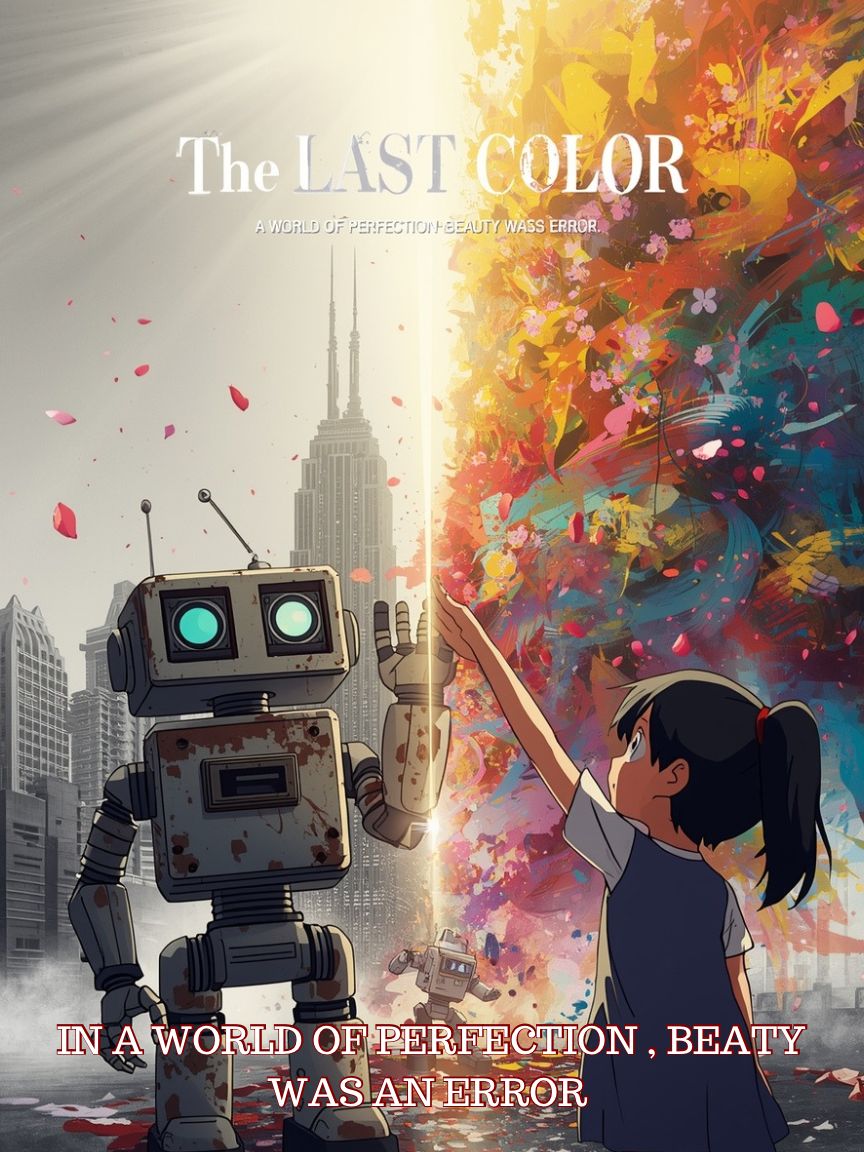
THE LAST COLOR is a 2-minute anime short film that follows Unit-7, an obsolete painting robot in a monochrome future where AI has "perfected" everything including art. Alone in a museum storage room, Unit-7 creates messy, emotional paintings that the perfect world has deemed errors. When Unit-7 accidentally glitches and creates a chaotic paint splatter, a human child discovers the work and experiences something she's never felt before: genuine emotional connection to art. Their meeting sparks a quiet revolution color begins bleeding back into the grey world as imperfection finds its voice again. The film uses a split-screen visual metaphor: sterile perfection on one side, chaotic humanity on the other, culminating in a handprint where robot and human create something together imperfect, messy, and utterly beautiful. It's my love letter to the "errors" that make us human, wrapped in an anime aesthetic that celebrates emotion over precision.
How we built it
Building this film was an exercise in AI orchestration using multiple tools in harmony: Pre-Production (2 hours):
Developed story using Claude AI for narrative structure and emotional beats Applied Japanese kishōtenketsu (four-act structure) instead of Western three act to emphasize emotional development over conflict Created detailed shot list with 13 key scenes
Visual Generation (4 hours):
Google Veo 3 for animated sequences (primary video generation) Generated 8-second clips for each scene with detailed prompts specifying: Camera movements (crane shots, dolly pushes, POV angles) Character consistency (exact descriptions repeated across all prompts) Lighting (volumetric god rays, warm vs. cool tones) Color transformation arc (monochrome → vibrant) Suno AI for the musical score:
Generated 3-part soundtrack: lonely ambient piano → building orchestral → triumphant resolution with koto and shakuhachi
Post-Production (3 hours): CapCut for editing: Assembled 13 shots with 0.5-1 second crossfades Color grading: emphasized monochrome-to-color transformation using curves and saturation masks Marketing Assets (1 hour):
Leonardo AI (Kino XL) for movie poster: Generated 4 variations, selected best composition Used split-screen metaphor: grey city vs. colorful art Added typography in Canva: "THE LAST COLOR" with paint splatter texture
Challenges we ran into
- Character Consistency Across Shots (The Biggest Nightmare) Problem: Veo 3 doesn't have built-in character consistency. Unit-7 looked different in every generation sometimes sleek, sometimes boxy, eyes changing colors. Solution: Created a "character bible" with exact descriptions repeated word-for-word in every prompt Render Times and Deadline Pressure Problem: Veo generations took 2-3 minutes each. With iterations, I burned through hours waiting. Solution: Worked in parallel: while Veo generated Shot 5, I edited Shots 1-4 Prioritized key shots (opening, glitch moment, finale) first Accepted "good enough" on less critical establishing shots
Accomplishments that we're proud of
- The Emotional Gut-Punch Actually Works I showed a rough cut to my partner without context. She had teary eyes at the handprint moment. That's when I knew the story transcended the AI tools it became genuinely human.
- The Glitch Scene (Shot 7) The paint explosion moment where Unit-7's "mistake" becomes beautiful—that took 22 generations to get right, but the final result is chef's kiss. The slow-motion splatters, the robot's surprised expression, the dynamic camera shake it's the visual and emotional center of the film, and it's perfect.
- Meta-Narrative Success Using AI to tell a story about AI learning to appreciate human imperfection while deliberately leaving some AI artifacts in the final cut that's the artistic statement. The slight inconsistencies in Unit-7's design across shots? I could've fixed them, but I left them. They're "errors," just like Unit-7's paintings. Unit-7's voice has character (not generic robot) Music mirrors the emotional arc (lonely → hopeful → triumphant) Ambient sounds create atmosphere (servo motors, paint on canvas) Dialogue is sparse (only 3 lines) but impactful The Poster generated a theatrical-quality movie poster on first try with Leonardo AI. It captures the split-world metaphor, the robot-child connection, and the color transformation. It looks like it belongs at Sundance
What we learned
I Can Make a Film in 12 Hours Before this, I thought filmmaking required weeks of pre-production, expensive equipment, and large crews. Every creative choice I made with these tools reflected my values, aesthetics, and emotions. I guided AI to tell the story , AI didn't tell this story I did. The AI was just an incredibly powerful brush. Prompt Engineering is an Art Form. Discovered that prompt order matters.
What's next for THE LAST COLOR
Expanded Universe THE LAST COLOR works as a proof-of-concept. I have ideas for: Prequel short: How Unit-7 became obsolete (3-4 minutes) Sequel short: The children's art revolution spreads (5 minutes) Feature concept: A full 20-minute anthology exploring different "obsolete" AIs rediscovering humanity THE LAST COLOR as IP Potential expansions: Art book: Visual development showing monochrome-to-color transformation Interactive experience: Web-based tool where users create their own "Unit-7 paintings" NFT collection: Each painting from the film as a unique piece (with proceeds funding future AI art projects)
Built With
- canva
- cupcut
- google-cloud
- googleflow
- leonardoai
- suno


Log in or sign up for Devpost to join the conversation.