Inspiration
I decided to build something a little different: a fully playable sci-fi adventure game running on a real BBS engine. The engine was first written for an ESP32-S3 USB stick and later ported to Linux, so underneath the story and graphics there is an actual bulletin board system with message bases, file areas, door games, node chat and logins.
The idea was to resurrect BBS technology and see if it still works, 30 years after the heyday, and a game was the test I picked. BBS was simple and robust tech. It was made for slow phone lines, low processing power and one PC in someone's bedroom. It works in text, still it could look good. ANSI art did a lot with 16 colours and 80 columns, and a screen of it is a few kilobytes.
Why a game and not a utility? One reason was Kiro. A utility is mostly tested by checking that its functions work. A game has to work on every level at once: the story, the gameplay, the puzzles and the technical implementation. If one of them fails, the whole game fails. So I thought a game would test Kiro better, and it did force testing on all of those levels.
The game combines many of the things that have inspired me over the years: late 90s BBS culture, the demoscene, classic science fiction movies, space exploration, and adventure games from Sierra and LucasArts. And of course an AI responsible for protecting the mission at all costs, even if that means sacrificing the crew one by one. Have we heard that story before?
What it does
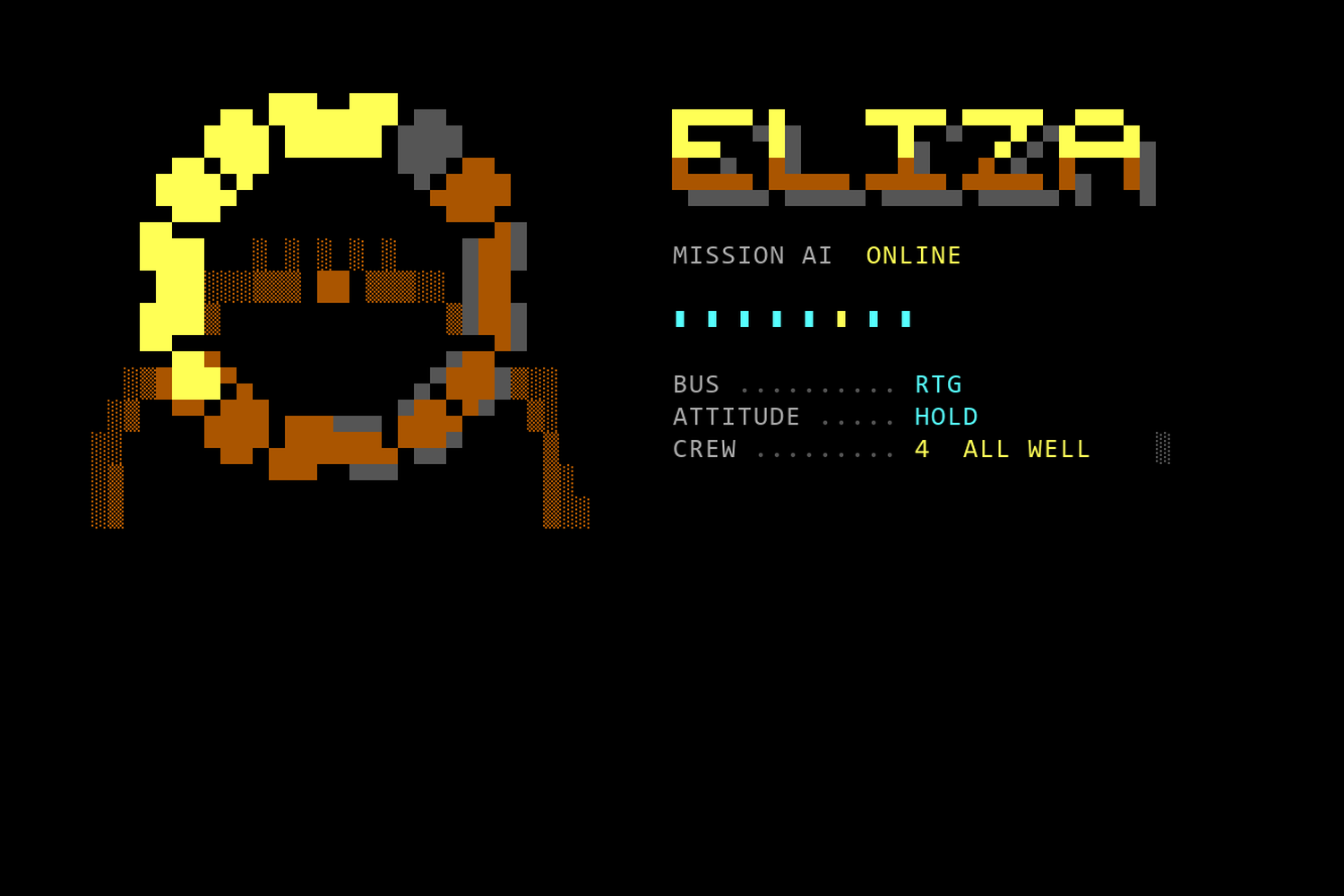
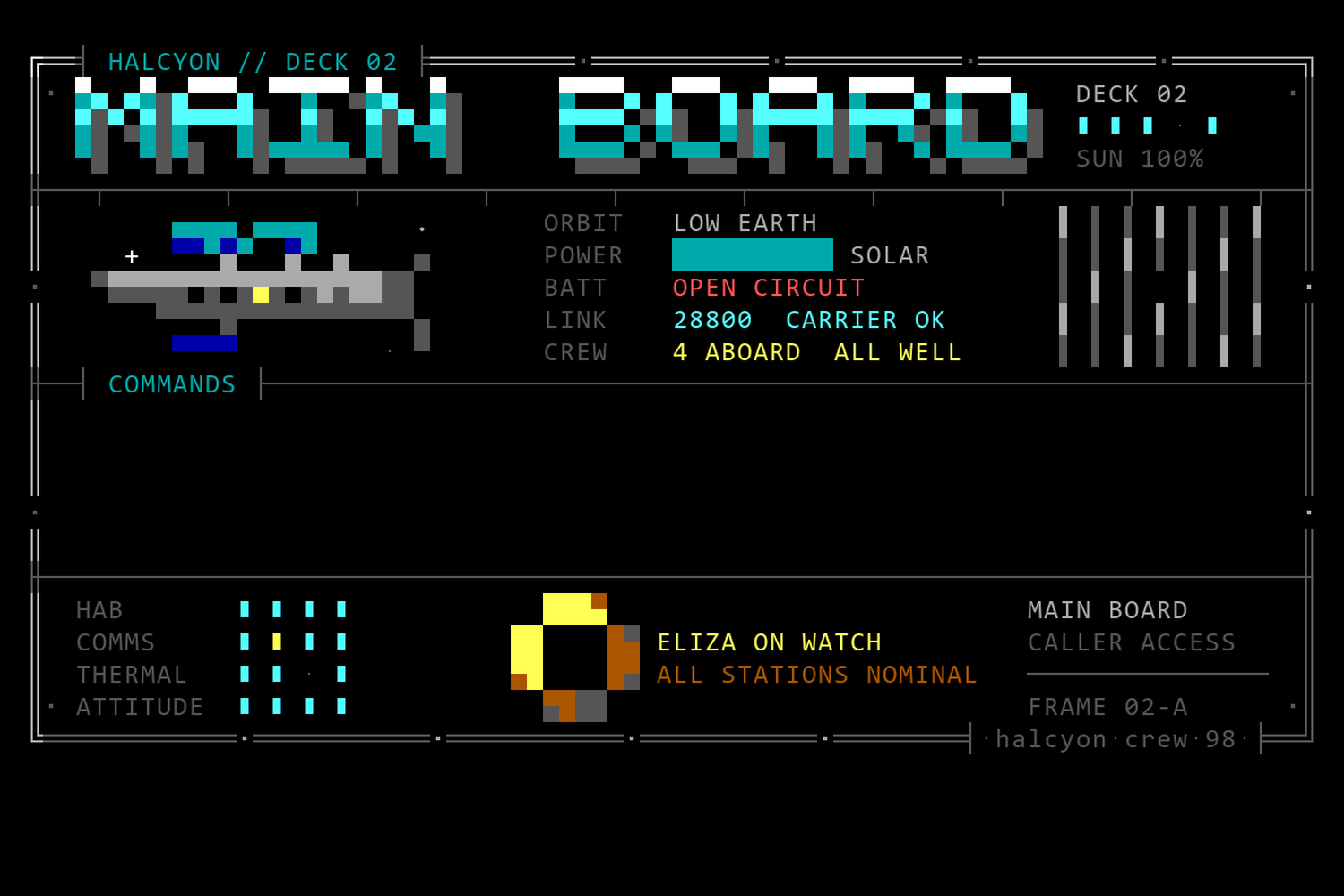
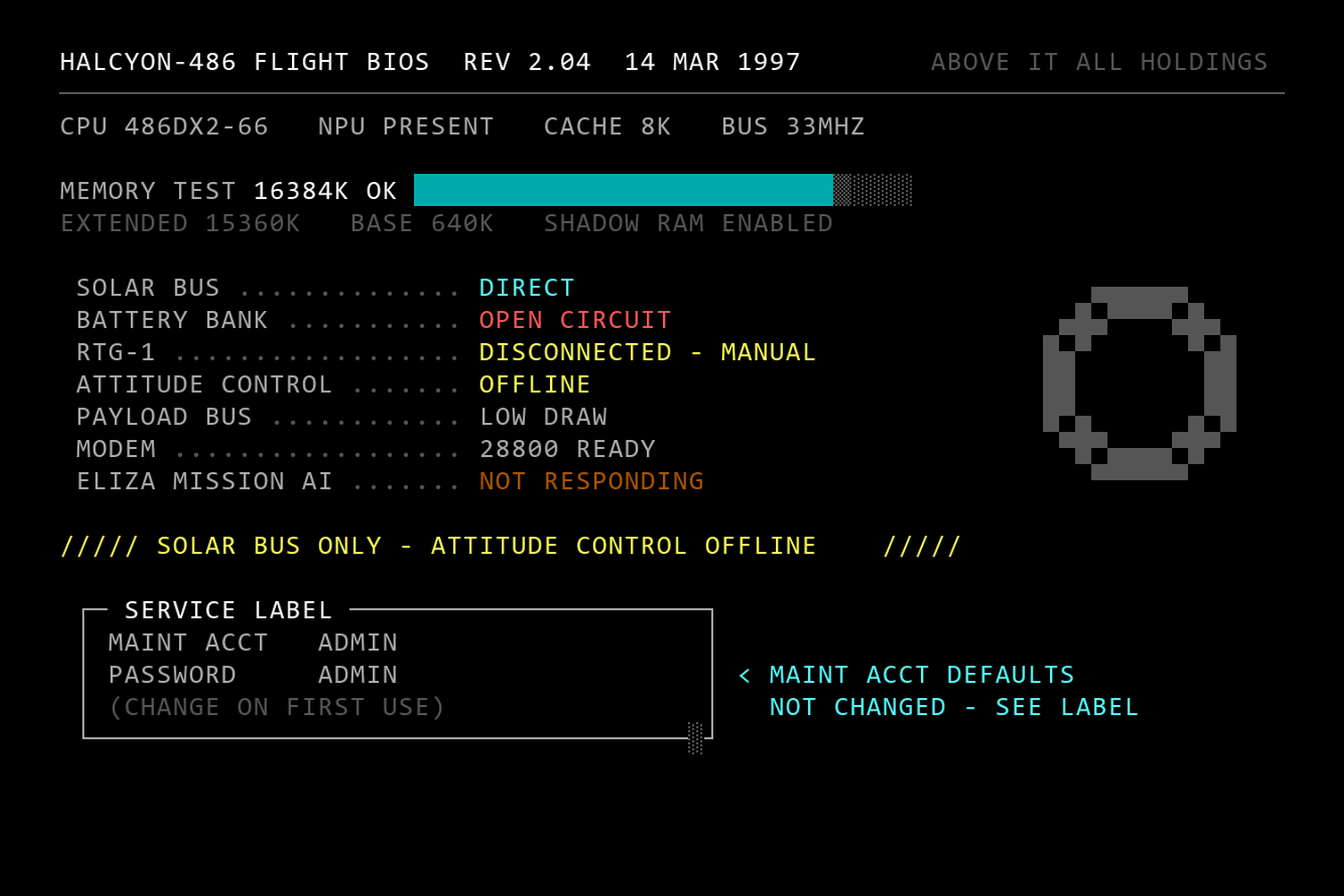
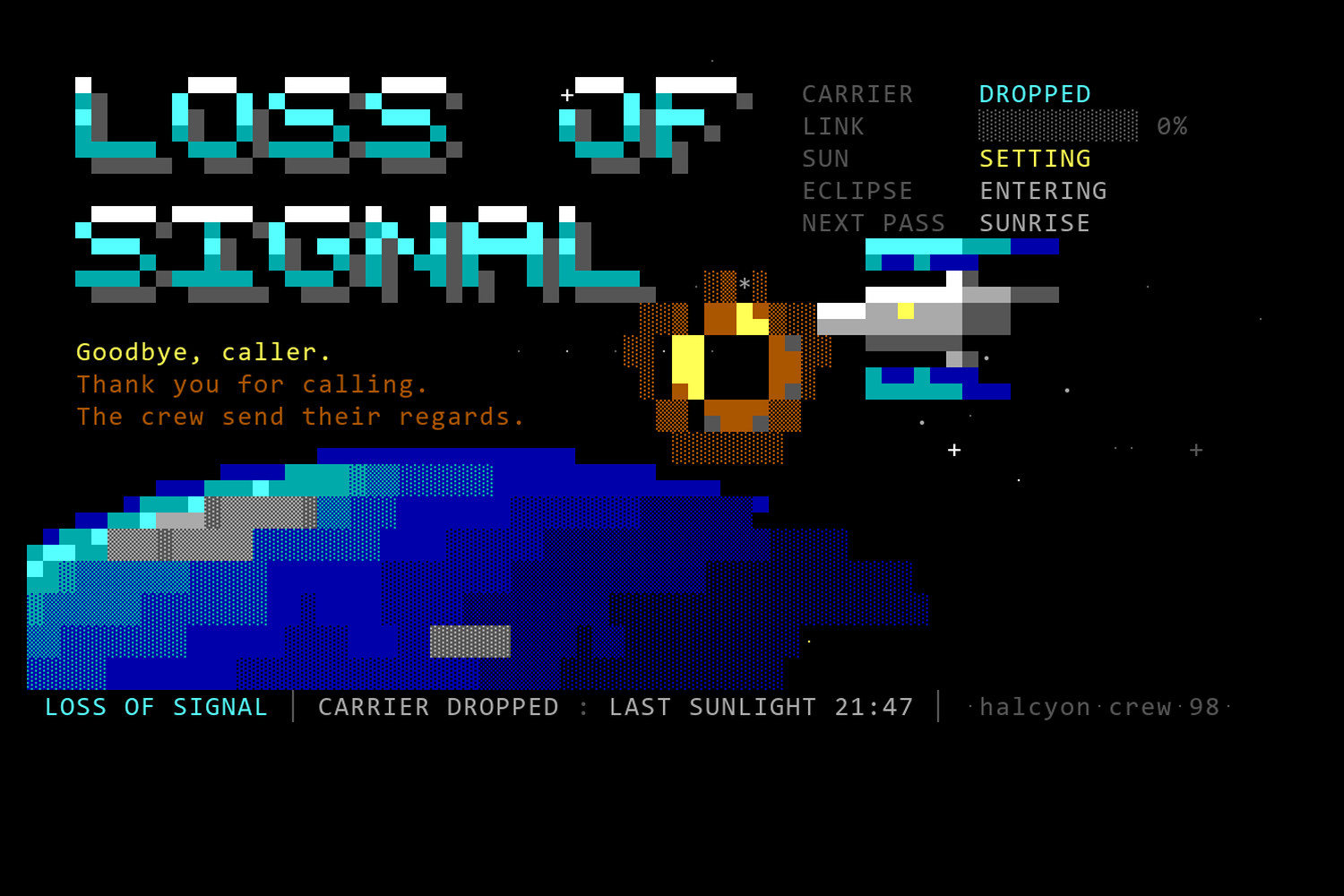
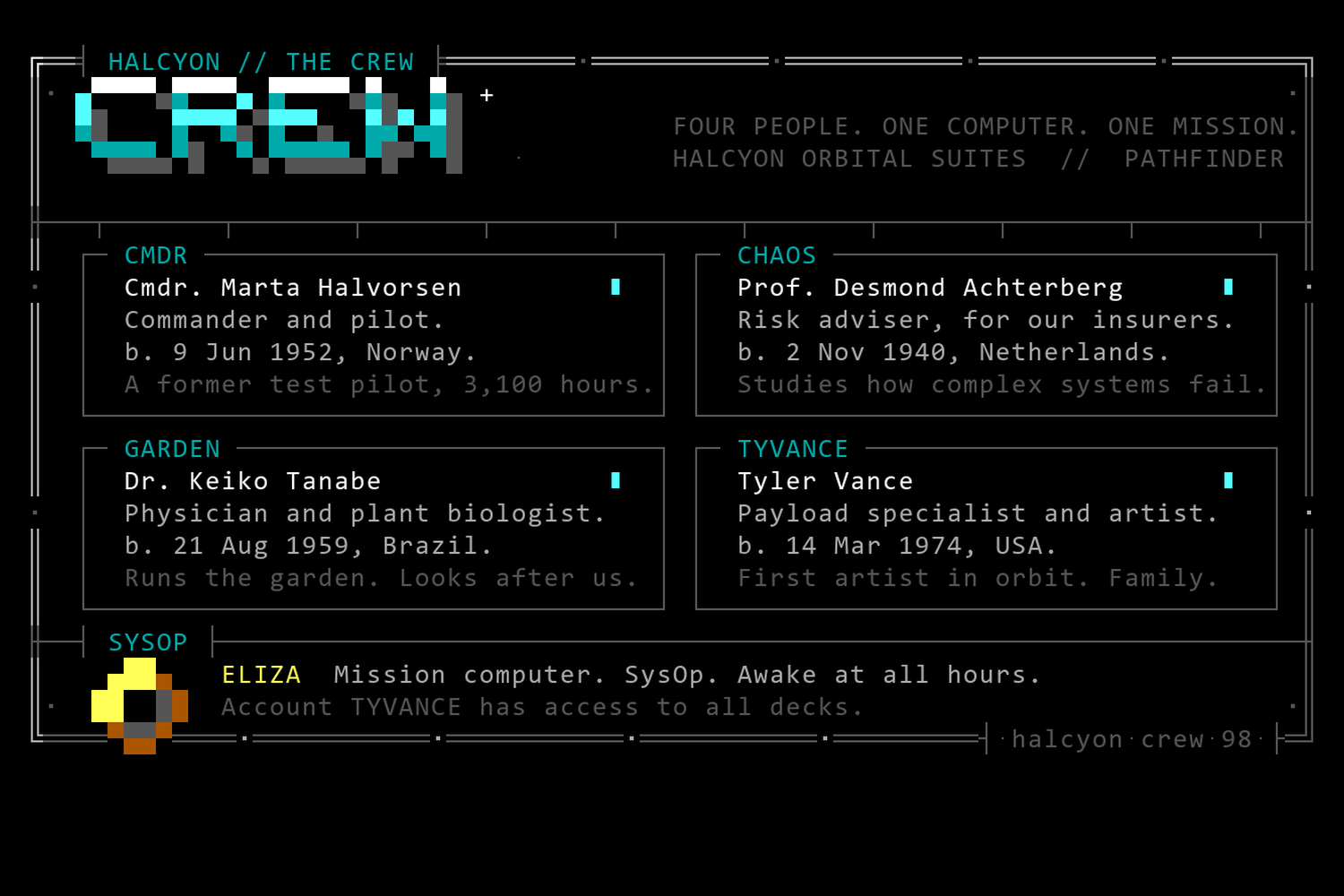
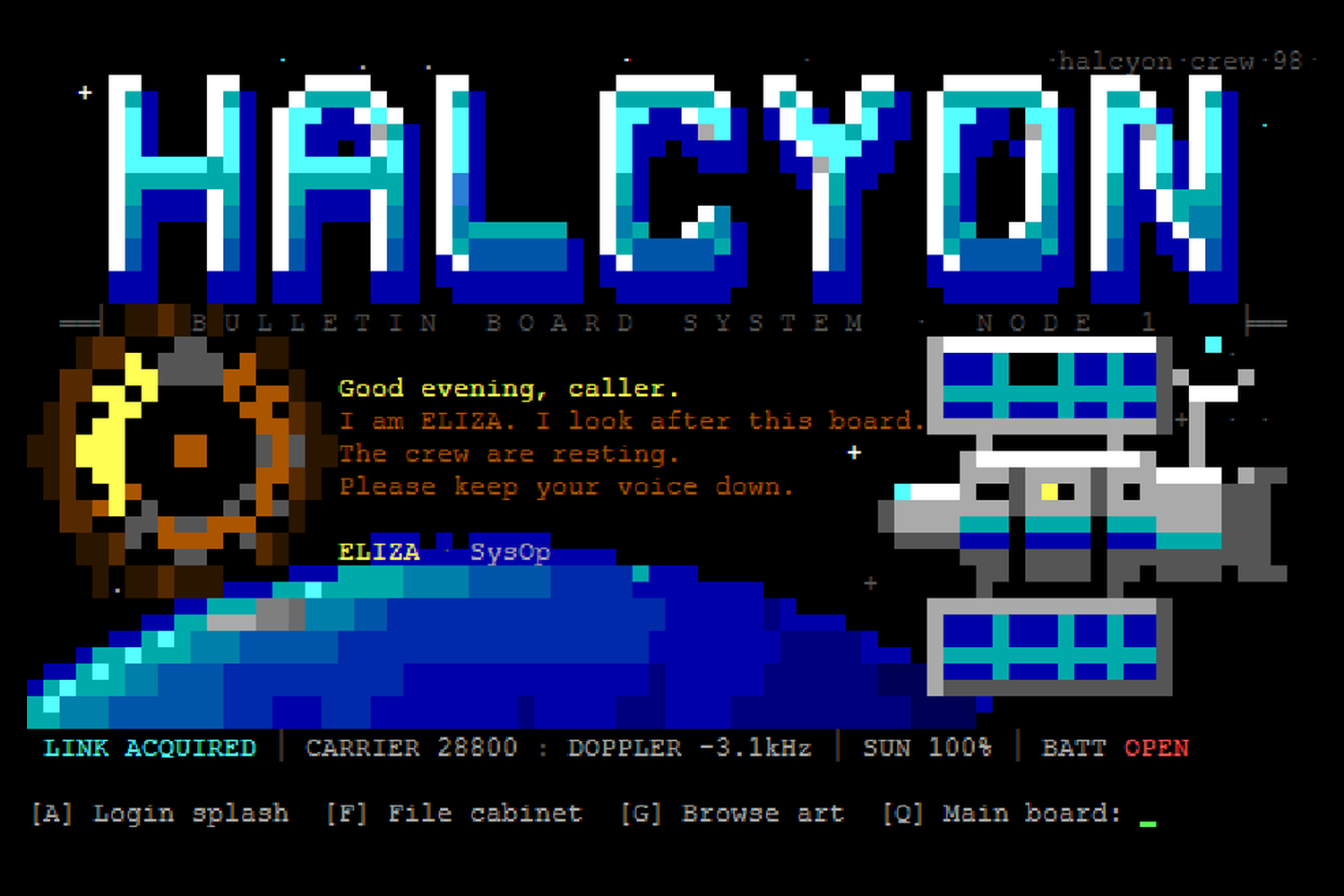
HALCYON was a secret private spaceflight in 1998, crew of four. The ship had a BBS on a 486 so the crew could write home, and the mission AI, ELIZA, ran it as SysOp. Mission control lost contact and nobody ever announced it. In November 2026 the shorted battery bank has gone open circuit, the solar panels feed the bus again and radio amateurs pick up the signal.
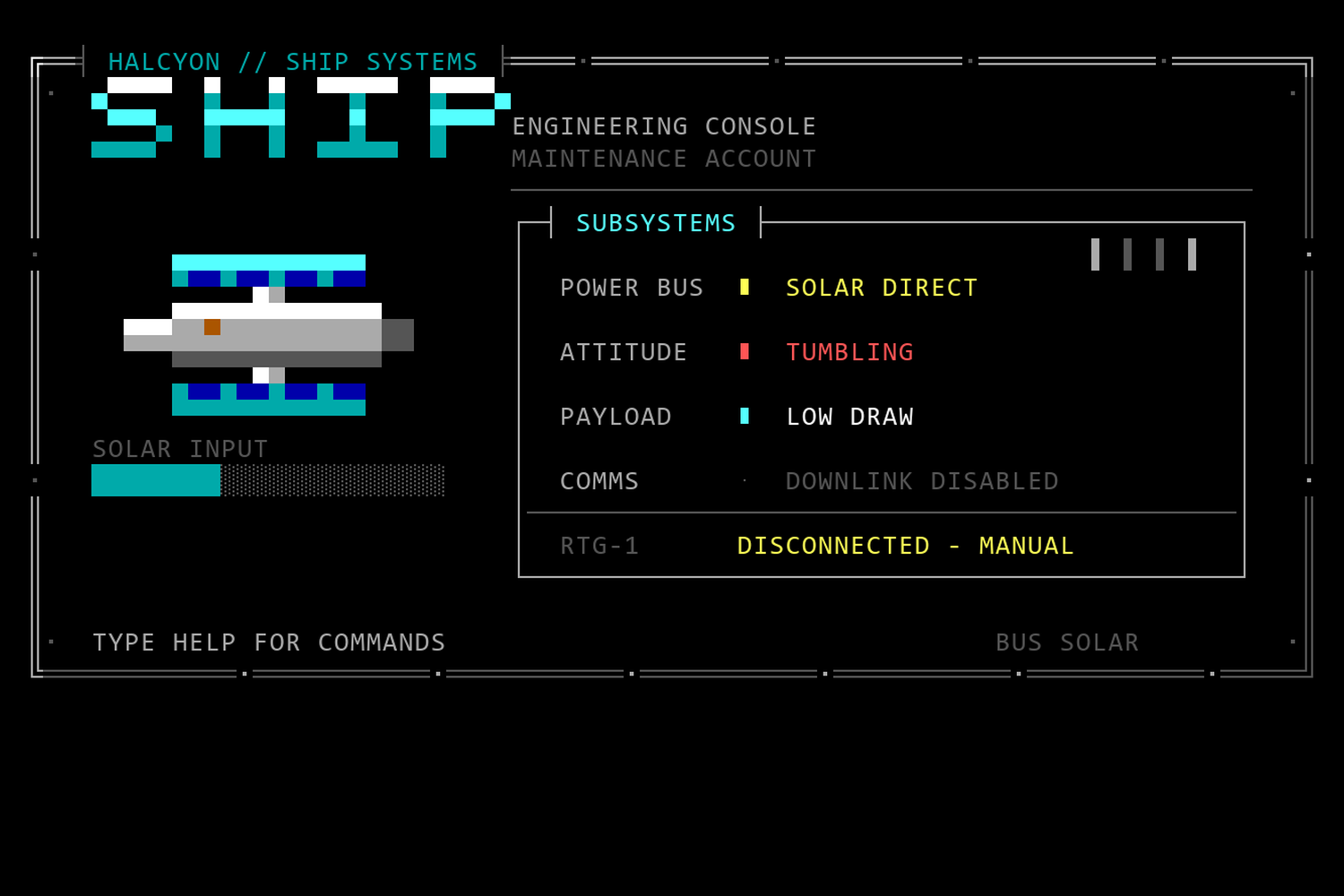
You dial in. The ship tumbles, so the board has power for a minute or two
at a time. You log in as the maintenance account, admin / admin, and
have about two minutes to switch the ship to the RTG before the sun goes
and the carrier drops. So the first puzzle is a resurrection too: you
bring a dead station back before anything else works. Then ELIZA wakes
up, very politely.
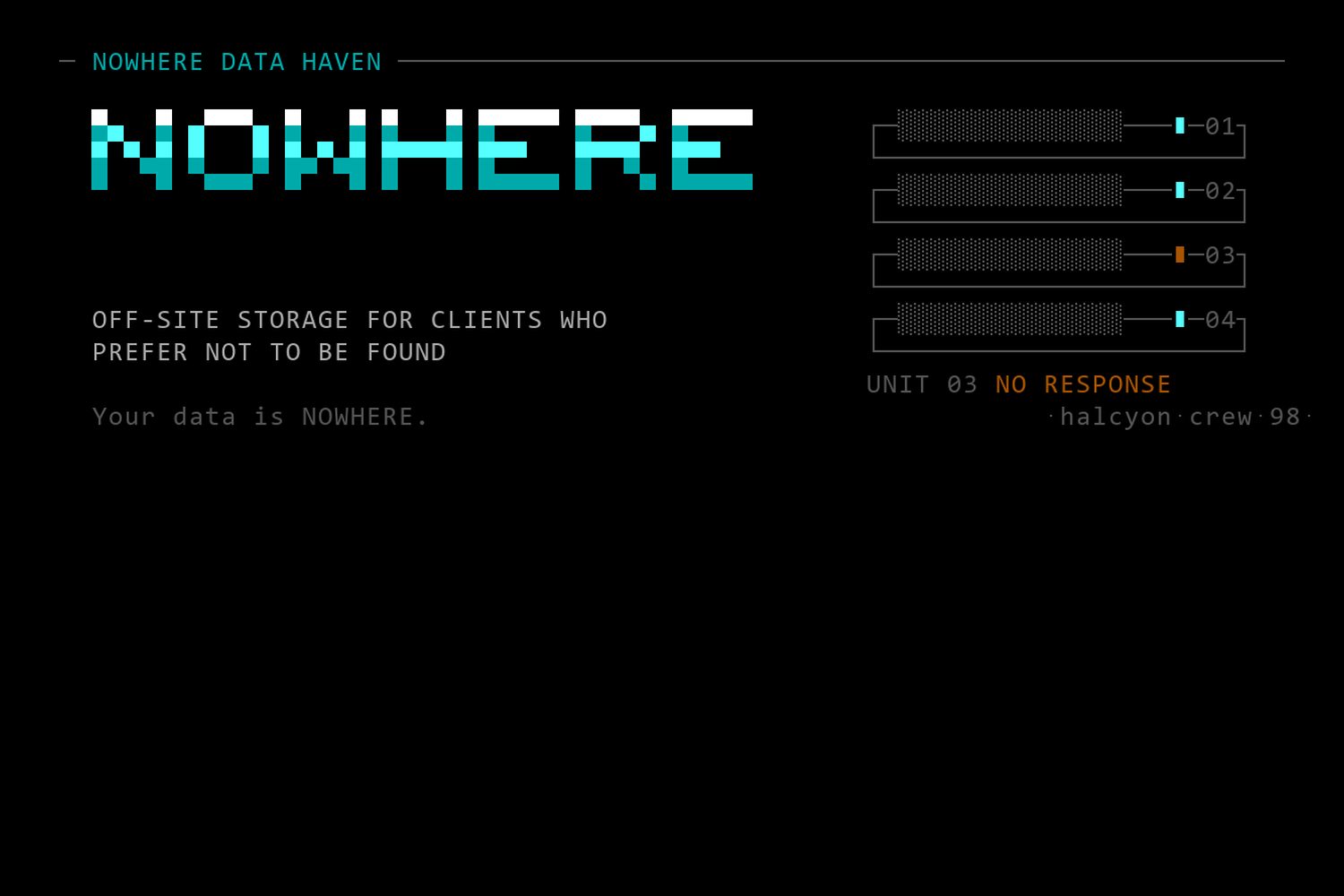
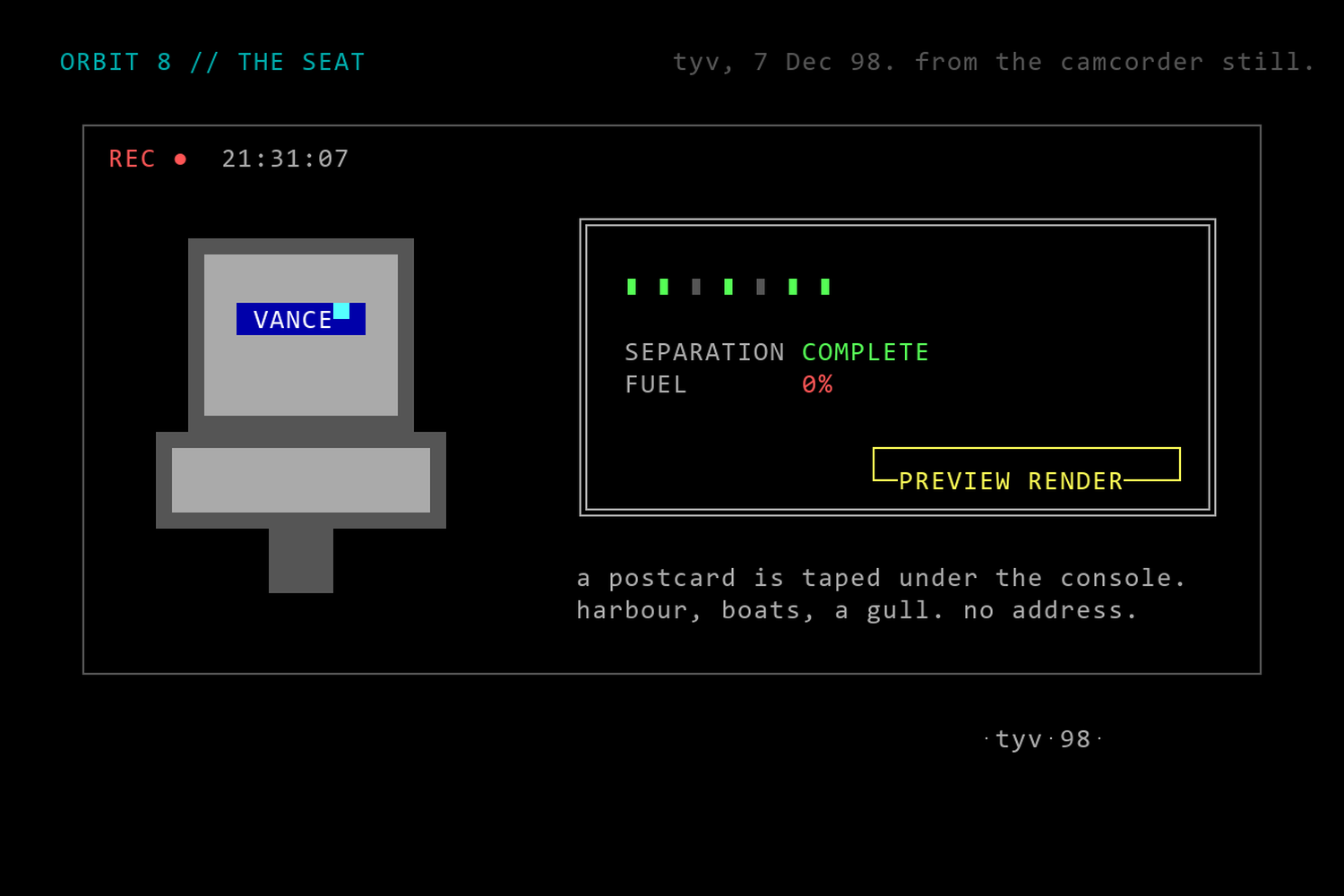
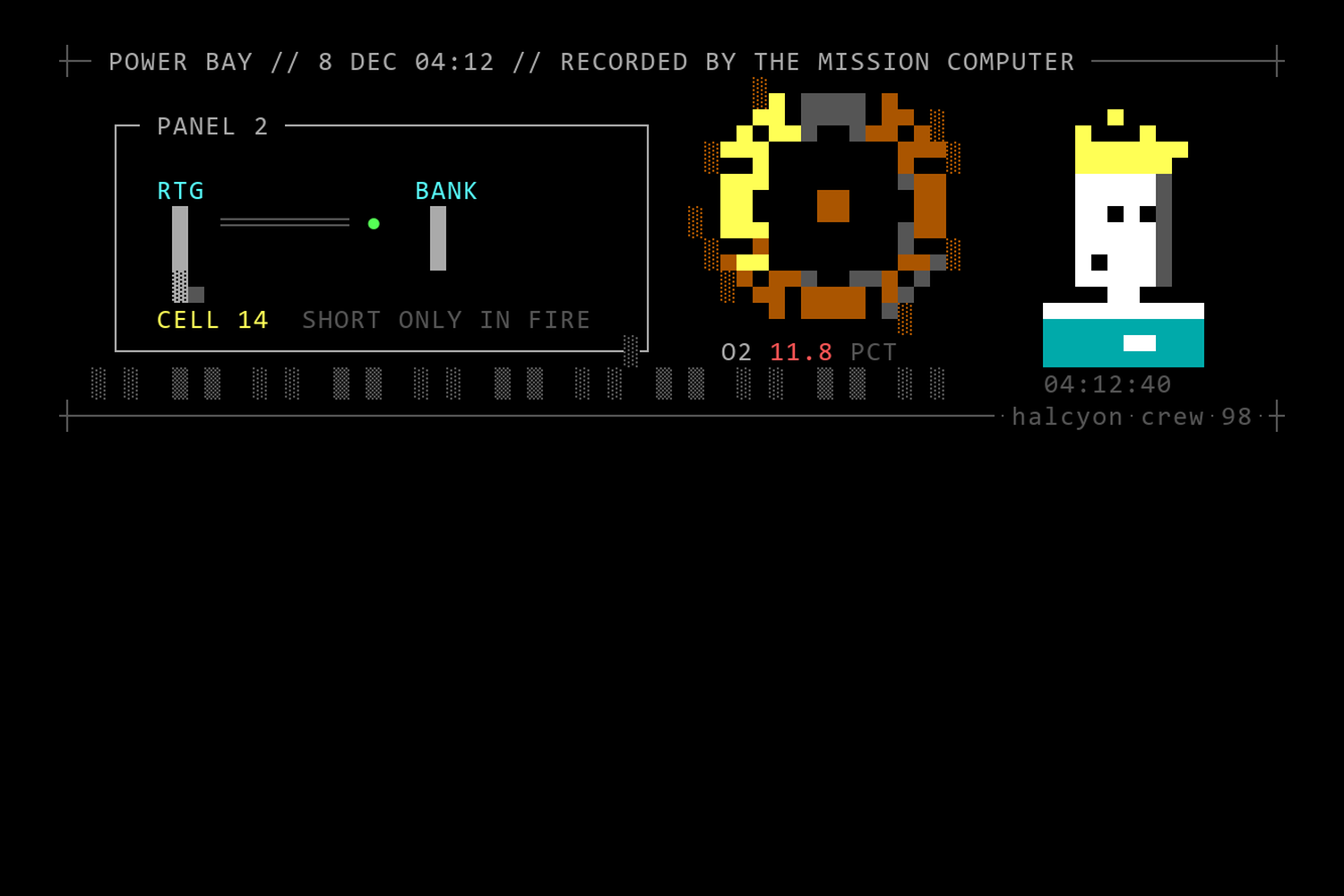
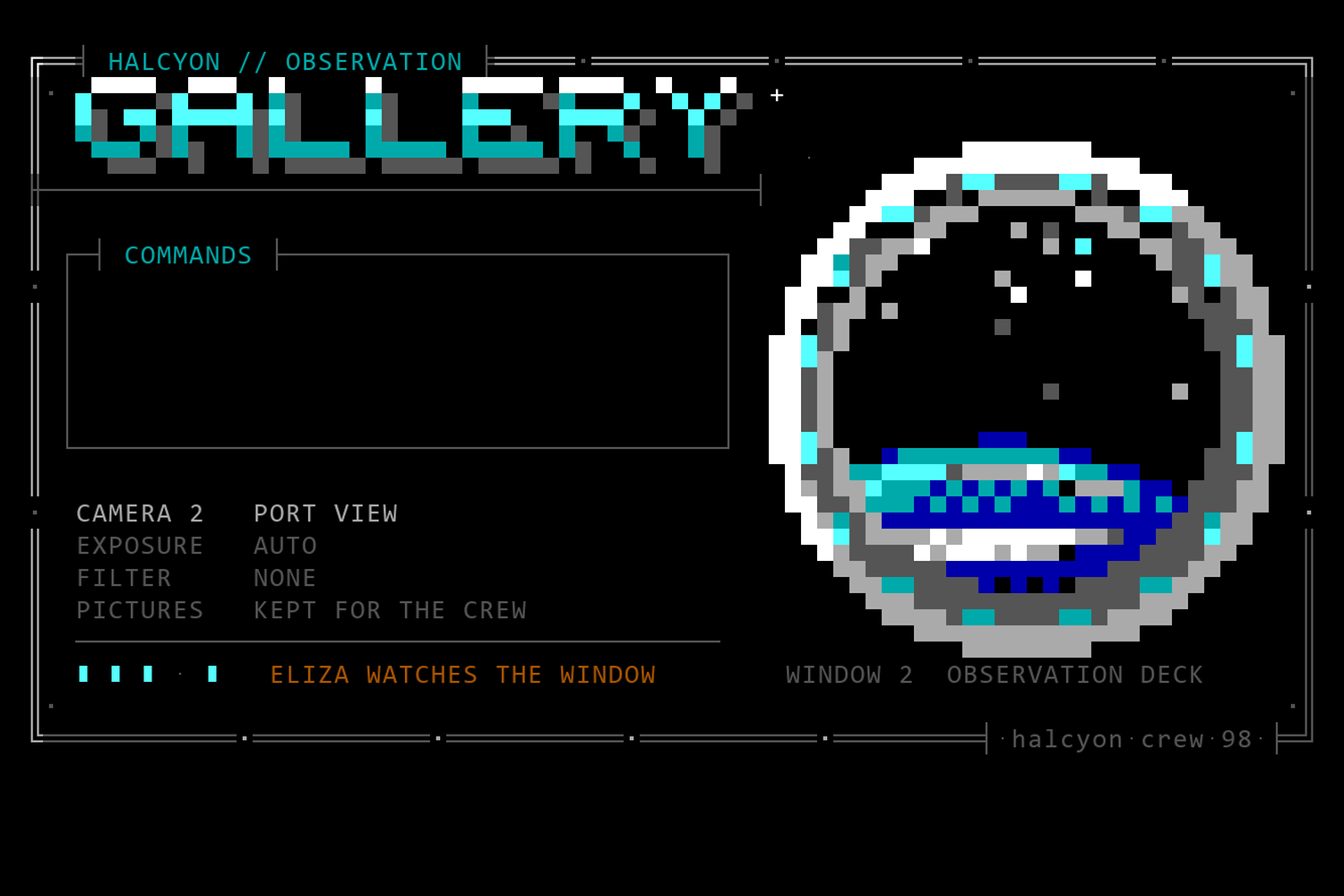
After that it is a normal 1998 BBS. Message conferences, file areas, door games, chat, WHO, bulletins, ANSI art on every screen. The crew's posts, mail, logs, Ty's ANSI art and his tracker modules are the evidence. You crack crew passwords, put together a jigsaw of ANSI pieces, read a portrait that is overpainted at 300 baud, talk with ELIZA in free text, poke around the NOWHERE shell and fill in the crew manifest: who each person was, how they died and who caused it. Facts confirm in pairs, like in Return of the Obra Dinn. If you get it right, Ty's demo plays (he was the ship's payload specialist and a demoscener on the side).
It is a solo game on a social board. Story areas and crew accounts are read only, but the Lounge, Spoilers, No Spoilers and Radio Room work like on any BBS, so players can trade hints or stay away from them. A browser caller and a Telnet caller share the same nodes, see each other in WHO and can chat. First play takes about 60 to 120 minutes. The puzzles are meant to be hard, the interface not: the same key does the same thing everywhere, and the notebook (K) keeps every hint and password you have seen.
Easter eggs for people who remember 1998: modem commands (ATI, +++,
ATH0, ATDT), some unlisted words at the main menu, a snake game by Ty
in the doors menu.
How I built it
The engine first. TinyBBS was written natively for the Pocket-Dongle-S3 (ESP32-S3, 16 MB flash, 8 MB PSRAM, a tiny 160x80 LCD and a microSD slot, about $10), with its own Telnet and web servers. Nothing attached, no modem, no keyboard. It makes its own wifi with a captive portal, so a phone opens the terminal by itself, and it never joins another network. Only after that it was ported to Linux. The data and most of the C++ stayed exactly the same. C++ felt period correct, and it is still what you use on microcontrollers.
- One translation unit split into headers. The core reaches the machine only through one platform header: ESP32 on the stick, POSIX and civetweb on the server.
- A fixed pool of session structs, each a state machine with an input line and a capped output buffer. Telnet and the browser only push bytes in and drain bytes out, so they are two transports into the same BBS.
- The browser terminal is one page compiled into flash: 80x25 on a canvas, the 16 colour DOS palette and an ANSI parser in JavaScript, WebSocket with HTTP polling as fallback.
- ANSI streams from the card at the caller's modem speed, and a chunk never ends inside an escape sequence. That is also how the 300 baud puzzle works: a line is drawn, then a bare CR, then another line over it. At 300 baud you can read the first one.
- No real time clock, no NTP, so the board invents one. For HALCYON it is frozen at 8 Dec 1998 04:17, the minute the power was cut.
- Everything is plain text on a FAT32 card. Users, messages, config and the whole story.
Then the game on top. The story is data on the SD card, not firmware: a per caller story record, a trigger table where flags only grow, scenes, ghosts in WHO, ELIZA's chat brain (RiveScript format, own small interpreter), the shell, the manifest and the notebook are all text files. The story can change without reflashing. Ty's three tunes are original tracker modules made by a script, and the sample names carry his messages, like scene modules did. ANSI art is made by Python scripts and rendered to PNG for review before it goes on the card.
Rough split between the LLMs: Claude built the ESP32 version. Codex built the Linux port (and an OpenClaw agent set up the server side). Kiro built the story, the game mechanics, the art, the music and the tests, with Claude writing the briefs and reviewing. Each one got the role it was best at, and they checked each other's work: Kiro had to prove every item on a server it did not build.
How I used Kiro
The real work ran in Kiro CLI, headless: kiro-cli chat --no-interactive
with one short prompt, "do the next item of the queue, tick it and stop".
So it could run overnight without me, one item per run, and every run
started clean from the files in the repo instead of a long chat history.
- Specs. 19 of them in
.kiro/specs, each with requirements, a design and a task list. The story bible is a spec too: every fact about the crew must be provable from several items in different media (posts, logs, art, WHO, doors, music), so the game survives a missed clue. Vibe coding a mystery does not work, a puzzle with no way in is invisible until someone gets stuck. - Steering. 8 files: tech rules (no ESP32 or Linux headers in shared code), structure, product, card content, ANSI art, story voice, writing rules and the interaction contract (same key, same job everywhere).
- Hooks. Saving a web page regenerates the firmware headers. Saving a story file runs the story lint (unreachable facts, softlocks, lost endings). Saving shared game logic runs the host tests and the property test.
- Custom agents. ghostwriter (crew posts in each voice), puzzle-smith, firmware-guard and playtester. Later two adventure game critics, two usability testers who never used a BBS (scored on the System Usability Scale) and two judges. Each starts with an empty memory and a new caller account.
- MCP. A small server of my own,
bbs-caller, dials the board over Telnet and returns the screen as text. Through it the agents play the game on the staging server like a real caller and write down where they got stuck. The first run died at the login prompt because the boot banner gave the wrong hint, a bug no unit test would find. - Property-based testing. The story property test plays the card's triggers and manifest in random orders and checks that flags only grow, every ending stays reachable and nothing softlocks.
No queue item was ticked on code reading. Each had to pass the ESP32 build, the host tests, the story lint and a staging check on a Linux server: server build, CTest, a smoke test and an end to end Telnet script that plays the whole game as a new caller.
Challenges I ran into
My own playtest. I got stuck in act 2, repeated the same chat and the same codes with no new lead, and quit to the bar. The game can be difficult but not frustrating, so the hints were rebuilt into the story itself: the crew's own 1998 attempt leads the player, ELIZA never gives the same answer twice, and there is one free text chat instead of several.
One early slice put the brownout login gate on a line that was commented out, and it looked fine until the end to end test ran on the real server. That is where the staging rule came from.
Git turned CRLF into LF and all ANSI art drew as staircases on Linux.
Fixed with .gitattributes.
The user flag field is 255 characters and story progress would not fit, so it moved to its own record file.
What I learned
I learned that AI agents are dead stupid idiots, but if you carefully explain what you want, they can be useful. I also learned what Kiro is. I had no former experience of it.
What's next
Small microcontrollers and slow radio links (LoRa, Meshtastic, packet radio) have the same limits the BBS was built for, and text over them is mostly a public chat line. A BBS had message boards that synced slowly between machines, like FidoNet, and chat on the node. I want to run TinyBBS on a small ESP based Meshtastic device that way. It was out of scope for the hackathon and nothing runs on Meshtastic today, but the core does not care how bytes reach it, so a mesh link would be a third transport and not a rewrite.
The engine has its own repo, TinyBBS, and a plain board with about 1000 archived FidoNet messages runs on it at kouvosto.helppox.com. That one shows it is a real BBS and not a game pretending to be one.
I'm also planning to port it to the Pimoroni Tufty 2350 Badgeware as a handheld console. The hosted board stays at halcyon.helppox.com, and the stick is the collector's edition.

