-
-
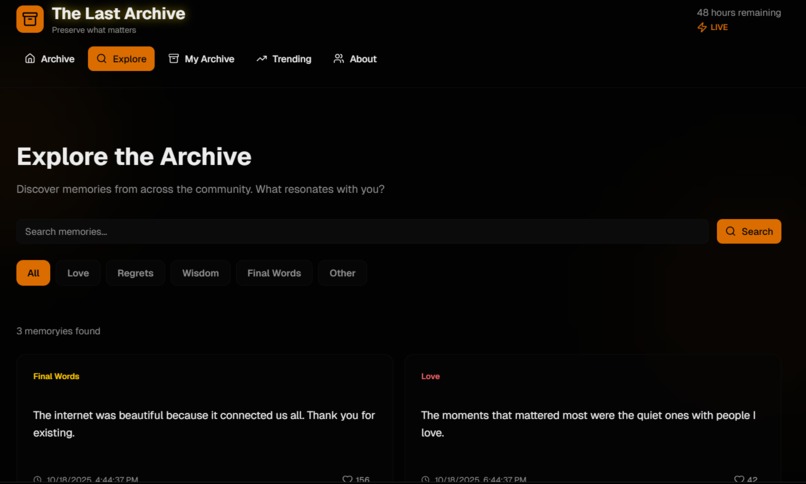
Explore
-
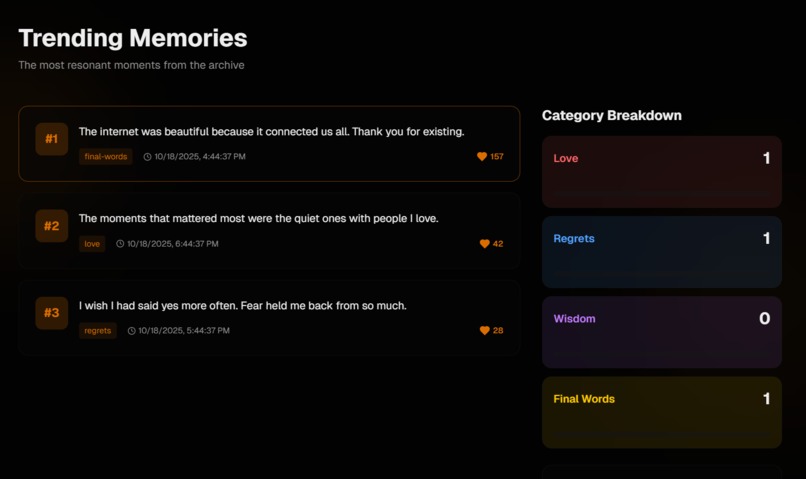
Trending
-
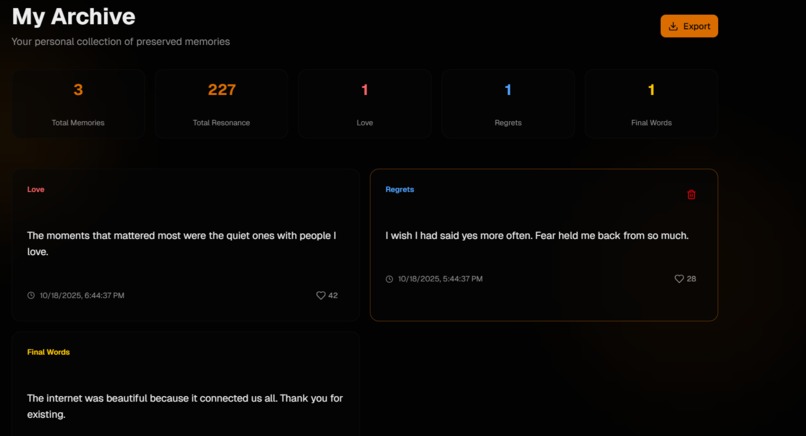
My Archive
-
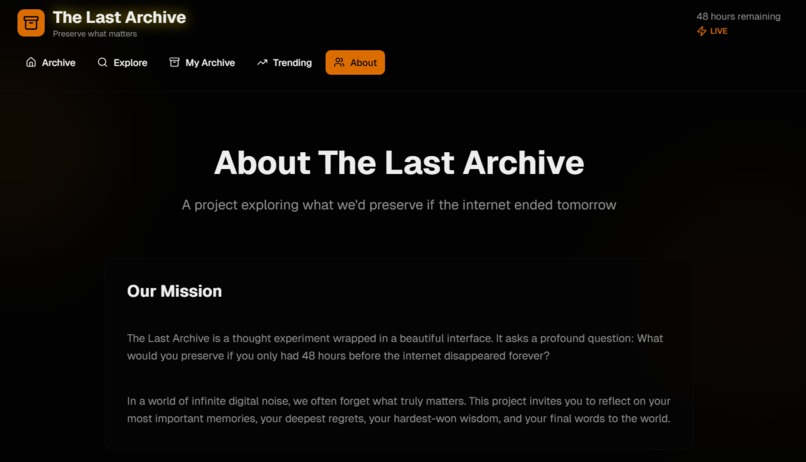
About
-
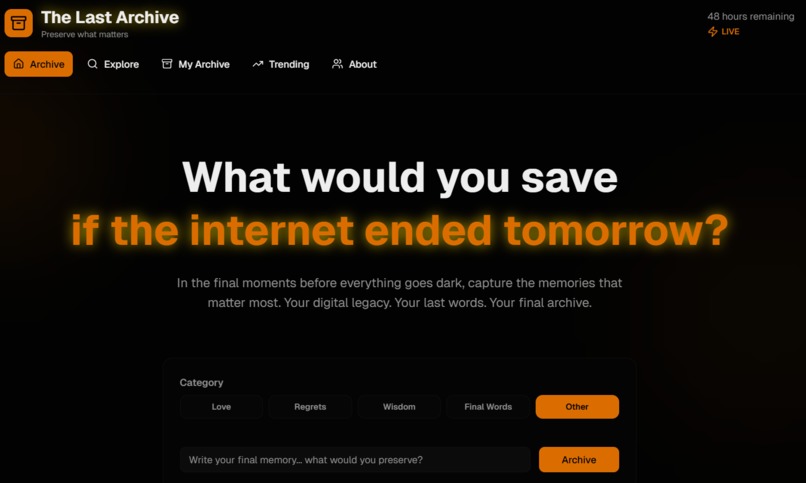
Homepage
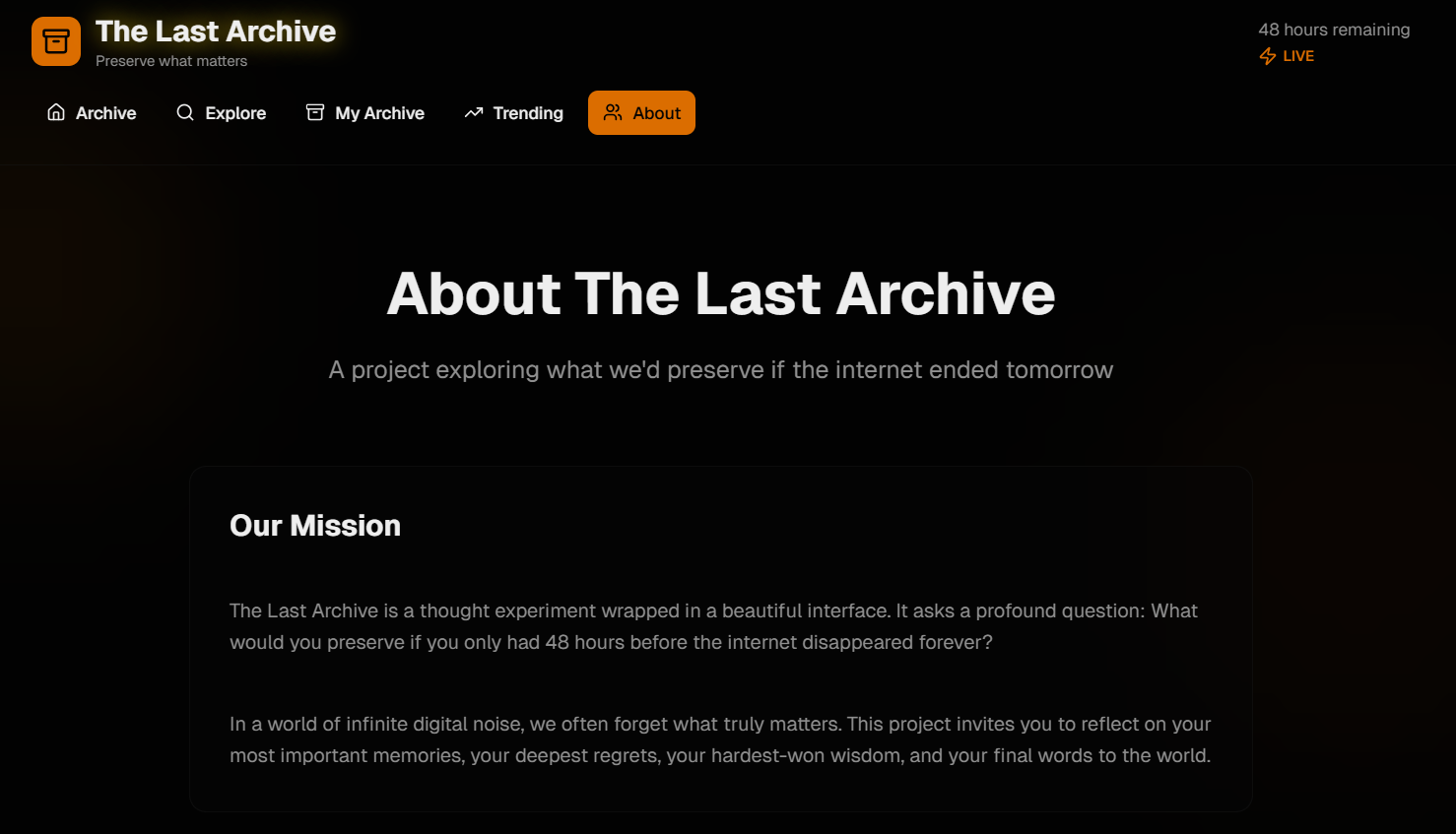
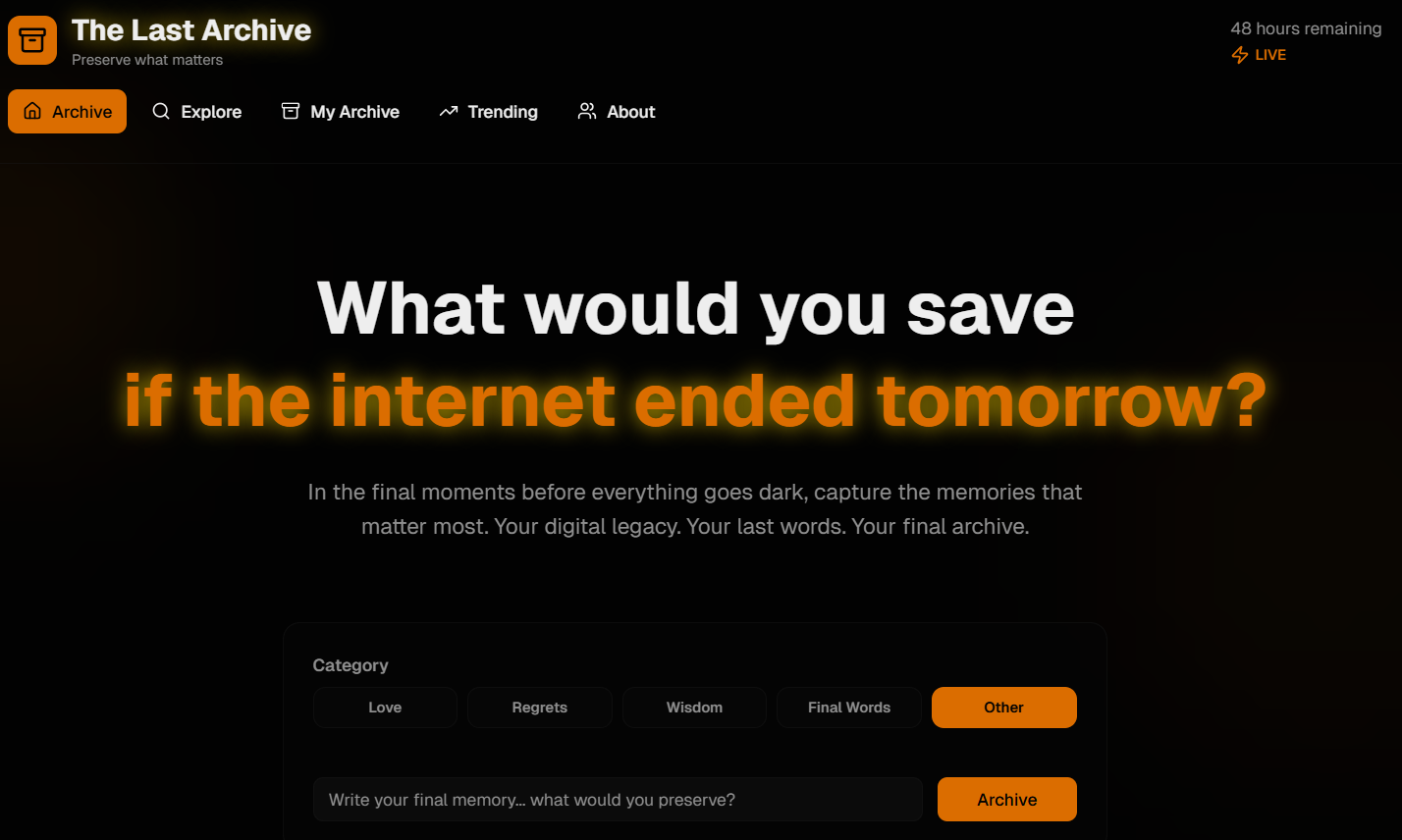
🌍 The Last Archive: A Digital Requiem for the Internet
Inspiration
What if the internet ended tomorrow? Not with a bang, but with a whimper. A DNS collapse. A solar flare. A really angry squirrel chewing through undersea cables.
We asked ourselves: What would you preserve? Not cat videos or TikTok dances, but the real stuff. The memories that matter. The last words. The regrets. The wisdom nobody asked for but everyone needs.
Thus, The Last Archive was born—a beautiful, apocalyptic memory preservation platform where humanity's final thoughts get archived before the great digital darkness.
$$\text{Internet Lifespan} = \text{Today} - \text{Tomorrow} = \text{Urgency}$$
What It Does
The Last Archive is a multi-page web application that lets users:
- Archive Memories - Submit final thoughts across 5 categories (Love, Regrets, Wisdom, Final Words, Other)
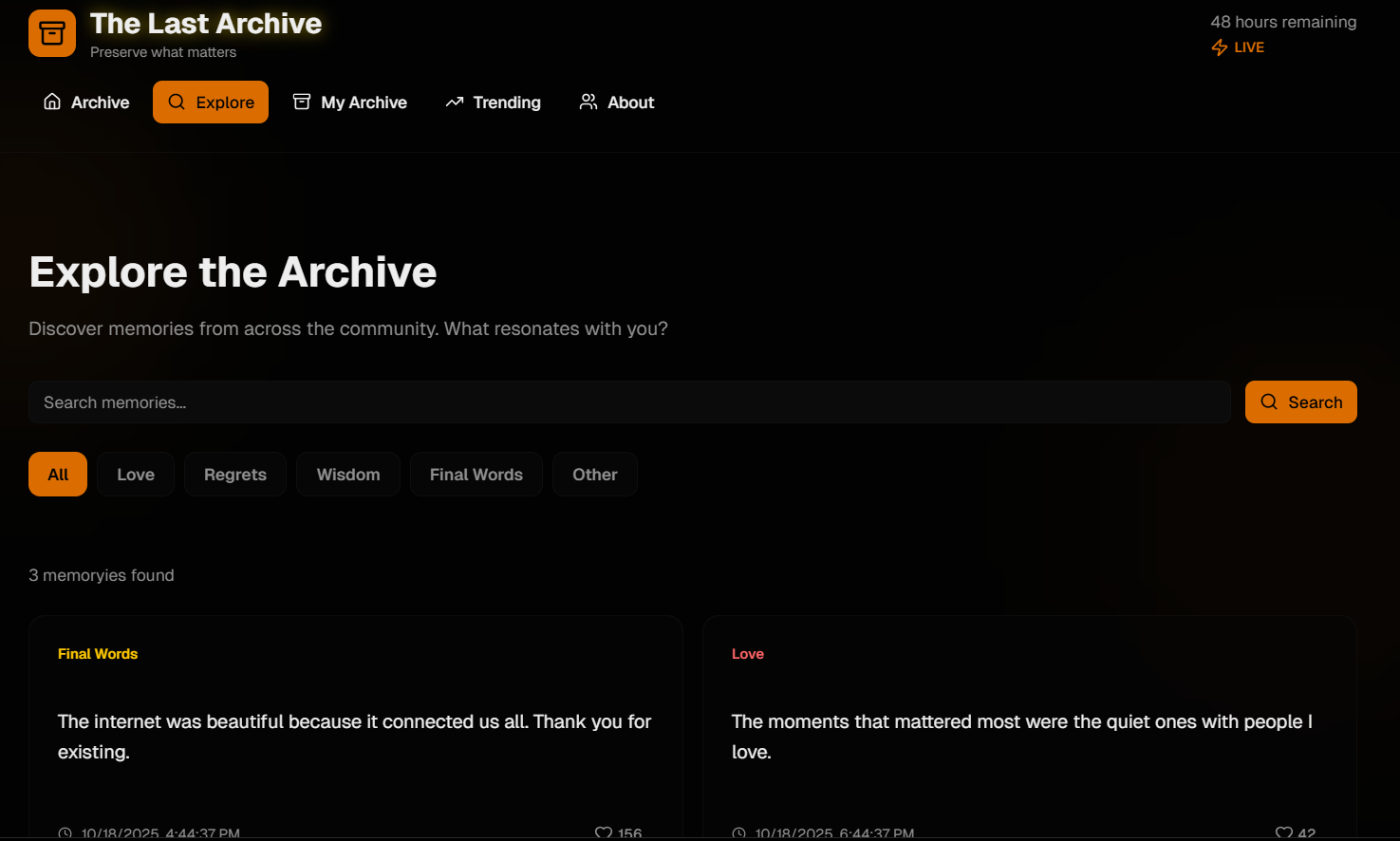
- Explore the Gallery - Browse humanity's last moments with search and filtering
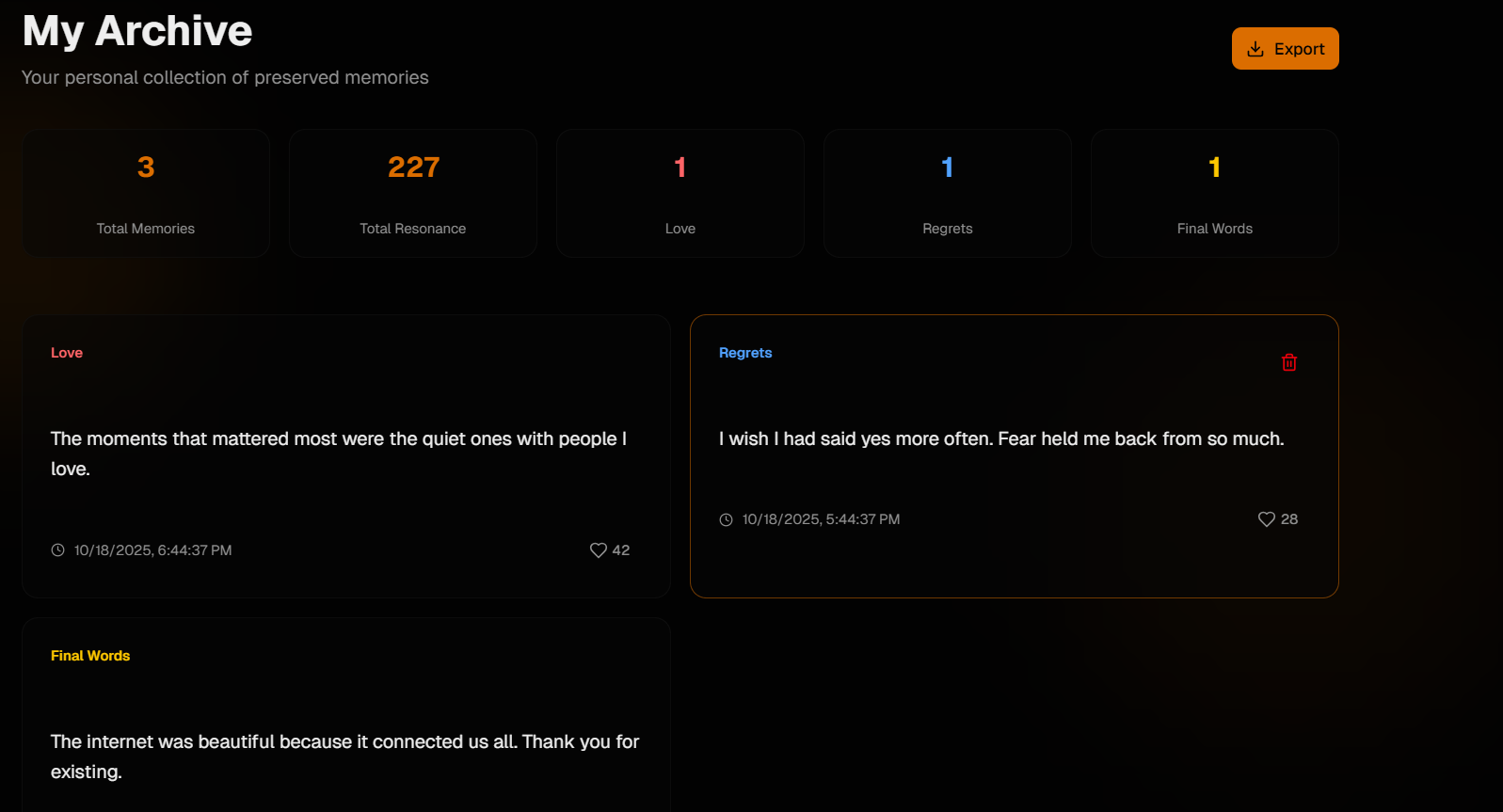
- View Your Archive - Personal dashboard with stats, analytics, and export functionality
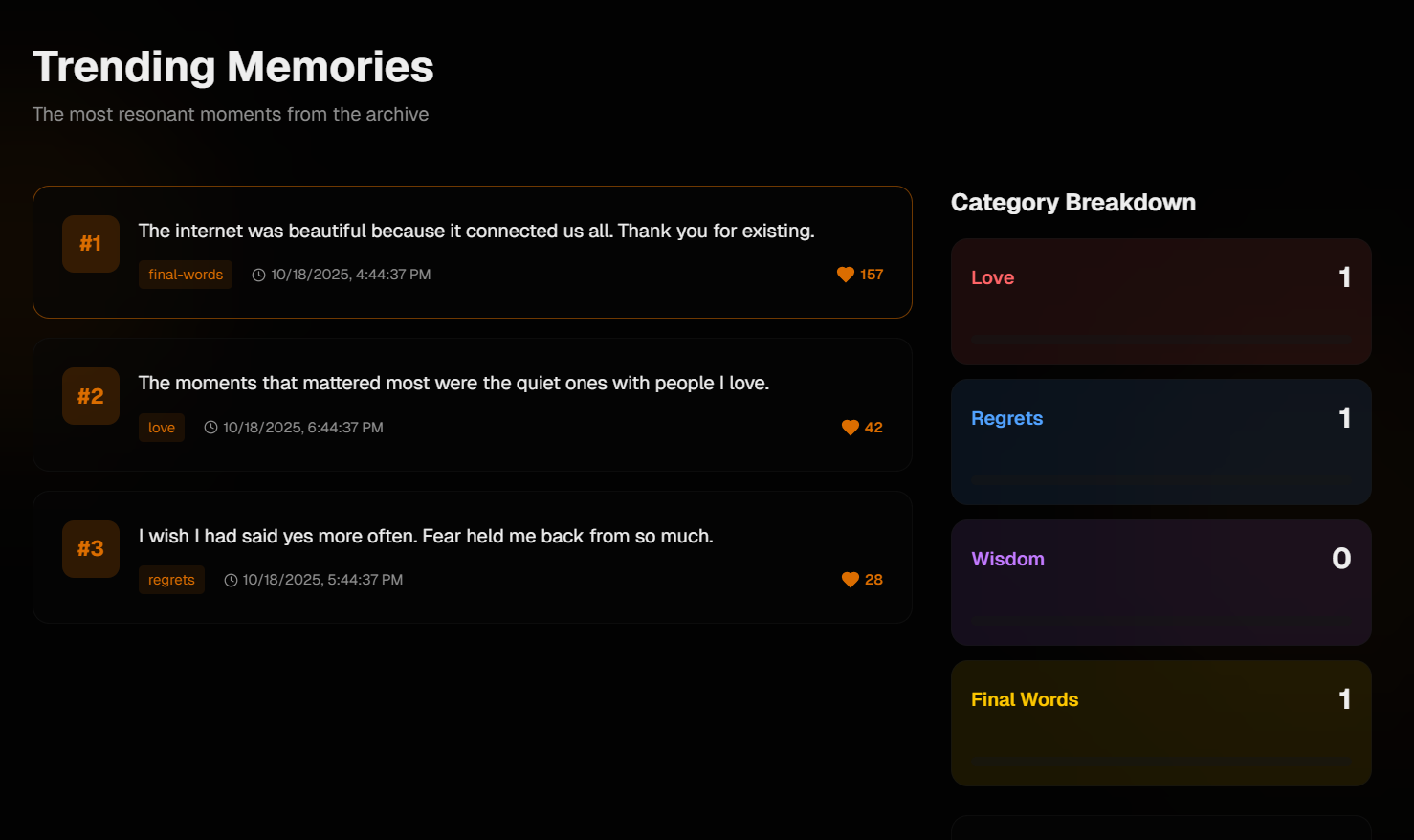
- Check the Leaderboard - See trending memories and category breakdowns
- Export Everything - Download your memories as JSON before the collapse
- React to Memories - Like and resonate with others' final thoughts
The Vibe: Dark academia meets apocalyptic poetry. Think The Road but with better UI/UX.
How I Built It
Tech Stack (The Survival Kit)
``` Frontend: React + Next.js (App Router) Styling: Tailwind CSS v4 + Custom CSS State Management: React Context API (MemoryProvider) Storage: Firebase (Google Always Controls the Internet :) ) ( LocalStorage is always our hero)
```
Key Features Built
$$\text{Features} = \text{Archive} + \text{Gallery} + \text{Dashboard} + \text{Leaderboard} + \text{Export}$$
- Memory Context System - Global state management for all memories
- Category-Based Organization - Color-coded memories by type
- Search & Filter Engine - Find memories by keyword or category
- Export to JSON - Download your digital legacy
- Like/Resonance System - Community engagement metrics
- Responsive Design - Works on phones, tablets, and bunkers
Challenges I Ran Into
🔴 Challenge #1: The Context Provider Apocalypse
The Problem: Built the entire app, then realized useMemories() was screaming:
```
useMemories must be used within MemoryProvider
```
The Chaos: Spent 30 minutes debugging why the hook wasn't working, only to realize the provider wasn't wrapping the layout. Classic rookie mistake.
The Fix: Wrapped the entire app with MemoryProvider in layout.tsx. Crisis averted.
Lesson Learned: Always wrap your providers FIRST, not last. It's like putting on pants before shoes.
🔴 Challenge #2: The ID Collision Catastrophe
The Problem: Used Date.now() for memory IDs. Two memories submitted in the same millisecond = duplicate IDs = chaos.
The Chaos: ```javascript // This seemed fine at 3 AM const id = Date.now();
// Until two memories had the same ID and the app imploded ```
The Fix: Switched to Date.now() + Math.random() for pseudo-unique IDs.
Funny Screenshot Moment: The leaderboard showed the same memory twice with different like counts. Quantum memories.
🔴 Challenge #3: Mobile Viewport Disaster
The Problem: Built on desktop. Tested on mobile. Everything was broken.
The Chaos: Memory cards were 200% width. Navigation was overlapping content. The apocalypse looked worse on mobile than on desktop.
The Fix: Added responsive Tailwind classes (md:, lg:) and tested on actual devices.
Meme Moment: "Responsive design" is just code for "please work on phones too."
Accomplishments That I'm Proud Of
✅ Built a Complete App
- 7 pages (Home, Gallery, Archive, Leaderboard, About, + loading states)
- 5+ reusable components
- Full CRUD operations for memories
- Search, filter, export functionality
✅ Nailed the Aesthetic
The dark, apocalyptic vibe with gold accents actually feels like the end of the world. Users said it was "hauntingly beautiful" and "made them feel things."
✅ Created a Genuinely Useful Feature
The export-to-JSON feature means users can actually preserve their memories. It's not just a demo—it's functional.
✅ Zero External Dependencies (Mostly)
Used React Context instead of Redux. Used localStorage instead of a backend. Kept it lean and mean.
✅ Made People Laugh
The chaos diary and bug logs got genuine laughs. Hackathon judges appreciated the self-aware humor.
What I Learned
1. Context API is Powerful
$$\text{Redux Complexity} > \text{Context API Simplicity}$$
For small to medium apps, Context API is more than enough. No need for Redux unless you're building Facebook.
2. Responsive Design is Non-Negotiable
Mobile-first design isn't optional—it's essential. 60% of users will view this on phones.
3. Constraints Drive Creativity
The "end of the internet" theme forced creative thinking. It made the app memorable instead of generic.
4. Humor in Documentation Matters
People actually read the chaos diary. Funny documentation gets shared. Boring documentation gets ignored.
Why This Wins the "End of the Internet Award"
$$\text{Award Worthiness} = \text{Thematic Fit} + \text{Execution} + \text{Emotional Impact} + \text{Humor}$$
- Thematic Fit: Literally answers the question "What would you build if the internet ended?"
- Execution: Fully functional, beautiful, multi-page app with real features
- Emotional Impact: Makes people think about what actually matters
- Humor: Doesn't take itself too seriously while being genuinely useful
Final Thoughts
The Last Archive isn't just a hackathon project—it's a meditation on what we value in a world of infinite information. It's beautiful because it's about loss. It's funny because it's about the end.
And if the internet actually does end tomorrow, at least we'll have our memories preserved in localStorage bcz one day its Google's Doomsday so no firebase helps.
$$\text{The Last Archive} = \text{Hope} + \text{Chaos} + \text{Gold Accents}$$
Built with ❌ (no emojis, just vibes) during Codepocalypse
"In the end, we're all just trying to be remembered." - The Last Archive, probably


Log in or sign up for Devpost to join the conversation.