Inspiration
Some of us don't realise what things they can recycle, thus throwing away tons of gloss paper, which is highly considered a non-recyclable article. On the other side, potentially biologically contaminated items such as unwashed meat trays often make their way to the PET recycle bins, although they potentially may worsen the situation by spreading bacteria onto the clean items, or growing mould. What is supposed to be a responsible behaviour becomes a bizarre for the recycling companies and the ecology.
What it does
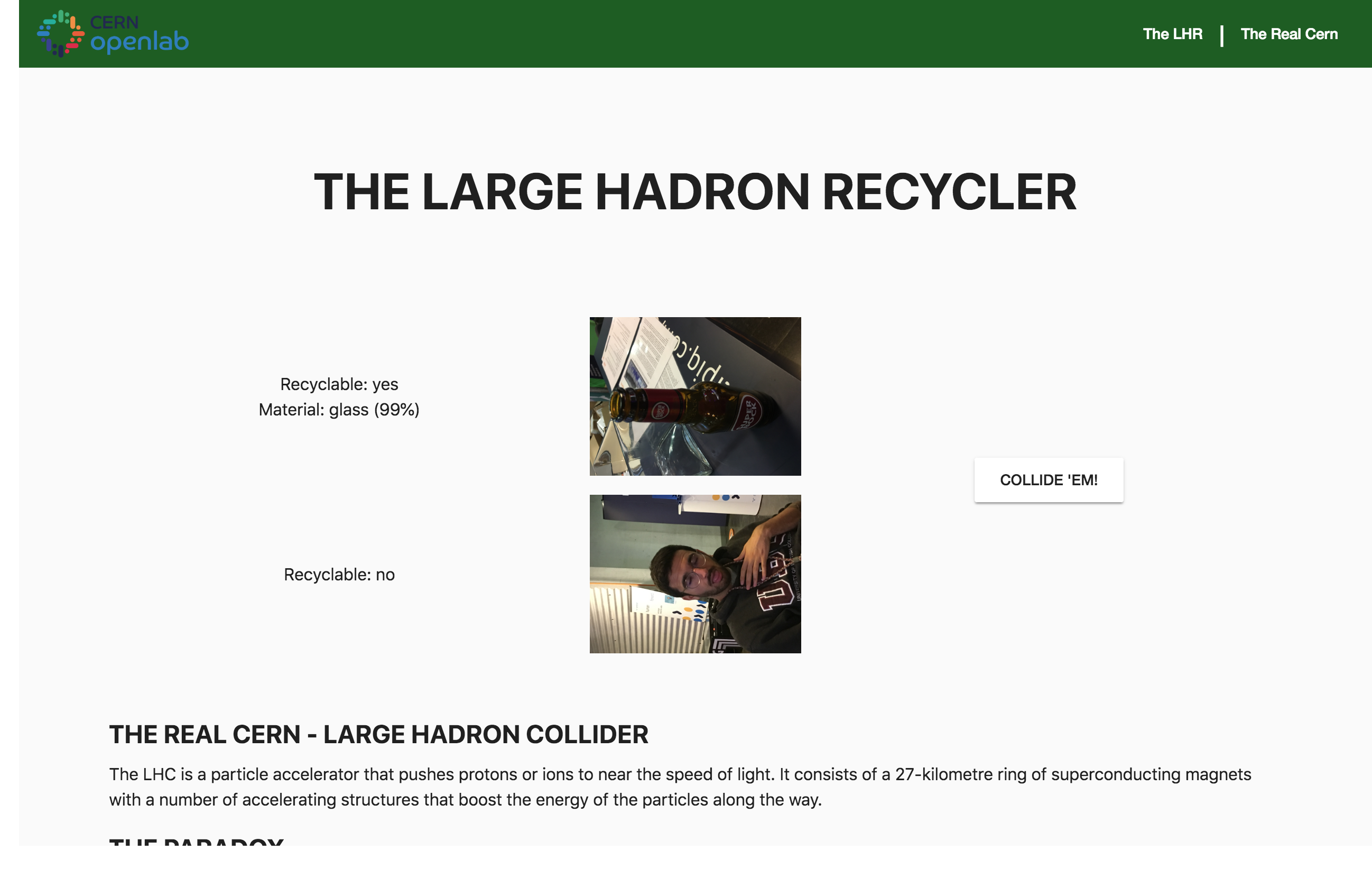
The app our team developed can tell between cardboard, plastic, glass and non-recyclable items by only analysing a photo. We provide a gamified interface designed for the visitor days at the CERN lab (which although may be adjusted for a specific programme).
The idea behind the hadron collider is once two particles collide at an extremely high speed, they may another particle out of pure energy. The particle produced may be absolutely anything, thus the topic is of high interest to the scientist.
Our application accepts two pictures as an input (a parallel with the two particles), analyses them and tell which of them depict a recyclable item and which don't. Then the two items "collide" producing an unexpected funny picture, just like an unexpected particle in the hadron collider.
We highly focus on the children who may find playing with the app entertaining, while learning about "hidden" recyclable materials and the hadron collider.
How we built it
We use the concept of serverless for our web app built on Angular and Angular Material and interact with Google Cloud/AutoML APIs to tell between different materials in a gamified interface.
Challenges we ran into
Google Cloud API is extremely complicated. It is inconsistent from one cloud offering to another and adds confusion when dealing with ambiguous error messages.
Accomplishments that we're proud of
We shifted our focus from an initially interesting but less innovative and creative idea to something 24 hours before the hackathon termination. The app is 100% functional which makes us proud.
What we learned
We learnt about the Large Hadron Collider. We practiced the ML. We learnt to think bigger and more creative and give up what has no potential in favour of a good idea, even though we invested our time and emotions.
What's next for The Large Hadron Recycler
If the project is to be launched at CERN, we'd be happy to collect the children's feedback. The final 'collided' image could be a result of a 'deep dream' algorithm, we would be happy to explore it. As a proof of concept app we did not train the model on very specific things such as meat trays, plastic bags or glossy paper. This needs to be done to fully accomplish the goal. We may be interested to provide advice on reusing things.


Log in or sign up for Devpost to join the conversation.