-
-
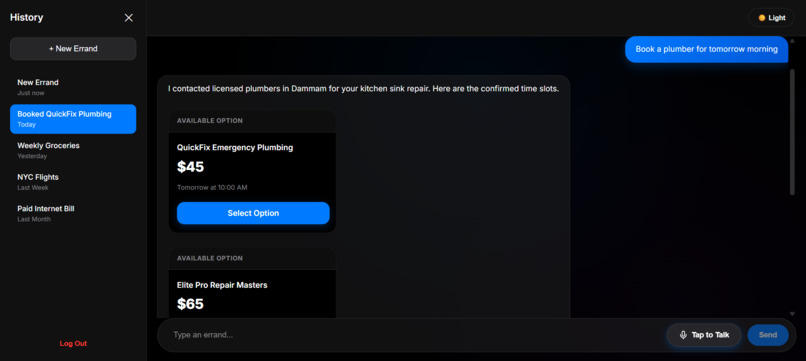
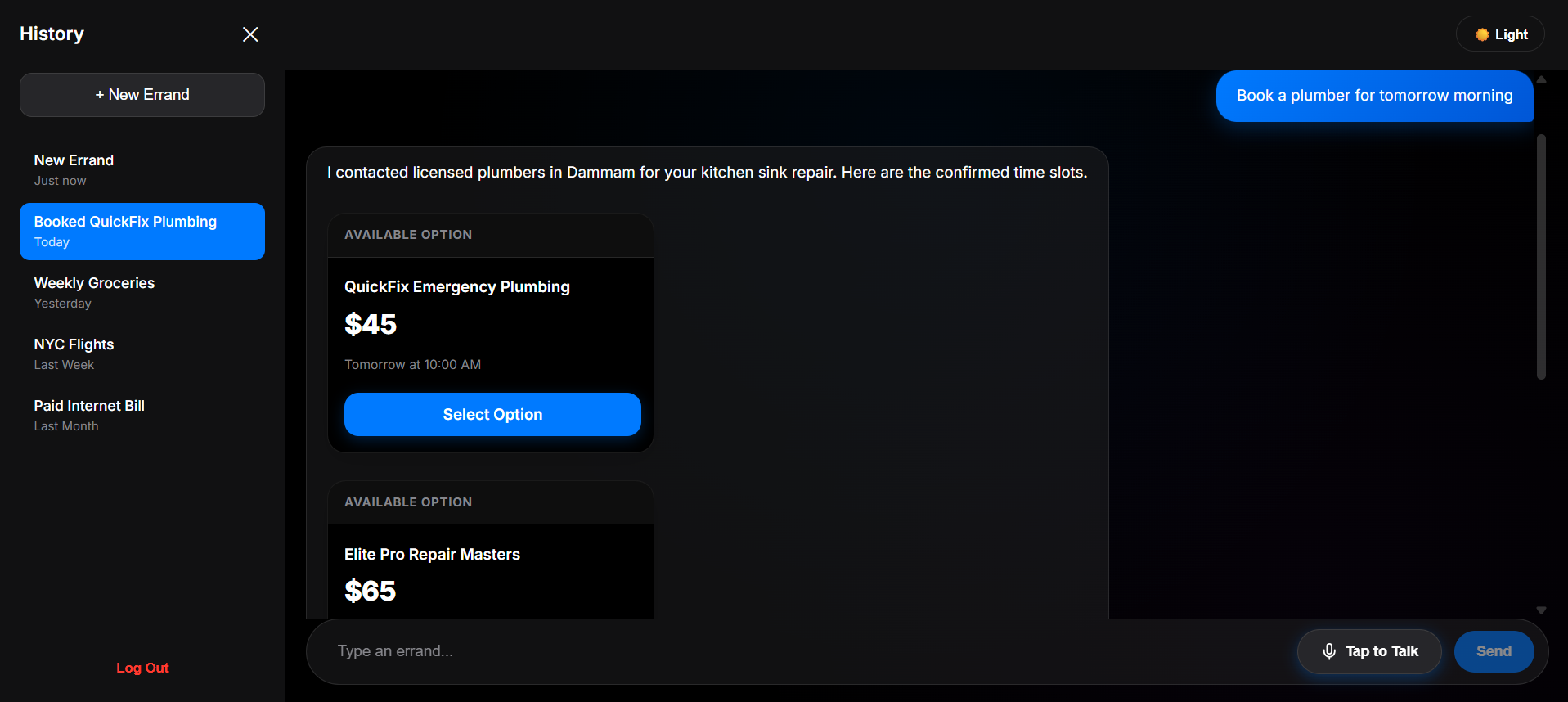
Autonomous Curation: The FastAPI backend parses user requests and curates structured, actionable service choices.
-
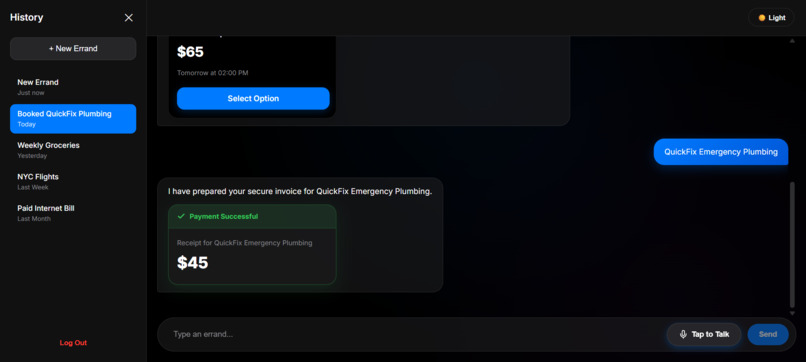
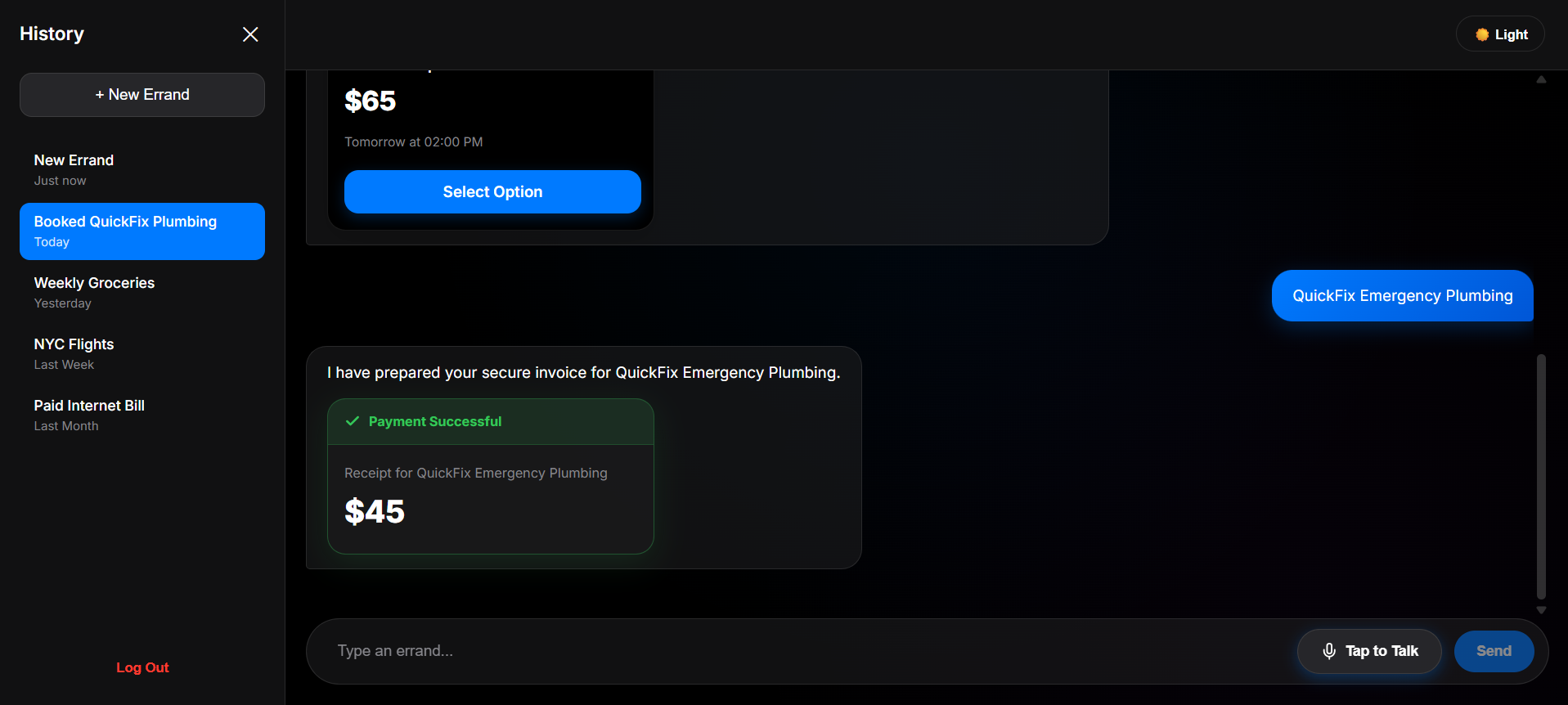
Secure Checkout: Seamless transaction completion via the PayPal Sandbox API with a verified green success receipt.
-
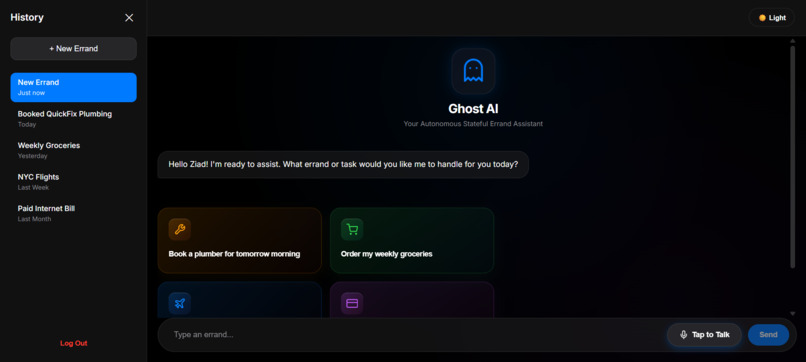
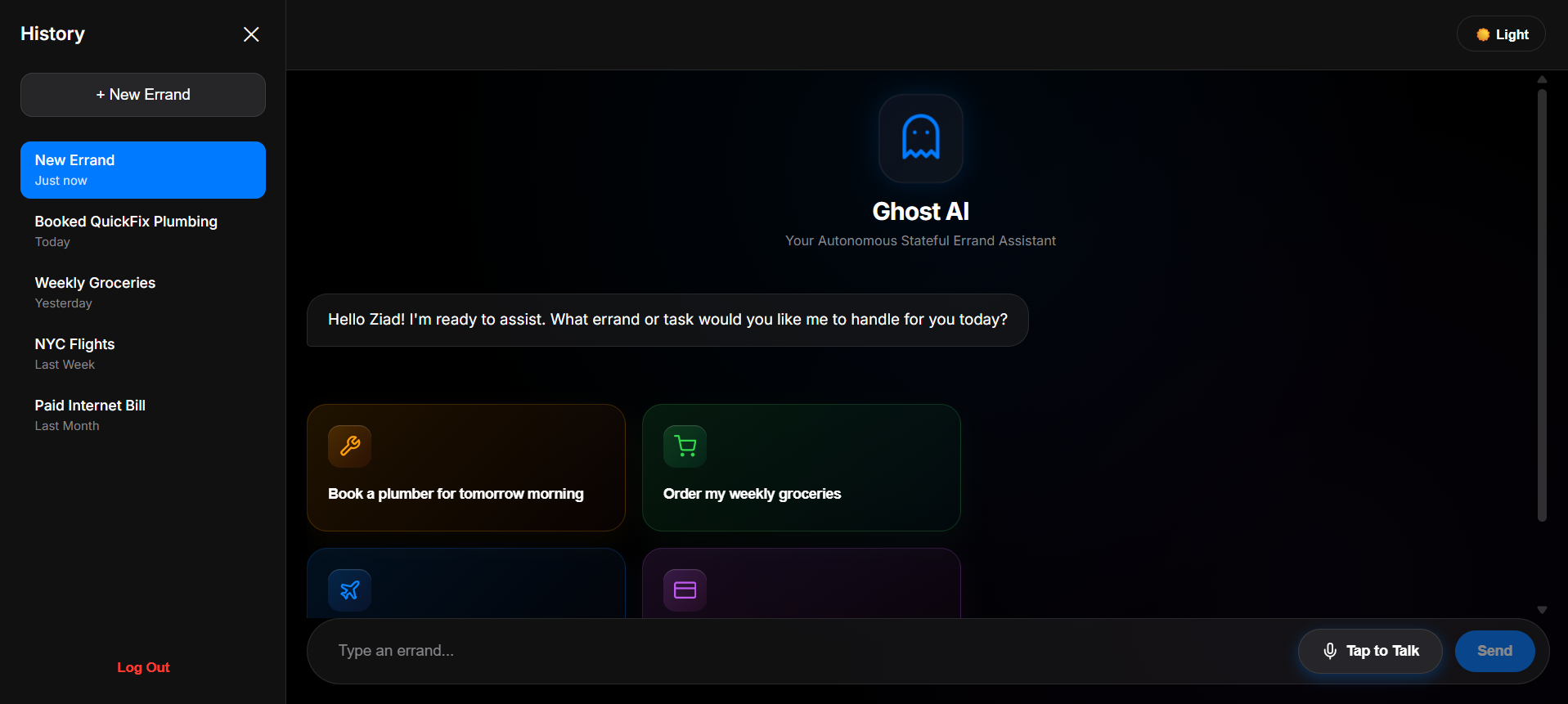
Dashboard Overview: Clean dark-mode interface with quick-action tiles, conversation history sidebar, and voice input controls.
-
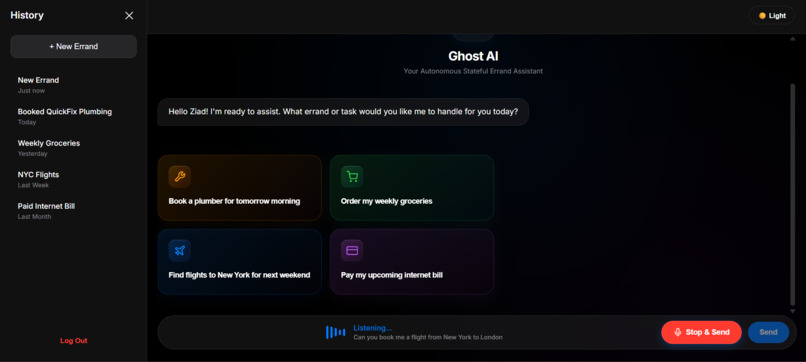
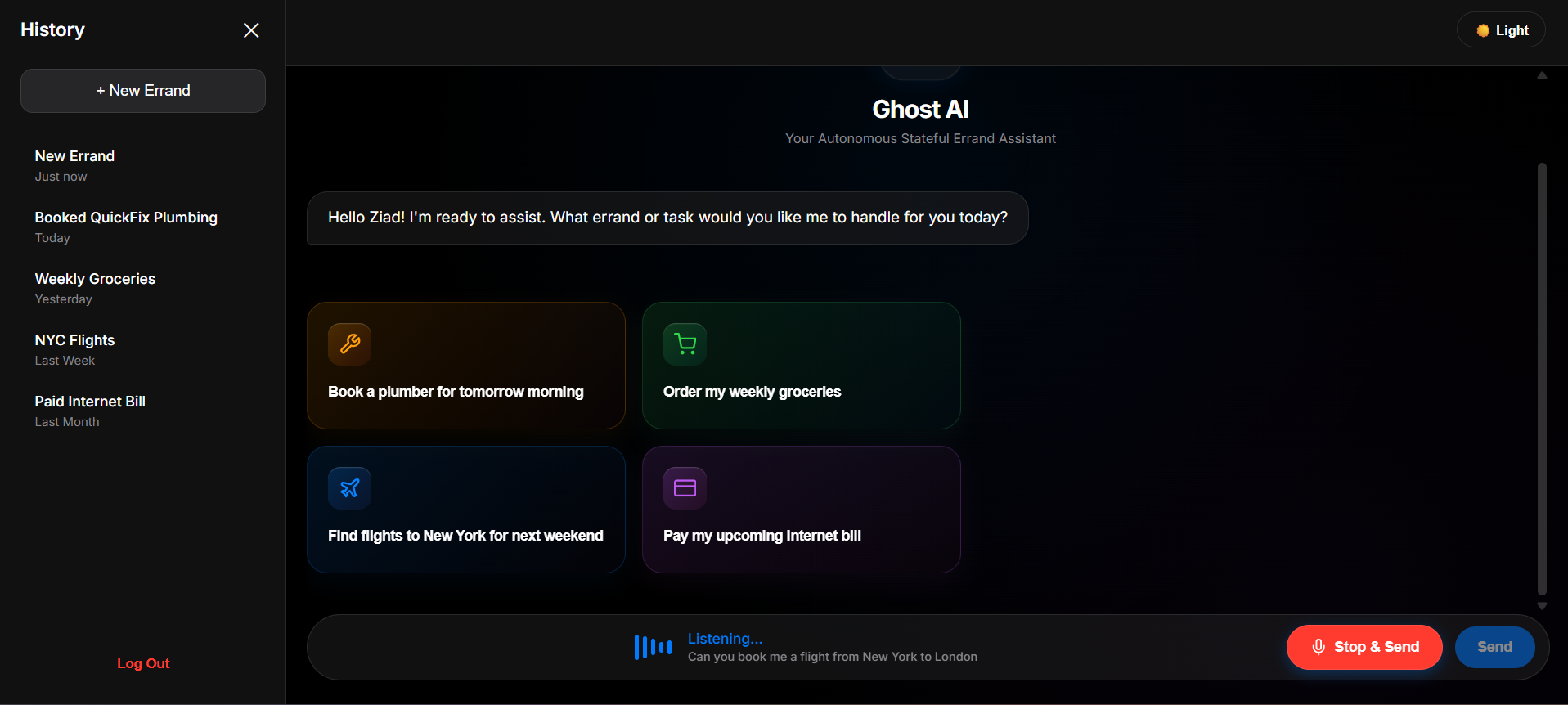
Voice Dictation: Real-time speech-to-text processing using the Web Speech API with live audio visualizer feedback.
Inspiration
Modern digital workflows are hindered by excessive fragmentation. Routine tasks—such as booking reservations, scheduling errands, or completing online transactions—frequently require users to navigate disjointed applications, manually enter data, and interact with cumbersome user interfaces.
Ghost AI was conceived to solve this friction through autonomous execution. By transforming natural language and voice dictation into structured operational workflows, Ghost AI acts as an intelligent proxy that bridges the gap between conversational AI and real-world utility.
What it does
Ghost AI is an autonomous AI proxy that converts natural language and voice dictation into scheduled errands, bookings, and completed transactions.
Unlike standard conversational chatbots that simply provide text responses, Ghost AI parses complex user intents, curates structured choices through a stateful multi-turn scenario engine, and executes secure real-world checkouts using the PayPal Sandbox API. Delivered via a sophisticated, Apple-inspired dark mode glassmorphic interface, it handles real-world logistics frictionlessly without any complex user configuration.
How we built it
Ghost AI was designed and built from the ground up leveraging Google Gemini as the primary AI development platform, utilizing a decoupled client-server architecture built for high performance, responsiveness, and reliability:
- AI-Assisted Engineering: Built using Google Gemini throughout the development lifecycle to architect full-stack React components, write async FastAPI REST endpoints, debug complex mobile PWA safe-area viewports, and structure agentic transaction routing.
- Frontend Interface: Developed using React and Vite, hosted on Vercel. Features a responsive off-canvas layout, fluid CSS transitions, and real-time audio visualizer components powered by browser-native Web Speech API voice parsing.
- Backend Intelligence & NLP: Built on Python with FastAPI, delivering high-throughput asynchronous REST endpoints and stateful multi-turn conversation parsing to turn natural language prompts into structured payloads.
- Payment Infrastructure: Integrated directly with the PayPal Developer REST API to support dynamic order creation, OAuth authentication, and asynchronous payment status polling.
- Mobile-First Engineering: Optimized for mobile viewports using
100dvhsizing, dynamic CSSsafe-area-insetpadding to prevent browser chrome and home-indicator clipping, and Progressive Web App (PWA) web-clip configurations.
Challenges we ran into
During the development lifecycle, our team navigated several complex technical challenges:
- Mobile Viewport Stabilization: Eliminating mobile layout shift and elastic scrolling issues by standardizing
box-sizing, enforcing rootoverflow: hidden, and implementing dynamic viewport height units (100dvh). - Safe-Area Compliance: Integrating
env(safe-area-inset-bottom)rules to ensure interactive elements, action bars, and input fields remain fully accessible above hardware home indicators on mobile devices. - iOS Caching Hurdles: Managing stubborn mobile springboard and web-clip caching behaviors on iOS during PWA configuration, ultimately focusing engineering efforts on flawless app execution and interface polish for the demo.
Accomplishments that we're proud of
- Successfully architecting a full-stack web application powered by Google Gemini AI guidance, transitioning seamlessly from natural language voice prompts to live API execution.
- Orchestrating a fully functioning multi-turn AI scenario engine with real-time intent parsing.
- Implementing a robust asynchronous transaction workflow with the PayPal Sandbox API, complete with real-time status polling and visual receipt states.
- Designing a sleek, high-end Apple-inspired glassmorphism UI with responsive touch targets and native mobile feel.
What we learned
- How to maximize Google Gemini as an AI pair programmer to rapidly generate, refactor, and debug production-grade full-stack code and backend logic.
- The critical importance of mobile-first CSS engineering when designing progressive web apps that bridge chat interfaces with native device features like the Web Speech API.
- How to architect robust stateful routing in FastAPI to support multi-turn conversational scenarios without dropping context or payment states.
What's next for Ghost AI-The Invisible Assistant
- Integrating deeper LLM models and API integrations to make the assistant even smarter, enabling broader semantic understanding of complex multi-intent requests.
- Expanding the multi-turn scenario engine to integrate directly with third-party service APIs, calendar booking systems, and live e-commerce webhooks.
- Enhancing multi-language support and voice command recognition to make hands-free errand execution completely universal.
- Refining cross-platform deployment pipelines for broader app store and PWA distribution.


