-
-
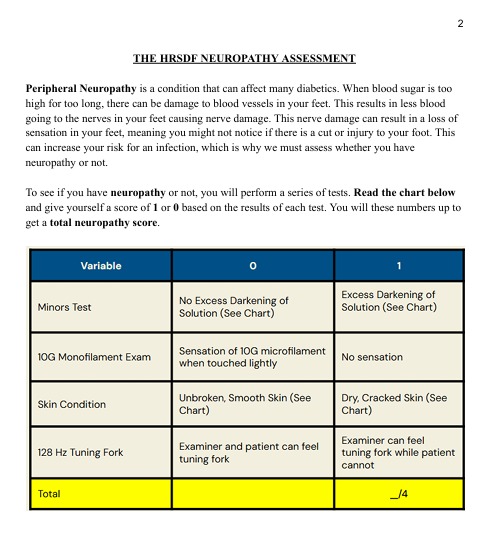
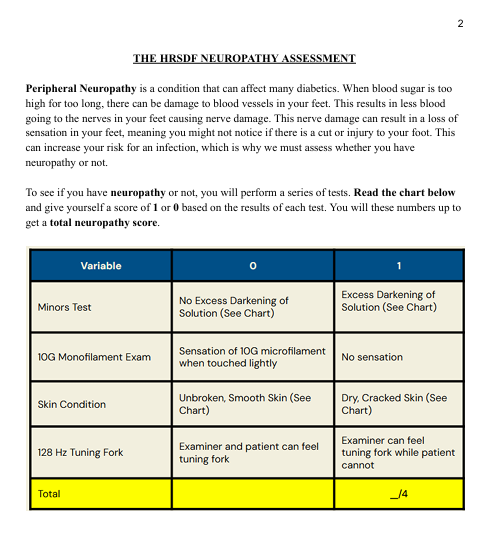
Sample page: Neuropathy Risk
-
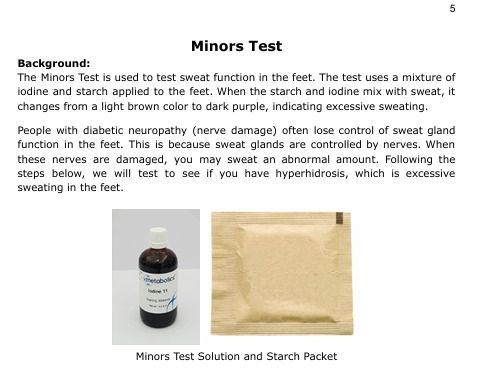
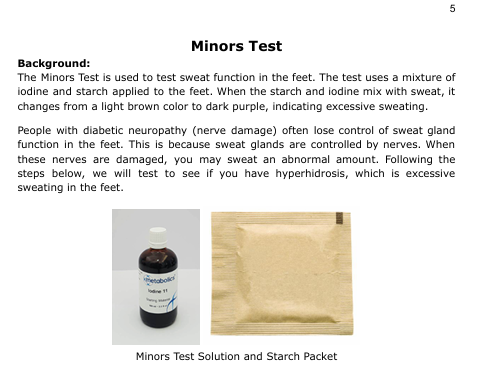
Sample page: Minors test page 1
-
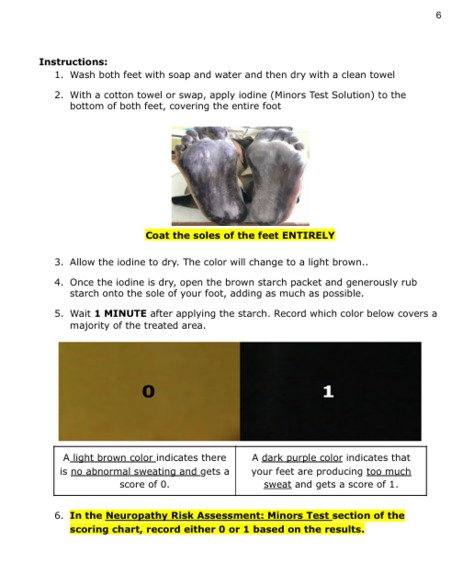
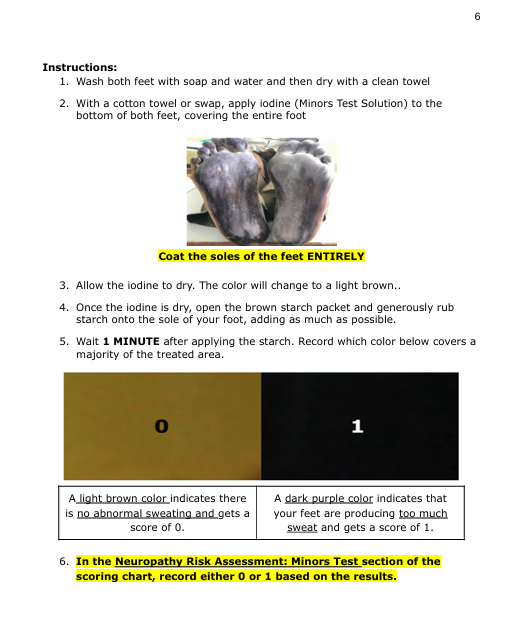
Sample page: Minors test page 2
-
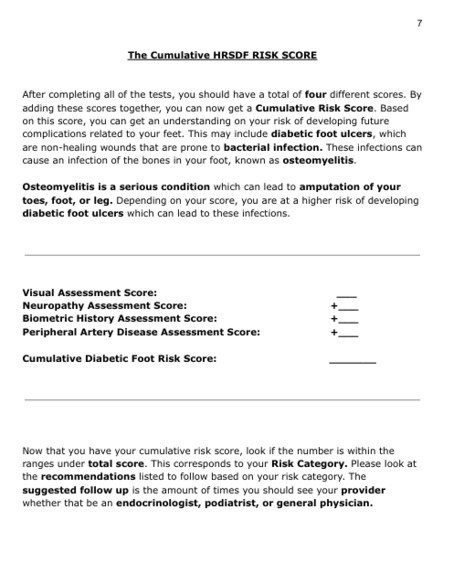
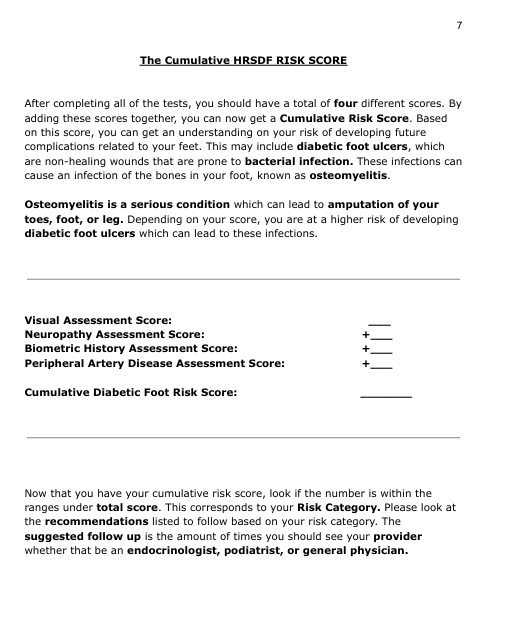
Cumulative Risk Form page 1
-
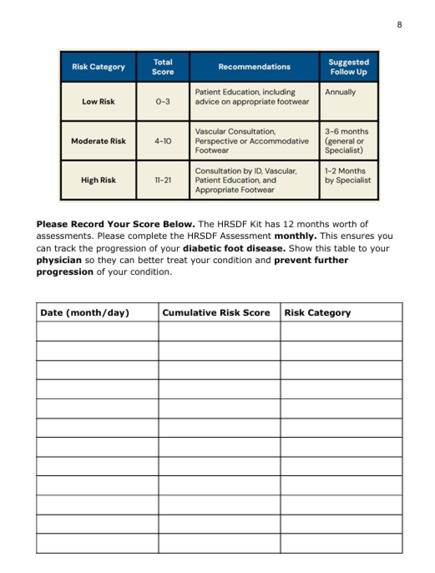
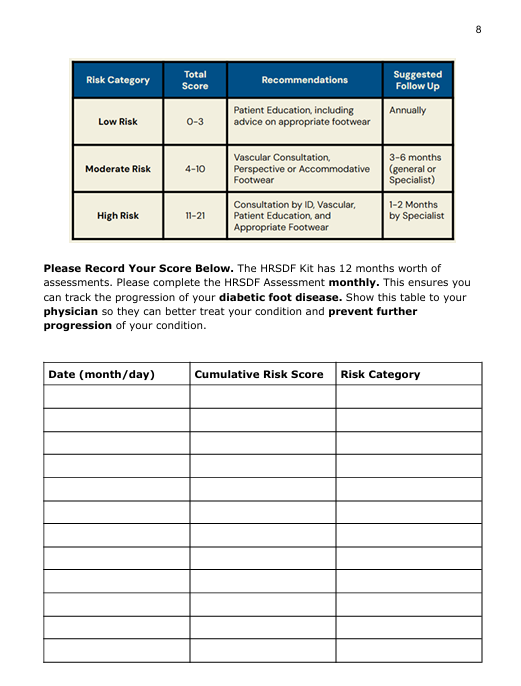
Cumulative Risk Form page 2
Inspiration
Our team comes from a diverse background. We are chemists, biologists, clinical researchers, and data scientists. Like many people, we know of loved ones who struggle with their health, either due to economic struggles, logistical difficulties, or social factors. This inspired us to create a way to not only assess their diabetic foot risk but also learn about diabetes complications in the process.
What it does
The Home Risk Assessment for Diabetic Foot Risk Assessment is a low cost, accessible, and reliable kit which contains a variety of assessments to determine the patient's risk of diabetic foot disease progression. Paired with the testing tools is a booklet that outlines how to perform the assessments, educational material on what the assessments test for, how to interpret their results, and what the next steps are for their risk category. Similar to how laboratory classes utilize active learning to enhance education, our assessment gives simple instructions while promoting patient engagement in their health. After a single test, the patient can have a better understanding on their condition and is given advice on what their next steps should be.
But this is only half of the story!
The HRSDF has enough testing supplies to provide 12 full monthly assessments. This means that one kit generates 12 data points to describe a patient's diabetic foot progression over a year. We developed the HRSDF Prognosis Prediction Model which utilizes a machine learning approach to determine an accurate prognosis for a patient based on their HRSDF score over even a few months. All a patient has to do is complete the assessment, and at their recommended follow-up, present the recorded scores to their clinician. The clinician can then use our Prognosis Prediction Model Software to generate a prognosis and begin more advanced interventions.
How we built it
For the model kit, along with the instructional and educational material, we researched how diabetic foot disease is detected early and treated. We had to find what leads to diabetic foot complications secondary to diabetic foot disease. We found that peripheral artery disease, neuropathy, deformities/visual symptoms, and biometric factors contribute to a patient's risk for diabetic foot complications. We then generated four assessments based on these factors, which add to a cumulative risk score. Each assessment utilizes tools that have been utilized in diabetic podiatry for decades, with proven validity when assessing risk. Along with this, we utilized advanced statistical analysis to further validate our assessments, with techniques such as Uni-LASSO, regression analysis, ROC curves and calibration curves.
We developed the HRSDF Prognosis Prediction Model, a machine learning system that powers a user-friendly software interface for clinicians. It generates forward-looking risk trajectories based on a patient’s cumulative HRSDF scores. To prioritize early detection, we use XGBoost — a model well-suited for clinical data — and optimize for high sensitivity to minimize false negatives. The system tracks how scores evolve over time and uses Univariate LASSO for feature selection, helping reduce redundancy and improve usability. Insights from model performance feedback into the scoring algorithm, allowing us to recalibrate thresholds and refine assessments with real-world data. Ultimately, the Prognosis Prediction Model transforms the HRSDF into an adaptive, data-driven platform for personalized diabetic foot care.
Challenges we ran into
A major challenge for us was determining how we could address the topic of patient education. Due to the sheer amount of patients, many clinicians have to meet with, consultation time between a patient and a generalist or specialist is limited. There is often little time for patient education outside of pamphlets that often fail to properly inform a patient about their condition. When developing our assessment, we realized we could format it into an educational experience through active learning, similar to how basic laboratory sciences are taught in high schools and universities. This doesn't just teach patients through reading but through doing! Through the act of completing the HRSDF assessment, they become informed at a level no simple pamphlet could accomplish.
Accomplishments that we're proud of
Among our proudest accomplishments is our ability to create a tool that is not only affordable and scalable but also grounded in clinical evidence. We’re especially proud of how we balanced real-world feasibility with technical rigor — integrating patient education, non-clinical usability, and machine learning into one cohesive, validated solution. This project has the potential to transform how diabetic foot disease is screened and managed in underserved communities.
What's next for The Home Risk Screening Assessment for Diabetic Foot
We hope to first explore whether this system works in low-resource areas near us in a small, short-term study. This may be done through Grady Memorial Hospital or Emory Hospital, but this short-term study could act as our proof of concept to pursue further validation and implementation of this scale. In the future, we hope to contact hospitals such as Apollo Hospital in Chennai, or Breach Candy Hospital in Mumbai, to explore an implementation study in rural and urban areas of India to flush out and fully validate this study. If the HRSDF proves effective in India, not just on a clinical level but a social level as well, we then would hope to expand to other countries that face similar problems, such as Vietnam, Cambodia, China, and Mexico.
Built With
- lasso
- uni-lasso
- xgboost


Log in or sign up for Devpost to join the conversation.