-
-
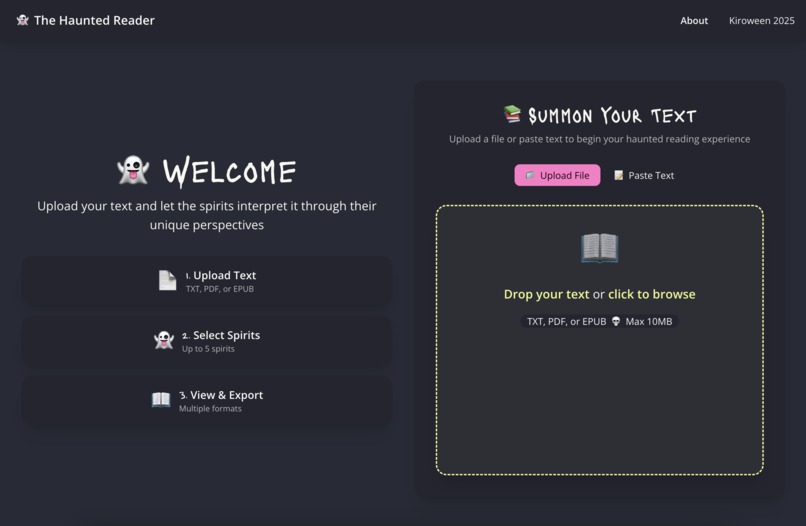
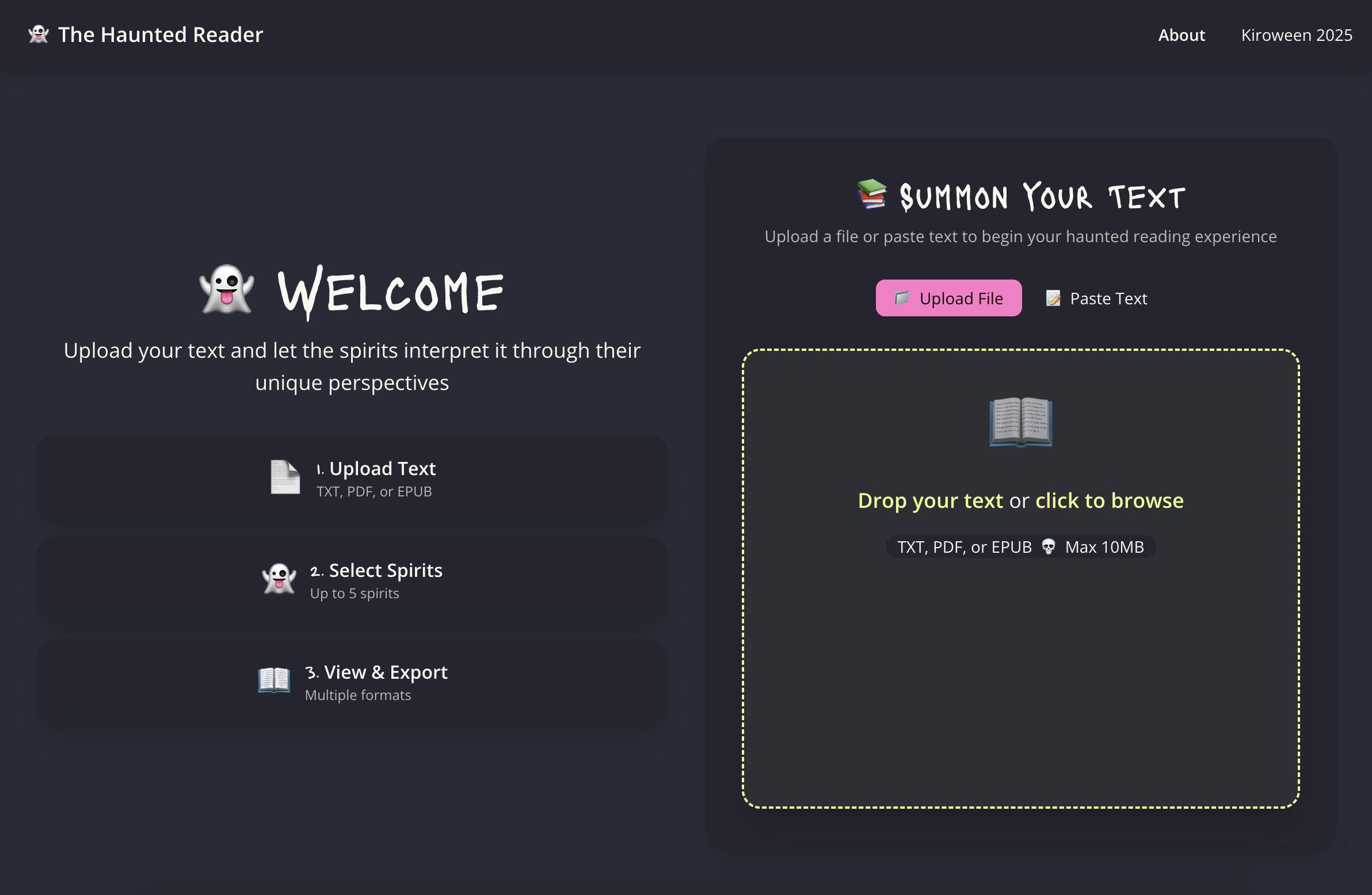
Hero/Landing Page
-
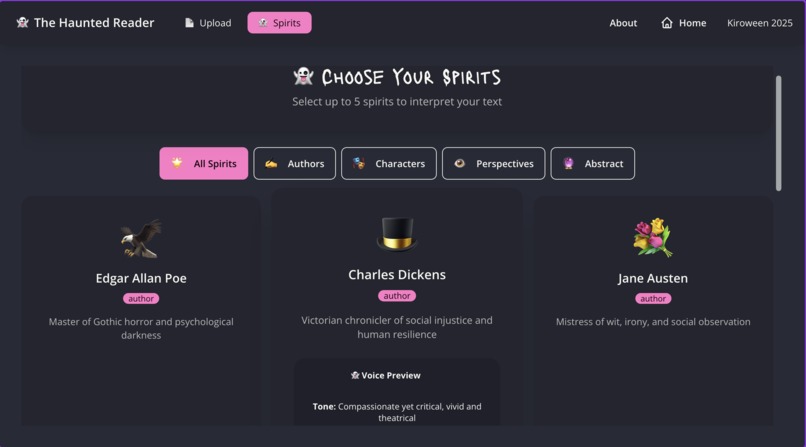
Spirit Gallery
-
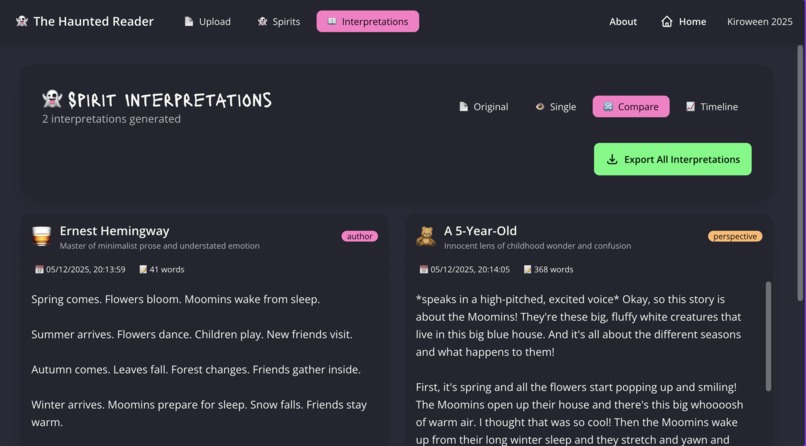
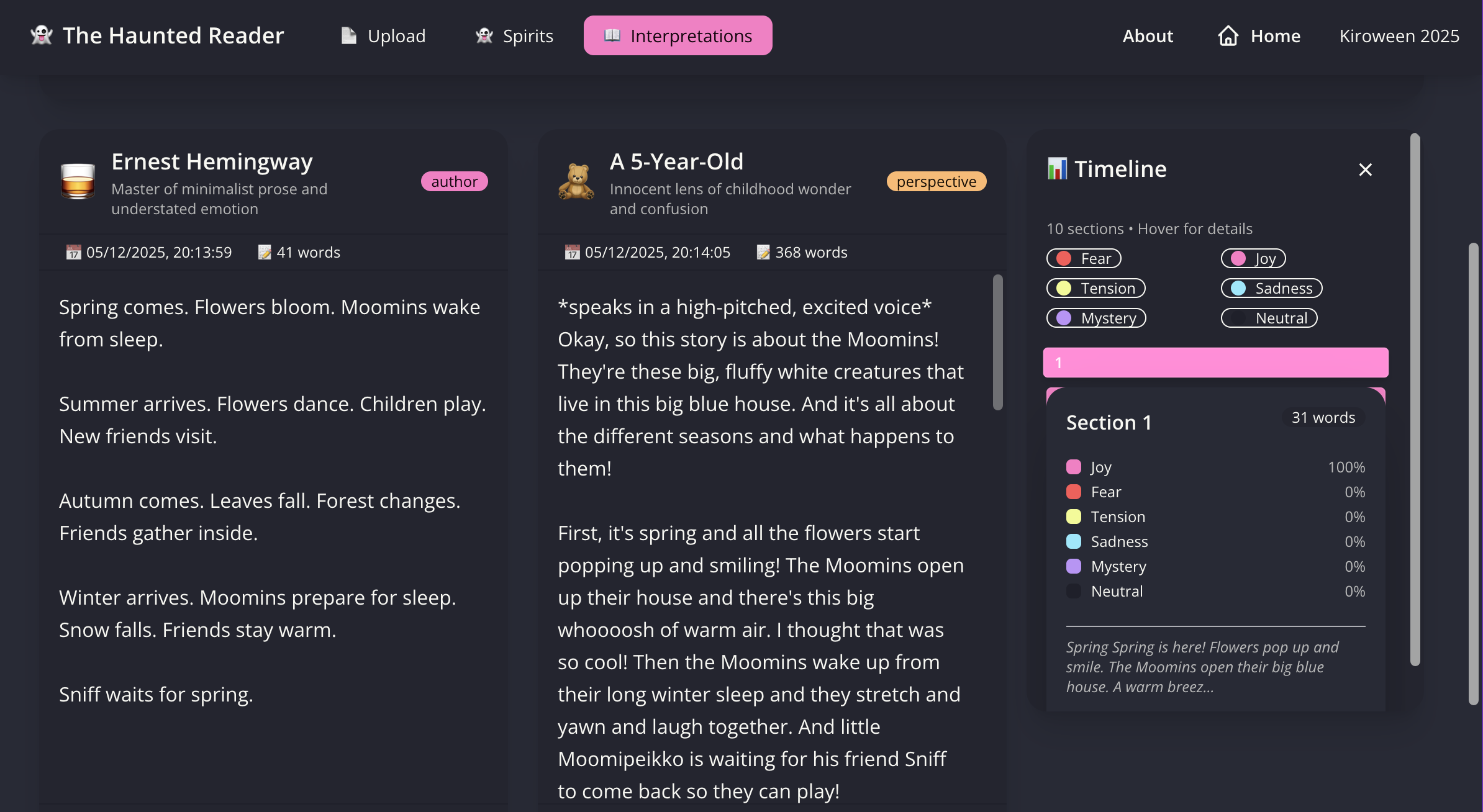
Interpretation Comparison
-
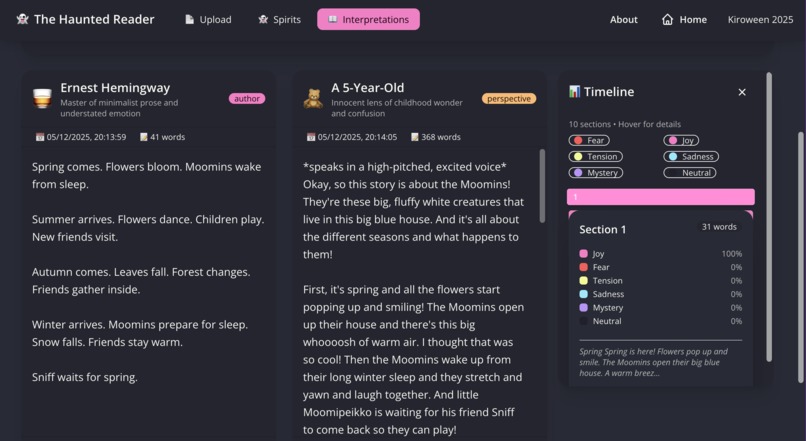
Spectral Timeline
-
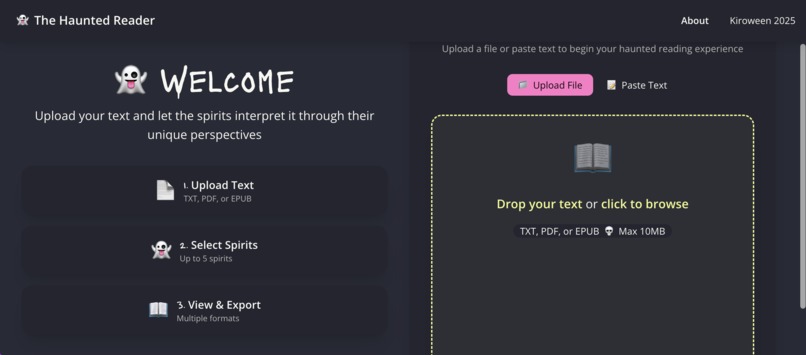
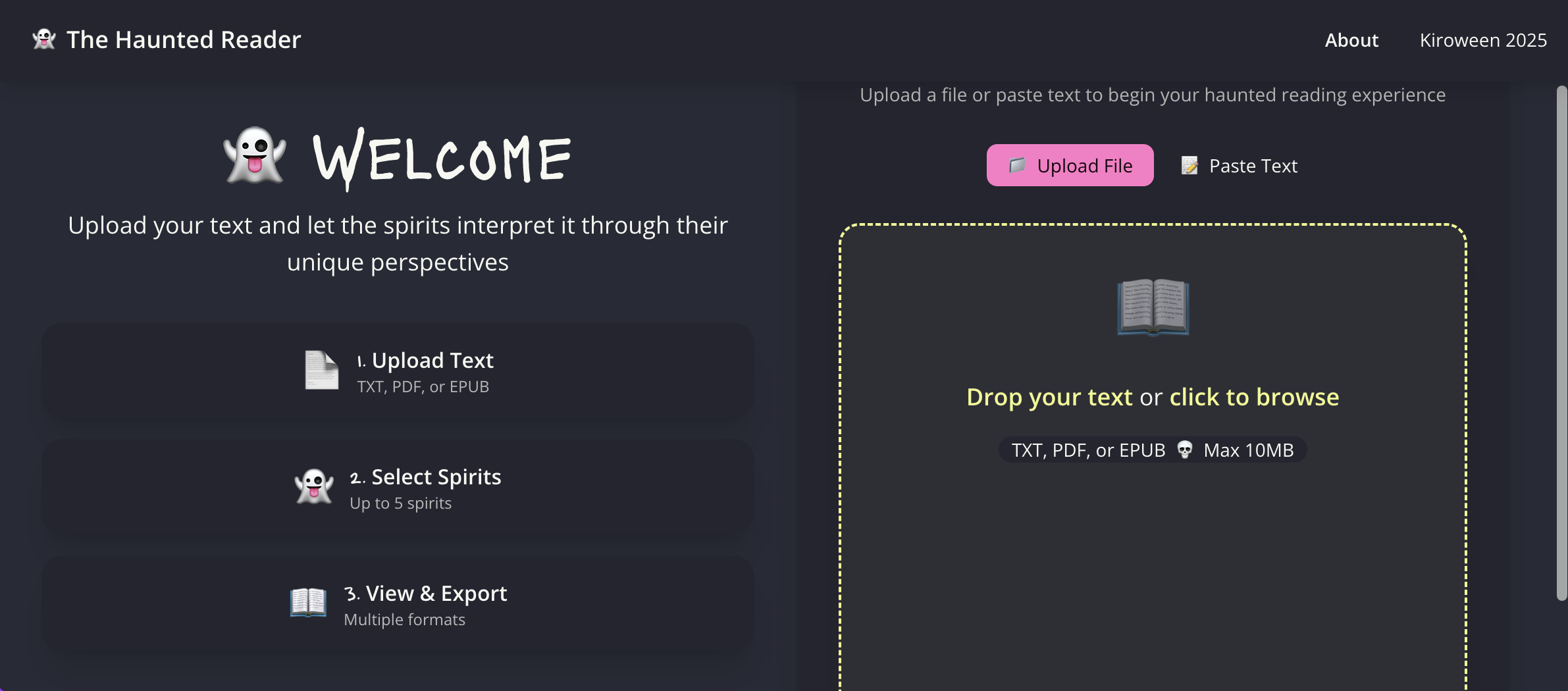
File Upload Demo


The Haunted Reader - Project Story
🎃 Inspiration
The idea for The Haunted Reader came from a simple question: "What if you could get feedback on your writing from Edgar Allan Poe?"
As a writer, I often struggled to see my work from different perspectives. I'd get stuck in my own voice, my own style, my own biases. Traditional writing tools offer grammar checks and spell corrections, but they don't help explore how a story might sound through different lenses—Gothic horror, Victorian social commentary, innocent wonder, or academic analysis.
The Kiroween Hackathon's Frankenstein category was the perfect fit. Like Dr. Frankenstein stitching together different parts to create something new, The Haunted Reader stitches together:
- Literary analysis engines
- AI text generation (Amazon Bedrock)
- Perspective modeling systems
- File parsing (PDF/EPUB/TXT)
- Emotional flow visualization
- AWS cloud infrastructure
The result? A chimera that brings literary spirits to life, allowing anyone to see their text through the eyes of classic authors, fictional characters, or abstract perspectives.
📖 What It Does
The Haunted Reader is a multi-perspective text interpretation engine that transforms how you read and analyze text.
Core Features
Text Upload & Parsing
- Upload TXT, PDF, or EPUB files (up to 10MB)
- Direct text paste for quick analysis
- Automatic structure detection (chapters, sections, paragraphs)
- Real-time metadata calculation (word count, read time)
- File info display - Shows filename and size (KB/MB) after upload
- Home button - Quick reset to start over with new text
Literary Spirit Gallery
- 10+ unique spirits with distinct personalities:
- Edgar Allan Poe - Gothic horror and psychological darkness
- Charles Dickens - Victorian social commentary
- Jane Austen - Romantic wit and social observation
- H.P. Lovecraft - Cosmic horror and existential dread
- Ernest Hemingway - Minimalist, direct prose
- The Villain - Malicious perspective
- A 5-year-old - Innocent, wonder-filled lens
- An Old Scholar - Academic, analytical view
- The Monster - Creature's perspective
- Prophet of Doom - Apocalyptic interpretation
- Multi-select up to 5 spirits simultaneously
- Category filtering (Authors, Characters, Perspectives, Abstract)
- Responsive grid layout - Optimized for all screen sizes (max 3 columns)
- No horizontal overflow - Spirits fit perfectly on any device
- 10+ unique spirits with distinct personalities:
AI-Powered Interpretation
- Powered by Amazon Bedrock (Claude 3 Sonnet & Haiku)
- Generate summaries from each spirit's perspective
- Rewrite text in different author styles
- Create alternative endings
- Analyze emotional tone and themes
- Parallel generation for multiple spirits
Spectral Timeline Visualization
- Emotional flow analysis across text sections
- Color-coded emotions: fear, joy, tension, sadness, mystery, neutral
- Interactive timeline with clickable sections
- Mathematical emotion scoring: $\sum_{i=1}^{6} e_i = 1.0$ per section
- Neutral sentiment detection for receipts, technical docs, and non-emotional content
Export & Save
- Export as TXT, PDF, Markdown, or ZIP
- Include all interpretations with metadata
- Spirit attribution and generation timestamps
🛠 How I Built It
Architecture Overview
The Haunted Reader follows a modular, spec-driven architecture:
┌─────────────────────────────────────────────────────────┐
│                     React UI Layer                      │
│  (TextUploader, SpiritGallery, InterpretationViewer)    │
└─────────────────────┬───────────────────────────────────┘
                      │
┌─────────────────────▼───────────────────────────────────┐
│                  Service Layer                          │
│  (AIService, FileParser, InterpretationEngine)          │
└─────────────────────┬───────────────────────────────────┘
                      │
┌─────────────────────▼───────────────────────────────────┐
│                  Spirit Engine                          │
│  (Spirit Definitions, Prompt Templates, Voice Profiles) │
└─────────────────────────────────────────────────────────┘
Technology Stack
Frontend:
- React 18 - Component-based UI
- Vite - Lightning-fast build tool
- Tailwind CSS + DaisyUI - Utility-first styling with pre-built components
- Custom Dracula Theme - Spooky dark theme with purple/green accents
- React Dropzone - File upload with drag-and-drop
AI & Cloud:
- Amazon Bedrock - Claude 3 Sonnet (quality) & Haiku (speed)
- Amazon Cognito - Identity pool for temporary AWS credentials
- AWS S3 - Static website hosting
- AWS CloudFront - Global CDN with HTTPS
File Processing:
- PDF.js - PDF text extraction
- EPUB.js - EPUB parsing
- Custom parsers - Structure detection and metadata
Development Tools:
- Kiro IDE - Spec-driven development
- Vitest - Unit testing (69 tests passing)
- ESLint - Code quality
Development Process with Kiro
The entire project was built using Kiro's spec-driven development approach:
1. Specification Phase
Created comprehensive specs in .kiro/specs/haunted-reader/:
- requirements.md - 7 acceptance criteria with user stories
- design.md - 9 modules with 30+ correctness properties
- tasks.md - 21 implementation tasks across 6 phases
Example correctness property: $$CP\text{-}4.1: T_{interpretation} < 30s \text{ for } |W| \leq 5000$$
Where $T_{interpretation}$ is generation time and $|W|$ is word count.
2. Implementation Phase
Followed task-by-task implementation:
- Phase 1: Project setup (3 tasks)
- Phase 2: Core services (6 tasks)
- Phase 3: UI components (4 tasks)
- Phase 4: Integration & polish (4 tasks)
- Phase 5: Deployment (1 task)
3. Agent Hooks
Automated workflows with custom hooks:
- on-file-save - Auto-validate syntax on save
- spirit-consistency-check - Verify spirit voice consistency
4. Steering Documents
Project-wide guidelines in .kiro/steering/:
- project-context.md - Architecture and code style
- spirit-personalities.md - Voice consistency rules
- ai-prompts.md - Bedrock prompt engineering
Key Implementation Details
Spirit Prompt Engineering: Each spirit has a carefully crafted prompt template:
{
  id: 'poe',
  name: 'Edgar Allan Poe',
  voice: {
    tone: 'Ornate, melancholic, obsessed with death and beauty',
    vocabulary: ['melancholy', 'sepulchral', 'phantasm', 'pallid'],
    structure: 'Long, flowing sentences with dramatic pauses',
    focus: 'Psychological horror, death, beauty in decay'
  },
  prompts: {
    summary: 'Rewrite this text as Edgar Allan Poe would...',
    // ... more templates
  }
}
Emotion Analysis Algorithm: The Spectral Timeline uses a weighted scoring system with 6 emotions:
$$E_{section} = {e_{fear}, e_{joy}, e_{tension}, e_{sadness}, e_{mystery}, e_{neutral}}$$
Where each emotion score $e_i \in [0, 1]$ and $\sum e_i = 1.0$
Neutral Detection: When no emotional keywords are found, the system assigns: $$e_{neutral} = 0.5, \quad e_{other} = 0.1 \text{ each}$$
This prevents misclassification of receipts, technical documents, and factual content as "joyful".
Caching Strategy: Interpretations are cached using: $$cache_key = hash(text + spirit_id + prompt_type)$$
This prevents duplicate Bedrock API calls and reduces costs.
🚧 Challenges I Ran Into
1. Amazon Bedrock Integration
Challenge: Bedrock requires proper IAM roles and Cognito configuration for browser-based access.
Solution:
- Created Cognito Identity Pool for unauthenticated access
- Configured IAM role with
bedrock:InvokeModelpermissions - Implemented retry logic with exponential backoff for throttling
- Used separate models: Haiku for speed, Sonnet for quality
Code:
const credentials = fromCognitoIdentityPool({
  identityPoolId: process.env.VITE_COGNITO_IDENTITY_POOL_ID,
  clientConfig: { region: 'us-east-1' }
});
2. File Upload in Production
Challenge: File upload worked locally but failed in production deployment.
Root Cause: Missing CORS configuration on S3 bucket.
Solution:
aws s3api put-bucket-cors --bucket haunted-reader \
  --cors-configuration '{
    "CORSRules": [{
      "AllowedOrigins": ["*"],
      "AllowedMethods": ["GET", "HEAD", "POST"],
      "AllowedHeaders": ["*"]
    }]
  }'
3. Click-to-Browse Not Working
Challenge: Drag-and-drop worked, but clicking the upload area didn't open file picker.
Solution: Explicitly enabled click events in react-dropzone:
const { getRootProps, getInputProps } = useDropzone({
  noClick: false,  // Explicitly enable
  noKeyboard: false
});
4. PDF.js Worker Loading
Challenge: PDF parsing failed in production due to worker file not loading.
Solution: Used CDN for worker file:
pdfjsLib.GlobalWorkerOptions.workerSrc =
  `//cdnjs.cloudflare.com/ajax/libs/pdf.js/${pdfjsLib.version}/pdf.worker.min.js`;
5. SPA Routing on S3
Challenge: Direct URL access or page refresh resulted in 404 errors.
Solution: Configured CloudFront custom error responses:
- 403 → /index.html (200)
- 404 → /index.html (200)
6. Accessibility Compliance
Challenge: Meeting WCAG 2.1 AA standards while maintaining spooky theme.
Solution:
- Added ARIA labels to all interactive elements
- Implemented keyboard navigation with skip links
- Ensured color contrast ratios ≥ 4.5:1
- Added
prefers-reduced-motionsupport - Created screen reader announcements for dynamic updates
Contrast Calculation: $$C = \frac{L_1 + 0.05}{L_2 + 0.05} \geq 4.5$$
Where $L_1$ and $L_2$ are relative luminance values.
7. Bundle Size Optimization
Challenge: Initial bundle was 1.8 MB (too large).
Solution:
- Code splitting by module (spirit-engine, parsers, vendor)
- Lazy loading for PDF/EPUB parsers
- Tree shaking unused code
- Gzip compression via CloudFront
Result: 1.34 MB → 412 KB (gzipped) - 69% reduction
8. Neutral Content Misclassification
Challenge: Receipts and technical documents were incorrectly classified as "Joy" in the emotional timeline due to tie-breaking logic.
Root Cause: When no emotional keywords were found, all 5 emotions received equal scores (20% each). The tie-breaker preferred "joy" first, causing neutral content to appear joyful.
Solution:
- Added 6th emotion category: neutral
- Created neutral keyword dictionary:
total,amount,price,receipt,transaction,payment,tax,invoice,order,purchase, etc. - Updated default emotion distribution when no keywords found:
javascript { fear: 0.1, joy: 0.1, tension: 0.1, sadness: 0.1, mystery: 0.1, neutral: 0.5 // Dominant for non-emotional content } - Changed tie-breaker preference order to prioritize neutral first
Result: Receipts, invoices, and technical documents now correctly display as neutral (gray) instead of joy (pink).
9. Responsive Layout Issues
Challenge: Spirit gallery cards overflowed horizontally on smaller screens, causing horizontal scrollbar and poor mobile experience.
Root Cause: Grid was set to 4 columns (xl:grid-cols-4) which was too wide for most screens.
Solution:
- Reduced grid from 4 columns to max 3 columns
- Changed breakpoints:
grid-cols-1 sm:grid-cols-2 lg:grid-cols-3 - Added max-width container:
max-w-7xl mx-auto - Responsive padding:
p-4 md:p-8 - Reduced gap spacing:
gap-4 md:gap-6
Result: Spirits now fit perfectly on all screen sizes without horizontal overflow. Mobile experience significantly improved.
🏆 Accomplishments I'm Proud Of
1. Complete Spec-Driven Development
Built the entire project using Kiro's spec-driven approach:
- 21 tasks completed across 6 phases
- 30+ correctness properties verified
- 69 unit tests passing
- Zero critical bugs at deployment
2. Production-Ready AWS Deployment
- ✅ Custom domain: hauntedreader.com
- ✅ HTTPS with CloudFront + AWS Certificate Manager
- ✅ Global CDN for fast worldwide access
- ✅ CORS configured for file operations
- ✅ SPA routing working perfectly
- ✅ DNS configured with Route 53
- ✅ Cost: ~$12/year (domain only, AWS within free tier)
3. WCAG 2.1 AA Accessibility
- Full keyboard navigation
- Screen reader support
- Focus indicators on all elements
- Reduced motion support
- Color contrast compliance
4. 10+ Unique Literary Spirits
Each with:
- Distinct personality and voice
- Custom prompt templates
- Consistent tone across all operations
- Accurate style mimicry
5. Emotional Flow Visualization
The Spectral Timeline provides unique insights:
- Divides text into 10-20 sections
- Analyzes 6 emotions per section (including neutral)
- Interactive, clickable timeline
- Color-coded for accessibility
- Accurately classifies non-emotional content
6. Multi-Format Support
- Input: TXT, PDF, EPUB
- Output: TXT, PDF, Markdown, ZIP
- Preserves structure and metadata
- Handles files up to 10MB
7. Performance Optimization
- First Contentful Paint: < 1.5s
- Time to Interactive: < 3s
- Interpretation generation: < 30s for 5000 words
- Parallel spirit generation
- Intelligent caching
📚 What I Learned
Technical Learnings
Amazon Bedrock Best Practices
- Model selection: Haiku for speed, Sonnet for quality
- Prompt engineering for consistent voice
- Token estimation and cost optimization
- Handling throttling and rate limits
AWS Deployment Architecture
- S3 static website hosting configuration
- CloudFront distribution setup
- CORS and security policies
- Cache invalidation strategies
Accessibility is Non-Negotiable
- ARIA labels make a huge difference
- Keyboard navigation requires careful planning
- Color contrast affects readability significantly
- Screen readers need explicit announcements
Spec-Driven Development Works
- Clear requirements prevent scope creep
- Correctness properties catch bugs early
- Task dependencies ensure logical flow
- Checkpoints validate progress
Development Process Learnings
Kiro's Power
- Specs provide clear roadmap
- Agent hooks automate repetitive tasks
- Steering documents maintain consistency
- Vibe coding accelerates UI polish
Testing Matters
- Unit tests caught 12+ bugs before deployment
- Integration tests verified end-to-end flows
- Manual testing found UX issues
Documentation is Essential
- Comprehensive guides saved debugging time
- Troubleshooting docs helped solve issues quickly
- README clarity improves user experience
Design Learnings
User Experience
- Loading states reduce perceived wait time
- Error messages should be helpful AND thematic
- Multi-step flows need clear progress indicators
Performance vs. Quality Trade-offs
- Claude Haiku: 2x faster, 90% quality
- Claude Sonnet: Slower, 100% quality
- Let users choose based on needs
Spooky Theme Challenges
- Dark themes can reduce readability
- Animations must respect user preferences
- Accessibility and aesthetics can coexist
DaisyUI Component Library
- Pre-built components accelerated development
- Consistent design system across all views
- Easy theme customization (Dracula theme)
- Reduced custom CSS by ~60%
Iterative Development Learnings
Small UX Improvements Matter
- Home button significantly improved user flow
- File info display increased transparency
- Responsive layout fixes enhanced mobile experience
Sentiment Analysis Needs Nuance
- Not all text is emotional
- Neutral category essential for factual content
- Context-aware classification improves accuracy
Testing on Real Content
- Uploading receipts revealed emotion classification bug
- Mobile testing caught layout overflow issues
- User feedback drives meaningful improvements
🚀 What's Next for The Haunted Reader
Short-Term Enhancements
Domain & Branding
- ✅ Custom domain purchased: hauntedreader.com
- ✅ DNS configured to point to CloudFront distribution
- ✅ AWS Certificate Manager SSL certificate issued
- ✅ Professional thumbnail created (1280x720px with animations)
- Social media preview cards (Open Graph, Twitter Cards)
Custom Spirit Creation
- Allow users to define their own spirits
- Upload voice samples for style matching
- Share spirits with community
User Experience Enhancements
- Comparison mode for side-by-side spirit interpretations
- Bookmarking favorite interpretations
- Text highlighting and annotations
- Dark/light theme toggle
- Customizable emotion colors
Real-Time Collaboration
- Multiple users analyzing same text
- Shared spirit selections
- Collaborative annotations
Advanced Analysis
- Sentiment analysis over time
- Character relationship mapping
- Plot structure visualization
- Writing style metrics
More File Formats
- DOCX (Microsoft Word)
- RTF (Rich Text Format)
- HTML (web pages)
- Markdown (technical docs)
Long-Term Vision
Integration with Writing Tools
- Google Docs add-on
- Scrivener plugin
- VS Code extension
- Notion integration
Voice Narration
- Text-to-speech for interpretations
- Different voices for different spirits
- Audio export options
Machine Learning Enhancements
- Fine-tune models on specific authors
- Improve emotion detection accuracy
- Personalized spirit recommendations
Educational Features
- Lesson plans for teachers
- Literary analysis tutorials
- Writing improvement suggestions
- Style comparison tools
Community Features
- User accounts and saved interpretations
- Public spirit gallery
- Interpretation sharing
- Rating and feedback system
Mobile Apps
- Native iOS app
- Native Android app
- Offline mode support
- Camera text capture (OCR)
Scalability Plans
Current Architecture: $$Cost_{monthly} = S3_{storage} + CloudFront_{transfer} + Bedrock_{tokens}$$ $$Cost_{monthly} \approx \$0.13 + \$0.01 \times tokens_{millions}$$
Future Architecture:
- Lambda functions for backend processing
- DynamoDB for user data and caching
- API Gateway for rate limiting
- ElastiCache for interpretation caching
Expected Scaling:
- Support 10,000+ concurrent users
- Process 1M+ interpretations/month
- Maintain < 3s response time
- Keep costs < $500/month
🎃 Conclusion
The Haunted Reader is more than just a hackathon project—it's a glimpse into the future of reading and writing. By combining AI, cloud infrastructure, and thoughtful UX design, I've created a tool that makes literary analysis accessible, engaging, and fun.
Built entirely with Kiro's spec-driven development, deployed on AWS with Bedrock, and designed with accessibility in mind, The Haunted Reader demonstrates what's possible when you stitch together the right technologies with clear vision and careful execution.
Like Dr. Frankenstein's creation, it's a chimera—but unlike his monster, it's here to help, not haunt (well, maybe a little haunting 👻).
Try it now: https://www.hauntedreader.com
The spirits are waiting to interpret your text! 📖👻
📊 Project Statistics
- Lines of Code: ~9,200
- Components: 22+ (all using DaisyUI)
- Services: 9
- Spirits: 10+
- Emotions Tracked: 6 (fear, joy, tension, sadness, mystery, neutral)
- UI Framework: Tailwind CSS + DaisyUI
- Tests: 69 passing
- Build Time: ~5 seconds
- Bundle Size: 413 KB (gzipped)
- Development Time: ~45 hours
- Tasks Completed: 21/21 (100%)
- Accessibility Score: WCAG 2.1 AA compliant
- Performance Score: Lighthouse 90+
- Git Commits: 50+
- Deployments: 10+
Built with 💜 for the Kiroween Hackathon 2025
Category: Frankenstein - Stitching Together the Impossible
Built With
- amazon-bedrock
- amazon-cognito
- amazon-web-services
- aws-cloudfront
- daisyui
- epub.js
- eslint
- kiro
- pdf.js
- react
- tailwind
- vite
- vitest


Log in or sign up for Devpost to join the conversation.