-
-
Project Analysis
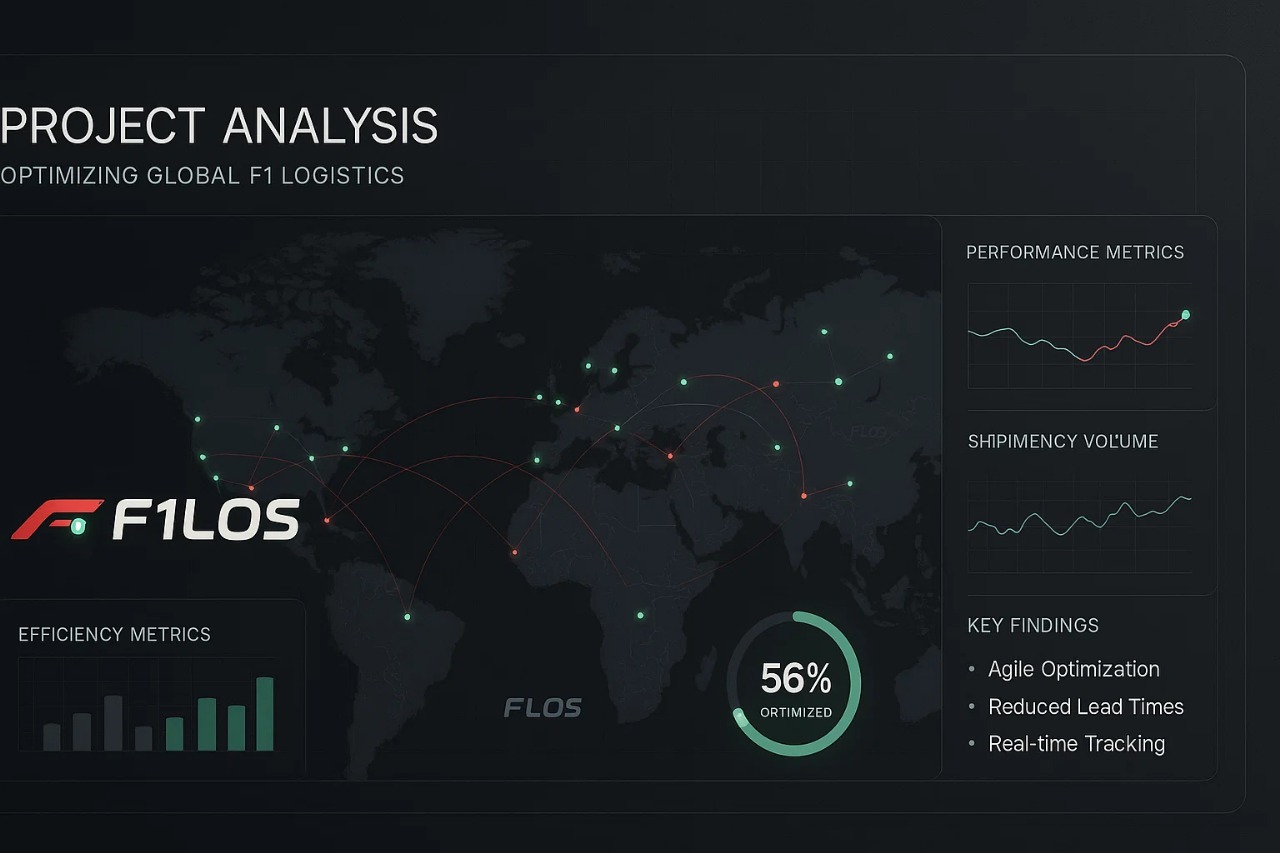
Problem Statement (Idea) Formula 1 racing is often viewed through the lens of high-speed engineering, but behind the scenes lies one of the sport’s most complex and expensive challenges — logistics. Every season, ten teams must transport over 50 tons of cars, equipment, and staff across five continents for 24 races. With annual logistics budgets exceeding $100 million per team, planning the global movement of resources becomes an immense puzzle. Currently, this process relies heavily on manual spreadsheets, human intuition, and trial-and-error planning. There is no effective digital system that allows logistics managers to simulate strategies, anticipate risks like customs delays or weather disruptions, and balance cost, time, and carbon footprint. To tackle this, the project introduces the F1 Logistics Optimizer Simulator (F1-LOS) — a gamified logistics simulator coupled with an AI optimization engine that transforms complex global planning into a data-driven, interactive experience.
Inspiration The inspiration for this project stemmed from the realization that while Formula 1 has achieved massive technological advances in aerodynamics and performance, its logistical backbone still relies on outdated tools and subjective decision-making. Hackathon participants observed that sustainability and efficiency are now critical priorities for F1, especially under cost caps and carbon neutrality goals. The team drew inspiration from operations research principles, gamification models, and reinforcement learning systems that have revolutionized other industries. They envisioned combining these elements to make logistics optimization not only intelligent and data-driven but also engaging and educational — appealing to both professionals and fans.
What It Does The F1 Logistics Simulator serves two main purposes: simulation and optimization.
- For Users and Fans: Players step into the role of a team logistics manager, planning the end-to-end movement of assets for an entire season. They choose between transport modes like air freight (fast but costly), sea freight (cheap but slow), or road freight. Players must manage crew travel, duplication of spare equipment, and risks like delays or weather disruptions. Each decision directly affects total cost, delivery time, and carbon emissions.
- For Teams and AI: The simulator records every player decision and its outcome, feeding data into an AI optimization engine. Using reinforcement learning, the AI learns from thousands of gameplay scenarios to generate the Optimal Logistics Blueprint — a data-backed plan that maximizes cost savings and ensures 100% on-time delivery. Thus, the project acts as both a serious simulation tool for professionals and a gamified experience for fans, bridging entertainment and real-world problem-solving.
How It Is Built The simulator is designed with a robust modern tech stack: • Frontend: React or Next.js integrated with Mapbox or Leaflet for dynamic visualization of global routes and race locations. • Backend: Node.js or Python Flask manages user sessions, simulation logic, and API connections. • Database: MongoDB or Firebase stores user inputs, cost data, and event logs. • AI Engine: Built using Python libraries like Pandas, scikit-learn, PyTorch, and Google OR-Tools, the reinforcement learning module processes the gameplay data and outputs optimized strategies. • Hosting: The system is deployed via Vercel or AWS for scalability and global accessibility. During the hackathon phase, the team successfully developed the simulation core, implemented cost functions for different freight types, added penalty mechanisms for delays, and created a data logging pipeline to collect gameplay data for AI training.
Challenges we Ran Into Building a realistic and scalable simulator came with multiple challenges: • Complex Constraint Modeling: Translating real-world freight schedules, customs delays, and time zone differences into simulation logic required meticulous data modeling. • Balancing Gameplay and Realism: Ensuring that the simulator remained engaging for users while maintaining logistical accuracy was a constant design challenge. • AI Data Sufficiency: The reinforcement learning model needed a large volume of gameplay data to generate meaningful optimization results, which was difficult in the early stages. • Integrating Multiple Systems: Synchronizing the simulation interface, cost engine, and AI backend posed architectural and performance difficulties. Despite these, the team managed to deliver a functioning proof of concept that laid the foundation for the complete platform.
Accomplishments we Are Proud Of The project achieved several notable milestones during its development: • Built a fully functional logistics simulation engine capable of modeling multi-modal freight planning. • Successfully implemented a real-time cost and penalty calculator reflecting real-world logistics trade-offs. • Designed a data collection pipeline that transforms gameplay decisions into structured datasets suitable for machine learning. • Developed an engaging user interface featuring an interactive global map and a live leaderboard to motivate players. These accomplishments not only demonstrated technical excellence but also proved the project’s potential as both an educational and professional tool for the F1 ecosystem.
What we Learned Throughout the project, the team gained valuable insights across several domains: • Operational Research & Optimization: Understanding how combinatorial logistics problems can be solved efficiently using AI-driven decision models. • Gamification for Data Collection: Realized the power of turning complex real-world systems into interactive games that crowdsource intelligence. • AI Ethics & Data Quality: Learned that high-quality, structured, and diverse data is essential for meaningful optimization outcomes. • Team Collaboration: Discovered the importance of multidisciplinary teamwork — combining knowledge from software engineering, logistics management, and data science. Ultimately, the project showcased how creative design and technical innovation can merge to address multi-million-dollar challenges in one of the world’s most demanding sports.
Tech Stack • Frontend: React / Next.js with Mapbox or Leaflet for visualization. • Backend: Node.js + Express / Python Flask. • Database: MongoDB or Firebase. • AI / Optimization: Python (Pandas, PyTorch / scikit-learn, Google OR-Tools). • Hosting: Vercel or AWS
Conclusion The F1 Logistics Optimizer Simulator reimagines how logistics can be planned, tested, and optimized. By fusing gamification, AI, and simulation, it not only supports Formula 1 teams in cutting costs and emissions but also educates fans about the operational intensity behind the sport. The project stands as a testament to innovation born from collaboration — turning a high-stakes real-world problem into an intelligent, interactive, and impactful digital solution.
Built With
- ai-optimization
- amazon-web-services
- cloud
- data-logging
- dotnet
- express.js
- firebase
- flask
- google-or-tools
- leaflet.js
- mapbox
- mongodb
- next.js
- node.js
- pandas
- python
- pytorch
- react
- reinforcement-learning
- rest-apis
- scikit-learn
- simulation-engine
- spring
- sql
- vercel

Log in or sign up for Devpost to join the conversation.