-
-
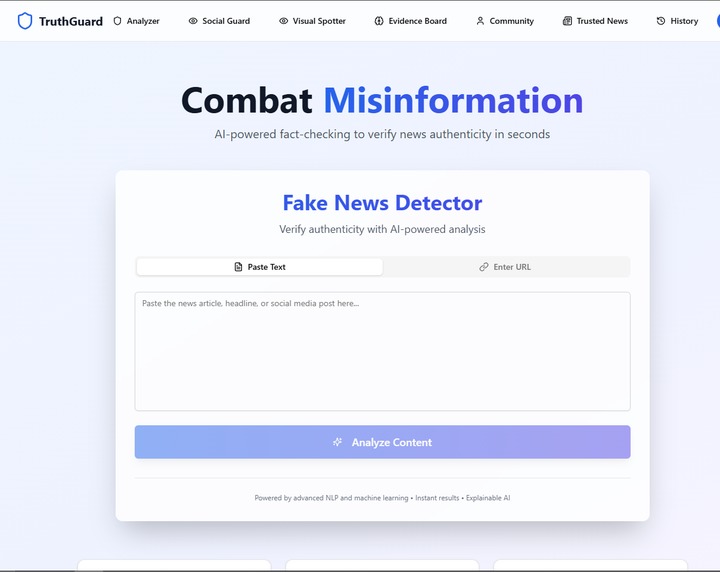
Main Page / Landing Page
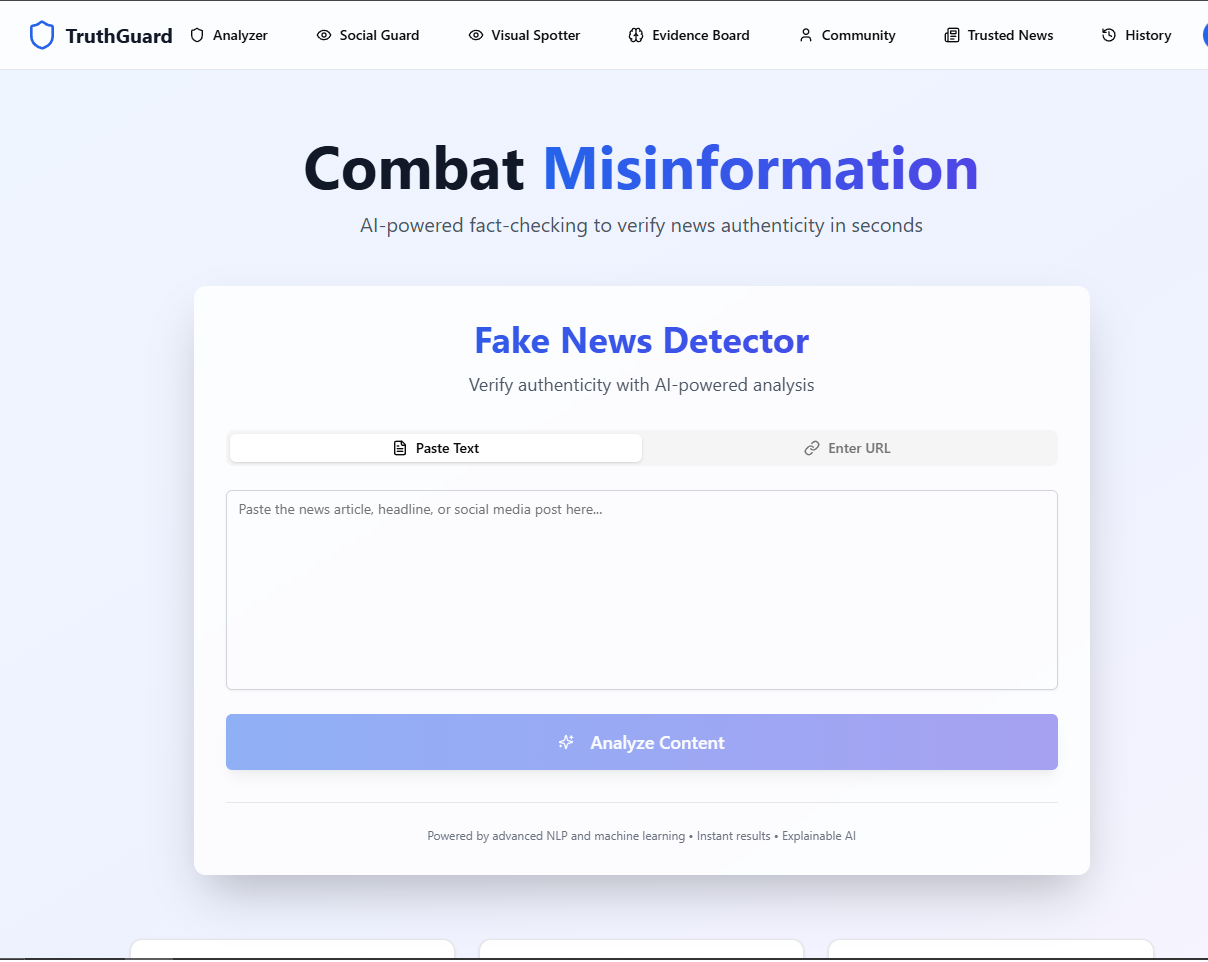
Inspiration
The core problem is the rapid and widespread dissemination of fake news and misinformation across digital platforms. This phenomenon erodes public trust in reliable sources, negatively influences civic discourse, and can have real-world societal and economic consequences.
What it does
TruthGuard is an AI-powered fact-checking and content verification platform accessible via web and mobile. It allows users to instantly analyze news articles, social media posts, or URLs to determine their authenticity and integrity. The core feature is the Fake News Detector, which utilizes advanced machine learning to provide rapid assessment results. Beyond text analysis, features like Visual Spotter (for analyzing visual media) and the Evidence Board (for aggregating verified sources) provide a comprehensive defense against various forms of digital deception.
How we built it
The application was built as a modern web application with a focus on speed and accuracy. The front-end uses modern responsive design principles. The back-end is powered by a robust Natural Language Processing (NLP) engine trained on vast datasets of real and fabricated news. This engine uses machine learning models to identify patterns, linguistic anomalies, source characteristics, and credibility signals far faster than human fact-checkers. The entire system is designed for Explainable AI, aiming to show users why a piece of content was flagged.
Challenges we ran into
The primary challenge was achieving high accuracy and precision in real-time, especially for rapidly evolving topics and new forms of deepfake content. Training the machine learning models to effectively distinguish subtle propaganda from legitimate reporting required significant data curation and iterative refinement of the algorithms. Furthermore, ensuring the application was scalable enough to handle high volumes of simultaneous user submissions without lag presented a significant technical hurdle.
Accomplishments that we're proud of
We are most proud of developing a system that provides verification results in under five seconds, a critical speed necessary to outpace viral misinformation. We successfully integrated a diverse set of analysis features (text, URL, visual) into a single, intuitive user interface. The initial positive feedback on the clarity and "explainability" of our AI results confirms that we are making complex fact-checking accessible to the average user.
What we learned
We learned that mitigating misinformation requires a multi-faceted approach; simply labeling content as "fake" is insufficient. We realized the importance of digital literacy and built features that actively educate the user. Technically, we gained deep insights into optimizing NLP models for real-time inference and maintaining ethical, unbiased training datasets to ensure the integrity of the verification process itself.
What's next for The Global Proliferation of Misinformation and Fake News
Our next steps involve expanding the Visual Spotter capabilities to handle complex video analysis, integrating the platform with major social media APIs for seamless one-click verification, and developing a Community feature to allow users and certified fact-checkers to collaboratively contribute to the evidence base, creating a more robust, collective defense against misinformation.

Log in or sign up for Devpost to join the conversation.