Inspiration
Traditional financial investigations are often slow, complex, and heavily dependent on manual review. Investigators face the enormous challenge of analyzing massive datasets to identify suspicious relationships and validate evidence before escalating a case. For the Infosys challenge, we were inspired to create a solution that doesn't just scream "Fraud!" at the sight of a mathematical anomaly, but instead applies the philosophy of a real auditor: prove before accusing, looking for both guilt and potential legitimate business explanations.
What it does
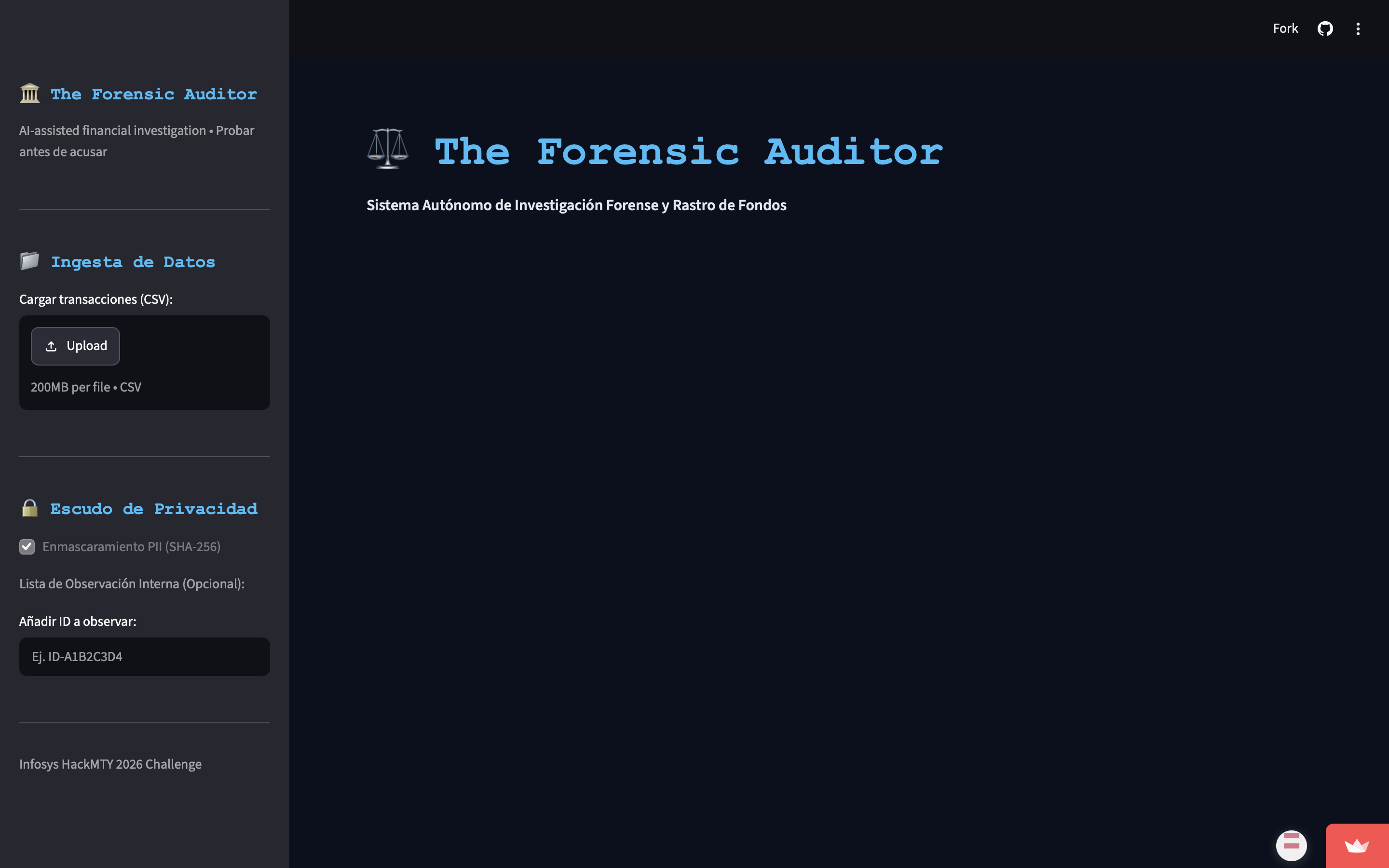
The Forensic Auditor is an AI-assisted financial investigation platform designed to help organizations detect, analyze, and review potentially fraudulent financial activity. Deterministic Detection: The system analyzes uploaded transaction data (protected by SHA-256 anonymization) and detects suspicious patterns such as circular money flows, unusual concentration of funds, and transaction dispersion. Next Best Investigative Action (NBIA): An AI investigator determines the most relevant next investigative action (e.g., checking watchlists, reconciling payments, or verifying available operational evidence). Adversarial Critical Review: An adversarial reviewer challenges the current hypothesis and searches for legitimate alternative explanations for the anomalies. Immutable Adjudication: It records every finding in an evidence ledger and deterministically classifies the case as supported, dismissed, or requiring human review when the available evidence is not sufficient. Deliverables: The platform also provides case visualization, investigation history, analytics, downloadable forensic reports in PDF, and voice synthesis.
How we built it
We built a forensic investigation state machine. The main orchestrator and user interface were developed using Python and Streamlit. For rapid topological analysis, we implemented Pandas and NetworkX, rendering interactive money laundering networks with PyVis. The logical "brain" uses the OpenAI API, structured to return strict JSON that feeds our UI flawlessly. Finally, we integrated ReportLab for real-time forensic report generation and ElevenLabs to deliver auditory verdicts.
Challenges we ran into
The biggest challenge was ensuring system stability during real-time investigations. When connecting the AI to Python tools, we faced severe network latency issues, "Rate Limit" (429) errors, and "Timeouts" on cloud servers that completely froze the application. We solved this by migrating our architecture from a complex multi-agent system to a streamlined, sequential engine driven by direct HTTP requests. We implemented a Failsafe Contingency Mode that detects network silence and automatically injects logical fallback responses so the audit never hangs during a live presentation.
Accomplishments that we're proud of
We are incredibly proud of programming the Adversarial Reviewer. In the industry, AI models often suffer from confirmation bias and falsely accuse individuals. Getting our platform to halt an accusation because it deduced a transaction might simply be a "technical cash adjustment" or because the amount was negligible demonstrates enterprise-level business maturity. Furthermore, consolidating a stable and fully functional environment after a long night of refactoring and bug squashing is a huge triumph for our team.
What we learned
We learned that at the intersection of Finance and Artificial Intelligence, "trust" is everything. We discovered how to anchor hallucination-prone Large Language Models (LLMs) using hard-coded tools (Python algorithms and static dictionaries). We learned that the true value of AI isn't in making the final decision, but in its ability to orchestrate the steps of an investigation in an automated and structured manner.
What's next for The Forensic Auditor
The next step is to expand the system's capabilities by providing tools that allow human reviewers to examine and approve cases requiring further attention with greater depth. We plan to integrate OCR (Optical Character Recognition) engines for live reading of legal contracts and connect the orchestrator to real government databases (like the SAT or OFAC) via live APIs, transforming The Forensic Auditor into an institutional-grade tool ready for the B2B market.


Log in or sign up for Devpost to join the conversation.