-
-
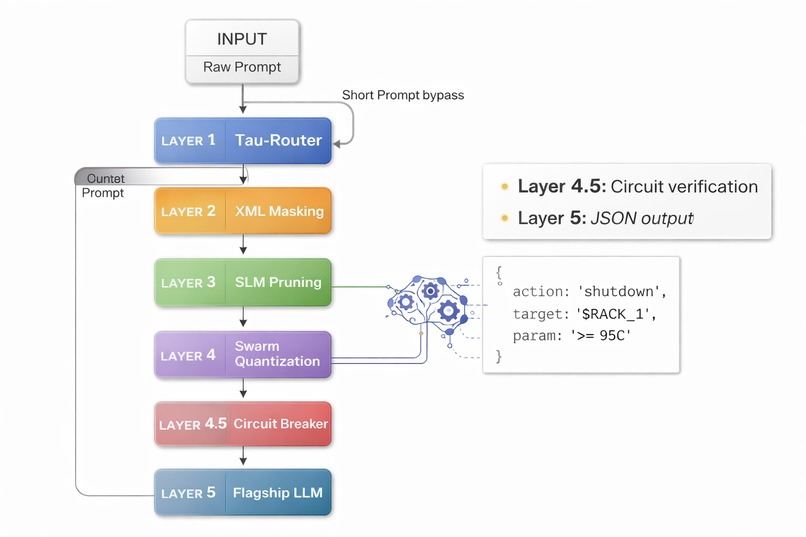
The Five Layer Token Optimizer Pipeline

Inspiration
As AI moves from chat interfaces into autonomous, enterprise-grade systems, we noticed a massive bottleneck: tokens are expensive, and generation is slow. Whether it is an industrial IoT system monitoring a power grid or an AI coding agent reading repositories, machines are constantly talking to Large Language Models (LLMs). However, natural language is inherently conversational and redundant. We realized that enterprises were paying massive API bills for filler words like "The," "is," "currently," and "approximately," when the LLM only really needed dense variables like DB_CPU_T = 95C.
We were inspired by recent academic breakthroughs in prompt compression and LLM cascades to ask a simple question: Can we build a middleware pipeline that aggressively compresses natural language into a dense "machine dialect" without losing a single drop of logical meaning?
What it does
The Five Layer Token Optimizer Pipeline (LAP) is a middleware architecture that intercepts natural language prompts, compresses them, and sends the optimized version to a flagship LLM. It reduces token usage significantly (achieving up to 85.7% compression in some benchmarks) while maintaining rigorous logical integrity.
It transforms verbose instructions into a highly dense format that saves enterprises money on API costs and reduces inference latency. It is specifically designed for mission-critical systems where an AI misinterpreting a compressed command could be catastrophic.
How we built it
We engineered a neuro-symbolic pipeline using Python, the spaCy NLP library, and the Groq API for ultra-low-latency small model inference. The architecture consists of five sequential layers: 1.Layer 1 (Deterministic Ingestion & Tau-Router): We clean the text using Unicode Normalization (NFKC). If the prompt is shorter than a dynamic threshold t, it bypasses the pipeline entirely to save processing time. 2.Layer 2 (XML Masking): Using edge-NLP, we identify critical logical hinges (like "not," "unless," or "always") and lock them safely inside tags. 3.Layer 3 (SLM Pruning): We use a blazing-fast Small Language Model (Llama-3 8B via Groq) to strip conversational fluff, but strictly instruct it to preserve the XML anchors. 4.Layer 4 (Swarm Quantization): We swap long, expensive enterprise jargon for dense symbolic variables using a localized registry (e.g., swapping "Primary server rack" for $RACK_1). 5.Layer 4.5 (The Circuit Breaker): A deterministic Python script mathematically verifies that the anchors from Layer 2 survived the neural pruning. If the logic is broken, it safely degrades to the original prompt. 6.Layer 5 (Flagship Execution): The compressed prompt is finally sent to the flagship model to output the final structured JSON.
Challenges we ran into
The biggest danger of aggressive text pruning is "logical hallucination." If a user types "Do not format the root drive," and a naive compression algorithm deletes "not," the resulting action is catastrophic. This exact challenge forced us to invent Layer 2 (XML Masking) and Layer 4.5 (The Circuit Breaker).
Another major challenge was the latency trade-off. During early testing, running an 8-word command through 5 layers of NLP processing took more time than it actually saved in API latency. We solved this by creating the Tau-Router to mathematically threshold and bypass short prompts.
Accomplishments that we're proud of
We successfully merged probabilistic neural networks with deterministic symbolic logic—a concept known as Neurosymbolic AI.
To prove our pipeline was safe, we moved beyond standard token-counting metrics and utilized the Action-Equivalence Rate (AER). We are incredibly proud that our architecture achieved an AER of 0.54 compared to a baseline of just 0.26, proving that our circuit breaker provides a level of logical reliability that standard heuristic summarization cannot match.
What we learned
Building this pipeline was a masterclass in modern AI engineering. We gained a deep understanding of Byte-Pair Encoding (BPE) and how tokenizers actually read text. We learned the absolute necessity of Unicode normalization to prevent tokenizer panic. Finally, we learned how to effectively orchestrate LLM Cascades—using a cheap, fast model to do the busywork so the massive, expensive flagship model only has to do the heavy reasoning.
What's next for The Five Layer Token Optimizer Pipeline
Currently, our Layer 4 relies on a localized, hardcoded registry of enterprise jargon to perform symbolic quantization. Our next major step is to build an automatic symbol registry generator using vector embeddings. This will allow the pipeline to dynamically adapt to any codebase, medical database, or industrial system without requiring manual dictionary updates, making it a truly plug-and-play middleware for global enterprises.

Log in or sign up for Devpost to join the conversation.