-
-
The Finish
The Finish — One outfit. Every detail. Perfectly you.
Inspiration
You know those moments when you have an outfit you really want to wear, but you don't quite know how to put the whole look together?
You have the dress, but then come the questions. What earrings would complement the neckline? Should you go with gold or silver? What shoes and bag would work? What about your hair and makeup?
That's the problem I wanted to solve with The Finish.
I've always been interested in how the smallest styling decisions can completely change an outfit. I also wanted a styling experience that works with what someone already has, rather than immediately suggesting that they buy something new or change their appearance.
Hairstyle was particularly important to me. If someone already has knotless braids, for example, I don't think a styling assistant should automatically suggest replacing them with a completely different hairstyle. It should help them find ways to style those braids to complement the outfit and occasion.
That thinking became the foundation of The Finish: an AI-powered personal styling studio that helps people finish the look using a dress they already own.
What it does
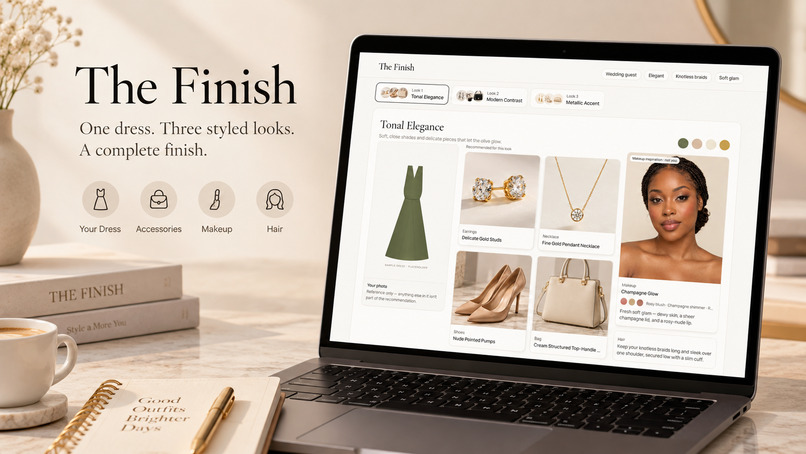
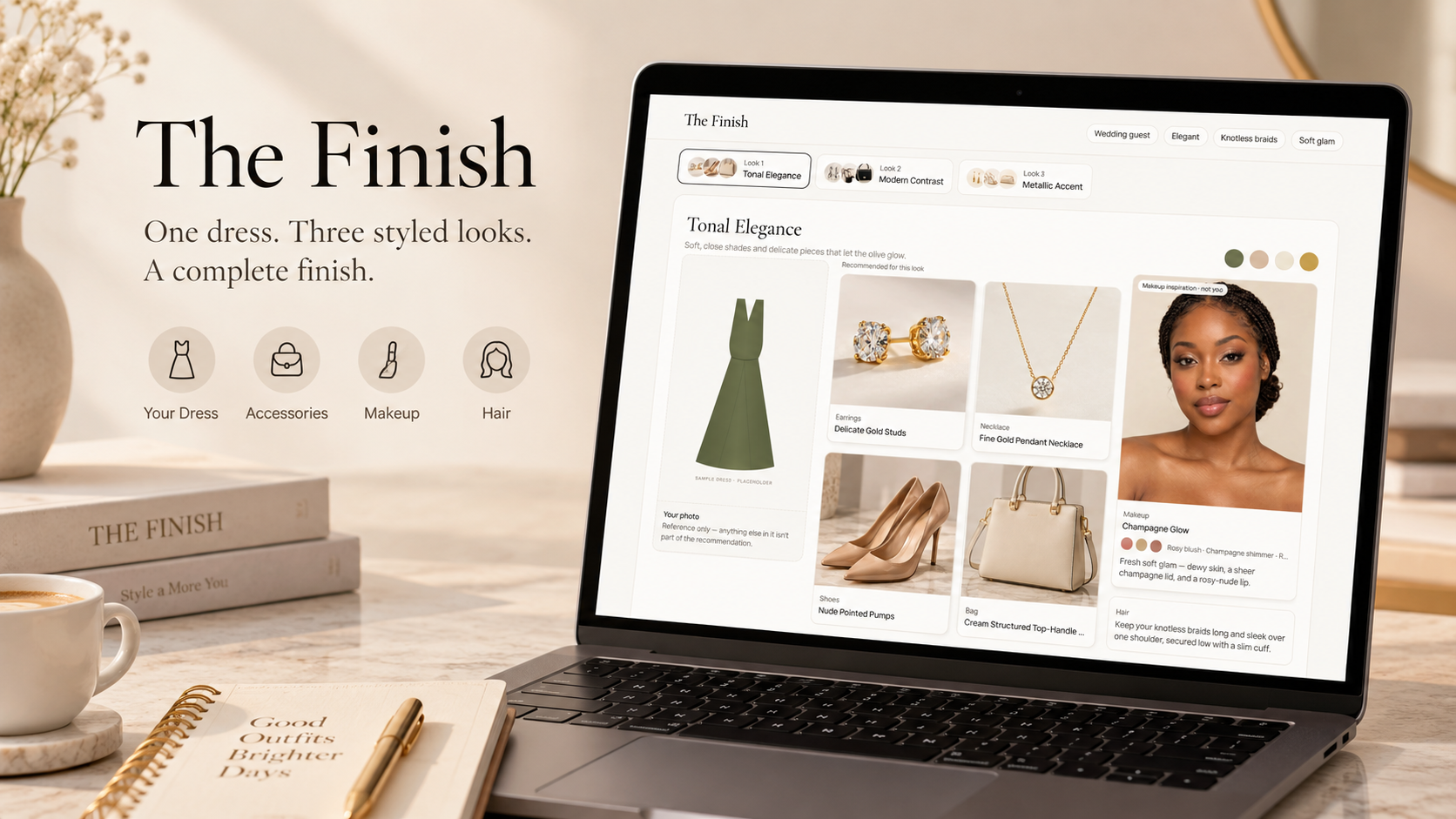
The Finish transforms one dress into three complete, coordinated styling directions.
A user starts by uploading a photograph of their dress. Claude analyzes its visible characteristics, including color, neckline, silhouette, pattern, and other details. The user can review and correct that analysis before continuing.
Next, they choose their occasion, aesthetic, current hairstyle, and preferred makeup intensity.
The Finish then generates three distinct interpretations of the same dress, each with:
- Coordinated earrings, necklaces, shoes, and handbags
- Visual makeup inspiration featuring different styles and colors
- Hairstyle guidance that respects the user's existing hair
- A complementary color palette
- Explanations of why each piece works with the outfit
Rather than only displaying a list of recommendations, The Finish brings these elements together into visual styling boards. Users can explore individual accessories, hairstyle guidance, and makeup recommendations to understand the reasoning behind each choice.
The Gold to Silver transformation
One of my favorite features is the ability to switch a look between gold and silver.
This isn't simply changing the color of a jewelry icon.
When a user switches metals, The Finish identifies the relevant accessory counterparts, changes shoes or handbag hardware where appropriate, adjusts the complementary palette, and generates a new explanation for the updated combination.
Unchanged pieces stay the same. The dress, occasion, hair, and makeup remain untouched.
Users can also switch between Original and Refined to compare both versions of a look.
The Finish includes a sample-dress demo, so anyone can explore the experience without creating an account or uploading a photograph.
Live demo: https://thefinish.vercel.app
How I built it
I built The Finish using Next.js, React, TypeScript, Tailwind CSS, and Anthropic Claude, and deployed it on Vercel.
One of the most important architectural decisions was separating the creative work of AI from the rules that needed to be predictable.
Claude handles dress analysis, styling decisions, hairstyle and makeup guidance, and the written explanations.
However, I didn't want the model to invent products that weren't actually available in the application.
I created a curated catalog of 22 accessory references and 9 makeup inspiration styles, each with stable identifiers. Claude selects from this catalog, and the server validates its responses using Zod before the results reach the user.
For gold/silver refinement, I took a different approach. The actual accessory transformation is implemented in deterministic TypeScript code, using catalog counterparts and consistency rules.
This means switching metals doesn't require the AI to choose an entirely new outfit. The code makes the changes, while Claude explains why the refined combination works.
I also implemented caching to avoid unnecessary AI calls, image resizing, rate limits, input validation, error recovery, and a fully labeled demo mode that works without making live AI requests.
The application was built incrementally and tested throughout development.
Challenges I ran into
Making AI recommendations reliable
One of the biggest challenges was making sure the recommendations displayed on screen always matched the AI's explanations.
There were situations where a styling description referred to an accessory or metal that no longer matched the selected look.
To address this, I introduced structured responses, catalog validation, consistency checks, and repair logic. For metal refinement, I separated the transformation from the explanation so the application always knows exactly which pieces changed.
Making the styling experience genuinely visual
Early versions of the interface relied on placeholder illustrations. Although the functionality worked, the results didn't communicate the styling recommendations as clearly as I wanted.
I spent time revisiting the layout, improving how the dress and accessories were presented, creating a consistent visual catalog, and adding realistic makeup inspiration photographs.
That process reminded me that an application can be technically correct without yet feeling like the product you're trying to create.
Balancing ambition with scope
I had several ideas for expanding The Finish, including realistic virtual try-on and a 3D character styling experience.
But implementing all of them would have taken attention away from getting the central styling experience right.
Learning what to defer was just as important as deciding what to build.
Accomplishments that I'm proud of
I'm proud that The Finish is a working, publicly deployed application rather than just a design concept.
A user can upload a dress, correct its analysis, make their styling selections, receive three coordinated looks, explore makeup and accessory inspiration, and refine a look from gold to silver.
I'm also proud of the attention given to the smaller details: preserving existing hairstyles, validating recommendations, explaining styling decisions, handling failures gracefully, and making the experience accessible through a no-account demo.
Most importantly, I was able to turn a broad idea into a focused application without losing the part of the idea that originally excited me.
What I learned
This project changed how I approach AI-assisted development.
Instead of jumping straight into implementation, I used the Devpost Learn Skill Pack with Claude Code to define the scope, write a Product Requirements Document, develop a technical specification, and build the application in manageable slices.
I learned that using AI effectively isn't just about prompting it to generate code. It also means understanding the decisions being made, setting constraints, reviewing outputs, testing assumptions, and knowing when to redirect the implementation.
I became much more intentional about separating what AI should decide from what conventional code should enforce.
I also learned the value of visual iteration. Seeing an interface in a real browser, using it, identifying what felt wrong, and refining it made a significant difference to the finished product.
What's next
I see The Finish growing beyond visual styling boards.
One direction I'm particularly excited about is "Style Room", a realistic 3D character styling experience inspired by fashion games.
I imagine users choosing a look and entering a virtual dressing room where they can rotate a character, inspect the full outfit from different angles, zoom into makeup details such as eyeliner and lipstick, and see how changes in jewelry or other accessories affect the completed look.
Another future direction is "Preview on Me", where a user could optionally upload a photograph and receive an AI-generated visualization of themselves in a selected styling direction, with appropriate privacy safeguards.
These features are not part of the current release, but they represent where I hope to take the product.
For now, The Finish focuses on one idea:
You don't always need a new outfit. Sometimes you just need a new way to finish the one you already have.
Built With
- anthropic-claude
- claude-code
- github
- next.js
- react
- sharp
- tailwind-css
- typescript
- vercel
- vitest
- zod

Log in or sign up for Devpost to join the conversation.