-
-
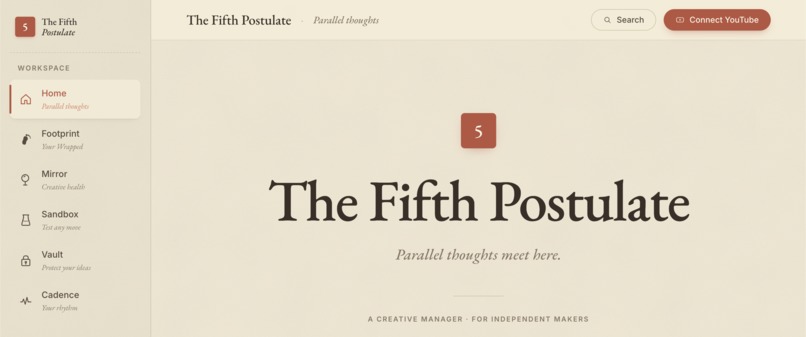
Parallel Thoughts Meet Here
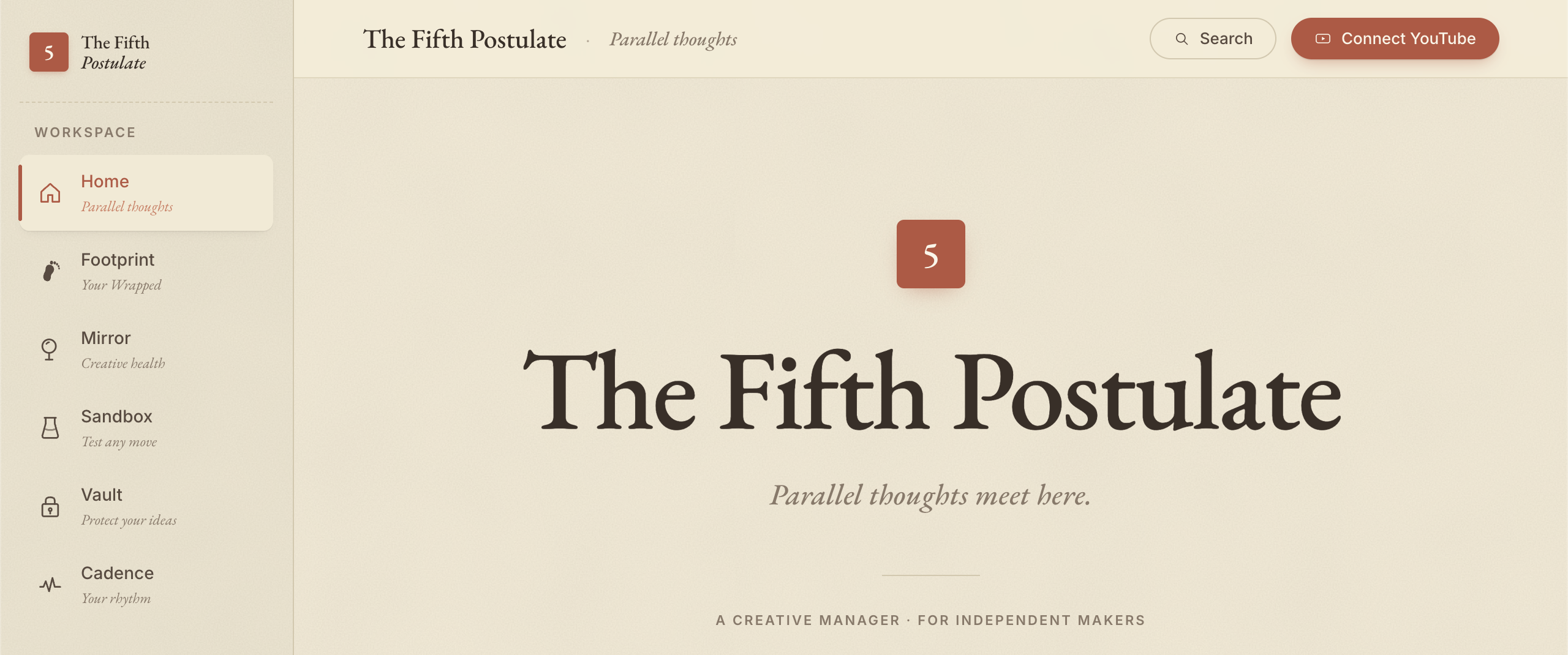
Inspiration
One of our favourite YouTubers, TwoSet Violin, spent eleven years building one of the most beloved classical music channels on YouTube — 4 million subscribers, a world tour, an academy, an apparel line. Then burnout hit. They deleted nearly all their videos overnight, devastated their community, lost six figures on cancelled tour dates from a visa denial, and had no way to gracefully evolve their identity without rupturing everything they'd built. They're not unique: this is the pattern for every independent creator who outgrows their niche. The problem isn't a lack of editing tools or scheduling apps. It's that creators build entire careers on infrastructure they don't own, can't see clearly, and can't safely evolve. Professional managers and creative strategists cost thousands a month and only exist for creators who've already made it. We're Beatles fans too, and we asked: what if every creator could have a Brian Epstein— the former manager of the Beatles— the person watching the whole picture, from day one? In Euclidean geometry, the fifth postulate is the foundational assumption. Change it, and you get entirely new worlds. Every creator's career is built on assumptions, too. We built the tool that helps them see those assumptions before the internet redraws the geometry for them.
What it does
The Fifth Postulate is an AI-powered creative manager for independent YouTube creators, built around three core workspaces. Footprint is your personal Wrapped — a visual synthesis of your YouTube channel's identity as the internet sees it, not as you see yourself. It pulls your upload history, engagement patterns, content concentration, and audience signals to surface the gap between self-perception and public perception. It includes your creative health indicators (burnout trajectory, output-to-engagement divergence) and your posting rhythm analysis — all delivered as a weekly digest, not an always-on dashboard, because the last thing a burned-out creator needs is another screen to obsessively monitor.
Sandbox is where you safely evolve. Type in a proposed move — a rebrand, a controversial take, a pivot to a new genre, a risky collaboration — and the AI provocateur stress-tests it against your actual Footprint data. It doesn't give you a score or tell you what to do. It asks hard questions: "62% of your subscribers came for recipes. If you pivot to travel, what's your plan for the audience that stays?" It surfaces audience retention estimates and new audience potential as data, then leaves the decision entirely to you. The tagline at the bottom says it all: "These are questions, not answers. You decide."
Vault protects your ideas with cryptographic proof — but only temporarily. Write a half-formed idea, and the AI provocateur first challenges you to sharpen it: "This overlaps with saturated meal-prep content. What's your angle?" Once you affirm it's distinct, a slow lock animation seals the idea with a SHA-256 hash and a server-signed timestamp. The protection window is 60 days. After that, the badge degrades from green to amber to gray, the paper card fades, and the lock visually opens. You can protect ideas while you develop them, but you can't squat on them forever. The Vault also features privacy-preserving similarity detection — it can tell you if your idea's core concepts overlap with others in the system without revealing anyone's identity or content.
How we built it
Backend Architecture: How It Works:
The core design principle: Claude never sees raw data. Every piece of creator data passes through our own analysis pipeline first. Claude receives pre-computed metrics and interprets them in plain language. This is the difference between a GPT wrapper and an engineered system.
Layer 1 — Authentication (OAuth 2.0) The creator authenticates via Google OAuth 2.0. The backend handles the full token exchange flow: the user is redirected to Google's consent screen, grants YouTube read access, and is redirected back with an authorization code. The backend exchanges that code for an access token server-side — the token never touches the frontend. This enforces privacy by architecture: you can only access your own data. There is no search, no lookup, no way to query another creator's channel.
Layer 2 — Data Processing Pipeline (processing.py)
Raw YouTube data (video titles, tags, view counts, likes, comments, upload timestamps) enters the pipeline and gets transformed into derived metrics through real computation:
- View-weighted topic scoring: Topics aren't just counted by frequency — they're weighted by the view count of the videos they appear in. A tag on a 130K-view viral video defines your brand more than a tag on a 28K-view flop.
- Content category clustering: Videos are classified (food/cooking, lifestyle/personal, challenge/entertainment, tech/review), and concentration risk is measured as the percentage of total views dominated by one category.
- Linear regression for burnout detection: We compute the actual regression slope of engagement rate over time and upload frequency over time. A negative engagement slope combined with a positive upload slope is the mathematical signature of burnout — producing more while each piece performs worse.
- Composite burnout score (0–100): Derived from the normalized regression slopes, not from comparing simple averages.
- Viral timing analysis: Best posting day and hour computed from historical engagement rates per day-of-week and hour-of-day.
- Performance extremes: Top 5 and bottom 5 videos by engagement rate, surfacing what works and what doesn't.
None of this involves an LLM. This is statistics, linear algebra, and data aggregation.
Layer 3 — LLM Interpretation (interpret.py)
Claude Sonnet receives the pre-computed metrics as structured JSON and generates plain-language interpretations within enforced output schemas. Four bounded interpretation tasks:
- Footprint: Reads topic scores, concentration risk, category breakdown, AND consumption data (what the creator watches/likes privately) to identify gaps between public brand and private interests that could create cancel risk.
- Mirror: Reads burnout score, regression slopes, and weekly trends to explain what the trajectory means in human terms.
- Sandbox (report): Reads the creator's identity profile and a proposed move to generate a structured risk assessment: cancel risk score (0–100), audience retention estimate, three worst-case interpretations, three best-case outcomes.
- Sandbox (conversation): Multi-turn stress test grounded in the initial report findings. The system prompt includes the creator's actual metrics and the quantitative risk assessment. Every challenge references real numbers. It never validates, never advises — only surfaces assumptions.
Every Claude response is validated as proper JSON before reaching the frontend. Malformed responses are caught and cleaned server-side.
Layer 4 — Cryptographic Provenance (vault.py)
The Vault implements privacy-preserving idea protection with semantic similarity detection:
- The creator submits an idea. Claude extracts 5–7 core concept tags.
- Concepts are stored anonymously — no creator name, no raw idea text attached.
- When a new idea is submitted, Claude performs semantic similarity comparison against all stored concept sets. This catches conceptual overlap that hash-based matching misses: "baking competition" correctly matches against "cooking competition."
- The full idea is hashed with SHA-256 concatenated with a server-authoritative timestamp (not client-spoofable).
- A signed JWT (HS256) is issued as a tamper-proof proof certificate containing the hash, timestamp, user ID, and expiration.
- Ideas have a 3-day action deadline and a 60-day protection ceiling — anti-hoarding by design.
- The similarity engine never sees anyone's raw ideas. It only compares anonymous concept fragments. Even the server cannot reconstruct the original idea from stored data.
Security Architecture: OAuth 2.0 token exchange (server-side only), row isolation by authentication, client-side hashing (plaintext never leaves browser in production), server-authoritative timestamps, JWT signing for tamper-proof certificates, no permanent raw data storage, anonymous concept storage for similarity detection.
Tech Stack: FastAPI (Python), YouTube Data API v3, Claude API (Sonnet), Web Crypto API, JWT (python-jose), linear regression (built from scratch, no scipy dependency).
Challenges we ran into
YouTube OAuth in testing mode was our first blocker — getting the consent screen configured, scopes approved, and the callback flow working ate more time than expected. Since neither of us are active YouTubers, we had to build a mock data fallback system that kicks in when a channel has insufficient videos, while still demonstrating that the real OAuth pipeline works with live authentication. Getting Claude to return consistently parseable structured JSON was another recurring issue — it kept wrapping responses in markdown backticks or adding preamble text, which broke our JSON parser. We had to write a server-side cleaning function to strip formatting before parsing.
The hardest conceptual challenge was scoping. We kept expanding the feature set (Instagram integration, Chrome extension for screen time, always-on dashboards) and had to ruthlessly cut back to what was buildable and demoable in the time we had. The final consolidation from five separate views down to three coherent workspaces happened late in the process but made the product dramatically clearer.
Accomplishments that we're proud of
The product has a genuine point of view. Most creator tools optimize for more output, more engagement, more growth. Ours might tell you to stop posting and take a break. The Mirror component inside Footprint doesn't just flag burnout — it suggests how to take a meaningful break without hurting your brand. That philosophical stance — protecting the creator from themselves, not just from external threats — is something we're genuinely proud of. The Vault's expiring protection window is a design decision we haven't seen anywhere else. Every other idea-protection tool lets you hoard indefinitely. Ours says: protect it while you develop it, but you can't patent-troll the Creative Commons. That tension between individual protection and collective creative freedom is baked into the architecture, not just the pitch. The Sandbox's "questions, not answers" approach is our answer to the ethical AI challenge. It would have been easier to output a risk score. Instead, we built a provocateur that asks hard questions grounded in your actual data and then says "you decide." We think that's what responsible AI-human collaboration actually looks like.
What we learned
Scope kills hackathon projects. We spent hours ideating and refining before writing a single line of code, which gave us a strong conceptual foundation but compressed our build time dangerously. The lesson isn't "ideate less" — it's "set a hard cutoff for when ideation stops, and building starts." We learned that the most impressive technical complexity isn't about how many APIs you call — it's about having a clear separation between what your code does and what the LLM does. Being able to point at 120 lines of math and say "Claude never touched this" is worth more to judges than calling ten different APIs. We also learned that the hardest design decisions aren't technical — they're philosophical. Should the Sandbox give scores or ask questions? Should Vault protection be permanent or temporary? Should the dashboard be always-on or weekly? Every one of those decisions shaped the product's identity more than any technical choice.
What's next for The Fifth Postulate
Multi-platform identity mapping. The current MVP pulls from YouTube only. In production, Footprint would ingest data from Instagram, TikTok, Twitter/X, and Twitch to build a true cross-platform identity map — because a creator's brand lives everywhere, not just on one platform.
Sandbox feedback loops. Currently, Sandbox stress-tests a proposed move in isolation. The next version would let creators run small, reversible experiments — post a test video, track the actual audience response, and feed that data back into Footprint to update the territory map. The system learns as the creator evolves.
Screen time and consumption analysis. A browser extension that tracks time spent on creation apps and consumption platforms, feeding into Mirror's burnout detection. What you consume shapes what you create — and how much you consume signals how close to exhaustion you are.
Creator collective mode. The Vault's privacy-preserving similarity detection opens up a fascinating possibility: creator collectives where members can detect conceptual overlap without revealing their ideas to each other. Collaborative protection without collaborative exposure.
Video and thumbnail analysis. Lighting quality, sound levels, thumbnail effectiveness — technical production signals that a human manager would notice and flag, but that most creators can't evaluate objectively about their own work.
Built With
- 2.0
- anthropic
- api
- claude
- crypto
- css
- data
- fastapi
- javascript
- json
- oauth
- postgresql
- python
- react
- recharts
- sha-256
- sonnet
- supabase
- tailwind
- tokens
- v3
- web
- youtube


Log in or sign up for Devpost to join the conversation.