-
-
mermaid png
Inspiration
History can be epic, but textbooks can make it boring, my daughter said to me once. So, to help kids (or adults!) learn, what if you could type any historical topic and watch it transform into a dramatic, illustrated graphic novel in minutes? That was the spark. I wanted to create an experience where AI agents collaborate like a real creative team: one researches, one writes, one paints — and the result feels worthy of the great classical masters.
What it does
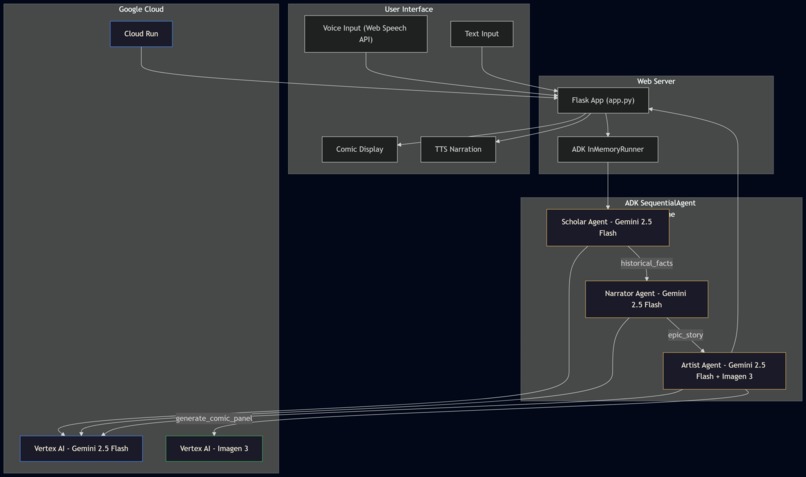
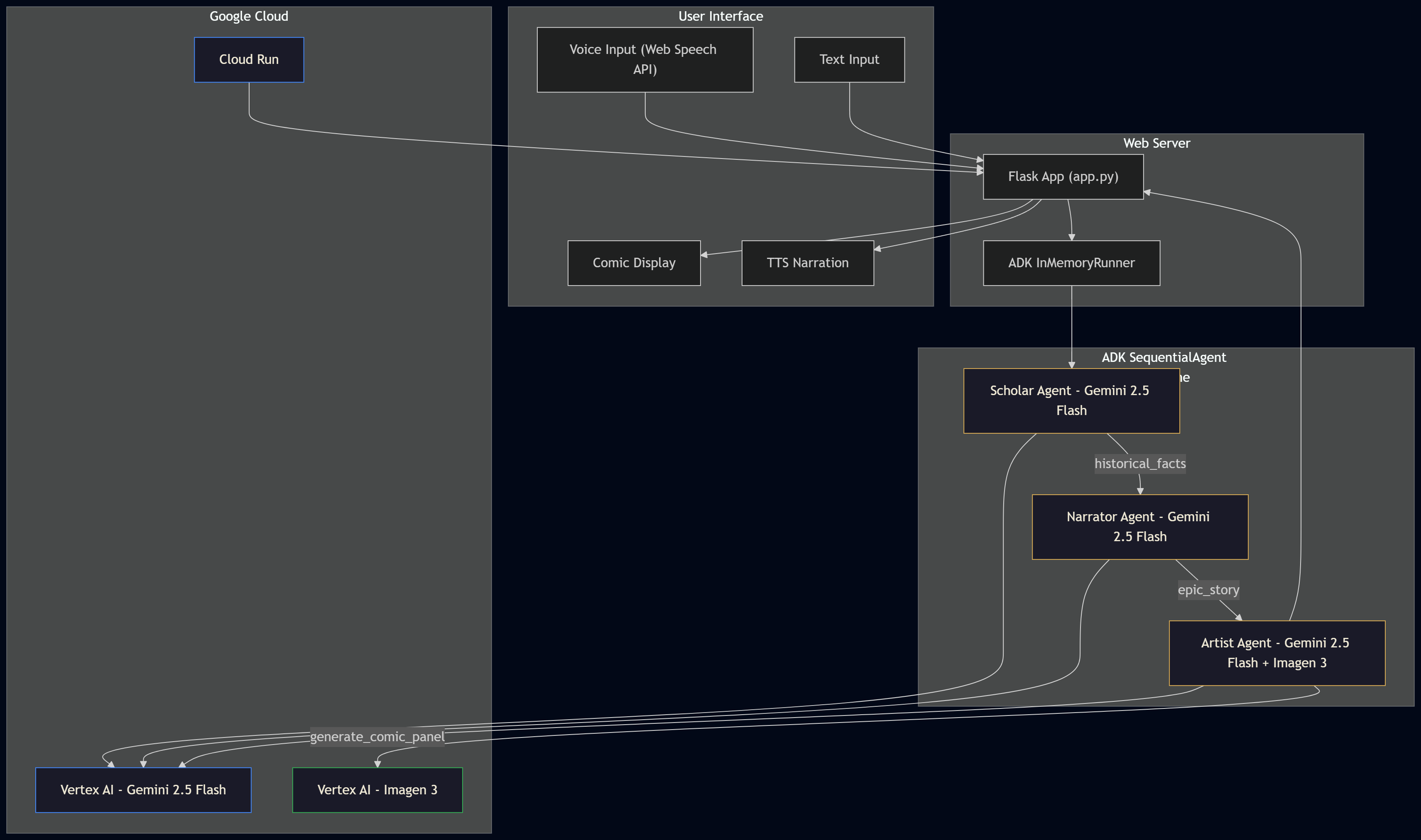
Epic Comic Agent is a multi-agent AI system that transforms any historical topic into an illustrated graphic novel. You type (or speak) a topic, and three specialized agents spring into action:
- The Scholar — Researches and extracts key historical facts using Gemini 2.5 Flash
- The Narrator — Transforms those facts into an epic script inspired by Homer, Camões, Shakespeare, and Dante, opening with a dramatic prologue that sets the scene with real dates and places
- The Artist — The Artist generates panels in a cinematic, painterly style with dramatic lighting, bold compositions, and rich textures inspired by European epic bande dessinée and historical graphic novels.
The result streams to the browser in real time — the introduction appears first so you have something epic to read while panels are painted one by one. A built-in narration feature reads the story aloud in a dramatic voice.
How I built it
- Google ADK (Agent Development Kit) orchestrates the three agents in a sequential pipeline using
SequentialAgent - Gemini 2.5 Flash (via Vertex AI) powers all three agents for text generation
- Imagen 3 (via Vertex AI) generates the comic panel illustrations
- Flask serves the web app with Server-Sent Events (SSE) for real-time progressive streaming
- Google Cloud Run hosts the production deployment
- Web Speech API provides browser-based text-to-speech narration
My development process as a vibe coder:
- Gemini 3.1 Pro helped me clarify the initial ideas, define the project vision, and plan the multi-agent architecture
- Antigravity (AI coding assistant) wrote the majority of the codebase — from the agent definitions to the Flask server and frontend
- Claude Code stepped in to solve the final problems — fixing critical bugs, fine-tuning the streaming experience, and polishing the deployment to Cloud Run.
Challenges I ran into
- Image generation rate limits: The free tier on AI Studio had strict quotas. Switching to Vertex AI with Cloud billing solved this, but I had to learn the difference between AI Studio and Vertex AI — two doors to the same models, but very different limits.
- Context window overflow: The Artist agent was returning base64 image data (~1.5M tokens per image) back into the conversation, blowing past Gemini's 1M token limit on the second panel. The fix: store images in a shared memory list and return only a lightweight status message.
- Real-time streaming: Getting panels to appear progressively (not all at once) required SSE streaming, background threading, and careful buffering control — a real lesson in async architecture.
- Model deprecation mid-project:
gemini-2.0-flashwas deprecated during development, requiring a migration togemini-2.5-flashand testing across all three agents.
What I learned
As a self-taught "vibe coder," this project was a crash course in multi-agent AI architecture, Vertex AI authentication (Application Default Credentials), streaming protocols (SSE), and cloud deployment. The biggest lesson: AI agents are most powerful when they specialize and collaborate — just like real creative teams.
What's next for Epic Comic Agent
- Support for more visual styles (manga, watercolor, pixel art)
- Multi-language narration and story generation
- Longer graphic novels with chapter-based storytelling
- Interactive mode where users can guide the story between panels


Log in or sign up for Devpost to join the conversation.