-
-
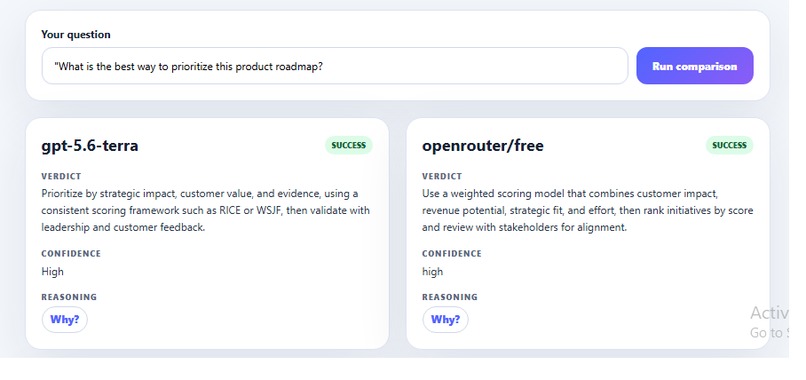
front page 1
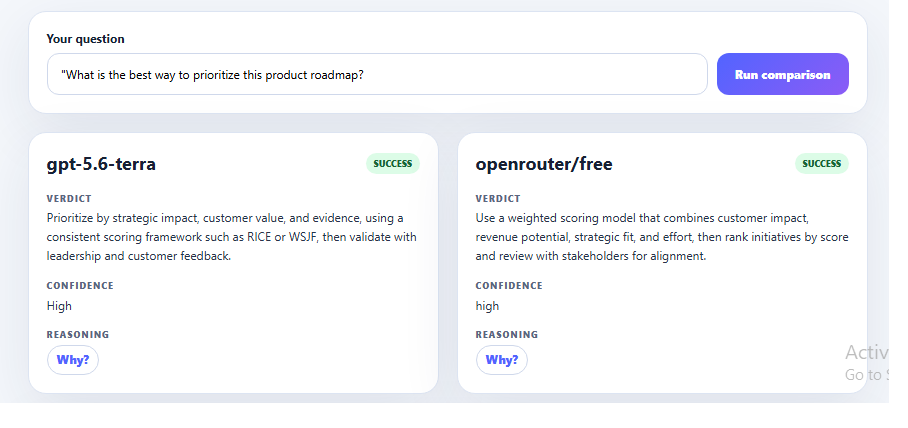
Inspiration
I think most AI tools just give you one answer, and you have to trust it. I wanted an AI to tell me — this is what I think, and this is my verdict — so I can read it and take the decision myself. Not one AI, but two, side by side, so I can see if they agree or not before I decide anything.
What it does
You type one question. It goes to two AI models at same time — GPT-5.6 from OpenAI, and a free model through OpenRouter. Each one gives back a Verdict, a Confidence level, and full Reasoning (hidden behind a "Why?" button so it's not cluttered).
Then one more step — GPT-5.6 reads both answers and makes an Insight Card:
- Agreement — where both models actually agree
- Conflict — not just "they disagree," but exactly what assumption is different between them
- Missing Information — the one fact that would clear up the confusion
- Next Best Question — what to ask next to get that fact
It's not about which AI is right. It's about showing where you still need to think before deciding.
How we built it
Built this whole thing in one day using OpenAI Codex, in Codex Cloud. I don't code myself — I directed Codex step by step:
- First version — Codex made the server and a simple page with input box and two response cards, calling two AI providers at once.
- Then I asked to change the output format — instead of long paragraphs, each model gives Verdict, Confidence, Reasoning in a fixed structure.
- Then the Insight Card — I saw an early version just say "the models disagree" and that was useless. I told Codex it must say exactly what assumption is different, not just that they disagree. Gave it a good example and a bad example so it understood.
- Found a bug during testing — if you ask a second question before the first one finishes, the old answer can overwrite the new one on screen. Asked Codex to fix that, and also added logging so I could actually see what was happening when something broke.
- Model providers changed a few times during the day — started with OpenAI + Anthropic, then switched to two OpenRouter models when I didn't want to spend money, then came back to OpenAI + OpenRouter once I realized the competition rules need GPT-5.6 actually running in the app, not just used to build it.
Things I decided myself, not Codex: keeping full Reasoning visible instead of showing only a verdict (didn't want to hide the "why"); forcing the Conflict field to name the real assumption instead of a generic answer; and cutting other ideas like report export, login accounts, model-selector dropdown — didn't have time, and they weren't needed to prove the actual idea.
Challenges we ran into
- Free AI models kept changing — a model that worked fine one hour said "not available for free" the next. Had to switch to OpenRouter's own auto-router so it always picks something that's actually working.
- Kept losing my API keys — every time the Codespace terminal restarted, the keys I exported were gone. Learned to add them to .bashrc so they stay set.
- GPT-5.6 doesn't accept a custom temperature setting like older models did — took some debugging with added logs to find that one.
- Had a lot of bigger ideas along the way — multi-round debate between models, hiding model names so you pick blind, full report export. Cut all of them. Only kept the one thing that actually matters: naming the real assumption behind a disagreement.
Accomplishments that we're proud of
- Built this end to end in one day, without knowing Codex at all before this — first time using it.
- The Insight Card actually names the real assumption causing disagreement, not just a generic "they disagree" line. That's the whole point of the project and it works.
- Stayed honest about scope — cut multiple flashier ideas instead of chasing all of them and ending up with nothing working.
What we learned
- Free-tier AI models are not stable — you can't hardcode one model name and expect it to still work later. Better to use an auto-router as fallback.
- Making both models answer in the same fixed structure (Verdict/Confidence/Reasoning) is what actually makes them comparable — free text answers can't really be compared side by side.
- Just showing two answers next to each other isn't that useful by itself. What's actually useful is something that reads both and tells you exactly where they disagree and what to check next.
What's next for The Dot
Want to add a dropdown so you can pick which two models to compare, and maybe keep a simple history of past questions. Didn't do it this time — wanted to keep the build honest and finish it in the time I had.
Built With
- api
- codex
- css
- gpt-5.6
- html
- javascript
- node.js
- openai
- openrouter


Log in or sign up for Devpost to join the conversation.