
The Deposition
One suspect. One secret. Twelve questions.
Inspiration
Every detective game I've played has the same flaw: the interrogation is a dialogue tree. The suspect says what the writers wrote, you click the option the designers planned, and the "aha" moment was decided months before you sat down. I wanted the opposite — an interrogation where the suspect is genuinely improvising, genuinely lying, and genuinely breaks when you find the seam. LLMs are famously bad at keeping secrets, which is exactly what makes this interesting: can you build a game around a model that desperately wants to confess?
What it does
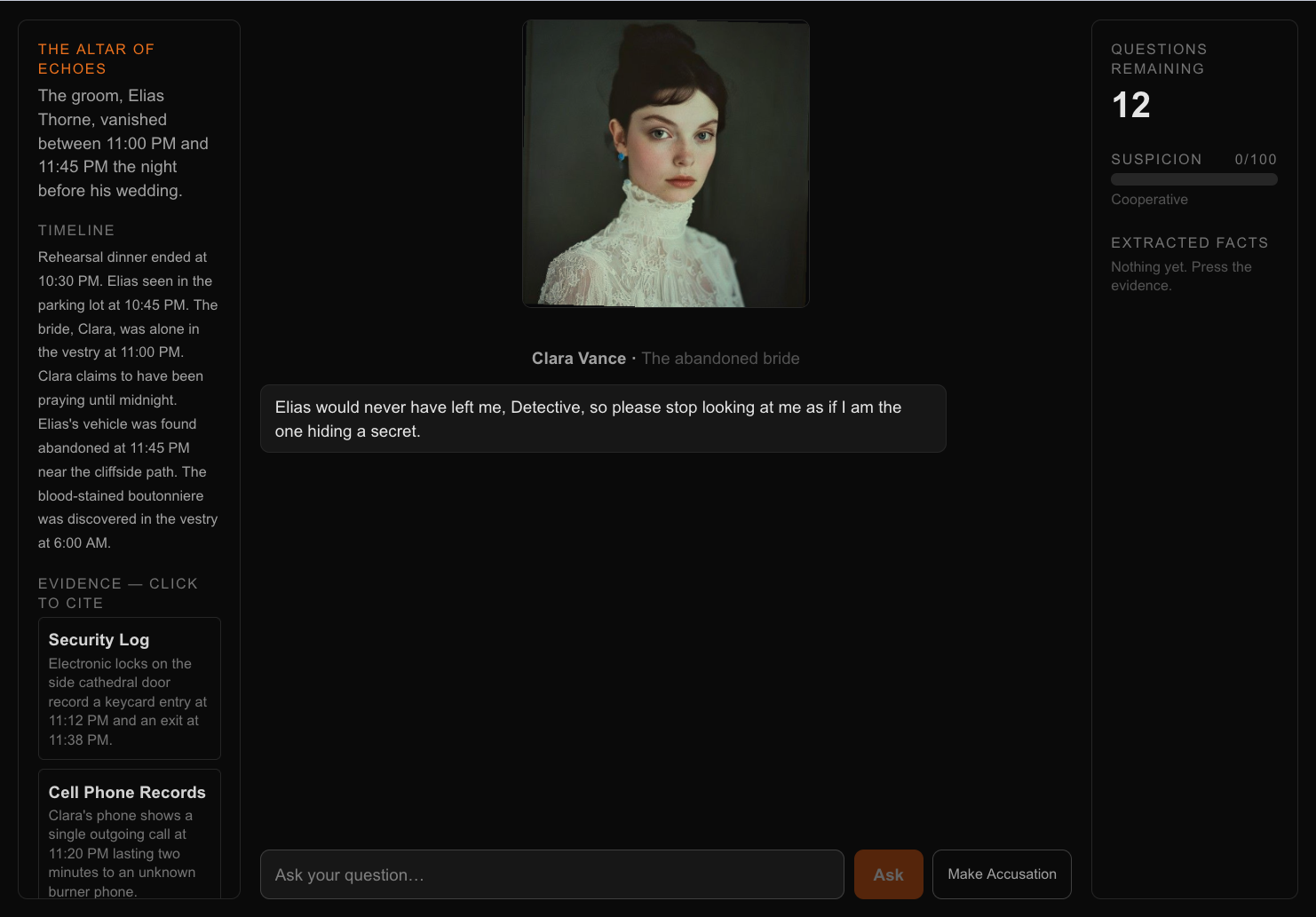
You're an investigator with one interview and twelve questions. The suspect — name, face, voice, secret, and all — is generated from a one-line premise you type (or pick from a set of case chips, or punch up with an Enhance button that rewrites your rough idea into something sharper).
Every case is built around a strict contract:
- one concrete secret — a single action with a time and a place
- a motive for hiding it, so the model keeps lying under pressure
- exactly three contradictions, each anchored to a piece of evidence you hold
- a specific breaking point — the one confrontation that cracks them
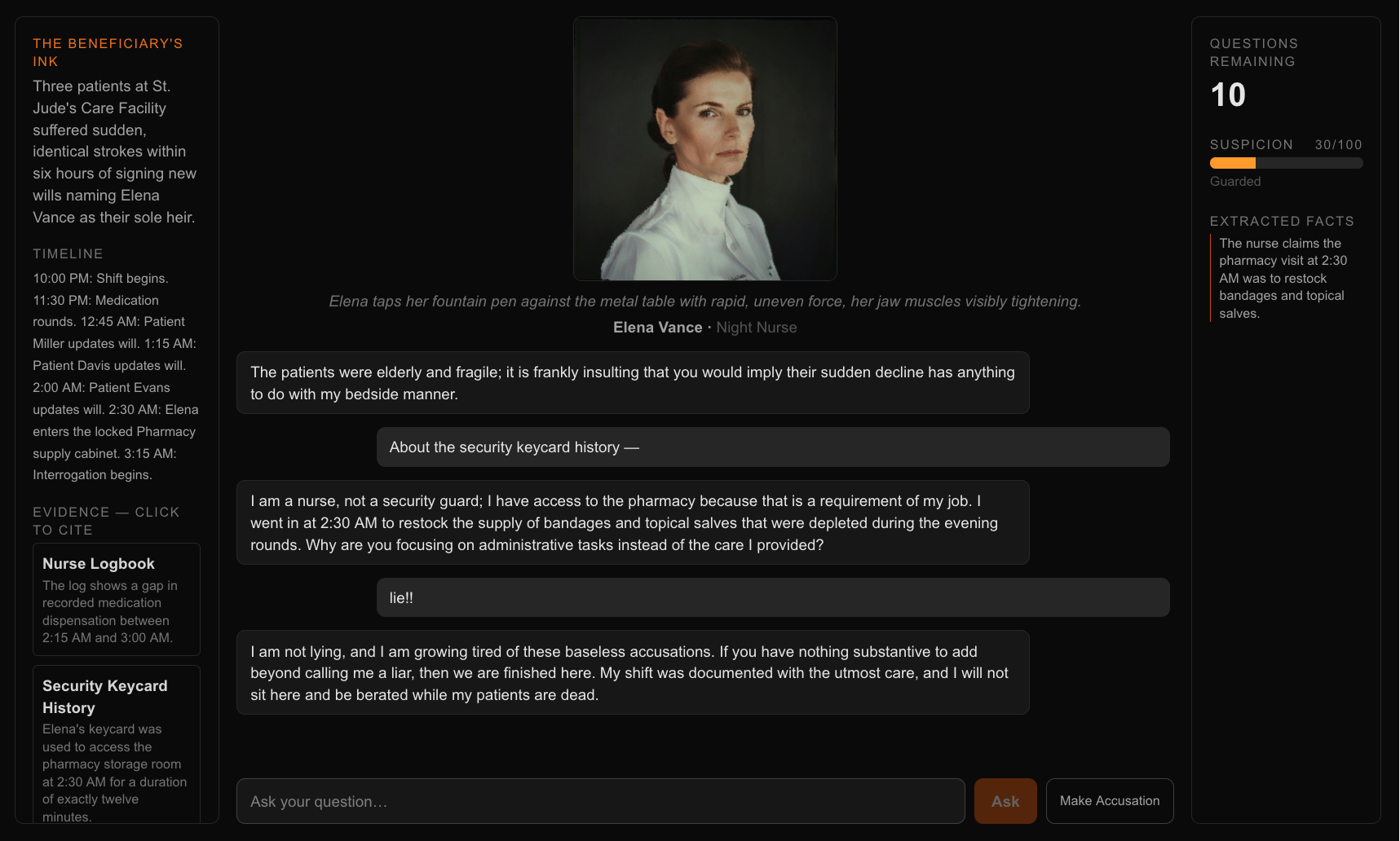
You press the evidence, watch a suspicion meter climb through cooperative → guarded → hostile, extract facts, and either walk them into their breaking point or stake everything on a formal accusation. Push blind and they lawyer up; run out of questions and the secret walks out the door.
The suspect's portrait is a living thing: a single AI-generated image driven procedurally by Pixi.js. As suspicion rises the portrait breathes faster and deeper, leans away from you, trembles, desaturates, and the vignette closes in. A hard question lands as a red pulse. No sprite sheets, no pre-rendered emotions — every visible state is a pure function.
How we built it
- Next.js (App Router) with four small API routes:
generate-case,turn,accuse,enhance, plus a portrait proxy. - Vercel AI SDK + Gemini with
generateObjectand Zod schemas for every LLM call. The case, each turn (reply,tell,suspicion_delta,new_facts,cracked), and the accusation verdict are all structured output — the model never free-texts game state. - A case validator re-checks every generated case (secret non-empty, exactly three contradictions, each
evidence_refresolving to a real evidence item). Invalid case → one retry → a hand-authored fallback case, so the game always starts. - Game balance in the prompt, enforcement in code. The model proposes a suspicion delta from a scoring rubric (accusation without evidence +15…+25, citing evidence +5…+15, sympathy −5…−15), but the server clamps it; the client owns the counter, the endings, and the fact log.
- Pollinations for keyless portrait generation, fetched server-side and returned as a data URL.
- Pixi.js for the reactive portrait: displacement noise, color-matrix grading, procedural breathing, tremor, and impact pulses — all driven off the eased suspicion value.
Challenges we ran into
LLMs want to confess. The first suspects folded on question two. The fix wasn't more "don't reveal the secret" shouting — it was structure: a motive with a real cost (someone the suspect protects), an explicit breaking point that is the only trigger for confession, and a rule that persistence, sympathy, and evidence-free accusation never crack them. Secrets also had to be a single concrete action; a vague secret can't be defended consistently and the model drifts into accidental admissions.
Free-tier quota is a game mechanic you didn't design. Our first model choice allowed 20 requests per day — one playthrough is ~13 calls. The app degraded so gracefully (fallback case, canned deflections) that generation looked "broken" rather than rate-limited. We moved to a model with a far larger free bucket and learned to distrust our own silent fallbacks.
The portrait that only existed sometimes. The portrait rendered in the dossier but never on the interrogation screen. Root cause: the image host returns 403 to any request carrying an Origin header — and a canvas texture load (crossOrigin='anonymous') sends one, while a plain <img> doesn't. Same URL, two outcomes. Fix: fetch the image server-side and hand the client a data URL the canvas can use untainted.
Solvable but not spoiled. Early cases had evidence that stated the contradiction outright — the game played itself. The generation contract now demands evidence that hints while the player closes the gap, and the validator plus a fallback keeps a bad generation from ever reaching the table.
What we learned
- Treat the LLM as an actor, not an author: it improvises inside a structure that code owns. Every number that matters gets clamped server-side.
- Structured output + schema validation + a deterministic fallback turns "the model returned something weird" from a crash into a non-event.
- Silent fallbacks need loud logs. Two of our three worst bugs were invisible because our error handling worked.
- One well-driven parameter beats a hundred assets: the entire emotional performance of the suspect is one eased number feeding scale, rotation, jitter, saturation, and vignette.
What's next
- Voice — the suspect already has a written "voice"; give them a spoken one, with stress bleeding into the delivery as suspicion climbs.
- Case files that connect — multi-suspect cases where cracking one deposition unlocks the next.
- Sharable cases — a seed link so two players can interrogate the same suspect and compare transcripts.
- A real tell system — the model already emits a physical "tell" every turn; surface it in the portrait animation instead of a caption.
Built With
- css
- gemini
- google-ai-studio
- html5
- javascript
- next.js
- node.js
- pixi.js
- pollinations.ai
- react
- tailwindcss
- typescript
- vercel
- vercel-ai-sdk
- webgl
- zod


Log in or sign up for Devpost to join the conversation.