Inspiration
Most online games are designed around individual achievement: finish a level, beat a high score, or climb a leaderboard. We wanted to explore a different question: what happens when thousands of people must live with the consequences of one shared decision?
Reddit is especially suited to this idea because its communities already debate, vote, collaborate, disagree, and create unexpected outcomes together. Instead of building a game merely decorated with Reddit references, we wanted to build something that uses the social behavior at the heart of Reddit.
That became The Daily Law, a shared civilization game where the community chooses one new law each day and returns later to discover what that decision did to the city.
The core inspiration came from political and city-building simulations, but we wanted to remove their steep learning curve. A player should not need to understand a complex economy or spend an hour managing a city. They should be able to make one meaningful choice in less than a minute, then remain curious about its consequences.
What it does
The Daily Law places every player inside the same evolving city.
Each day, the community is presented with several possible laws, such as:
- Introduce a four-day workweek
- Make public transport free
- Require rooftop gardens
- Allow factories to operate all night
- Give every citizen a goat
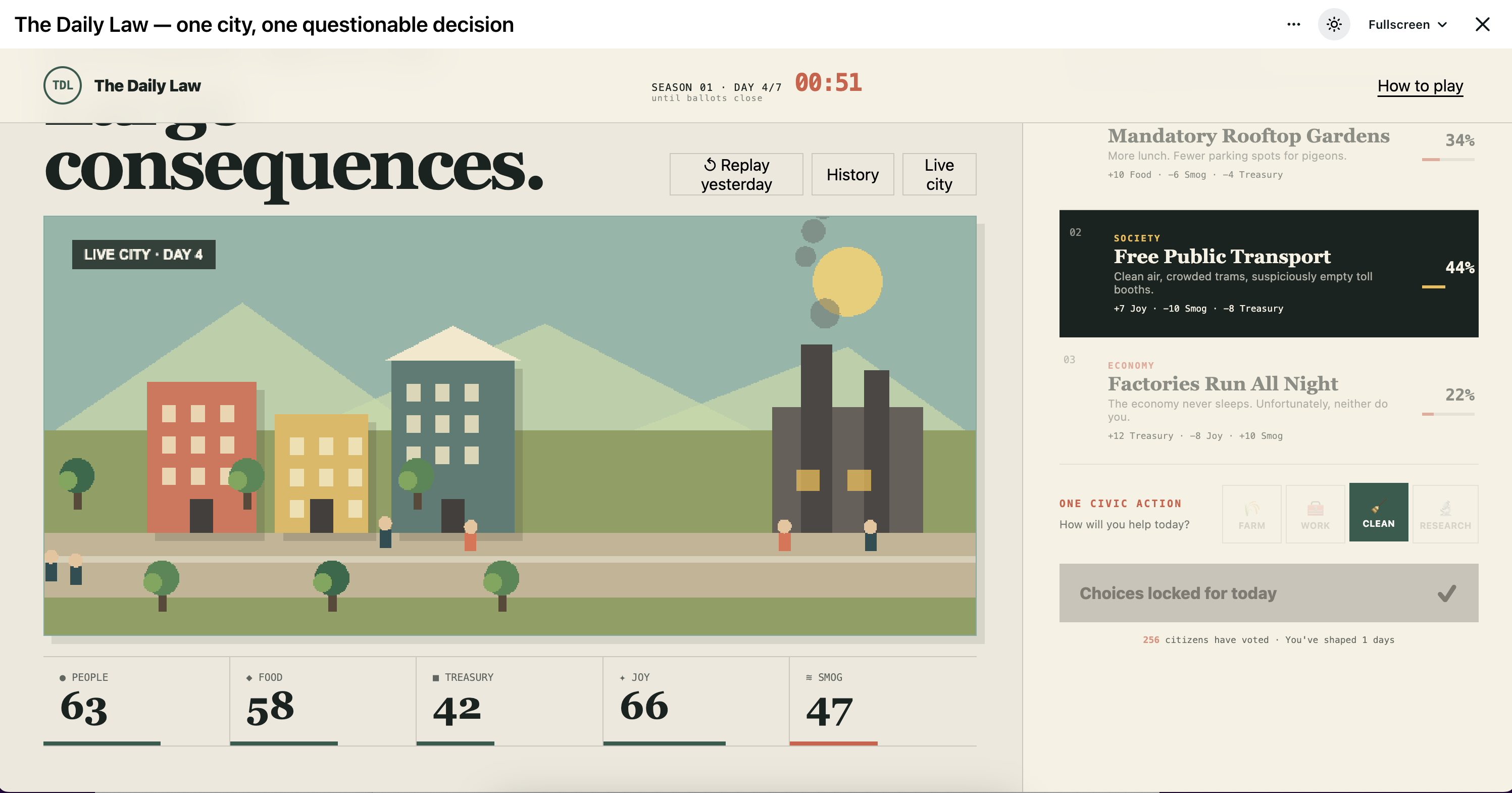
Every law creates trade-offs across the city’s key indicators, including happiness, food, treasury, population, and pollution. Players vote for the law they believe the city should adopt.
After voting, players can see the current community preference and preview how the leading law may affect the city. The final outcome is determined collectively rather than by any single player.
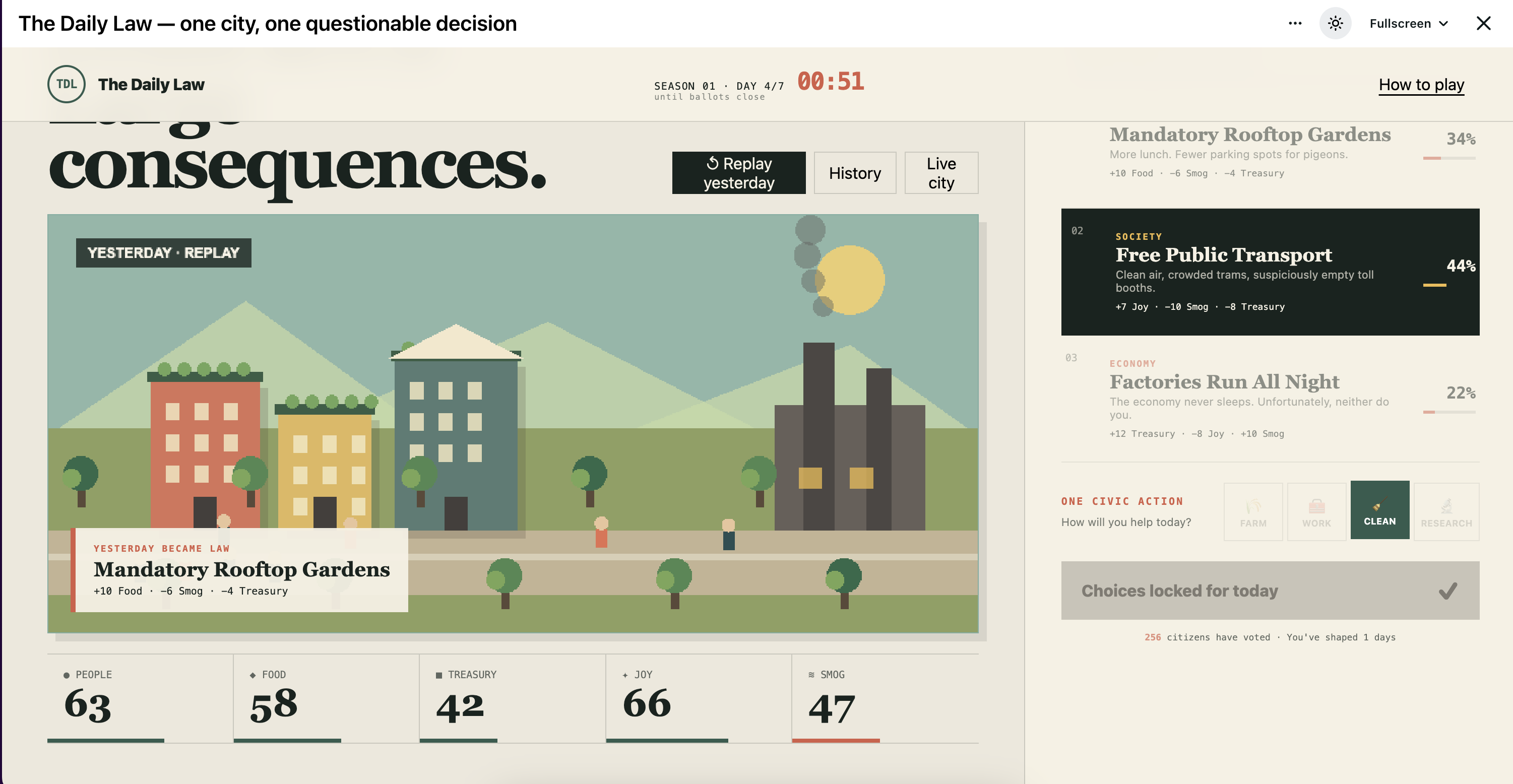
When the day is resolved, the winning law changes the shared city. Phaser turns those numerical consequences into visible events: factories produce more smoke, citizens celebrate or protest, vegetation grows, streets become busier, and buildings respond to the city’s changing condition.
The main gameplay loop is:
- Review the consequences of yesterday’s law.
- Inspect the current state of the city.
- Vote for today’s law.
- Preview the potential outcome.
- Return later to discover what the community decided.
This creates three reasons to come back: curiosity about the result, curiosity about how other players voted, and curiosity about what kind of civilization the community is gradually creating.
How we built it
We built The Daily Law as a Devvit Web application using React, TypeScript, Phaser, and Reddit’s developer platform.
React handles the product interface, including:
- Daily law cards
- Voting interactions
- City statistics
- Community vote distribution
- Previous-day results
- Onboarding and responsive layouts
Phaser powers the living city and the visual simulation. Instead of using Phaser only as a decorative canvas, we use it to communicate the consequences of community decisions through animation, environmental changes, citizen behavior, camera movement, and visual effects.
The application separates the interface from the simulation layer. React sends the selected law and city state into Phaser, while Phaser translates those values into a visual scene.
The game state includes a small set of understandable indicators:
- Population
- Food
- Treasury
- Happiness
- Pollution
Each law contains a group of modifiers that affect those indicators. When a daily result is resolved, the modifiers are applied to the current city state, constrained to safe ranges, and stored as part of the city’s history.
We used Devvit’s server capabilities to connect the Reddit user to their daily vote and persist the shared game state. This prevents repeated voting while ensuring that every visitor sees the same evolving civilization.
We intentionally kept the simulation deterministic and explainable. The goal was not to create a scientifically accurate economy, but to make every law produce understandable trade-offs and entertaining consequences.
Challenges we ran into
The first major challenge was balancing simplicity with meaningful decision-making. If laws only increased positive metrics, voting would have no strategic value. If every law had too many effects, the game would become difficult to understand. We solved this by giving each law a clear benefit and at least one visible cost.
Another challenge was making a daily game immediately rewarding. Waiting until tomorrow is a powerful retention mechanism, but players still need feedback during their current session. We introduced a live forecast that previews the possible effect of the leading law without permanently changing the city.
We also had to decide where React should end and Phaser should begin. Building the entire interface inside a game canvas would have made responsive layout and accessibility harder. Keeping everything in React, however, would have weakened the game’s visual identity. Separating the dashboard from the animated city gave us the strengths of both approaches.
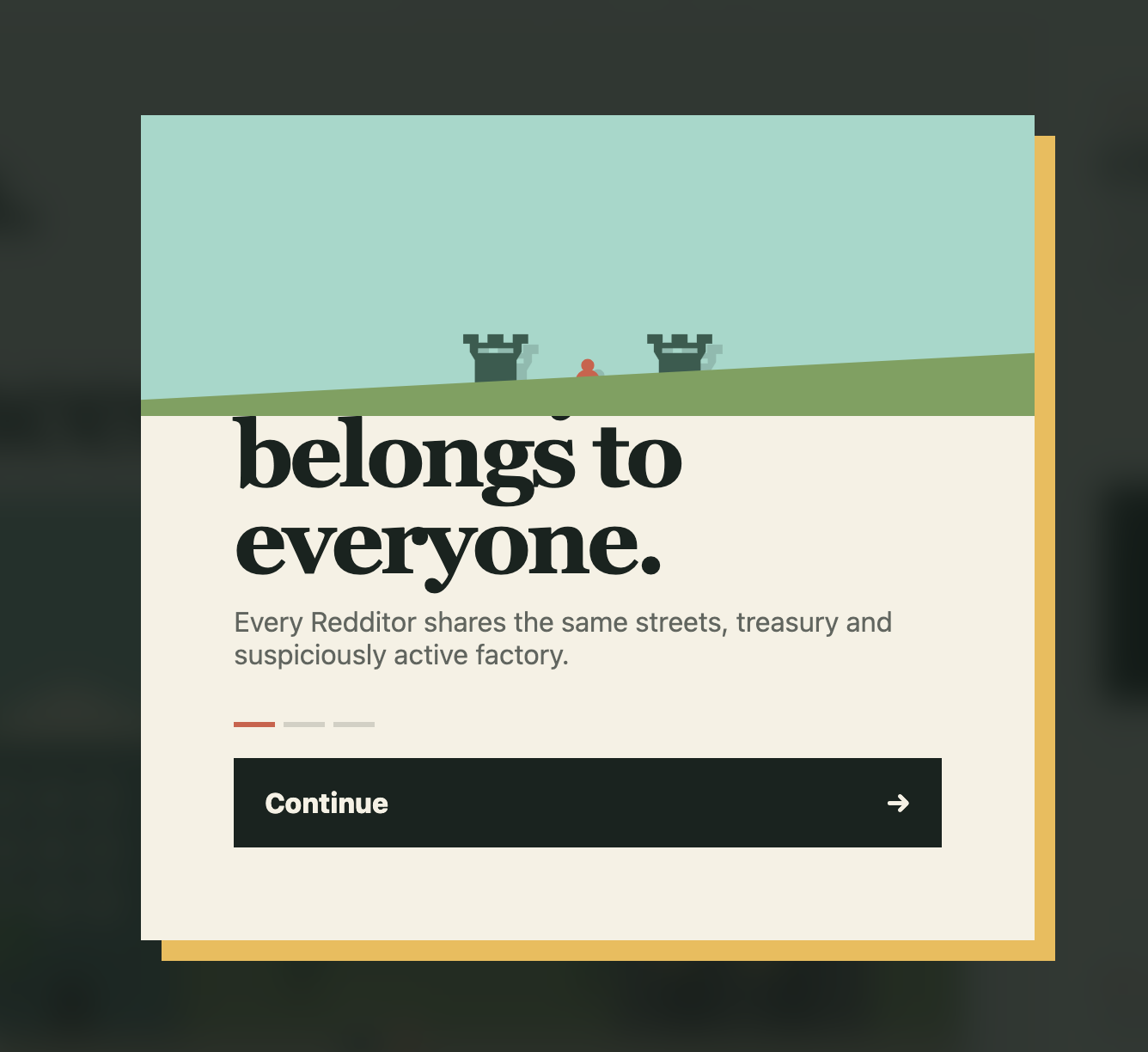
Designing for Reddit’s embedded and mobile environment created additional constraints. The game needed to explain itself quickly, fit naturally inside the available viewport, and avoid long tutorials. We reduced onboarding to one core message: vote today, then return to face the consequences.
Finally, collective games introduce a scaling problem. The impact of player actions cannot grow linearly forever as more users join. Our simulation therefore works with vote distributions and normalized community effects instead of directly adding every individual contribution to the city’s statistics.
Accomplishments that we're proud of
We are proud that The Daily Law feels like a genuinely collective game rather than a single-player experience with a shared leaderboard.
Every player sees the same city, votes on the same laws, and inherits the consequences of previous community decisions. A player cannot simply optimize a private save file; they must participate in a civilization shaped by strangers.
We are also proud of how Phaser turns abstract statistics into visible storytelling. Pollution is not only a number—it changes the sky and fills the city with smoke. Happiness is reflected in how citizens move and react. Economic growth brings construction and activity, while decline makes the city visibly quieter.
Another accomplishment was creating a game loop that is short without being disposable. A daily interaction can take less than a minute, but the outcome remains unresolved after the player leaves. That anticipation is a central part of the experience.
The project also establishes a flexible system for adding new laws, events, visual consequences, and seasonal outcomes without redesigning the core game.
What we learned
We learned that retention does not always require longer sessions or endless content. Sometimes the strongest reason to return is an unanswered question.
In The Daily Law, that question is simple: What did the community choose, and what happened because of it?
We also learned that social participation becomes more meaningful when players share consequences. Voting is more engaging when the result changes a world that everyone will see again tomorrow.
From a technical perspective, we learned how to combine a traditional web interface with a game engine inside Devvit Web. React was better suited to structured information and controls, while Phaser was better suited to simulation, animation, and emotional feedback.
We also learned to keep the game state deliberately small. Five well-presented city indicators created clearer decisions than a larger and supposedly more realistic model.
Most importantly, we learned that a Reddit-native game does not need to be about Reddit itself. It can instead be built around the qualities that make Reddit communities compelling: collective judgment, disagreement, creativity, participation, and unpredictable human behavior.
What's next for The Daily Law
The next major feature is a structured community law builder. Players will combine predefined subjects, actions, conditions, and targets to propose laws such as:
Every factory must close at night when pollution exceeds 70.
This approach would let players create content while keeping laws understandable, balanced, and safe to simulate. The most popular community proposals could appear in future daily votes.
We also plan to introduce seven-day seasons with distinct endings. Depending on the community’s decisions, a city might become a sustainable utopia, an industrial powerhouse, a happy but bankrupt republic, or a civilization unexpectedly dependent on goats.
Other planned improvements include:
- Daily civic actions alongside voting
- City crises driven by previous decisions
- Personal participation streaks
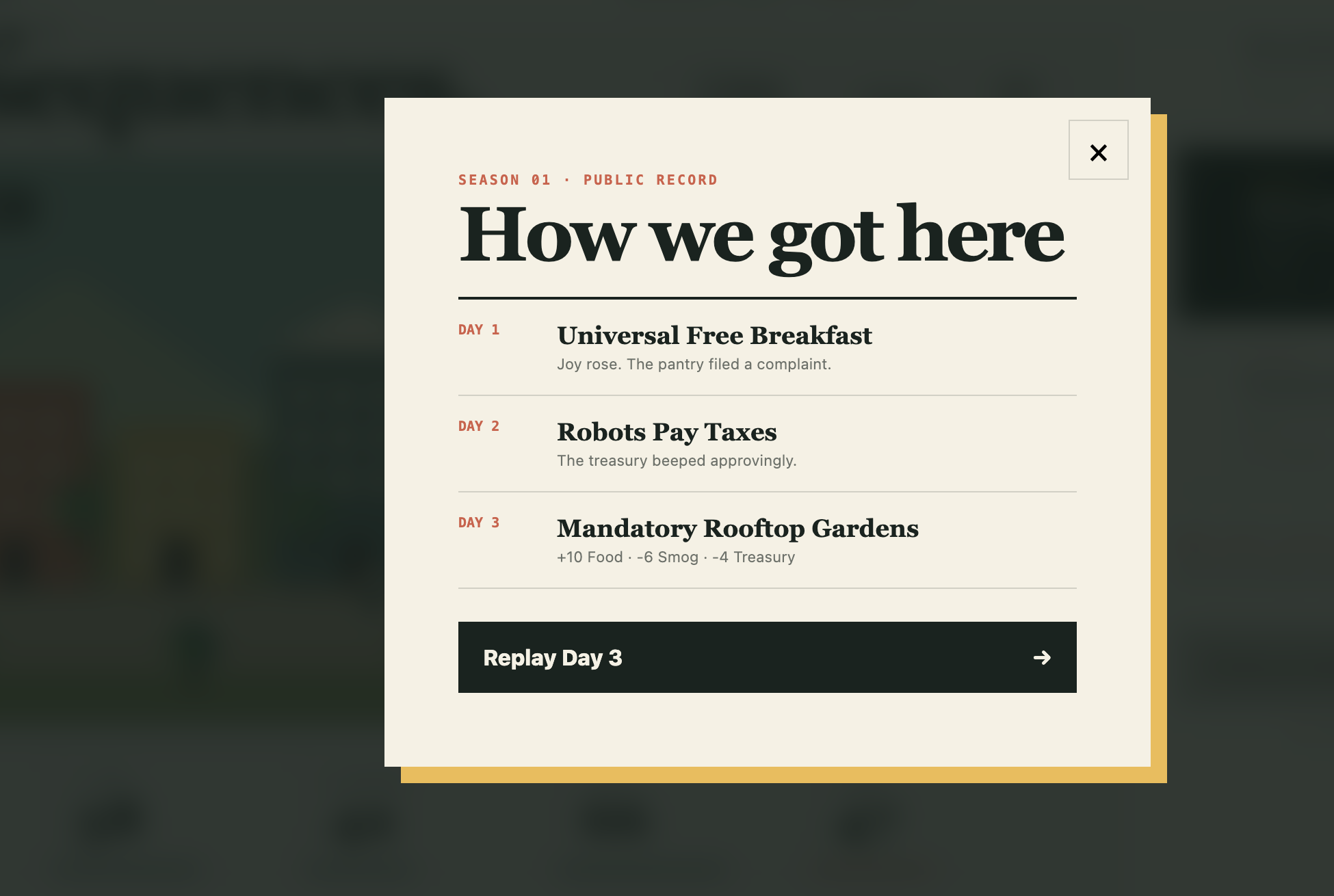
- Historical timelines and law replays
- Community achievements
- More detailed citizen behavior
- Additional environments and city themes
- Seasonal summaries and shareable result cards
- Subreddit-specific civilizations with different starting conditions
The long-term vision is for every community to create a civilization that reflects its own personality. Some cities may be carefully optimized. Others may be chaotic, contradictory, or completely absurd.
Either way, everyone has to come back tomorrow and live with the law.


Log in or sign up for Devpost to join the conversation.