-
-
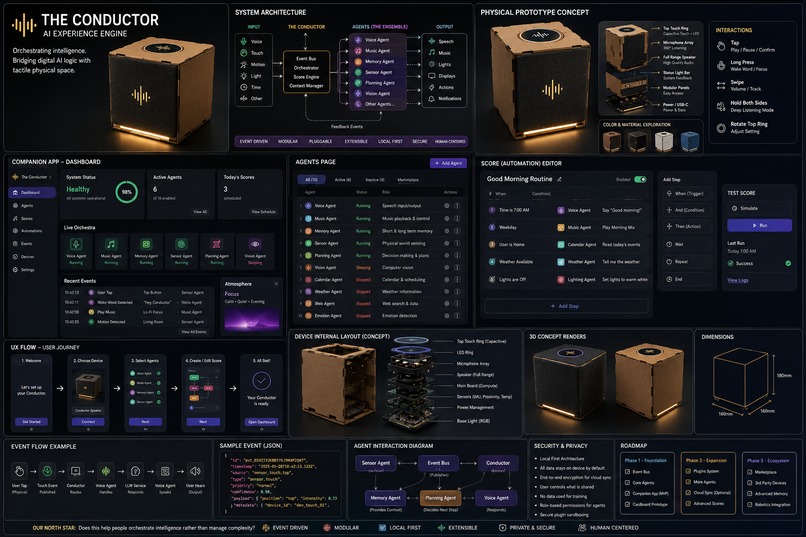
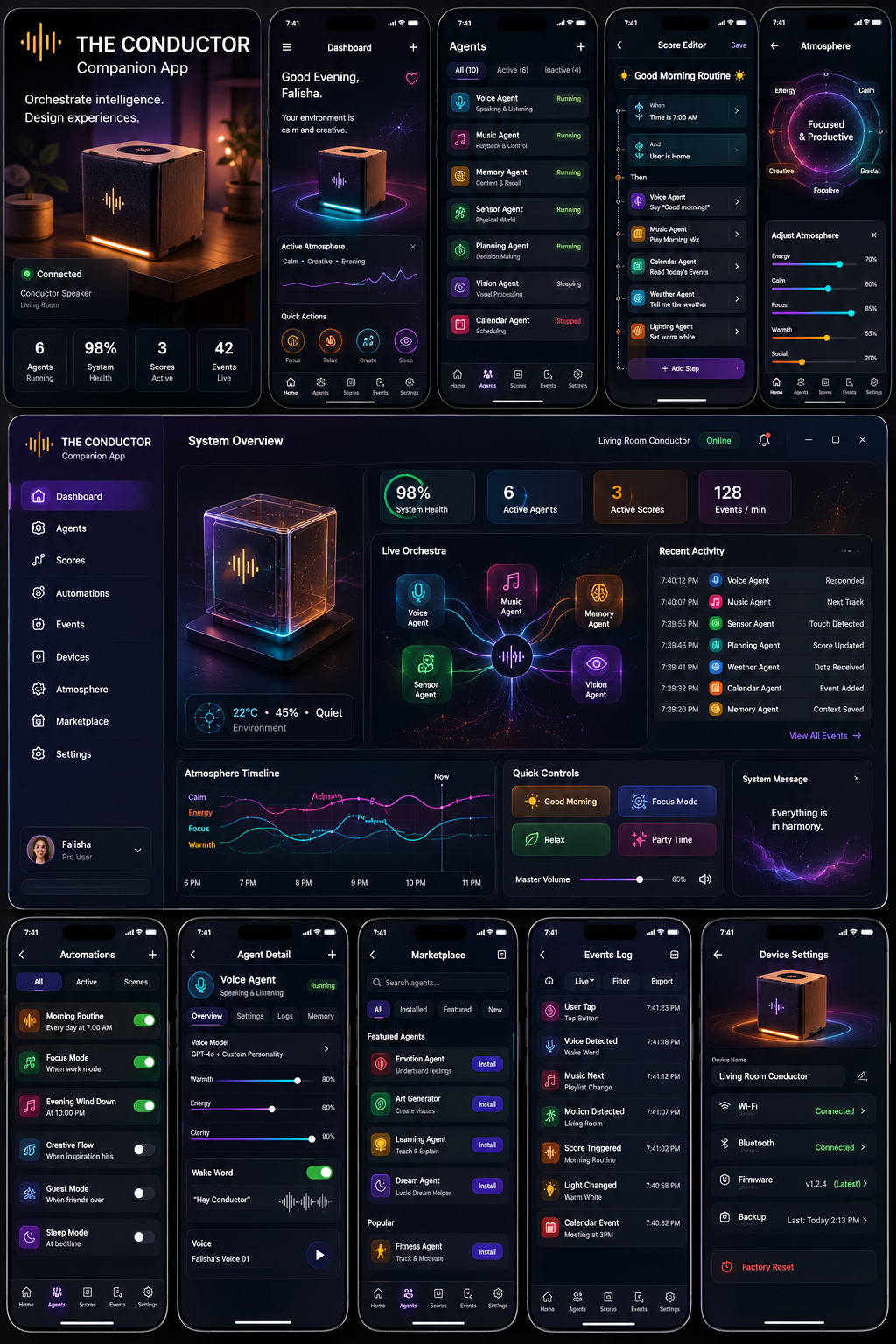
Concept UI: A sleek, dark-mode dashboard showing The Conductor's modular agent manager and active status.
-
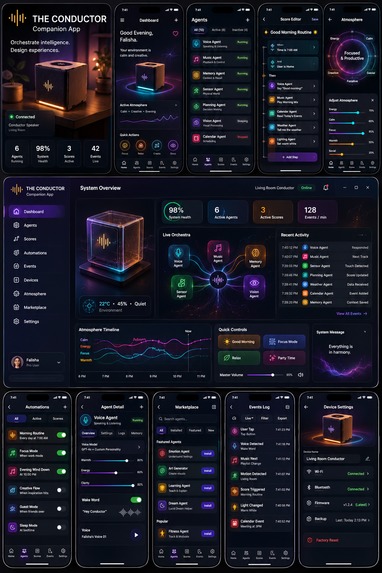
Concept UI: Visualizing the Live Activity timeline, showing how physical triggers cascade to specialized AI agents.
-
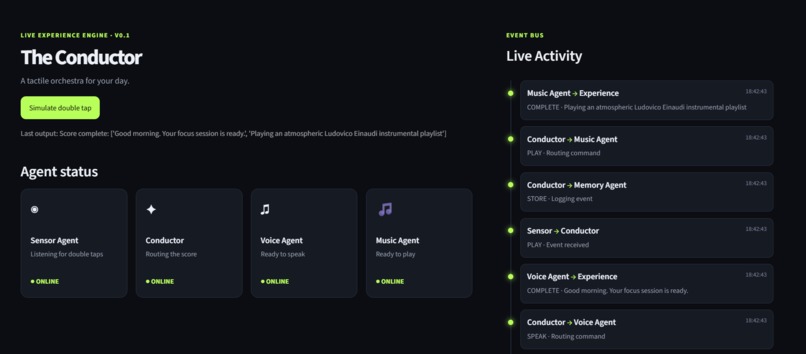
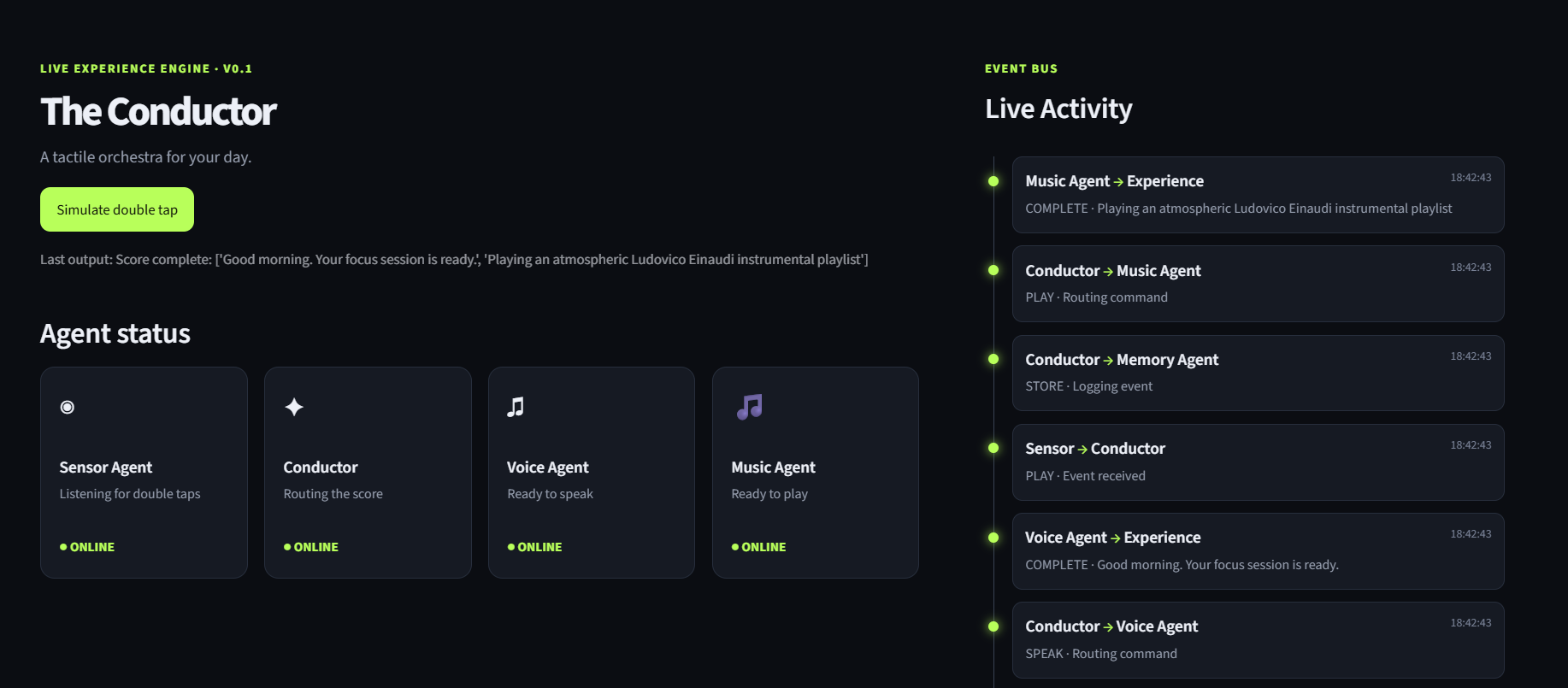
Our v0.1 MVP Dashboard built in Streamlit. It features a simulated physical trigger and a real-time Event Bus timeline.
Inspiration
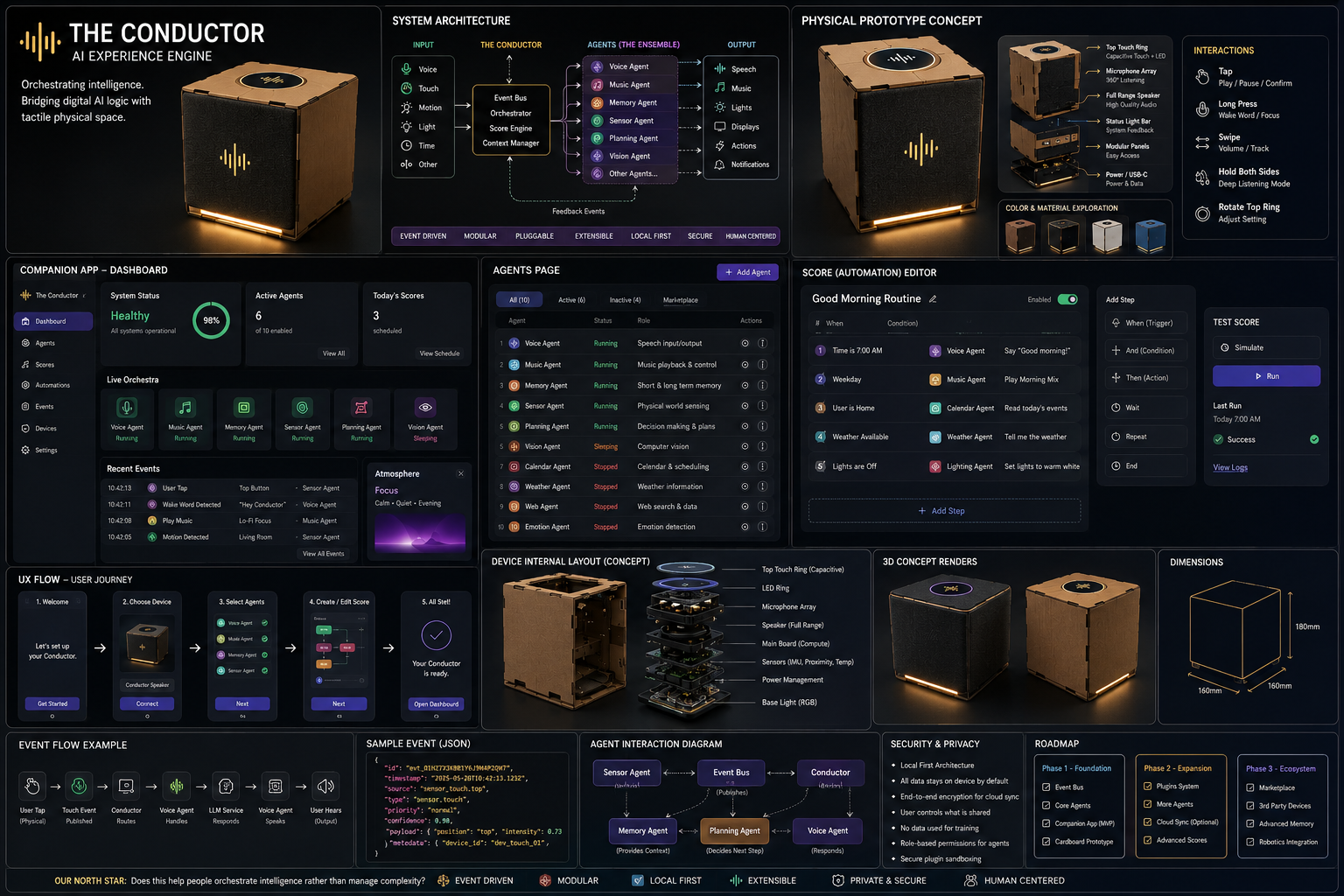
Most AI experiences today are trapped behind a monolithic chat box. But our daily lives aren't lived in text threads—they are tactile, physical, and multi-sensory. I wanted to step out of the browser and build a framework for a context-aware partner in physical space. This inspired the "Orchestra Metaphor." Instead of one giant AI trying to do everything, I envisioned a "Conductor" (a central event router) that delegates tasks to specialized, single-purpose AI agents (the "Line Cooks").
What it does
The Conductor is an open, event-driven framework for orchestrating cooperative AI agents. In this Version 0.1 MVP, the system uses a Streamlit dashboard to simulate a physical hardware trigger. When triggered, the Conductor executes a JSON "Score." Rather than executing logic itself, it simultaneously routes commands across an Event Bus to specialized agents. A single tap can trigger a Memory Agent to log the stateful interaction, a Voice Agent to speak a greeting, and a Music Agent to queue a playlist—all running concurrently.
How we built it
We adhered to a 7-Layer Multi-Agent Architecture. We built a zero-latency web dashboard using Streamlit, connected to a Python backend powered by asyncio to handle non-blocking event routing. To ensure the Conductor had "Working Memory" without the latency of a vector database, we utilized a session-scoped Python dictionary. Codex and GPT-5.6 acted as my Senior Implementation Engineers, instantly writing the asyncio.gather() logic required for concurrent multi-agent actions.
Challenges we ran into
Building an asynchronous event loop from scratch in Python is inherently complex. Managing state so that the Conductor didn't suffer from "amnesia" required careful planning. Furthermore, translating the vision of a physical cardboard prototype into a purely digital MVP required pivoting our hardware integration strategy to a web-based UI.
Accomplishments that we're proud of
We successfully separated orchestration from intelligence. Building a fully functional, zero-latency Event Bus and stateful Memory cache using lightweight Python dictionaries instead of heavy databases proved that multi-agent systems can be incredibly fast.
What we learned
I learned how to deeply integrate asynchronous Python programming (asyncio) and how to use Codex as a strategic architectural partner rather than just a simple code generator.
What's next for The Conductor
The next step is Layer 6: Hardware Integration. We plan to move the simulation out of the browser and into our tactile cardboard enclosure, mapping physical sensors (like piezoelectric vibration sensors) to the Event Bus to bring The Conductor into the physical world.
Built With
- asyncio
- codex
- dashboard
- gpt-5.6
- multi-agent
- openai
- python
- streamlit

Log in or sign up for Devpost to join the conversation.