-
-
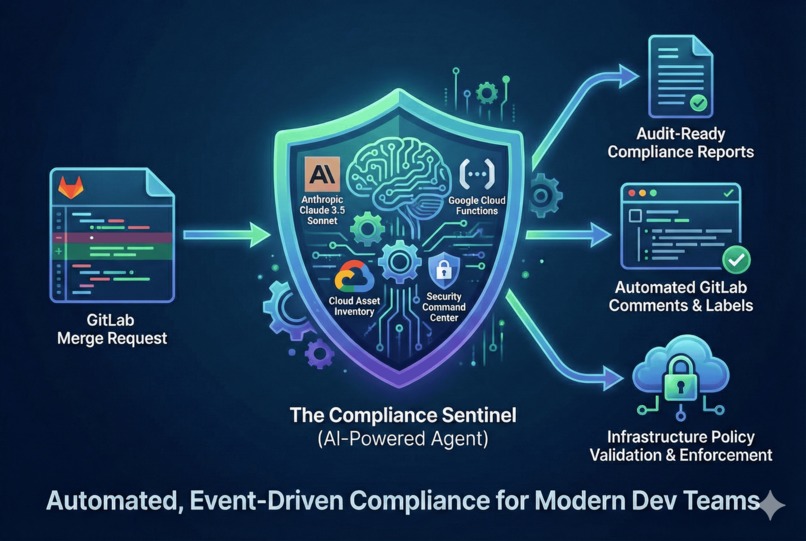
The Compliance Sentinel: simple, integrated, automated.
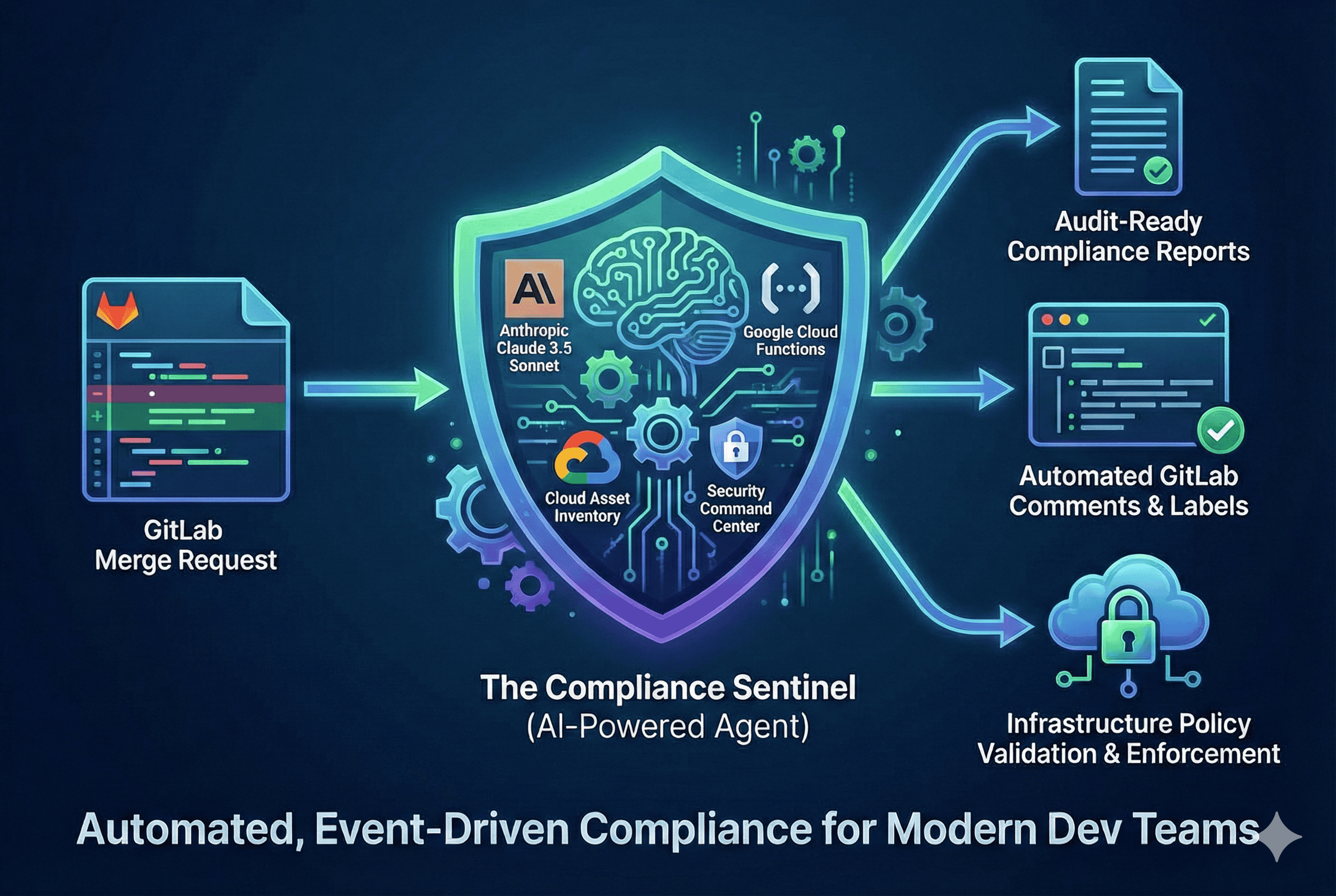
The Compliance Sentinel Inspiration
AI writing code is no longer revolutionary.
The real bottlenecks in modern software teams are elsewhere: security reviews, compliance validation, infrastructure governance, audit preparation.
Engineering teams move fast. Compliance teams move carefully. Security checks often happen too late — after deployment, after incidents, after audits.
This creates friction.
The Compliance Sentinel was built to remove that friction.
What if compliance wasn’t a manual review? What if every Merge Request automatically became a compliance checkpoint?
Not as a suggestion. As enforcement.
What It Does
The Compliance Sentinel is an event-driven compliance enforcement agent built on the GitLab Duo Agent Platform.
It reacts to GitLab events and takes real action.
When a Merge Request is created or updated, the agent:
• Analyzes the code diff for security risks and sensitive data exposure • Detects infrastructure changes (Terraform, cloud configs) • Validates encryption and cloud policies • Calculates a compliance risk score • Generates structured, audit-ready findings • Posts actionable feedback on the Merge Request • Adds compliance labels • Blocks the merge if critical violations are detected
Every Merge Request becomes a self-enforcing security and compliance gate.
This is not a chatbot. It is a digital compliance teammate embedded inside the workflow.
How We Built It
The architecture is fully event-driven.
GitLab Webhooks trigger the workflow on Merge Request events.
A custom public GitLab Duo Agent orchestrates the flow.
Claude 3.5 Sonnet analyzes code diffs and returns structured JSON.
Deterministic components validate findings and compute a compliance score.
Infrastructure policies are validated using Google Cloud APIs.
The agent writes back to GitLab via REST APIs:
Comments
Labels
Merge blocking decisions
The system is built around:
• Tool-calling • Structured AI outputs • Policy enforcement logic • Workflow orchestration
Not conversational AI.
Why It Matters
Compliance today is reactive and manual.
The Compliance Sentinel shifts compliance left by embedding enforcement directly into the SDLC.
Before:
Security reviews were manual
Compliance was documentation-heavy
Violations were found late
After:
Violations are caught at Merge Request time
Compliance status is visible instantly
Risk is measurable
Enforcement is automatic
It transforms compliance from a bottleneck into an automated workflow primitive.
Challenges We Solved
• Designing a true event-driven agent (not chat-based) • Forcing structured, machine-actionable JSON outputs • Connecting AI reasoning to deterministic enforcement logic • Translating regulatory requirements into programmable rules • Maintaining performance in a hackathon environment
What We’re Proud Of
• Building a multi-agent orchestration architecture • Combining AI reasoning with cloud policy validation • Implementing automated merge blocking based on compliance scoring • Creating audit-ready structured outputs • Aligning deeply with GitLab Duo Agent Platform capabilities
Most importantly:
We built an agent that acts.
What We Learned
• How to design trigger-based agents inside GitLab • How to structure prompts for reliable tool orchestration • How compliance frameworks can be translated into automated checks • How AI can augment — not replace — deterministic policy enforcement
We learned that the future of AI in DevOps is not just code generation.
It is workflow enforcement.
What’s Next
• Compliance scoring per Merge Request • Cross-cloud policy validation • Integration with SAST/DAST correlation • Compliance trend dashboard • Production-grade SaaS deployment
The long-term vision:
Make compliance invisible. Built directly into development workflows. Always enforced. Never forgotten.
Built With
- ai-catalog
- anthropic-claude
- gitlab-ambient-environment
- gitlab-api
- gitlab-duo
- google-vertex-ai
- rest-api
- yaml


Log in or sign up for Devpost to join the conversation.