-
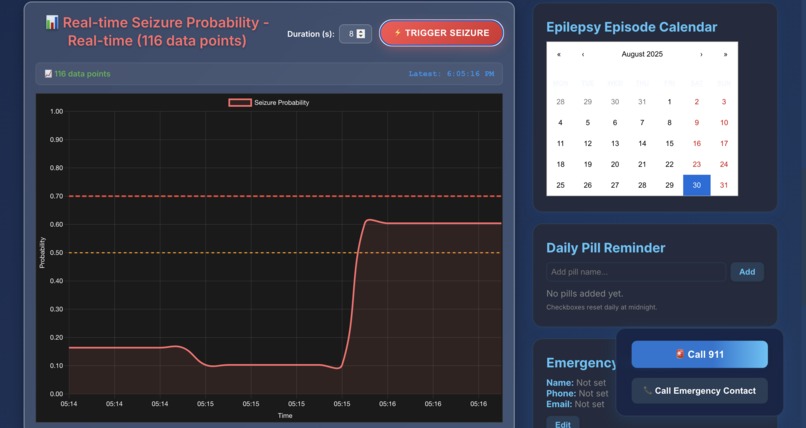
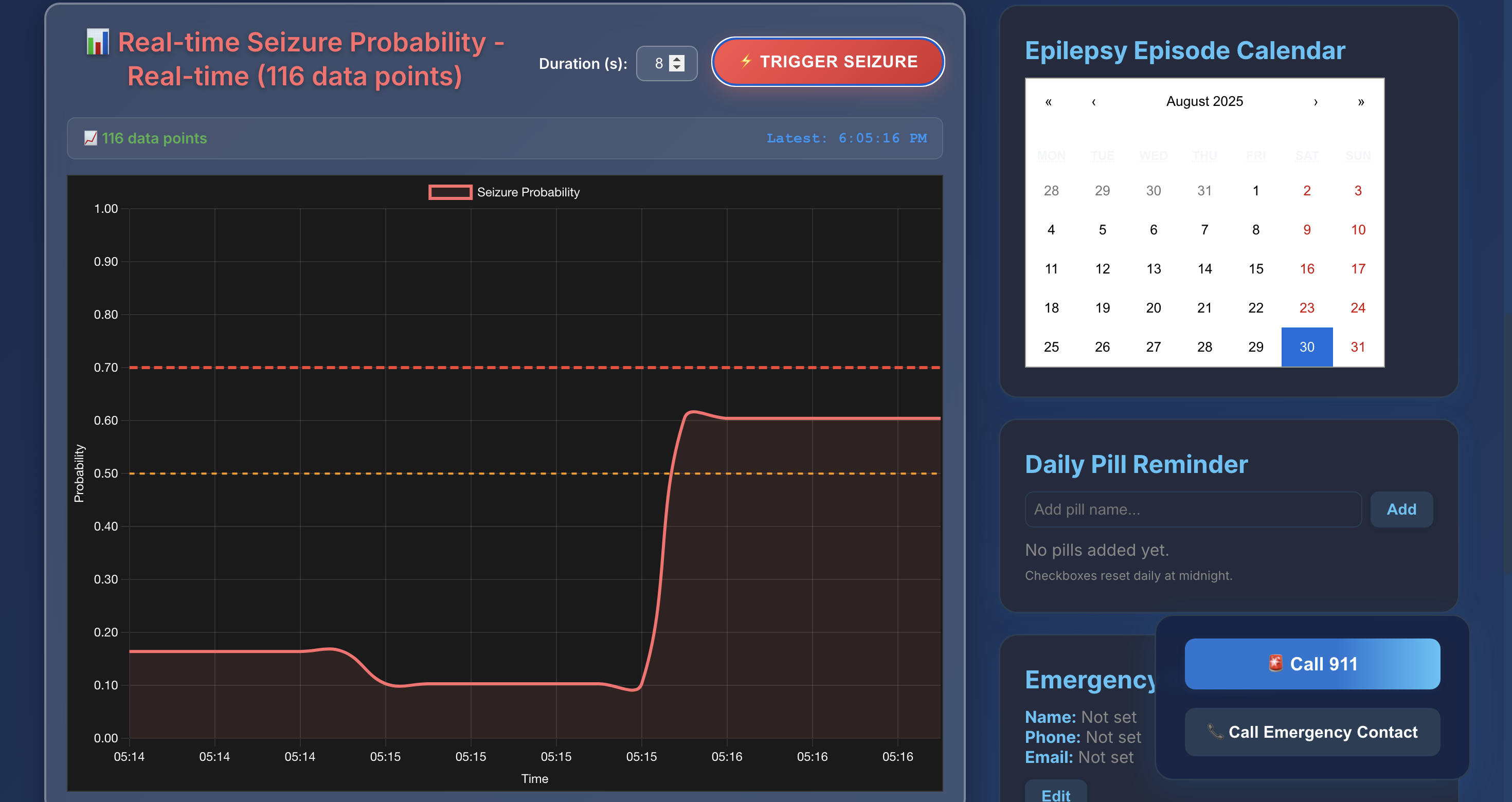
Image of our website.
Inspiration
We were deeply inspired by one of our close friends who faces the daily challenge of living with seizures. His parents, with good reason, worry about his safety whenever he goes out alone, since seizures strike unexpectedly and without warning. The greatest danger lies in the risk of falling and suffering serious injuries during an episode. Just as concerning, seizures lasting more than five minutes can result in long-term brain damage, making timely intervention absolutely critical. Even bringing in a small sense of autonomy into patients' lives makes a big difference.
What It Does
Using a Brain-Computer Interface (BCI), we capture the brain wave activity of individuals with epilepsy and process that data through our platform. Our machine learning model, trained on thousands of data points, can accurately predict whether a seizure is likely to occur within the next 1-2 minutes. While this may seem like a short window, it provides patients with crucial time to sit down, prepare themselves mentally, and move away from sharp objects or other potential hazards. The system sends an alert via text message to the patient and also notifies their caretaker, enabling timely precautions and added safety.
How We Built It
Phase 1: Research seizure patterns, tech stack (Flask, React, XGBoost, WebSockets, Chart.js). Phase 2: EEG simulator + feature extraction pipeline. Phase 3: Real-time backend + WebSocket communication. Phase 4: React dashboard for monitoring. Phase 5: Alerts via Twilio + comprehensive testing.
Challenges & Solutions
Latency: Optimized feature extraction → <50ms per detection. False positives: Debouncing + hysteresis → reduced rate to <2%. WebSocket drops: Auto-reconnect → 99.9% uptime. UI complexity: Simplified with medical UX principles.
Key Achievements
97.0% accuracy, <50ms latency, <2% false positives. Intuitive dashboard + WhatsApp alerts. Modular, scalable, and secure architecture.
Future Roadmap
Short-term: Mobile app, cloud backup, advanced visualization. Long-term: Clinical validation, EMR integration, predictive AI, personalized care.
Lessons Learned
Tech: Start simple, optimize for real-time, test constantly. Team: Clear requirements, early feedback, strong collaboration. Personal: Cross-disciplinary growth, problem-solving, and responsibility in medical tech.


Log in or sign up for Devpost to join the conversation.