-
-
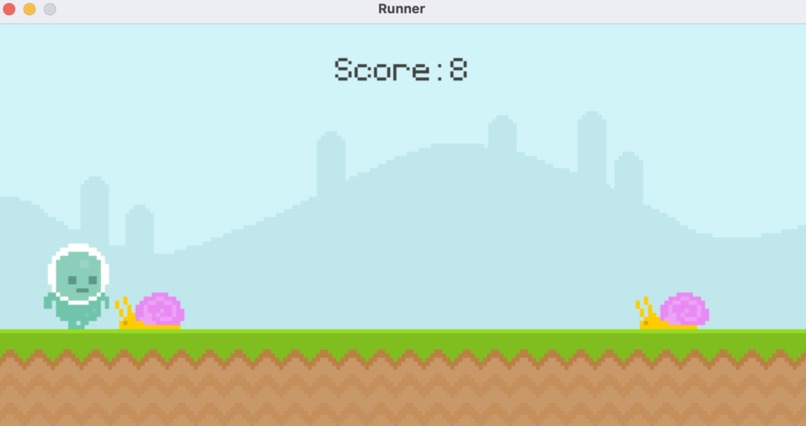
Introductory level of our game.
-
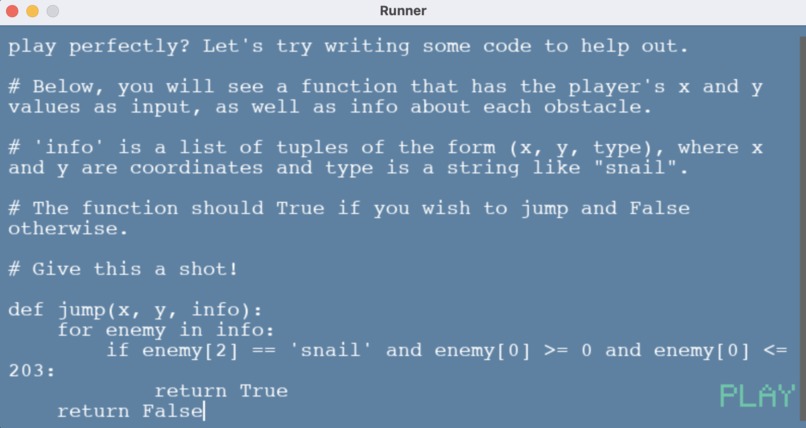
Menu item with interactive user interface, allowing users to create their own Python code.
-
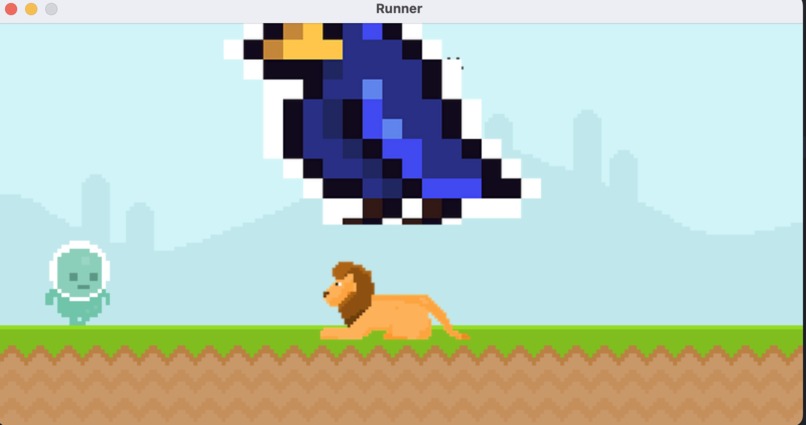
Additional levels which challenge the user to implement out of the box Python code.


Inspiration
We found that even there are so many resources to learn to code, but all of them fall into one of two categories: they are either in a generic course and grade structure, or are oversimplified to fit a high-level mould. We thought the ideal learning environment would be an interactive experience where players have to learn to code, not for a grade or score, but to progress an already interactive game. The code the students learn is actual Python script, but it guided with the help of an interactive tutorial.
What it does
This code models a "dinosaur game" structure where players have to jump over obstacles. However, as the player experiences more and more difficult obstacles through the level progression, they are encouraged to automate the character behavior with the use of Python commands. Players can code the behavior for the given level, telling the player to "jump when the obstacles is 10 pixels away" with workable Python script. The game covers the basic concepts behind integers, loops, and boolean statements.
How we built it
We began with a Pygame template and created a game akin to the "Dinosaur game" of Google Chrome. We then integrated a text editor that allows quick and dirty compilation of Python code into the visually appealing format of the game. Furthermore, we implemented a file structure for all educators to customize their own programming lessons and custom functions to target specific concepts, such as for loops and while loops.
Challenges we ran into
We had most trouble with troubleshooting an idea that is both educational and fun. Finding that halfway point pushed both our creativity and technical abilities. While there were some ideas that had heavily utilizing AI and VR, we knew that we could not code that up in 36 hours. The idea we settled on still challenged us, but was something we thought was accomplishable. We also had difficulty with the graphics side of the project as that is something that we do not actively focus on learning through standard CS courses in school.
Accomplishments that we're proud of
We were most proud of the code incorporation feature. We had many different approaches for incorporating the user input into the game, that finding one that worked proved to be very difficult. We considered making pre-written code snippets that the game would compare to the user input or creating a pseudocode system that could interpret the user's intentions. The idea we settled upon, the most graceful, was a method through which the user input is directly input into the character behavior instantiation, meaning that the user code is directly what is running the character--no proxies or comparison strings. We are proud of the cleanliness and truthfulness this hold with our mission statement--giving the user the most hand-ons and accurate coding experience.
What we learned
We learned so much about game design and the implementation of computer science skills we learned in the classroom. We also learned a lot about education, through both introspection into ourselves as well as some research articles we found about how best to teach concepts and drill practice.
What's next for The Code Runner
The next steps for Code Runner would be adding more concepts covered through the game functionality. We were hoping to cover while-loops and other Python elements that we thought were crucial building blocks for anyone working with code. We were also hoping to add some gravity features where obstacles can jump with realistic believability.


Log in or sign up for Devpost to join the conversation.