Inspiration
🔥 Climate change might be the most important challenge for us and future generations. Last year, Earth's average surface temperature was the warmest on record. We are facing a climate crisis: from extreme wildfires to rising sea levels, we can see our Earth is changing, which will significantly impact human health.
🌎 This project aims to increase awareness about how climate change affects human health so we can accelerate research to mitigate it.
What it does
This App has 2 main sections:
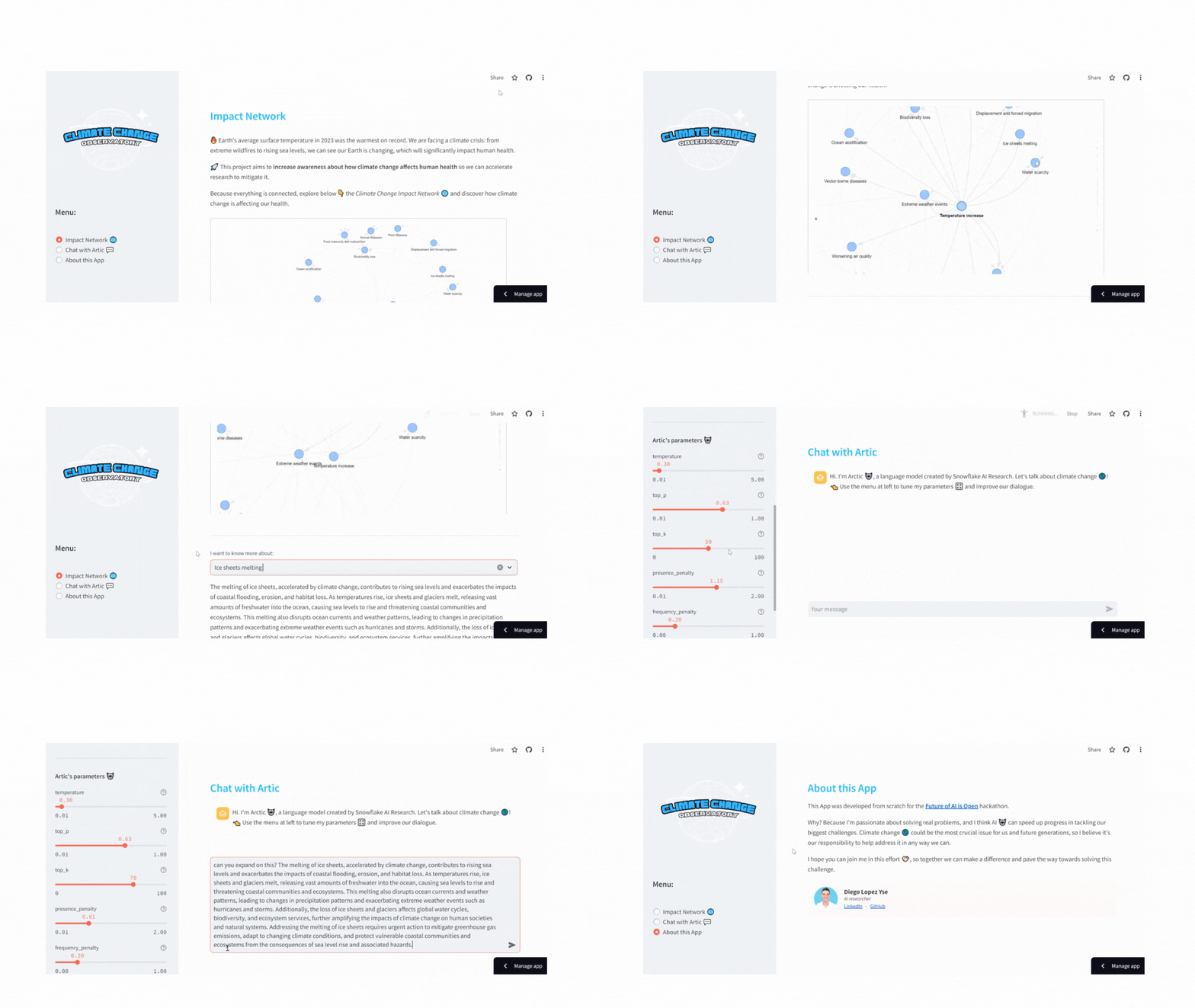
🌐 Impact Network
You can find in this section an interactive graph connecting different causes and consequences brought by climate change. The idea is to gain an understanding of how different events are connected and visualize impacts that might not be so evident. Also, by adding more impacts, we can start identifying clusters of events that might be related. For example, animal and plant diseases are closely linked to biodiversity loss, food insecurity, and malnutrition as a consequence of the links with other impacts defined in the graph. Texts explaining each node were generated using Artic ❄️.
💬 Chat with Artic
This section leverages the Artic model facilitated in Replicate. Once you enter this section, a sidebar menu is enabled with different parameters to tune the model, each one with a helper button explaining its purpose. For example, I can ask it to expand on another section's statement.
How we built it
This App was developed from scratch for this hackathon, built and deployed using Streamlit, and employs Artic as one of the main components. Everything was coded in Python 🐍, using VS Code as IDE.
Challenges we ran into
Although the App's concept became very clear, it took several iterations to define a proper system design and reach the final product.
Prioritizing the user experience, I spent a lot of time testing libraries and functionalities to produce an integrated experience between climate change events and the idea of embedding Artic into that journey.
Accomplishments that we're proud of
I'm satisfied with the end result because it integrates different ideas, technologies, and resources into a unique system capable of scaling and incorporating additional functionalities 😊.
I'm also very happy with the inclusion of Artic into the system. This was the first LLM development I have performed so far, and it triggered additional ideas for future developments 🤯.
What we learned
I learned a lot about system design, graph visualization, and LLMs. In particular, I learned about the Streamlit/Snowflake integration, and all the capabilities available to developers.
Although I already used Streamlit 🎈 before, I also learned new components and functionalities.
What's next for The Climate Change Observatory
During the App development process I had a lot of ideas I'd like to incorporate in future versions:
1️⃣ The Artic model could be fine-tuned to provide knowledgeable answers on climate change, training it on scientific documents.
2️⃣ The Impact Network could also be further improved by incorporating filtering/expansion/ functionalities. This would allow users to gain insights as they navigate the graph.
3️⃣ Artic can be used to expand the Impact Network, discovering new relationships and climate change events.
4️⃣ In a more advanced version 🚀, Artic can be used to build an Agent 🤖 to search for potential climate change solutions, connecting scientific knowledge related to the challenge.
Built With
- artic
- python
- streamlit
- vscode


Log in or sign up for Devpost to join the conversation.