Inspiration
Cities are more than buildings, roads, and landmarks. They are collections of stories, memories, people, and moments that change over time.
We wanted to explore the idea of a city that could remember — a digital world where places are connected to the memories and stories that happened there.
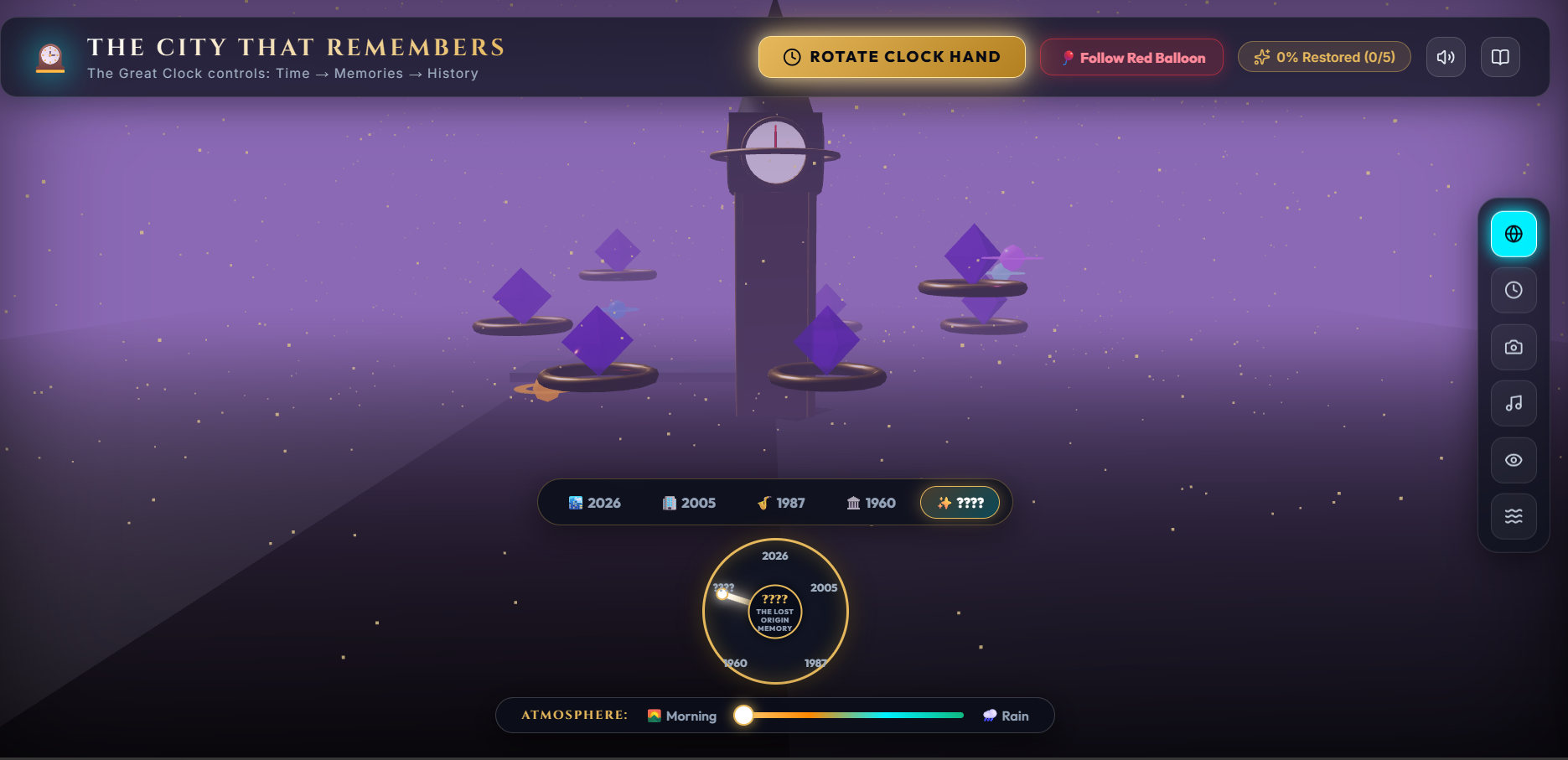
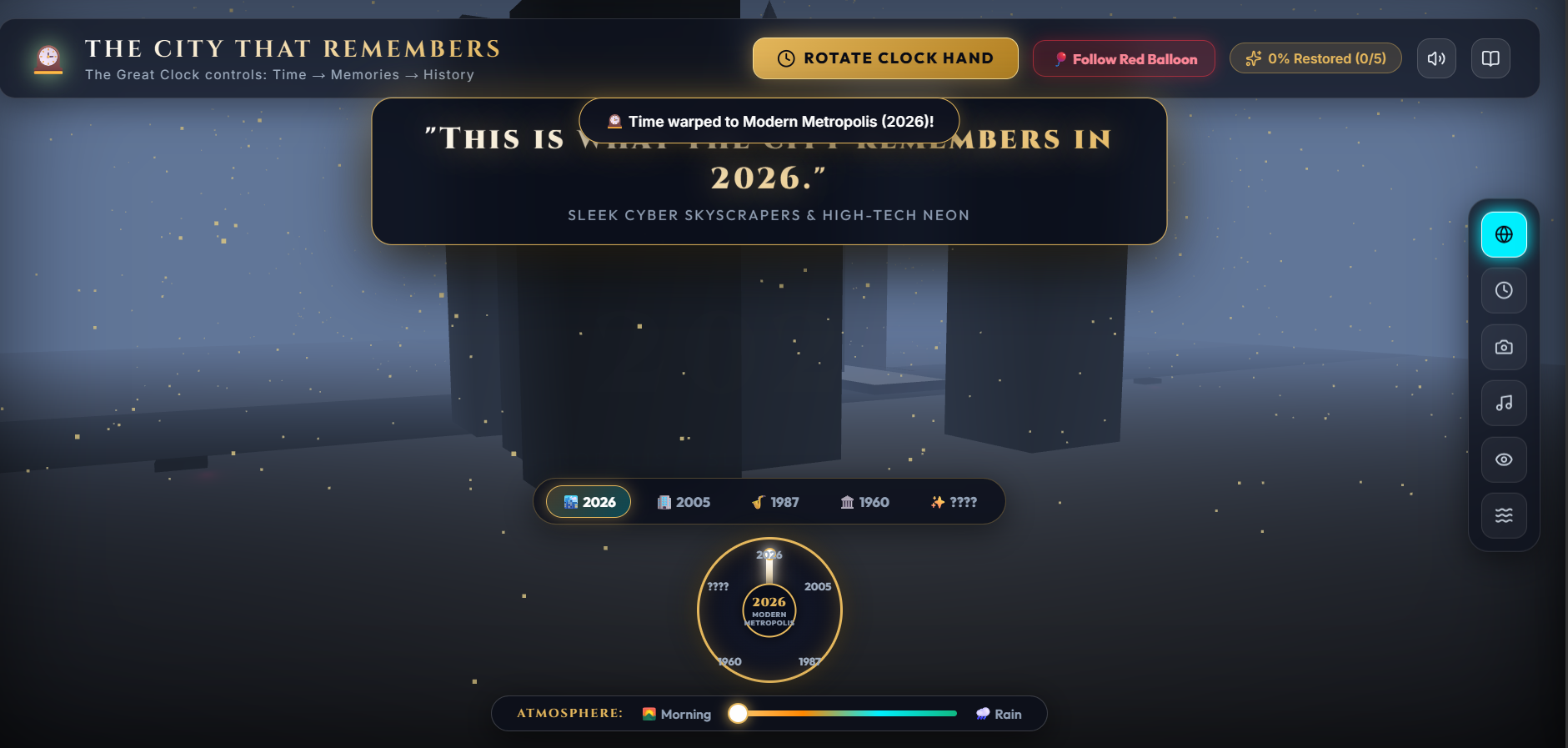
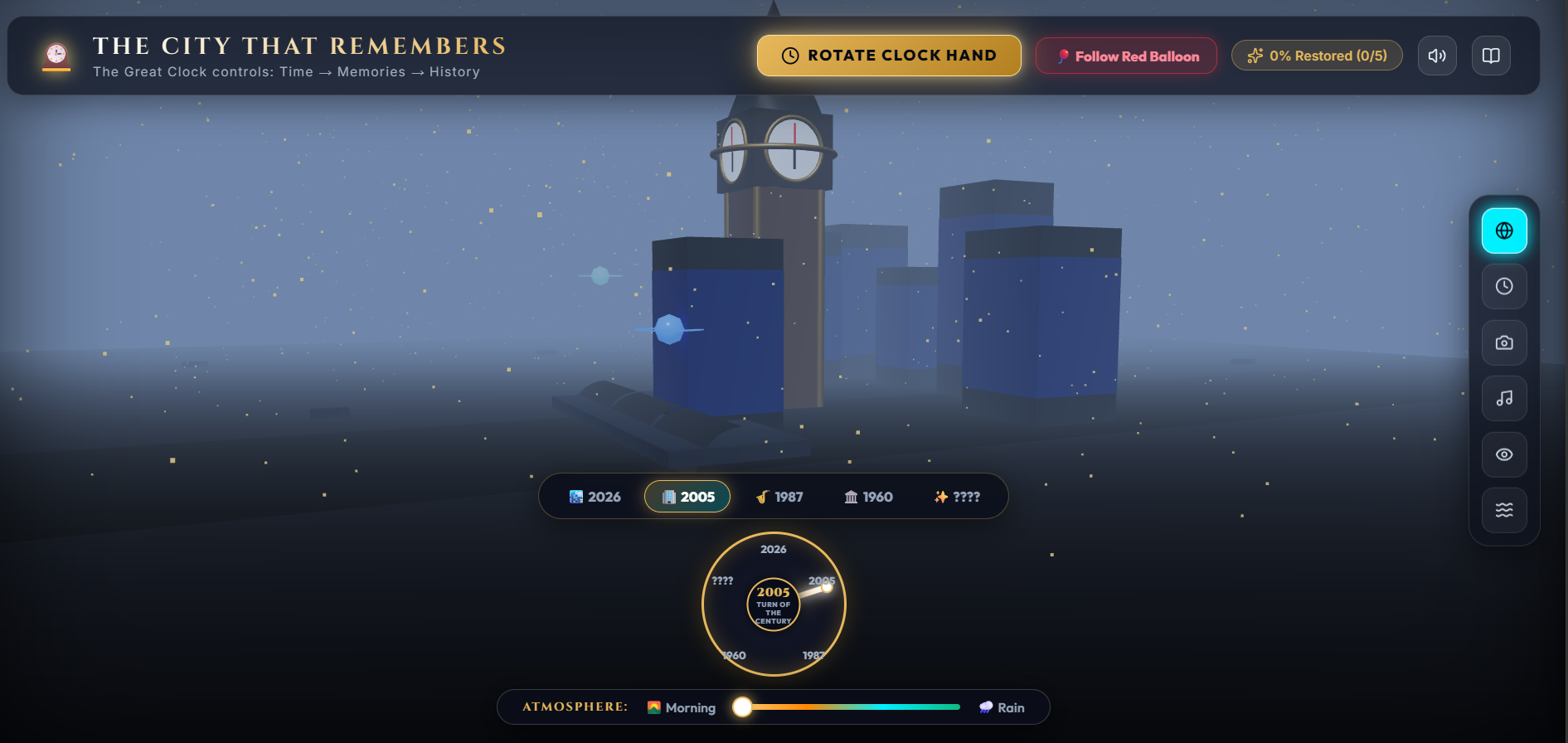
This concept became The City That Remembers, an immersive 3D web experience designed to turn a website into an interactive journey through a living digital city.
Instead of simply presenting information on a screen, we wanted users to explore, discover, and feel connected to the environment.
What it does
The City That Remembers creates an interactive 3D representation of a city where users can explore different areas and discover the stories hidden within them.
The experience focuses on:
- 🌆 An immersive 3D city environment
- 🗺️ Interactive exploration
- ✨ Animated visual elements
- 📖 Storytelling through locations
- 🖱️ Interactive user experiences
- 🎨 Atmospheric lighting and visual effects
- 🎥 Cinematic transitions
- 📱 Responsive web experience
The central idea is that every location has a story.
Instead of navigating a traditional website through static pages, users move through a digital environment and uncover different parts of the city's identity.
How we built it
We approached the project as a combination of 3D visualization, frontend development, animation, and interactive storytelling.
The experience was structured around a 3D environment where the visual world and interface work together.
Core workflow
User
  ↓
Interactive Interface
  ↓
3D City Environment
  ↓
User Exploration
  ↓
Interactive Locations
  ↓
Stories & Memories
  ↓
Immersive Experience
The frontend handles navigation, interactions, animations, and responsive behavior, while the 3D layer creates the depth and atmosphere of the city.
We focused heavily on visual hierarchy, camera movement, transitions, lighting, and interaction so that the experience feels intentional rather than simply placing 3D objects onto a webpage.
Challenges we ran into
The biggest challenge was finding the right balance between visual complexity and usability.
A 3D website can easily become overwhelming if there are too many animations, objects, or interactions.
Some of the challenges included:
- Building an immersive environment while keeping navigation intuitive
- Creating smooth animations and transitions
- Integrating 3D elements with traditional web UI
- Maintaining performance while rendering complex visuals
- Designing an experience that works across different screen sizes
- Making the city feel atmospheric without distracting from the story
- Turning the concept of “memory” into something users could actually experience
We learned that creating an immersive website isn't just about making it visually impressive — every interaction needs a purpose.
Accomplishments that we're proud of
We are proud of transforming an abstract idea — a city that remembers — into an interactive digital experience.
Some of the things we're particularly proud of include:
- 🌆 Creating an immersive 3D city experience
- 🎨 Developing a distinctive visual identity
- 🧭 Making exploration part of the navigation experience
- ✨ Combining animation with storytelling
- 🖱️ Building meaningful interactive elements
- 📱 Considering responsive experiences across devices
- 🚀 Creating a website that goes beyond conventional layouts
Most importantly, we are proud that the project doesn't treat 3D as decoration.
The 3D environment is part of the story.
What we learned
This project taught us that immersive web experiences require a different approach to traditional website development.
We learned how important it is to think about:
- User movement and exploration
- Visual storytelling
- Interaction design
- 3D performance
- Animation timing
- Responsive layouts
- The relationship between environment and interface
We also learned that a strong concept can guide technical decisions.
Rather than asking “What 3D effects can we add?”, we started asking:
“What should the user feel when they experience this?”
That shift helped us make better design and development decisions.
What's next for The City That Remembers
The current experience is only the beginning.
Our vision is to turn The City That Remembers into a much larger interactive world where users can explore a city through the memories of the people who experienced it.
Future possibilities include:
- 🏙️ A larger explorable 3D city
- 📍 Interactive memory locations
- 📸 User-submitted memories and photographs
- 🎙️ Audio stories attached to locations
- 🕰️ Time-based versions of the city
- 🌅 Dynamic day/night environments
- 👥 Multiple user stories connected to the same location
- 🤖 AI-generated connections between memories
- 🗺️ Interactive city maps
- 🌐 Community-driven storytelling
- 📱 Improved mobile and WebGL performance
Ultimately, we want to build a digital city where places don't just have coordinates — they have memories.
The vision
A city built from places, powered by stories, and remembered through people.

Log in or sign up for Devpost to join the conversation.