-
-
The Carbon Games - Carpool CO₂ Proof of Impact Marketplace
Inspiration
Transportation emissions make up around 15% of global CO₂ emissions, with cars and vans accounting for 3.53 billion metric tons in 2022 alone. Single-occupancy vehicles, often used for daily commutes, significantly contribute to this footprint, especially in urban areas where solo car trips are the norm. Efforts to reduce this impact—such as carpooling—have shown that increasing vehicle occupancy can lead to substantial emissions reductions and improved air quality.
Our solution aims to address this by transforming daily commutes into a positive environmental impact for large corporations with high numbers of single-occupancy commuters. Inspired by Project Drawdown's findings that carpooling can save up to 11.07 gigatons of CO₂ by 2050, we’re creating a platform that allows corporate employees to “own” and track their emissions reductions. Similar to how platforms let individuals purchase or offset personal carbon emissions, we empower employees to generate verifiable carbon credits based on their carpooling activities, contributing directly to the company’s sustainability goals while also creating an innovative marketplace for carbon credit trading.
This model aligns with the global trend of decentralized, user-owned systems, putting the power of emissions tracking and offsetting in the hands of users and supporting corporations in building sustainable workplace initiatives.
What it does
Our Carpool Carbon Credits Marketplace has five key components:
Part 1: Carpool Tracking and CO₂ Savings Calculation Employees use our app to connect or create a NEAR wallet, enabling them to track CO₂ savings generated from their carpool rides. After each ride, the app calculates total CO₂ saved based on distance, occupancy, and vehicle efficiency, providing precise emissions reduction data. These reductions form the basis for Proof of Impact NFTs.
Part 2: Minting Proof of Impact NFTs with AI-Generated Art and Decentralized Storage Once CO₂ savings are calculated, employees can mint these Proof of Impact NFTs on the NEAR blockchain. Each NFT is a verifiable representation of real CO₂ reduction, complete with unique AI-generated artwork that reflects the user’s specific carbon savings. To ensure data permanence and decentralized access, we store these images on Arweave, a blockchain-based storage network. Arweave’s decentralized design guarantees that the NFT images are accessible indefinitely, preserving their environmental impact data over time.
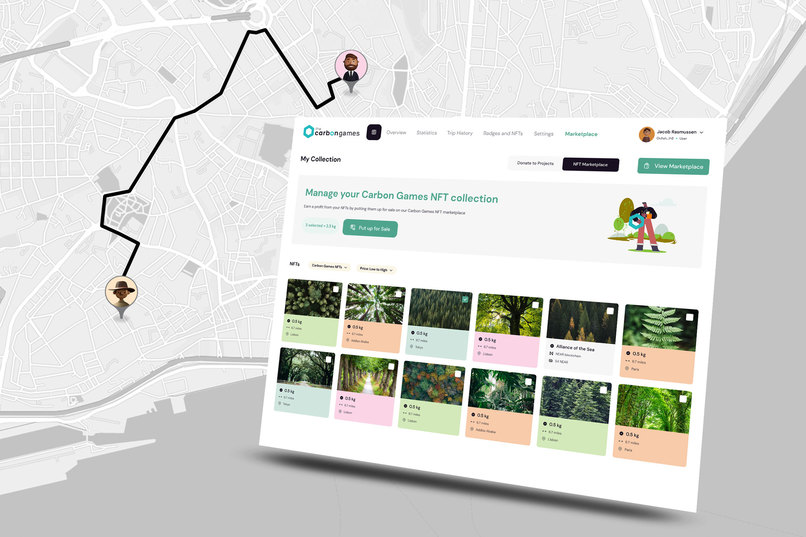
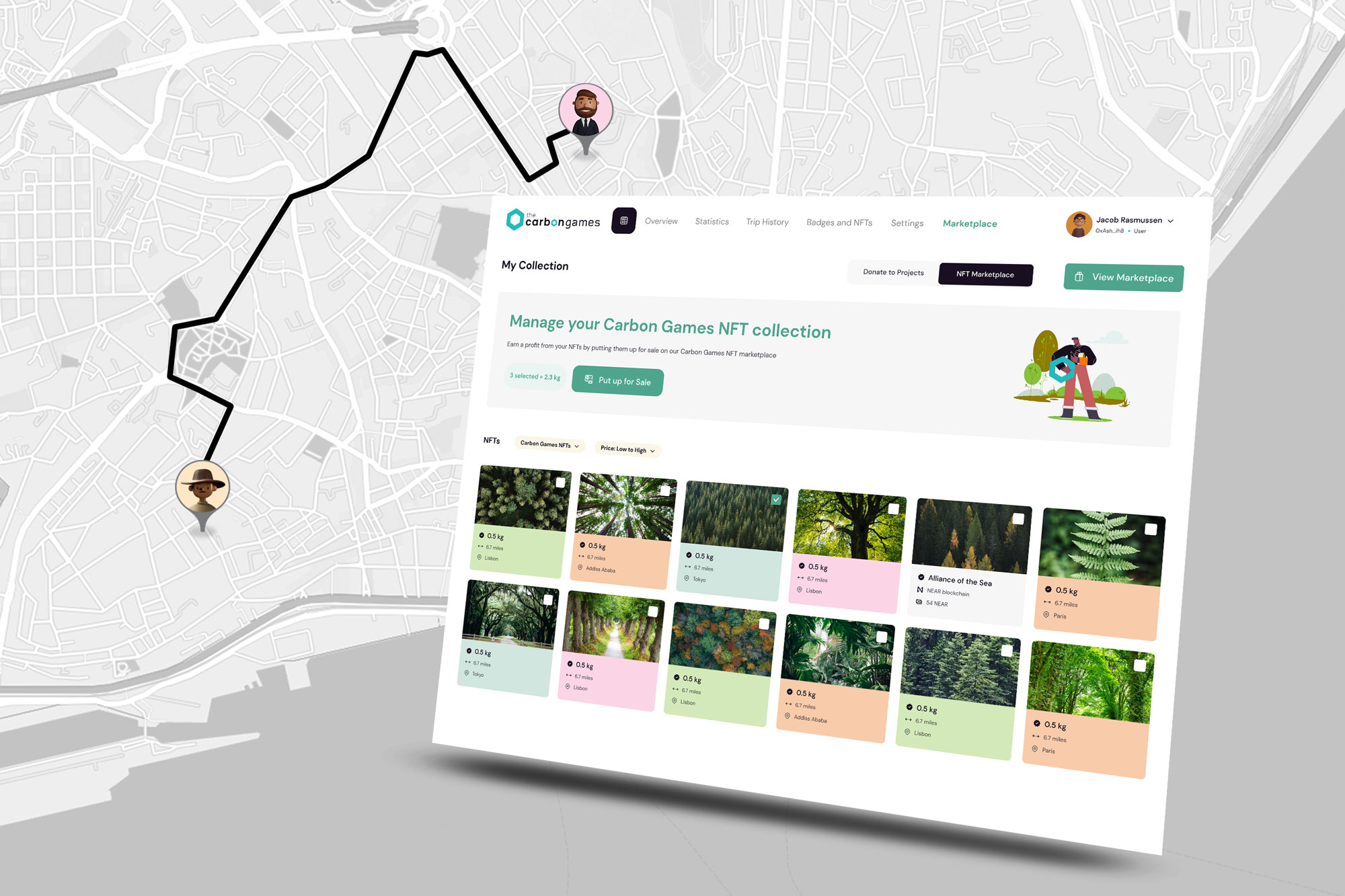
Part 3: Corporate Carbon Credit Marketplace Employees can list their Proof of Impact NFTs on our integrated marketplace, accessible to sustainability departments and HR teams interested in offsetting corporate emissions. This marketplace allows companies to support and incentivize sustainable commuting efforts, while tracking progress on environmental goals.
Part 4: Real-Time Carbon Credit Pricing Based on World Bank Data When companies purchase these Proof of Impact NFTs, the system uses real-time carbon pricing data from the World Bank. For instance, credits earned in Portugal will be priced differently than those in South Africa, reflecting local carbon markets. Current rates vary, with EU prices around $100 per tonne of CO₂ and South Africa’s prices approximately $11 per tonne. This alignment with World Bank data ensures transparent, region-specific pricing.
Part 5: Retirement of CO₂ Credits Once purchased, companies have the option to retire their Proof of Impact NFTs by “burning” them, permanently removing them from circulation. This retirement, or burning, is essential to prevent double-counting and to verify that the company’s carbon offset goals have been met, with each credit’s impact being unique to the purchasing organization.
How we built it
Frontend Development Setup: We began with a React project using TypeScript and Create React App, establishing a strong, typed foundation for reliable and scalable frontend development. State Management: For managing application state across components, Redux was implemented alongside Axios for API calls, providing efficient state handling and data fetching throughout the app. Wallet Authentication: NEAR wallet authentication was integrated, enabling secure access and login for users and supporting seamless interaction with blockchain functionalities. NFT Listing and Purchasing Interface: The user interface is designed for an intuitive experience with listing and purchasing NFTs, applying responsive design principles to optimize usability across devices.
Backend Development Node.js API: A backend API was built using Node.js to manage secure interactions with NEAR contracts. This server acts as an intermediary, enhancing security in handling contract requests. Firebase Deployment: We chose Firebase Functions for deploying the Node.js backend, prioritizing scalability and easy access. Firebase ensures that our backend can handle spikes in traffic, critical for a marketplace environment. Service Account Implementation: To facilitate NFT minting without needing users’ wallets, we implemented a service account on NEAR. This allows centralized minting management, addressing NEAR's limitations in native mobile support by securely minting NFTs on behalf of users.
Smart Contract Development Contract Writing: Two NEAR smart contracts were developed and rigorously tested: one for minting NFTs and another to support marketplace functions like listing, purchasing, and royalties. Deployment: These contracts were deployed on the NEAR blockchain, ensuring smooth, decentralized handling of minting, listing, and trading operations.
Image Generation and Storage DALL-E 2 Integration: To bring unique value to each NFT, we used OpenAI’s DALL-E 2 API for generating custom images based on user inputs. This AI-driven approach creates distinctive artwork that represents each user's carbon savings. Decentralized Storage with Akord and Arweave: For secure and permanent storage, generated images are stored on Akord, utilizing Arweave’s decentralized blockchain. This ensures each NFT image remains accessible long-term, with Arweave’s blockchain providing data integrity and resilience.
API Integrations CoinGecko API: To support transparent pricing, we integrated CoinGecko’s API for real-time NEAR-to-USD price updates, ensuring users receive accurate pricing information at the point of transaction. NEAR API SDK: The NEAR API JavaScript SDK was used to facilitate efficient interactions with our smart contracts, enabling smooth blockchain communication and contract execution.
Challenges we ran into
1. NEAR API Documentation Inconsistencies Challenge: NEAR's JavaScript SDK documentation was sparse and inconsistent, making it difficult to implement critical features. Solution: Extensive trial and error with manual API calls allowed us to troubleshoot and better understand NEAR contract interactions. Our development process included documenting workarounds and creating reusable code patterns, which streamlined integration for future contract calls.
2. Cross-Contract Gas Limits Challenge: NEAR’s gas limits presented constraints with cross-contract calls, often leading to exceeded gas errors. Solution: By optimizing gas allocation and attaching the exact amounts needed to each contract call, we reduced excessive gas use. We also restructured some contract functions to minimize cross-contract calls, achieving smoother contract executions.
3. Backend Integration with Firebase Challenge: Deploying the backend with Firebase Functions required careful adjustments for secure key management with NEAR, especially for server-side interactions. Solution: We restructured the backend architecture on Firebase, including secure handling of NEAR service accounts to protect user data. This allowed for a robust server-side setup that handles minting and marketplace functions seamlessly.
4. Lack of NEAR Native Mobile Support Challenge: NEAR's lack of mobile app support limited frontend options to a web-based interface, impacting native mobile user experiences. Solution: We developed a responsive web app that functions smoothly on mobile browsers and will revisit full mobile capabilities as NEAR's mobile support grows. This approach balances accessibility with functionality for now, ensuring users can interact with the platform on both desktop and mobile.
5. Image Generation and Decentralized Storage Challenge: Integrating OpenAI’s DALL-E 2 for image creation and Akord with Arweave for decentralized storage proved technically complex, involving multi-layered API interactions. Solution: We established a streamlined workflow for creating and storing NFT images, using Akord’s interface to ensure seamless data handling on Arweave’s decentralized network. This integration secures each NFT’s data and image, enhancing user confidence in asset permanence and integrity.
Accomplishments that we're proud of
1. Smart Contract Creation and Deployment We successfully developed, tested, and deployed two NEAR smart contracts: an NFT Contract for minting unique tokens and a Marketplace Contract to facilitate NFT transactions. This end-to-end contract implementation included rigorous testing on NEAR’s testnet to ensure stability, resulting in a smooth mainnet deployment that optimized user experience. The experience strengthened our expertise in Rust and assembly scripts, enhancing our capabilities in blockchain development.
2. Firebase Functions and Node.js API Launching a Node.js server using Firebase Functions allowed us to adopt serverless architecture for the backend, managing interactions with NEAR’s blockchain efficiently. Through Firebase’s Authentication and Firestore, we created a secure, scalable system for handling user accounts and NFT minting requests. This setup met the dual goals of scalability and security, making backend operations resilient to increasing demand while adhering to best practices for data protection.
3. Image Generation and Decentralized Storage Integrating OpenAI’s DALL-E 2 for custom NFT imagery enabled us to generate unique digital art tailored to each user’s token. To ensure these images remain secure and accessible, we utilized Akord for decentralized storage, leveraging Arweave’s blockchain for permanence. This combination of AI-driven artwork and secure, decentralized storage guarantees long-term ownership and accessibility, boosting user confidence in the lasting value of their NFTs.
4. Enhanced User Authentication and Experience We implemented NEAR wallet authentication within our React frontend, simplifying the onboarding process for users and creating a seamless environment for interacting with the marketplace. This integration eliminates complex login requirements, fostering a user-friendly interface that encourages participation and enhances the overall user experience.
5. Real-Time Data Integration for Transparent Pricing To provide users with accurate and transparent pricing, we integrated the CoinGecko API for real-time NEAR-to-USD price updates. This feature allows users to view live market trends and make informed purchasing decisions, increasing transparency and optimizing the buying and trading experience.
6. Service Account for NFT Minting Using a NEAR service account to manage NFT minting operations allowed us to overcome limitations with mobile wallet support, ensuring consistent NFT creation without user intervention. This approach leverages server-side key management for secure, centralized minting, streamlining the process while maintaining high security standards.
What we learned
1. Unique Contract Architecture on NEAR NEAR’s architecture supports both near-native and cross-contract calls, allowing complex dApps to execute multi-step operations smoothly. By understanding and leveraging this structure, we optimized contract interactions to enhance efficiency and enable more seamless user experiences.
2. Gas Management for Efficient Contract Performance Effective gas management is essential on NEAR to ensure optimal performance, especially for cross-contract calls that are more resource-intensive. We learned how to manage gas limits carefully, ensuring that our operations remain cost-effective and performant while avoiding errors from exceeded gas limits.
3. Service Accounts for Enhanced Security and User Experience Implementing service accounts for key management on NEAR proved to be a valuable approach, as it simplified NFT minting processes while enhancing security. Given NEAR's current limitations on native mobile support, service accounts allowed us to centralize sensitive operations, offering a streamlined experience for users without compromising security.
What's next for The Carbon Games - Carpool CO₂ Proof of Impact Marketplace
Our vision includes scaling the marketplace to regions with established carbon markets, such as the European Union, California, South Korea, and the UAE, where companies are particularly proactive in managing emissions. In 2022, the top 100 companies were responsible for over 70% of global CO₂ emissions, underscoring the need for corporate accountability and actionable solutions. Our platform will leverage dynamic, localized carbon pricing from resources like the World Bank, supporting region-specific valuations and making it easier for corporations to track and offset emissions where it matters most.
Moving forward, we aim to enhance data privacy through Calimero Network, add cross-chain capabilities for broader blockchain interoperability, and deploy advanced AI features to customize Proof of Impact NFTs. These improvements will create a powerful, decentralized, and user-owned solution to help corporations and individuals contribute to global sustainability efforts.
Built With
- akord
- arweave
- axios
- coingecko
- dall-e-2-api
- firebase-functions
- firestore
- near-javascript-sdk
- near-protocol
- node.js
- react
- redux
- rust
- typescript

Log in or sign up for Devpost to join the conversation.