-
-
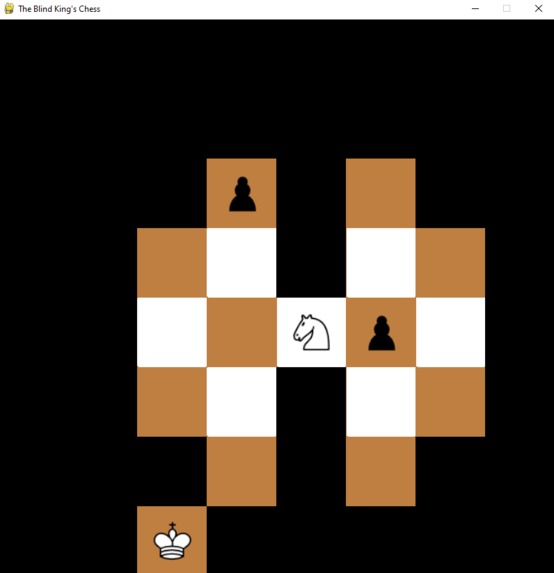
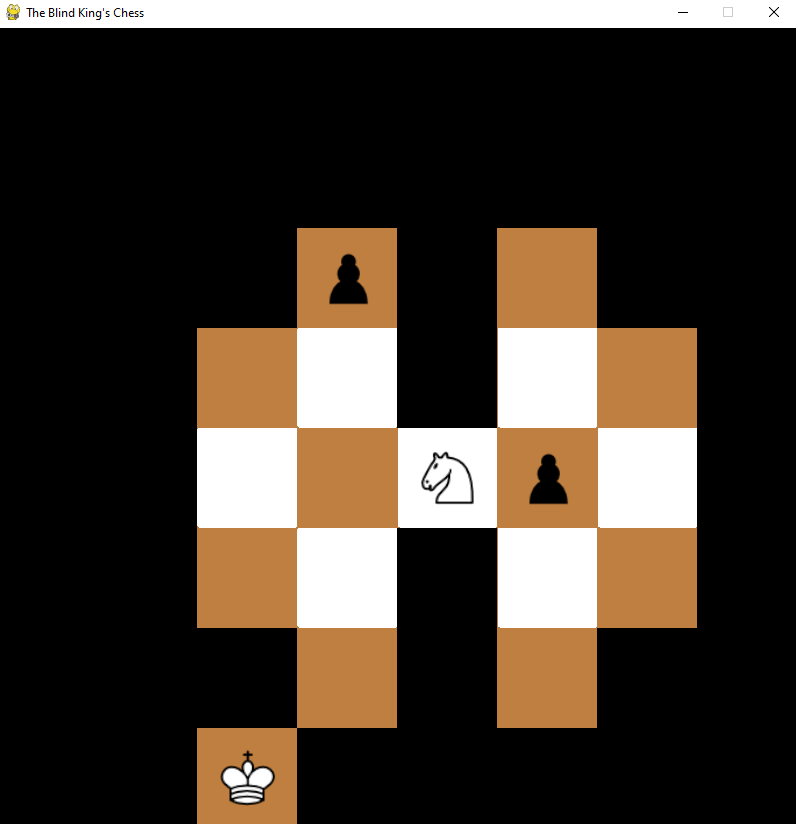
Knight Vision
-
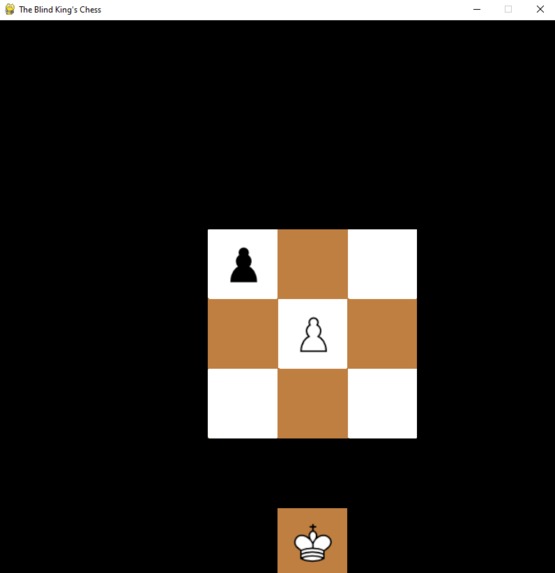
Pawn Scouting
-
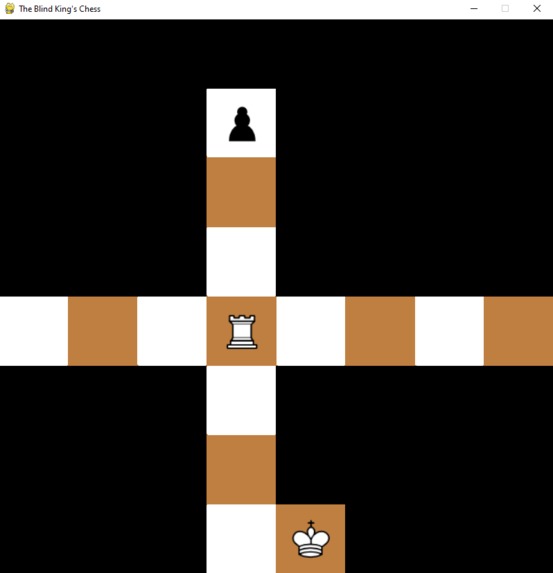
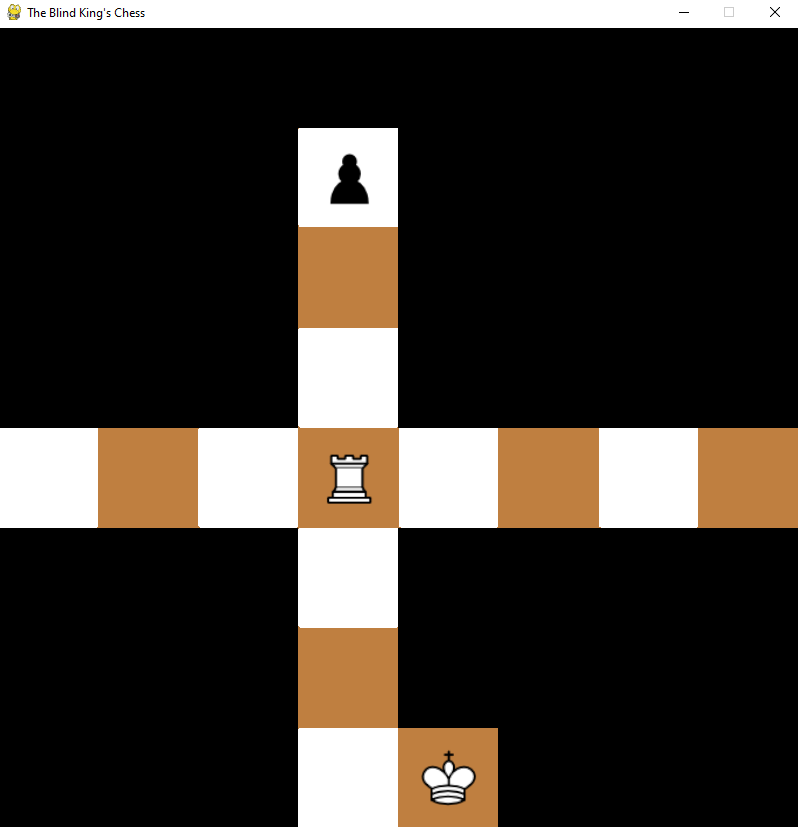
Rook Line of Sight
-
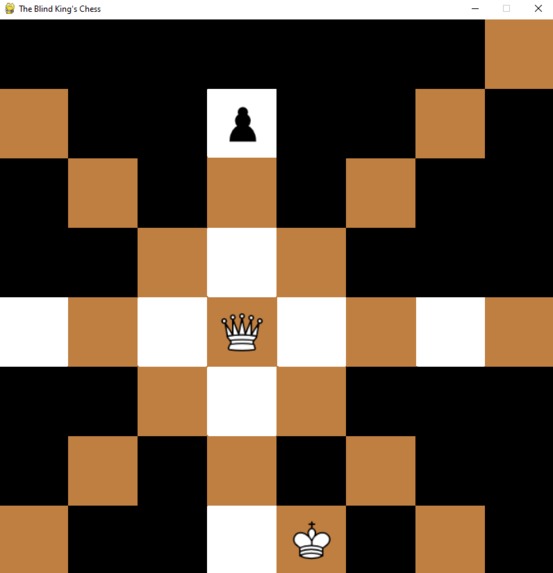
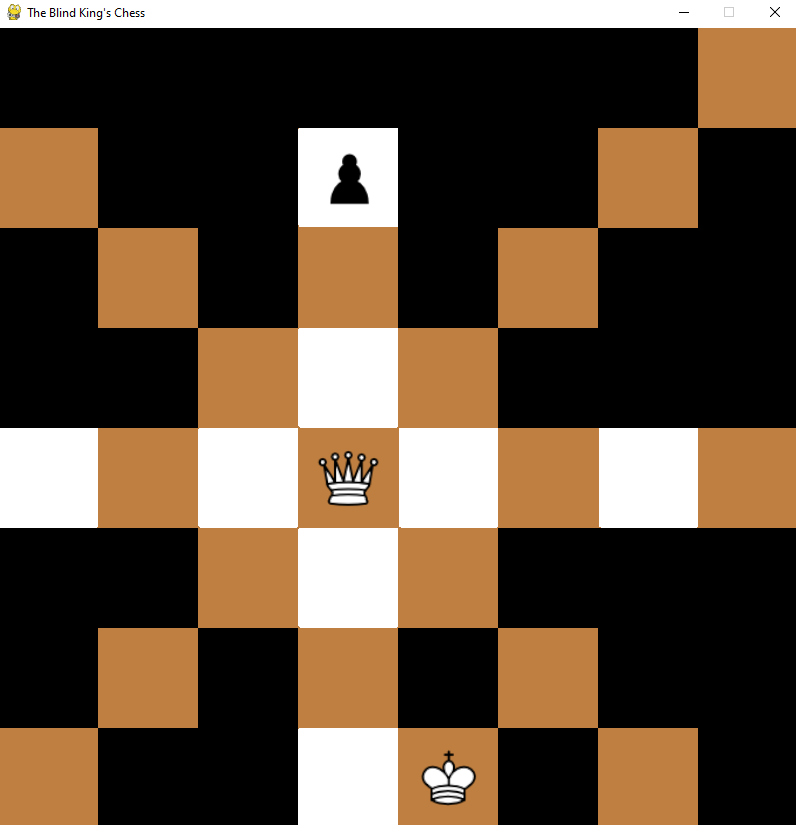
Queen Line of Sight
-
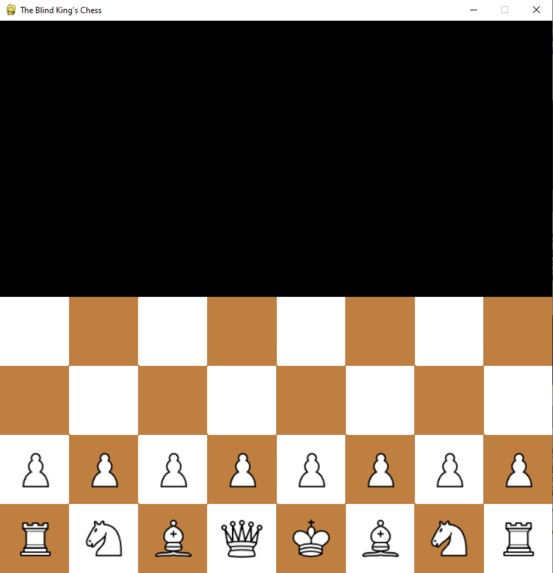
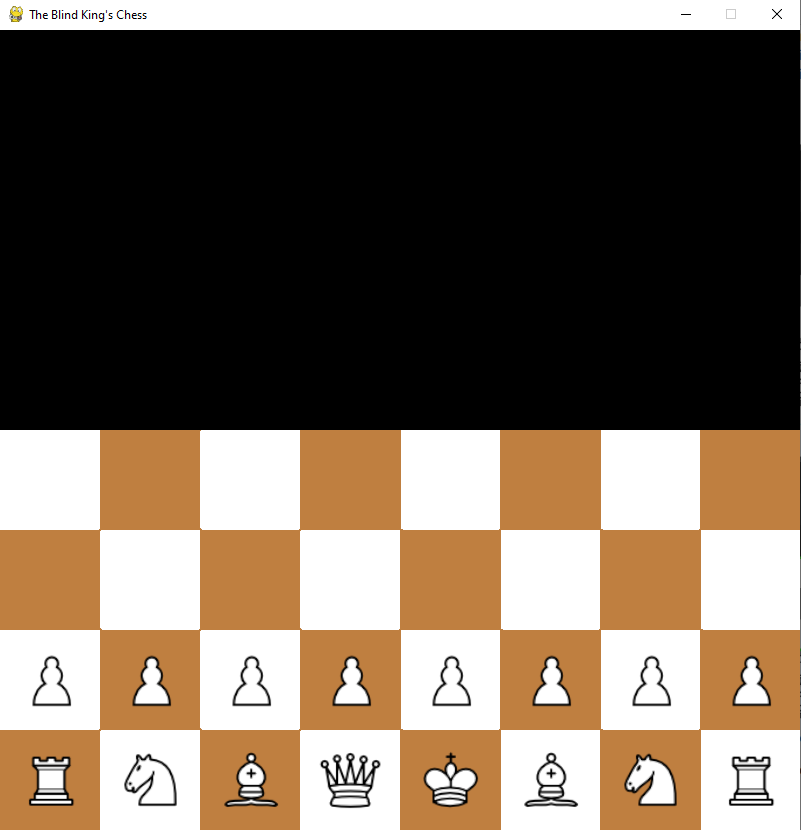
White's Starting Board
-
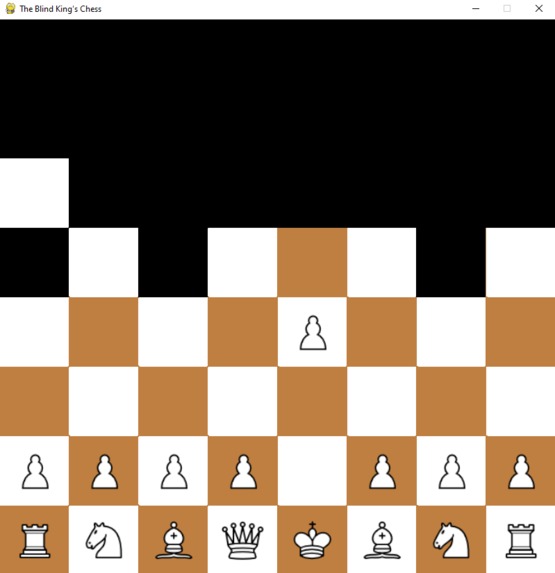
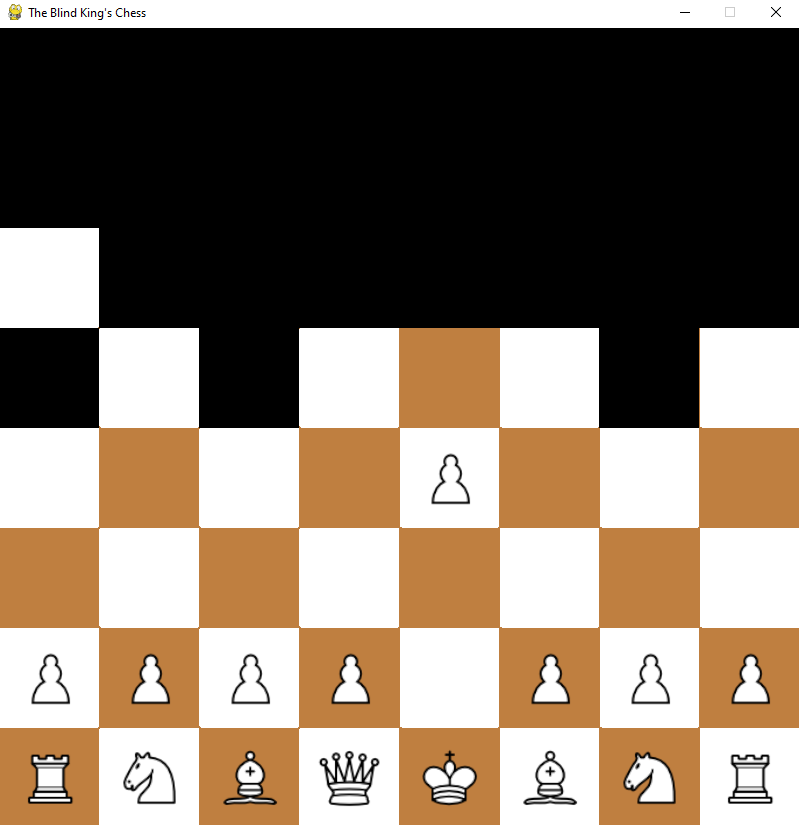
Tiles revealed by a single move.
-
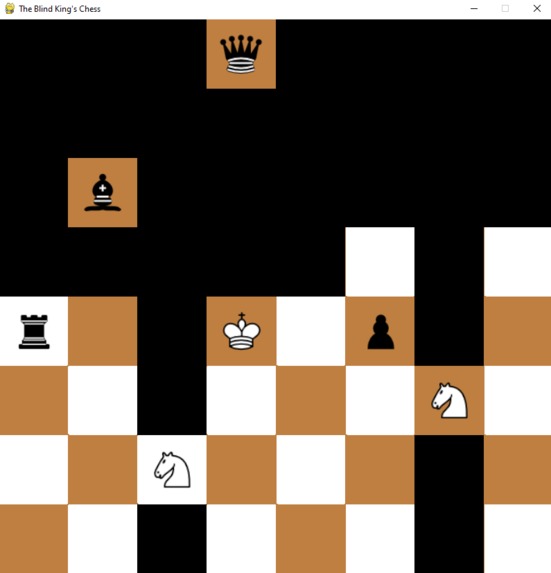
Pieces revealed via check.
-
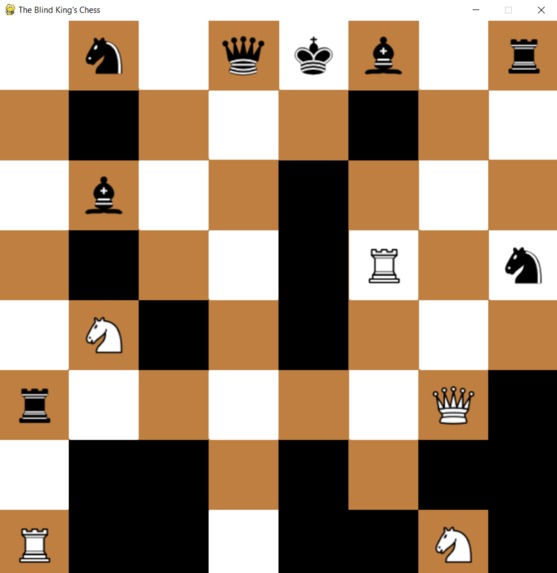
Random Game Scenario - Black's View
-
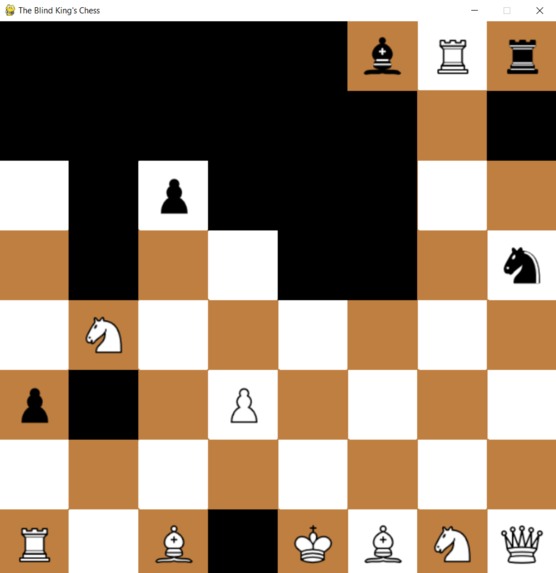
Random Game Scenario - White's View



Inspiration
The inspiration for this game comes from an old project of Steve’s, which was a concept write-up of an interesting chess modification. Rather than a simple concept, we have successfully realized a fully playable and functional version of the game.
What it does
Chess, at its core, is a simulacrum of war: it is a struggle between two factions, Black and White, who partake in a duel of strength and strategy to exhaust the enemy's resources and eventually capture the enemy king in order to reign victorious. The Blind King’s Chess is a variation of chess that, in addition to simulating the strategic maneuvers of war, represents a different deciding factor for victory: the war of information. Most of the mechanics when it comes to moving pieces is similar to conventional chess, with one main key difference: players can only see pieces on the board that are in “line of sight” of their own.
RULES
The Blind King’s Chess plays similarly to traditional chess, but with a few important rule changes:
1. Line of Sight
Players cannot see any of their opponent’s pieces that are not in the ‘line of sight’ of allied pieces. The ‘line of sight’ of a piece is determined by all the tiles a piece crosses when making a move to the furthest distance it can travel in any valid direction. So, at the beginning of the game, both players would only be able to see their side of the board, as well as two tiles ahead due to the “line of sight” of the pawns.
2. Knight Vision
The Knight piece not only reveals the tiles it can move to but also the tiles in a one-tile radius around it, except directly in front and behind it. The only piece in the game that doesn't have its vision blocked by other pieces. However, the Knight has blind spots two tiles forward and backward.
3. Pawn Movement
Unlike conventional chess, the pawn can move both forward and backward. Its line of sight is a 3x3 tile-space centered around itself, except before its first move, where it can see 2 tiles in front of itself. The inclusion of this rule is there as a way to balance out the lack of being able to see the opponent’s board. As a result of the rule, pawns are of much higher value in The Blind King’s Chess, able to scout out potential threats and even retreat back into defensive positions. However, pawns are still only able to move diagonally forward to capture another piece, and cannot capture pieces behind them.
4. The Blind King
The name of the game is The Blind King’s Chess; as one would expect, then, the king is, indeed, blind. King pieces do not naturally reveal any tiles, and cannot move into tiles that are not currently in the line of sight of allied pieces. The king still only moves one tile at a time to any adjacent space.
The king is still unable to move to revealed spaces that would result in it being captured in the following turn. Even if the piece that is threatening the king is not currently revealed, the king cannot move to spaces that would result in it entering check. The player will have a hint that their king is in danger, but will not know from what. In the case that the king is already in check, however, the enemy pieces that are currently checking it are revealed, and the checked player is forced to take appropriate action to prevent their king from being captured.
As a natural consequence of this rule, there is an additional way to win in The Blind King’s Chess – it is possible to checkmate a player by staying out of sight of enemy pieces and in the range of a king that is currently surrounded by darkness. This is a variant of a check/mate coined as an “assassination check/mate”.
How we built it
We decided to use PyGame to implement the graphics of the game. The internal code itself was all created with Python. The game itself was built from scratch, with only PyGame and the standard Python library to implement all of its internal mechanics.
Challenges we ran into
Programming chess from scratch while implementing unique mechanics
At first, programming chess seemed like a simple task. Pieces like the Pawn and King with unique mechanics proved to be surprisingly difficult to implement, whereas pieces like the Rook, Queen, and Bishop were easier, as they played nearly identical to their traditional counterparts.
Accomplishments that we're proud of
As first-time hackathon participants, we made a playable game in a limited amount of time. It is kind of hard to collaborate within a virtual environment but we managed to make it work.
What we learned
We learned about the fundamentals of chess and how to program the game, along with some unique mechanics, without using an existing chess engine.
What's next for The Blind King's Chess
Implementing Online Multiplayer.
As we only had limited time, the multiplayer mode of this game was not a priority to develop. If given extra time, we would’ve liked to flesh out a fully functional multiplayer mode, as the game is ideally supposed to be played by two players without sharing a screen.
Implementing Checkmate Alert
With the line of sight limitation, the implementation of checkmate situations is difficult to integrate into the current game. As of now, the player in a checkmate situation is not notified and simply cannot move pieces. Given more time, the game will include notifications for special situations such as checkmate and stalemate.
Title Screen and Other Aesthetic Elements
Since the title screen does not affect the functionality of the game, it was not our priority to design and display the title screen. With the time restrictions of this event, we’ve decided not to design a title screen for the game. Modifying the aesthetics of this game will be included in the next stages of development.


Log in or sign up for Devpost to join the conversation.