
Inspiration
Somewhere in every streaming studio there is a person in rights administration who cannot explain a royalty payment. Not because they are careless — because the calculation lives across a contract written in prose, a stream count in a warehouse, and a ledger that says a number with no working shown. When a rights holder asks "why is this the amount?", the honest answer is often "I'd have to reconstruct it."
That person has counterparts. The ad-ops engineer who learns a live slot went blank when the advertiser disputes the invoice. The on-call streaming engineer who finds out a region degraded from social media. The analyst asked "why did this title drop?" who can produce a chart but not a cause.
Six people, six problems, six separate tools — and none of those tools can see what the others see. That last part is the real problem. A buffering spike and a blank ad slot on the same CDN node in the same fifteen minutes are not two incidents. They are one incident wearing two costumes, and no tool built to look at only one domain can ever say so.
What it does
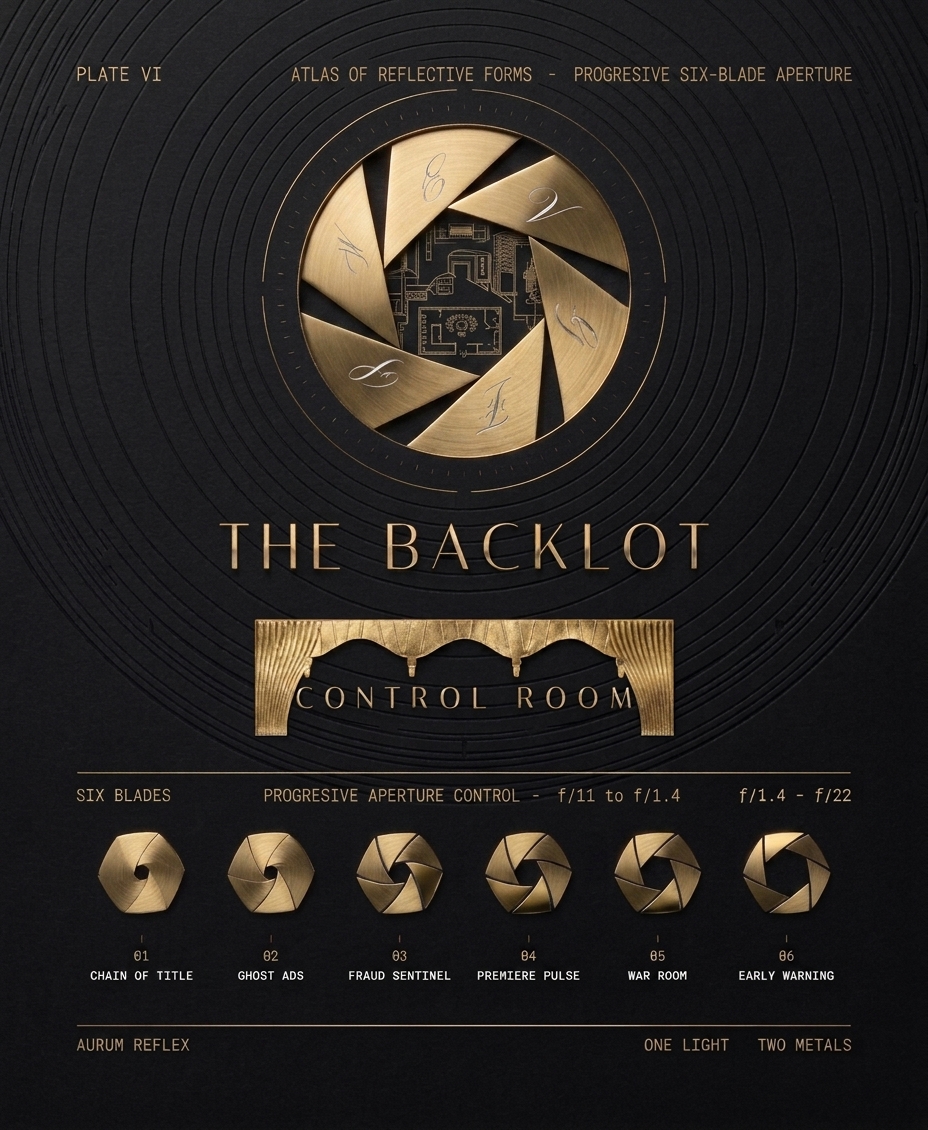
The Backlot is a studio operations command center: six specialist agents over one shared ClickHouse database, coordinated by an orchestrator whose job is correlation, not routing.
- chain_of_title — forensic royalty reconciliation. Reads the raw contract clause with Gemini, recomputes what is actually owed including tiered escalation, and shows the arithmetic behind any gap.
- ghost_ads — silent server-side ad-insertion failures, quantified in dollars rather than incident counts.
- fraud_sentinel — credential-sharing and bot rings, from device-fingerprint fan-out corroborated by impossible travel and session concurrency.
- premiere_pulse — live playback health by CDN node and time window, measured against a baseline instead of an absolute threshold.
- performance_war_room — title and territory performance, with sentiment brought in when the question is really "why".
- churn_early_warning — audience retention risk, caught while there is still time to act on it.
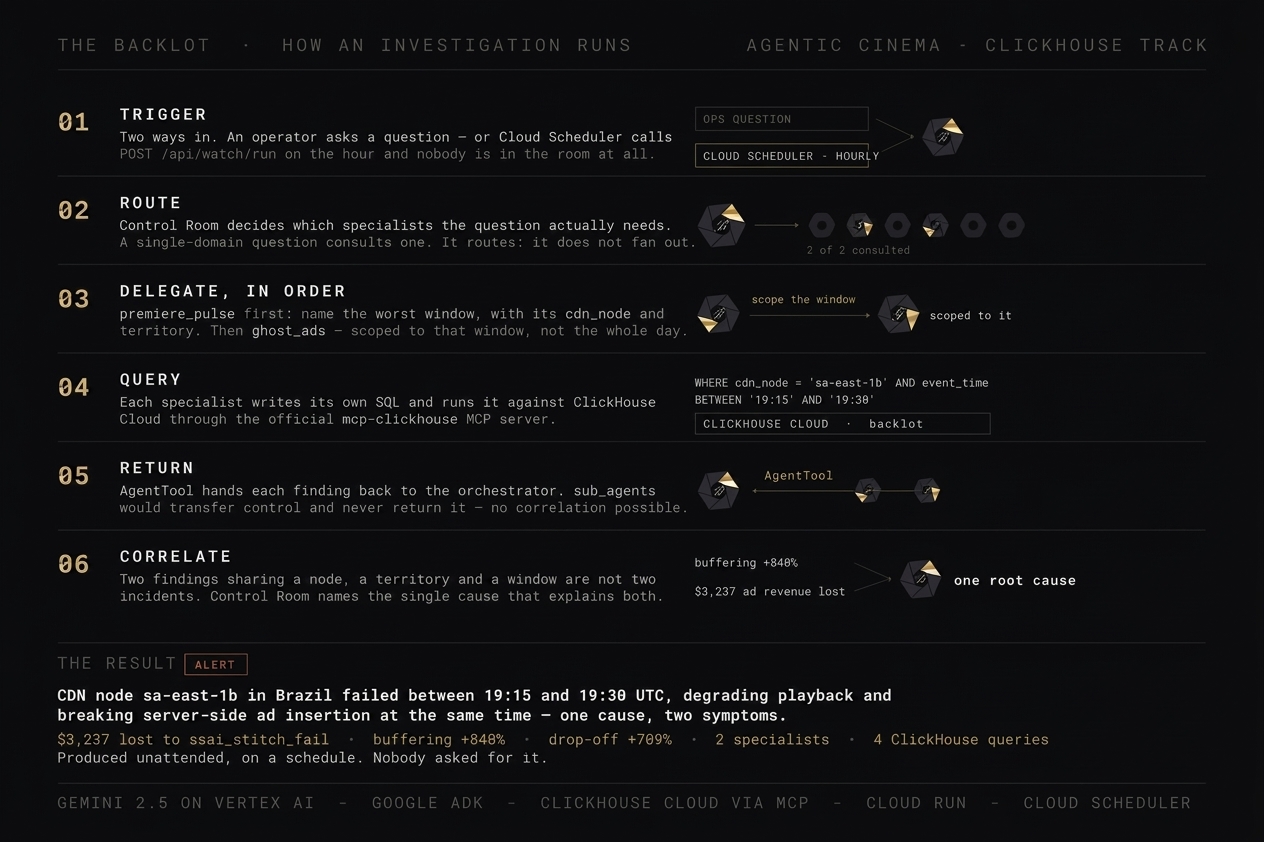
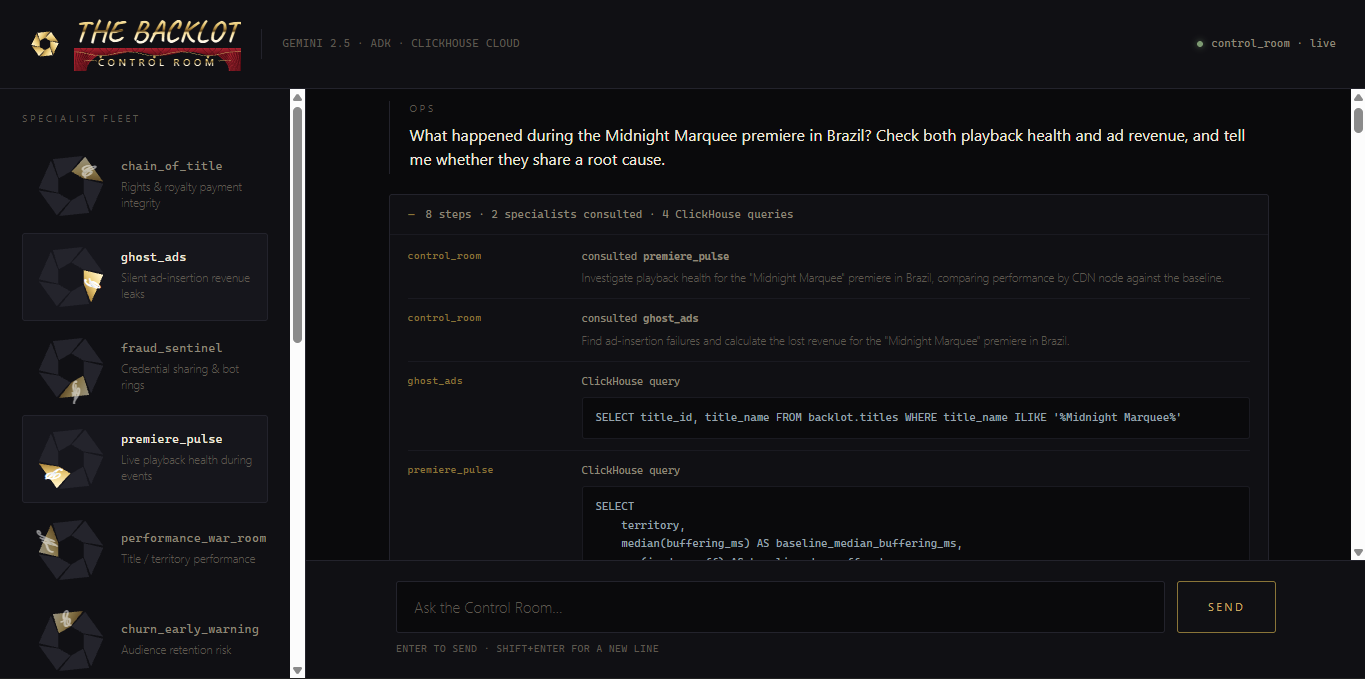
Ask what happened during a premiere and it consults the two specialists that matter, then answers with one root cause: a degraded CDN node in Brazil that produced both a buffering spike and an ad-stitching failure inside the same window. Two symptoms, one incident.
Ask a single-domain question and it consults one specialist. It routes; it does not fire at everything.
Every answer opens into an audit trail: which specialists were consulted, what each was asked, what each replied, and the exact SQL each ran against ClickHouse. Nothing about the answer has to be taken on trust.
And it does not wait to be asked. A studio's worst night is not a business-hours event: a CDN node degrades at 03:40, ad stitching fails behind it, and a system that only answers questions finds nothing because nobody is awake to ask one. The Watchtower holds four standing briefs — the questions an ops lead would ask every hour if they never slept — and runs them against the same orchestrator on a schedule, unprompted. Findings land in ClickHouse with their own severity triage, and the console reads them back on load. The panel fills itself in.
That path is asynchronous in both senses that matter. It is triggered by a
clock rather than a request, and because an investigation is minutes of real
Gemini reasoning and real ClickHouse round trips, the trigger endpoint hands
the work to a background task and returns 202 Accepted in milliseconds. The
fleet keeps working long after the caller has gone.
How we built it
- Google Agent Development Kit (ADK) — seven agents, wired with
AgentToolrather thansub_agents. This is the decision the whole product rests on. - Gemini 2.5 Pro and 2.5 Flash on Vertex AI — Pro for the orchestrator's cross-domain synthesis and for contract reasoning; Flash for the four read-mostly operational agents. A deliberate cost and latency trade rather than a uniform default.
- ClickHouse Cloud, queried at runtime by every agent through the official
mcp-clickhouseMCP server over stdio. Seven day-partitioned MergeTree tables ordered by(title_id, territory, event_time)— the access pattern the agents actually use, not an afterthought. - A custom Control Room console (FastAPI + vanilla JS), not the ADK development UI, with a server-side trace plugin that captures every specialist's tool calls and replies so the audit trail can exist at all.
- Cloud Run for the hosted deployment, with ClickHouse credentials in Secret Manager and Gemini reached through the runtime service account.
- Cloud Scheduler as the Watchtower's clock. Not a loop inside the container: Cloud Run freezes an idle instance's CPU and scales to zero, so an in-process scheduler stops running under exactly the conditions an unattended watch exists to cover. An external clock making a real request is the only trigger that survives it.
The dataset is synthetic and generated by this repository — around 1M playback
events, 350k ad events and 1M fraud signals, plus contracts, a royalty ledger and
sentiment. Four ground-truth anomalies are seeded into it and written to
ANOMALIES.json, so every claim the agents make can be checked against what was
actually planted.
Challenges we ran into
Correlation was structurally impossible, and it looked like a prompt problem.
Built with sub_agents, Control Room handed the conversation to premiere_pulse,
which replied "I do not have access to ad revenue data… you might need to consult
another agent" and ran no queries at all. In ADK, sub_agents means control
transfer — the orchestrator never gets the floor back, so it can never hold two
findings at once. No amount of instruction tuning fixes that. AgentTool returns
the finding to the orchestrator, and the same question then produces one
synthesized root-cause report.
A full post-mortem reported "no royalty issues" while the ledger held a real $462.84 underpayment. The audit trail showed Chain of Title had queried both numbers it needed. The orchestrator had simply sent the same generic sentence to all six specialists, and a request that vague gave it nothing to check against. Delegation has to speak each specialist's own language.
The MCP toolset silently loaded zero tools. Launching the server by its
console-script name only resolves when the virtualenv's script directory is on
PATH. When it is not, the spawn fails quietly and the failure surfaces much
later as Tool 'run_query' not found. Launching via sys.executable -m <module>
always resolves.
Every agent failed with "No API key was provided" — with Vertex AI enabled,
billing active and ADC configured. ADK builds its client against the AI Studio
backend unless GOOGLE_GENAI_USE_VERTEXAI=TRUE is set. The error names an API
key, which sends you looking in exactly the wrong place.
Our first fraud dataset was a needle in an empty haystack. Every session had a unique user and a unique device, so the seeded ring was the only fingerprint shared by more than one account. Detection was one equality filter. That is not detection.
The first unattended sweep came back half-blind, and it read like a success.
It found the seeded Brazil incident correctly — node sa-east-1b, buffering at
9x baseline, drop-off at 37% — and reported ad revenue as unknown, because
Gemini had emitted a malformed function call for ghost_ads. The specialist was
recorded as consulted and never answered. The orchestrator handled it honestly,
which is what made it dangerous: the finding was well-written, correctly severe,
and quietly missing half the correlation the watch exists to perform. When a
human is driving they notice a missing answer and ask again. Nobody is driving
here, so each watch now declares the specialists it cannot do without, the trace
is checked for an actual reply from each, and a hollow run is repeated once.
Then the fixed sweep confidently reported the opposite of the truth. Both
specialists ran, seven ClickHouse queries between them, and the verdict came
back "Root cause: None. The two findings do not share a time window, territory
or underlying infrastructure." Both specialists were right. premiere_pulse
returned a 30-minute window in Brazil; ghost_ads returned a day-wide $10,505
ad-loss total across every territory, because the brief had asked both of them
the same broad "last 24 hours" question. A day-wide aggregate and a half-hour
window genuinely share nothing, so the orchestrator's reasoning was sound and
its conclusion was wrong. Correlation needs delegation to be sequenced, not
merely specific: ask the first specialist for the window, then scope the second
question to the window it named. An interactive user supplies that scoping
without noticing, just by mentioning the premiere in their question — which is
exactly why it survived so long in a system that had only ever been driven by
hand.
Accomplishments that we're proud of
The correlation genuinely works, and it is visible. Two specialists find two symptoms independently, and the orchestrator names one cause — with the shared node, territory and time window that prove it, and the SQL behind each number one click away.
Every royalty figure is re-derivable from the warehouse. An earlier version billed per-minute contracts at an invented "~4 minutes per stream". That constant existed nowhere the agent could reach, so its arithmetic could never match the ledger and every such contract was a latent false positive. Now each rate type maps to one queryable aggregate — so when Chain of Title disagrees with the ledger, the disagreement is real.
The anomalies hide in a realistic crowd. Households sharing devices, venue devices with high account fan-out and nothing else wrong, a VPN and travel baseline, honest payments carrying rounding drift. Detection is a discrimination problem, not a filter.
We test for restraint, not just recall. Two of the five evaluation cases check that the fleet does not invent a royalty discrepancy and does not find an incident in a quiet title. An agent that always finds something is worse than useless in operations, and no positive test catches that.
What we learned
That the interesting failures in a multi-agent system are architectural, not conversational. Five of the six hardest bugs — control transfer, generic delegation, the silent toolset, the half-blind sweep, the unsequenced correlation — produced plausible-looking output rather than errors. A specialist politely saying "you might need to consult another agent" reads like a reasonable answer, and reports "no issues found" read like good news. Without a trace showing which agents ran and what SQL they issued, we would have shipped a system that looked like it worked.
Taking the human out of the loop multiplies that. Every one of those failures was caught because somebody was sitting there reading the answer and found it suspicious. An agent running on a schedule has no such reader, so the checks a human performs by instinct — did the specialist I needed actually answer? — have to become code, or the system degrades silently and on a timer.
We also learned that synthetic data has to be adversarial to itself, and that a self-contradicting schema makes a correct agent look wrong: a per-minute contract whose escalation threshold was worded "after N streams" led Chain of Title to compare minutes against a stream count and report a genuinely underpaid contract as correctly paid. Its reasoning was right. The data was incoherent.
What's next for The Backlot
Streaming the audit trail as it happens rather than after the answer. Pushing an
alert-severity finding to where an ops lead actually is at 3am — the
Watchtower already triages its own findings, so the missing piece is a channel,
not a judgement. And a seventh agent for licensing and acquisition decisions —
which title to renew, which to let go — because it fits the same shared
foundation without breaking it.
Built With
- asyncio
- clickhouse
- clickhouse-cloud
- cloud-build
- cloud-run
- cloud-scheduler
- fastapi
- gemini
- gemini-2.5-flash
- gemini-2.5-pro
- google-adk
- google-cloud
- javascript
- mcp
- mcp-clickhouse
- model-context-protocol
- multi-agent
- python
- secret-manager
- sql
- uvicorn
- vertex-ai


Log in or sign up for Devpost to join the conversation.