-
-
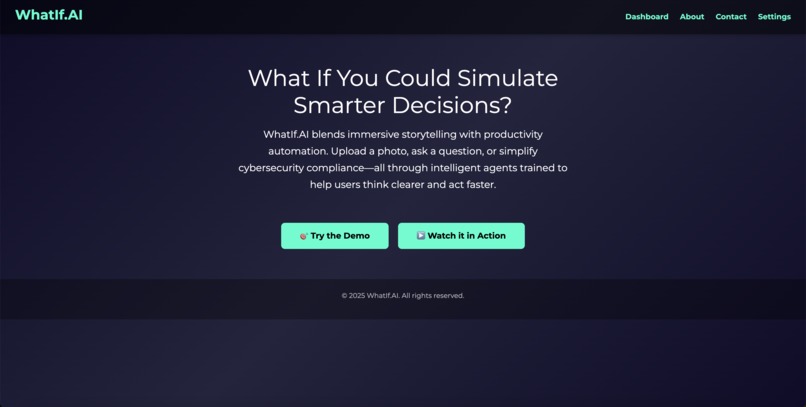
Entry Page
-

User Log In
-
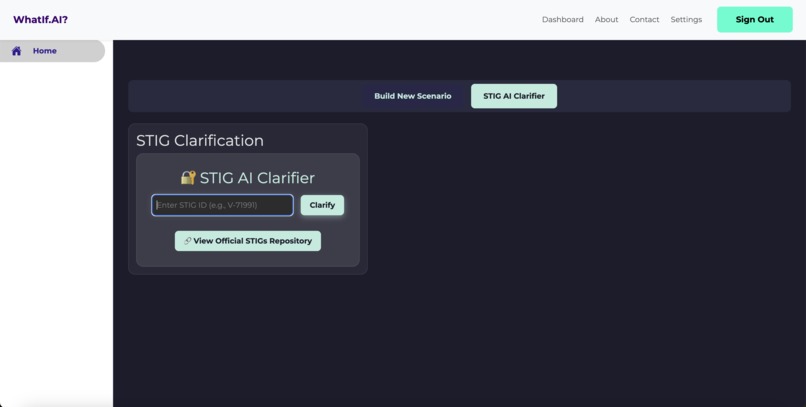
Dashboard_STIG AI Clarifier
-
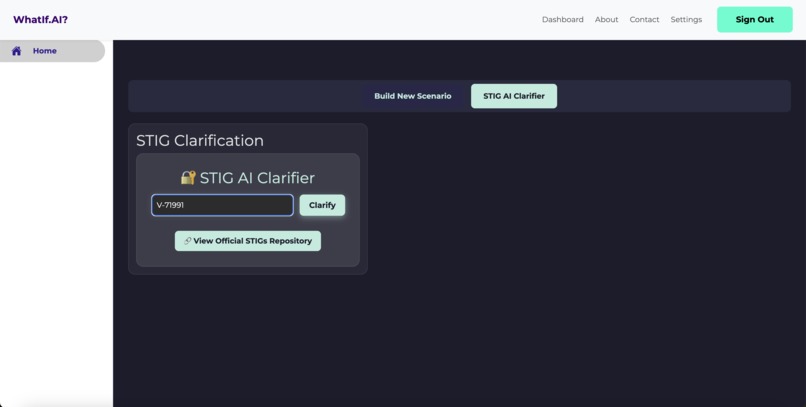
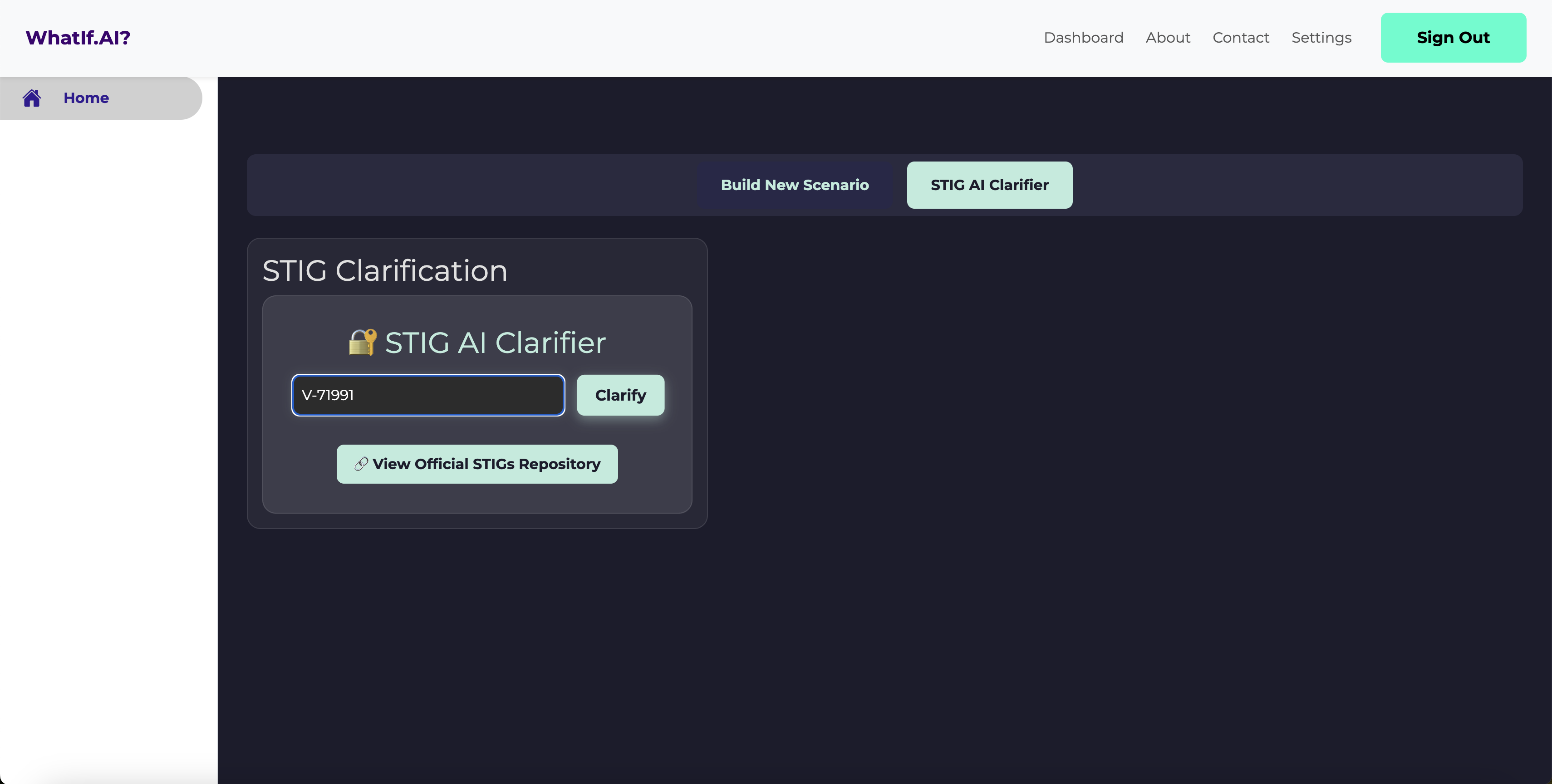
STIG AI Clarifier User Input
-
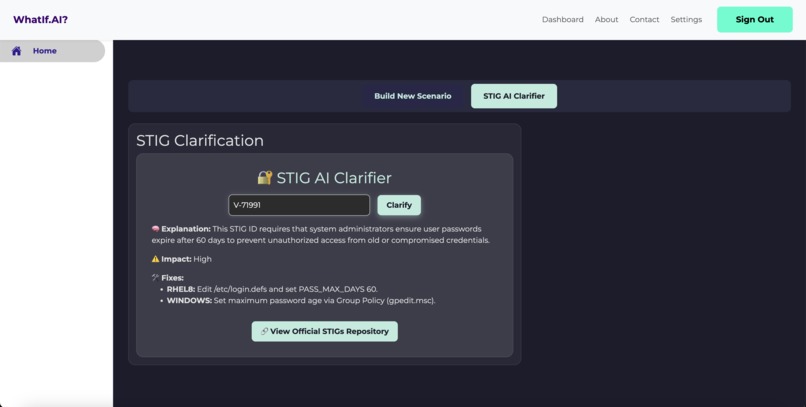
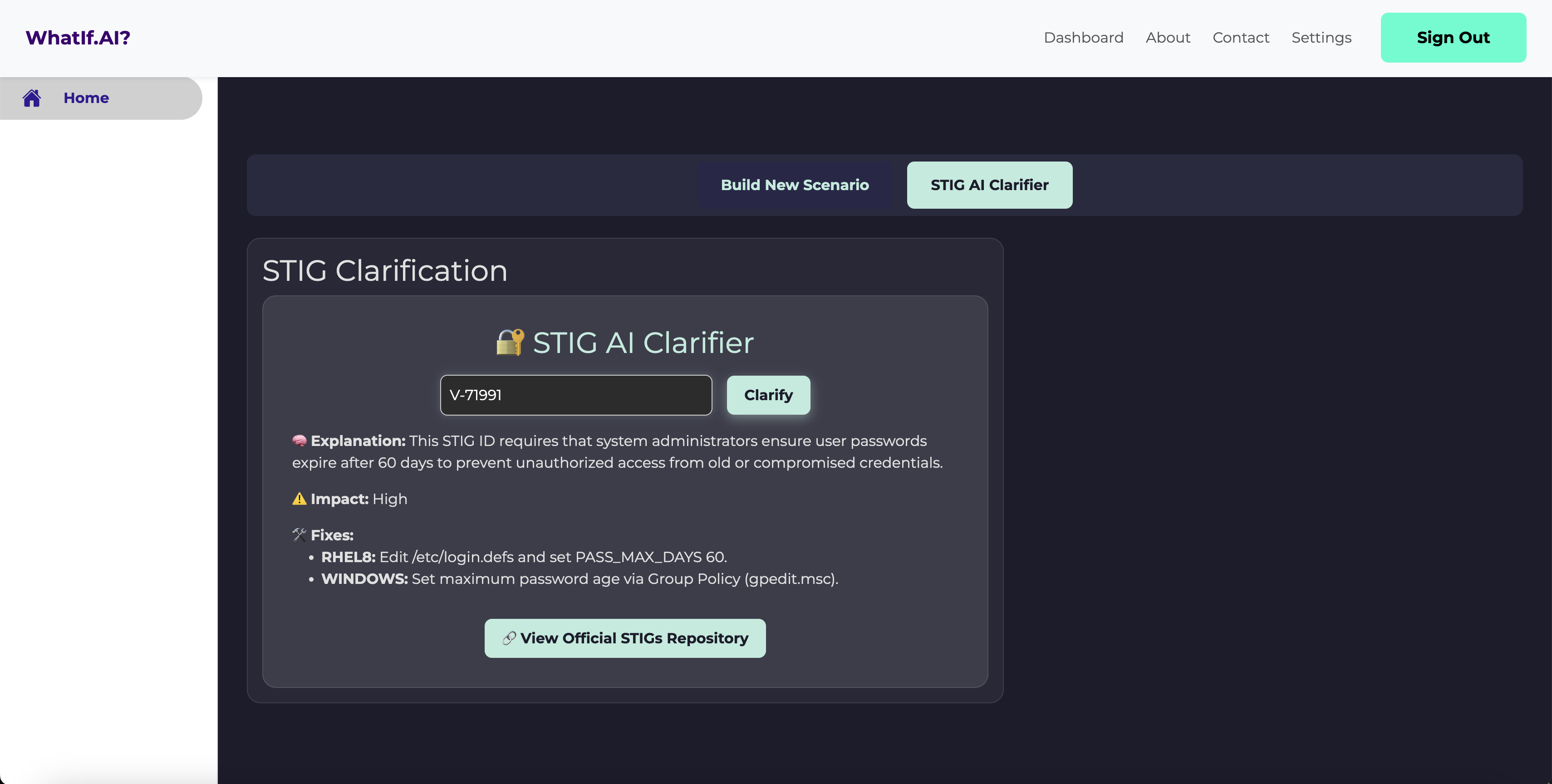
STIG AI Clarifier Output
-
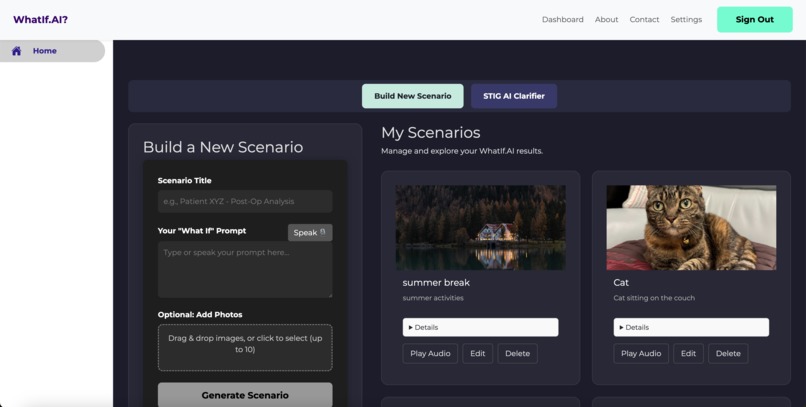
Dashboard_Scenario Creator
-
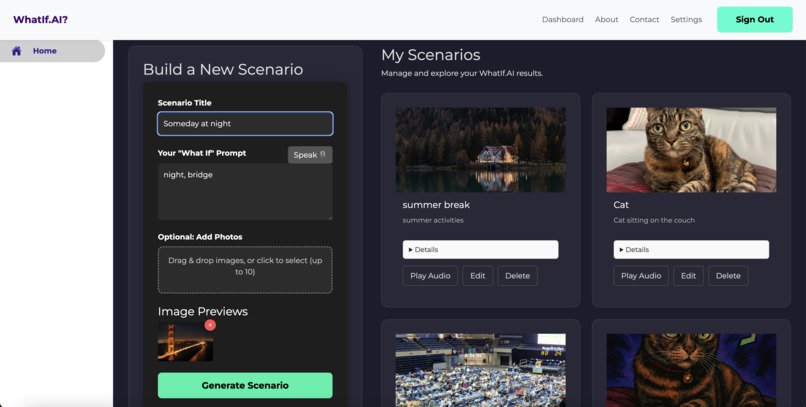
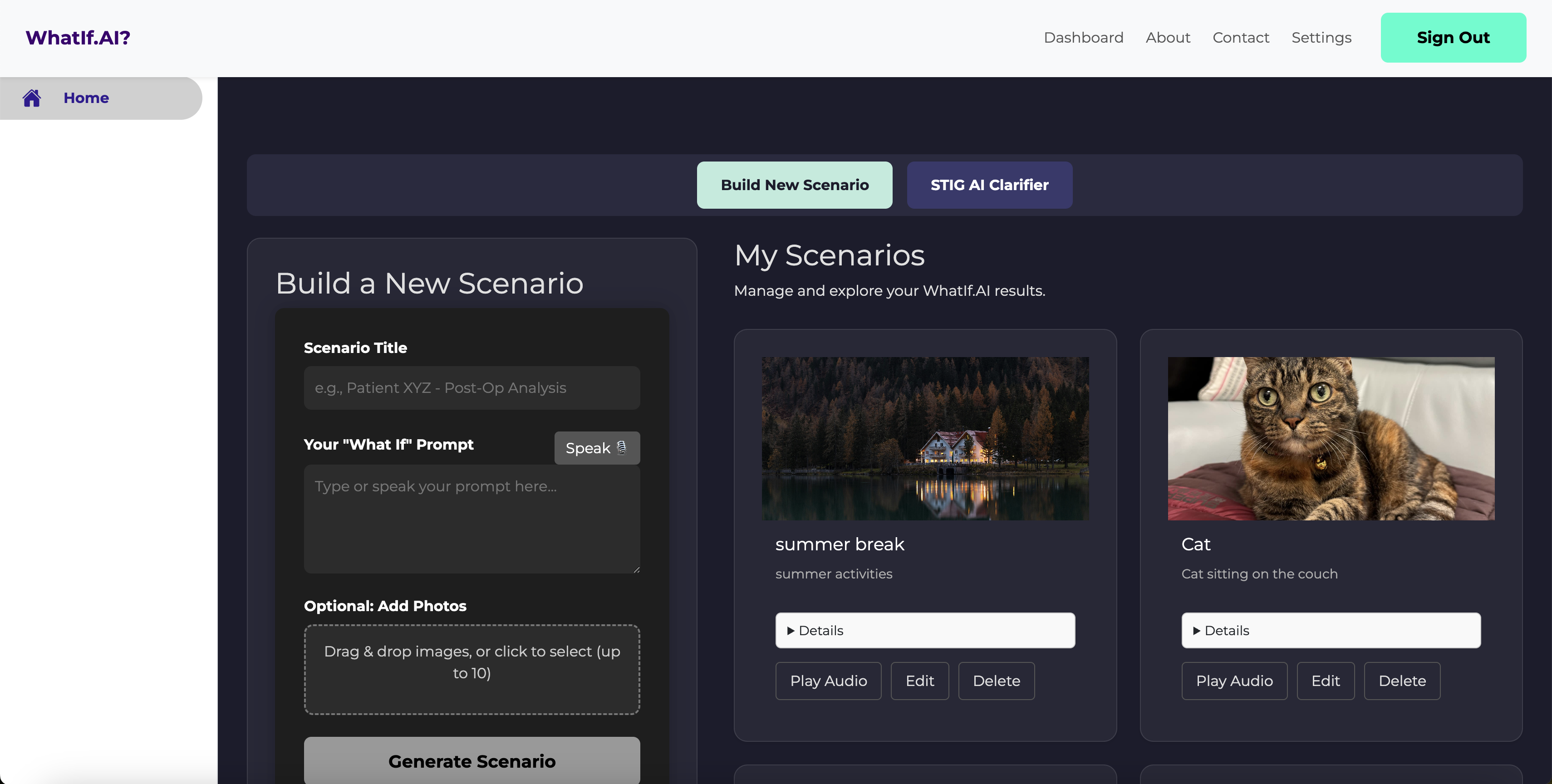
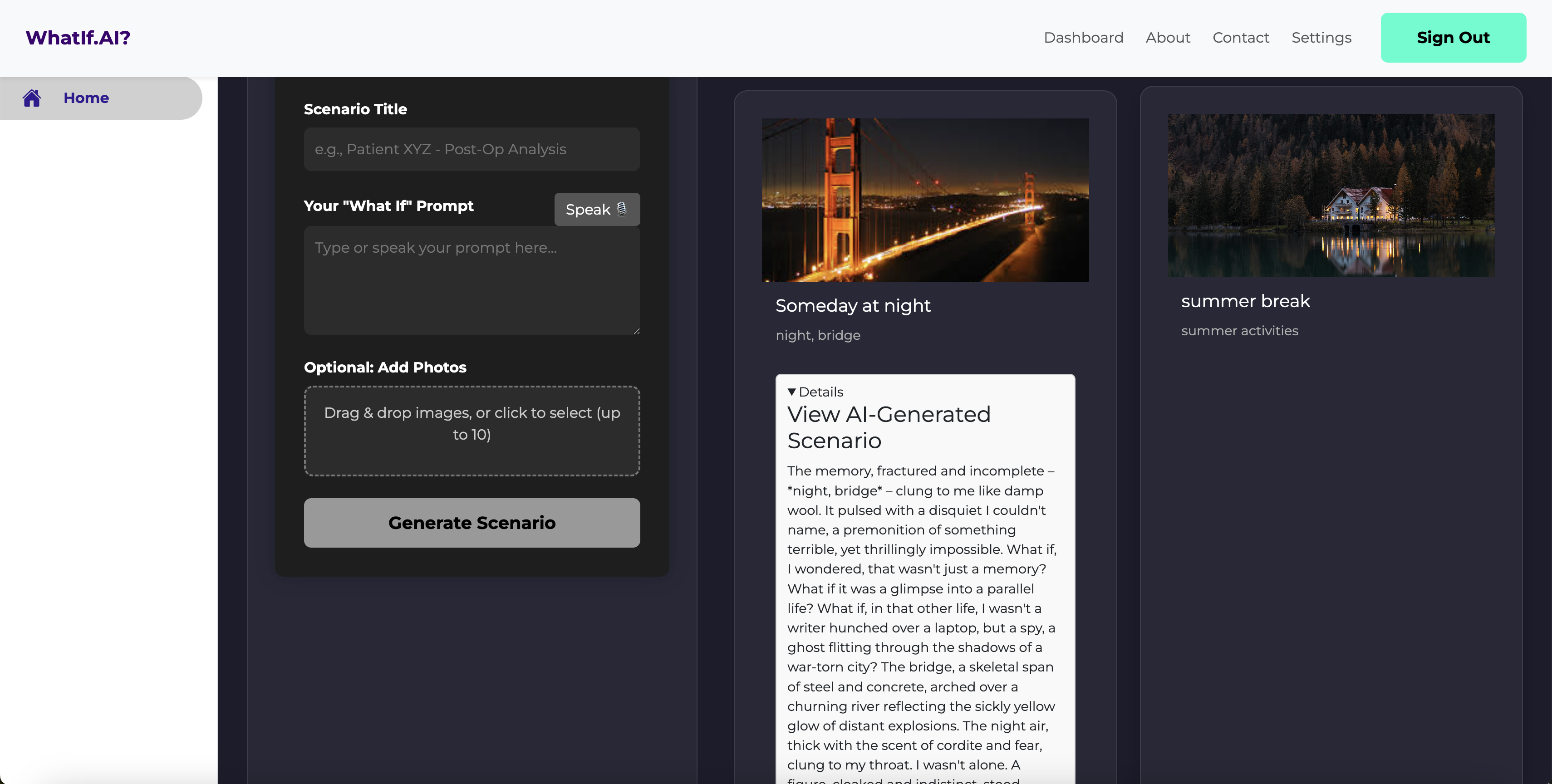
Scenario Creator_User Input
-
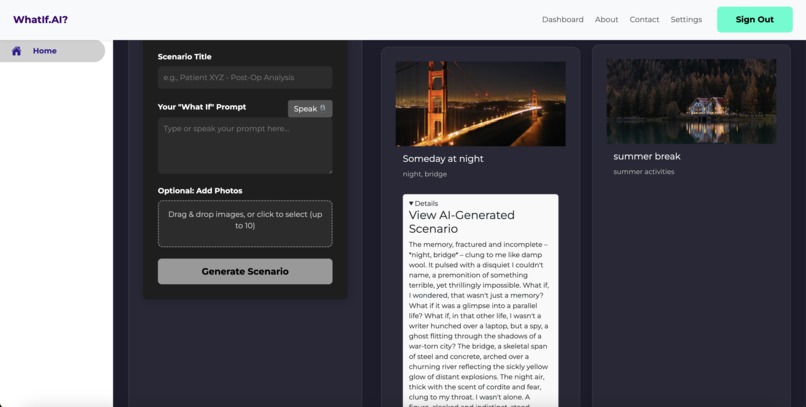
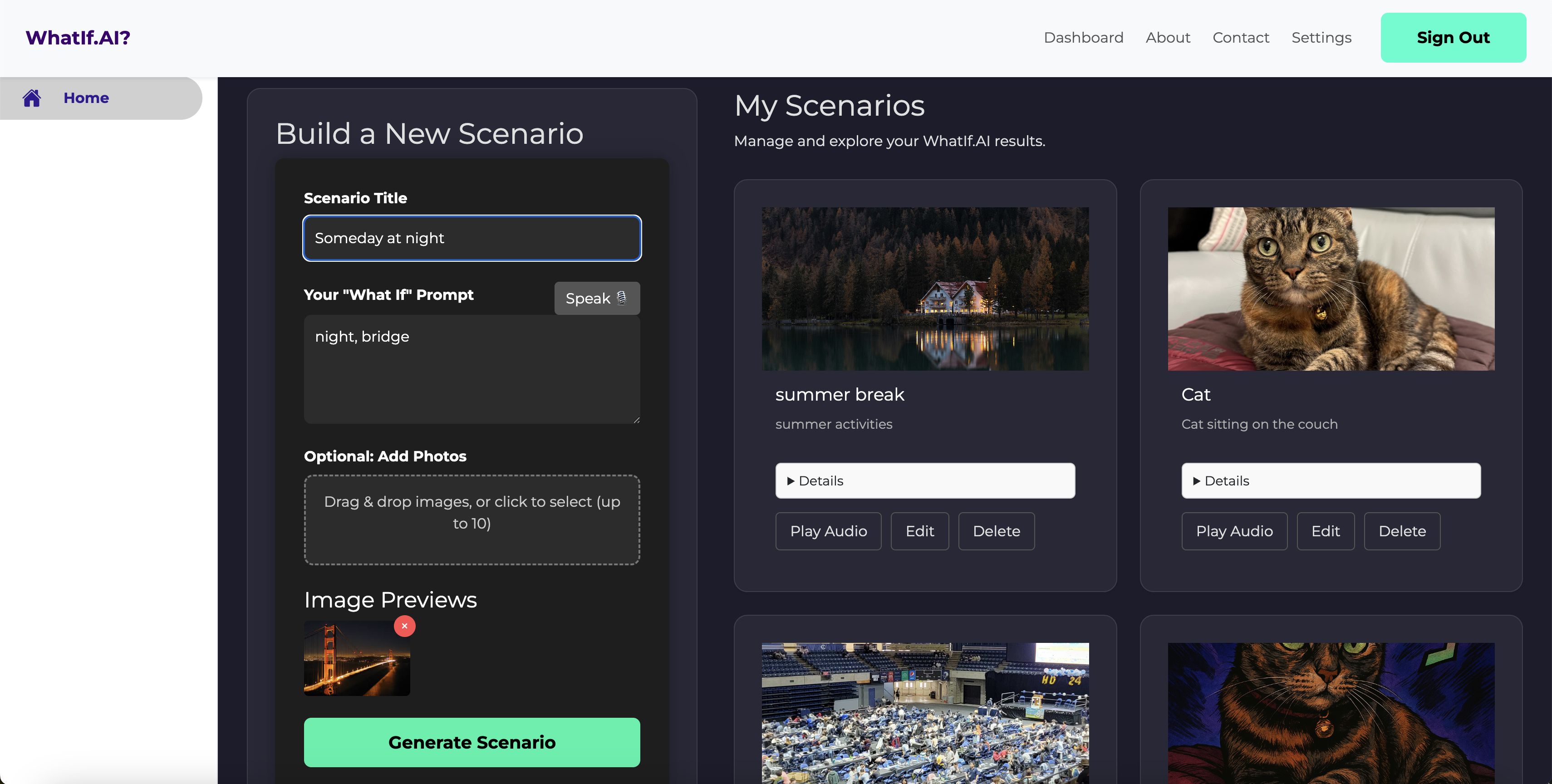
Scenario Creator_Output
-
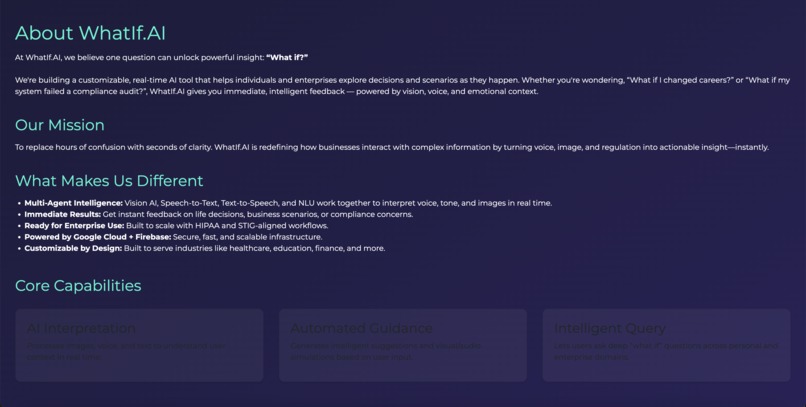
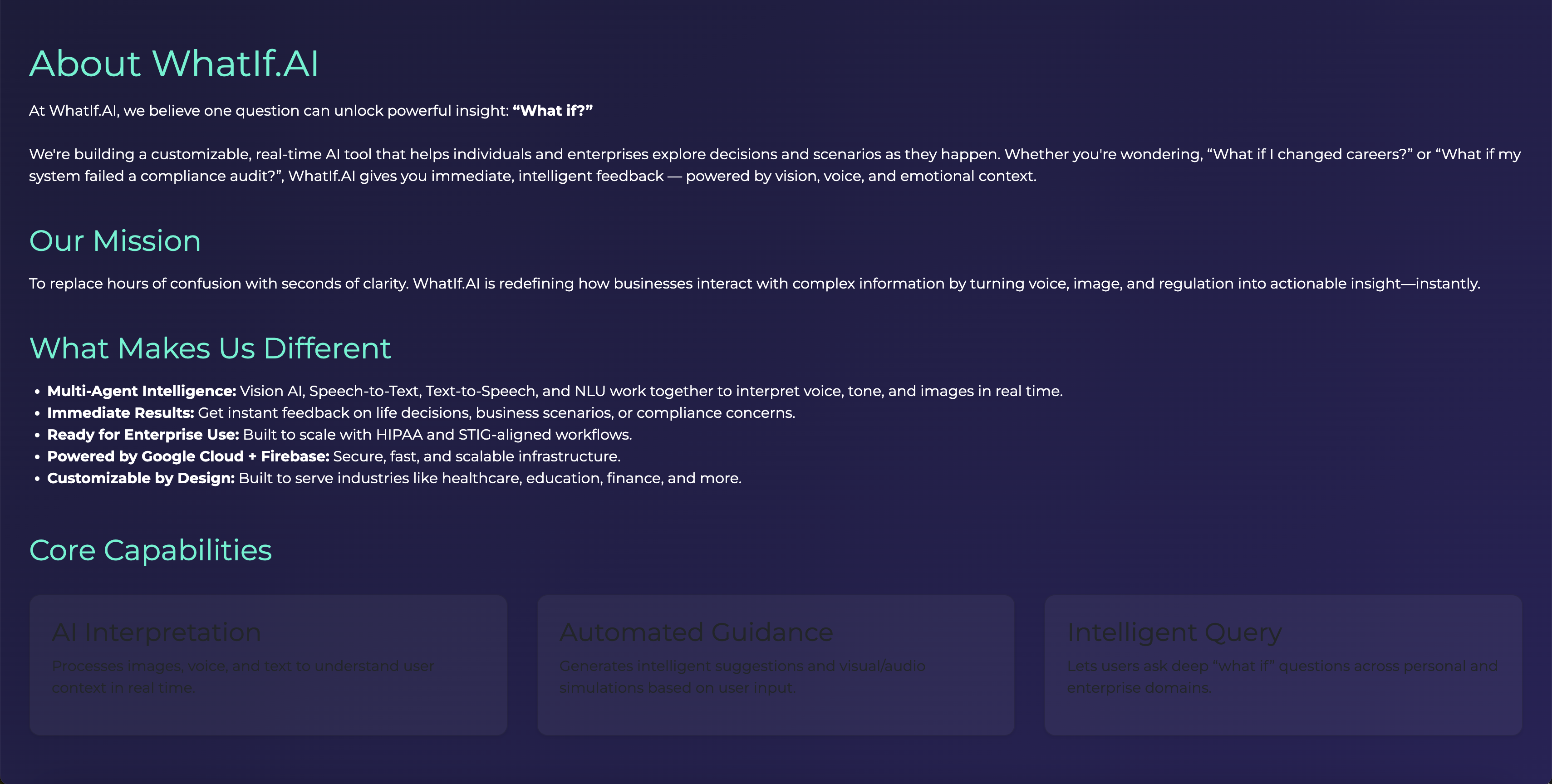
About
-
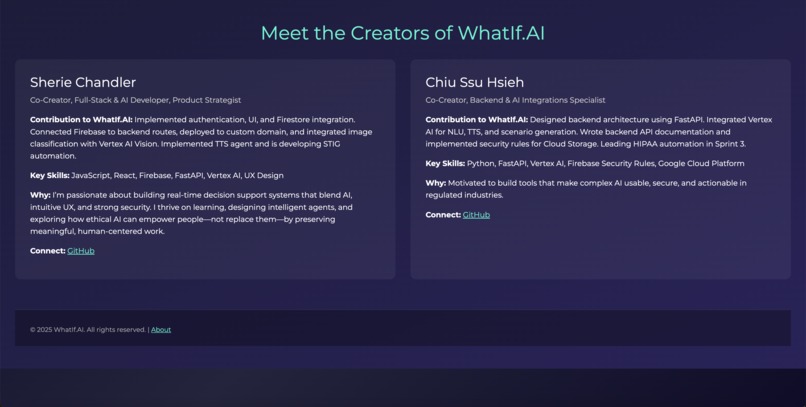
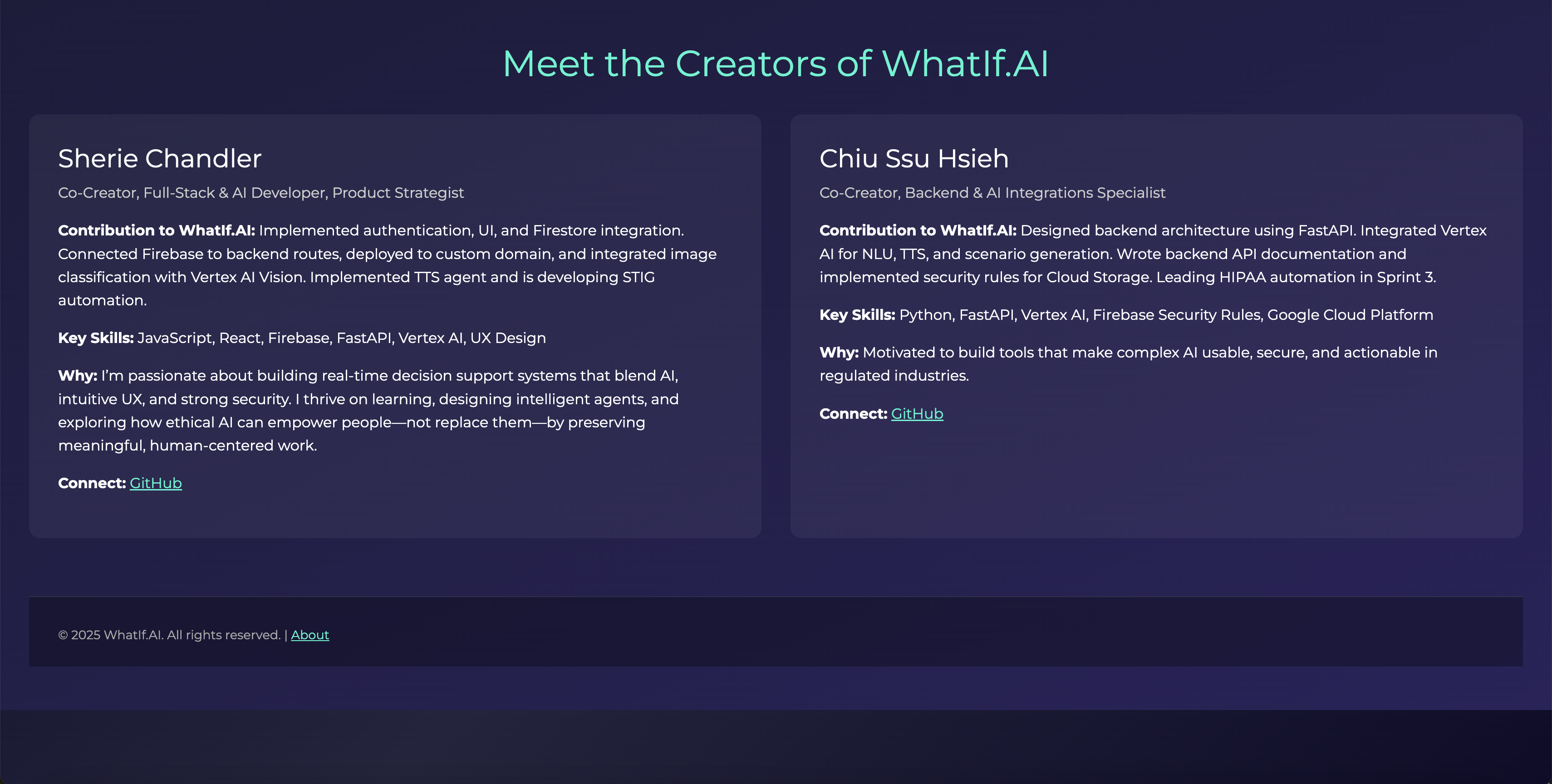
Contact
-
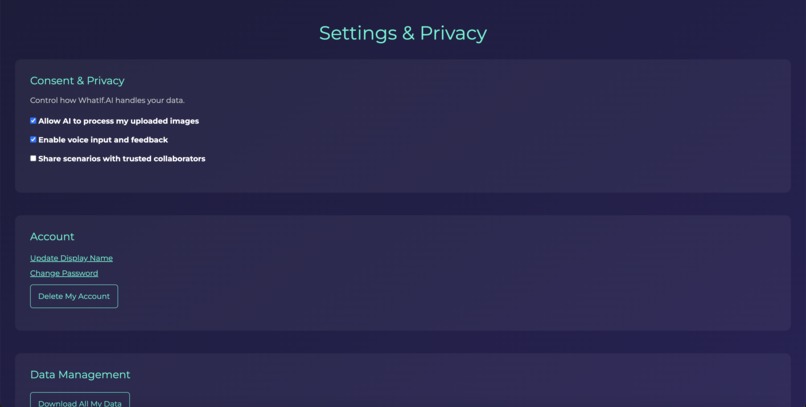
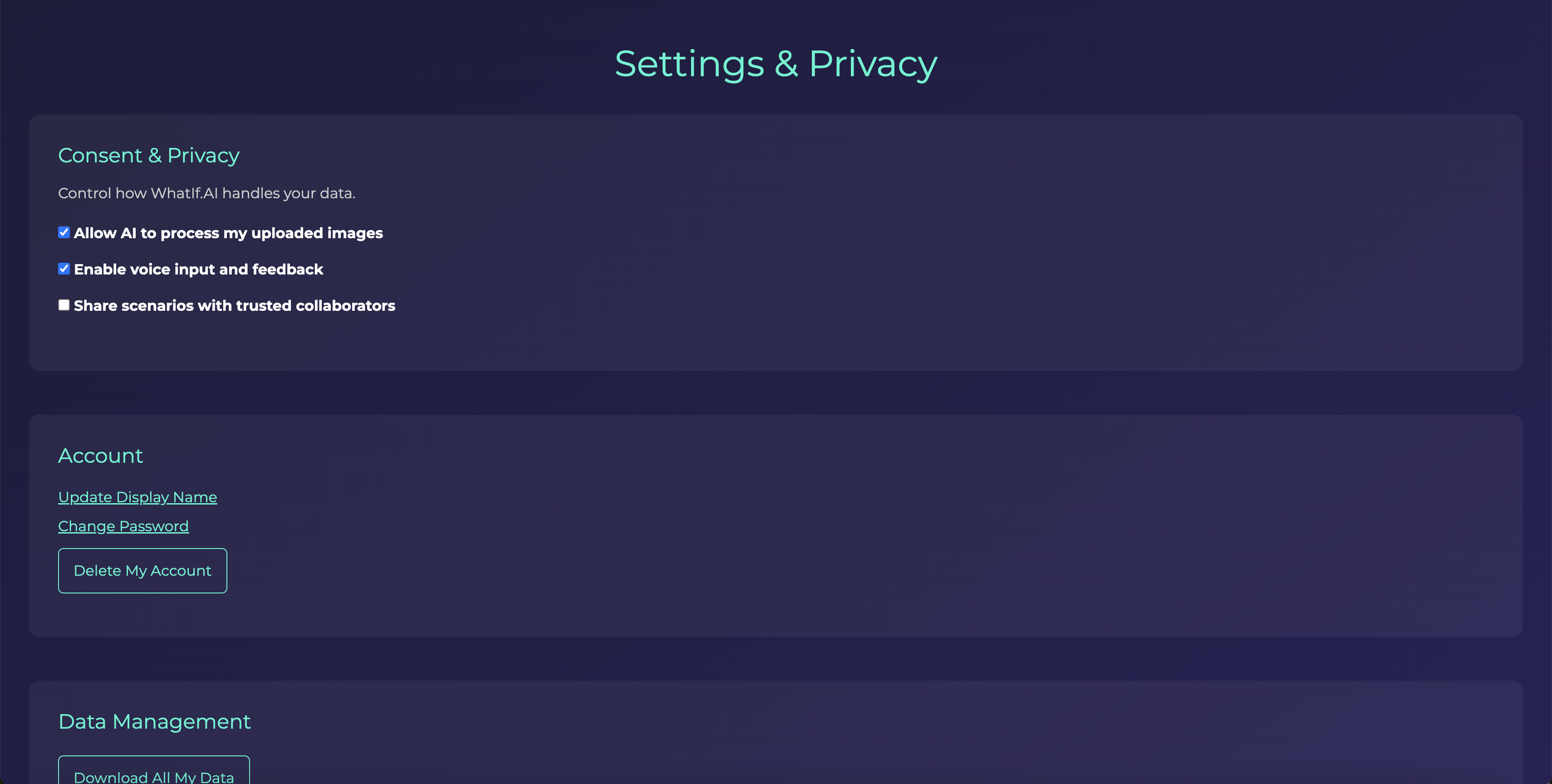
Setting and Policy

WhatIf.AI: Storytelling Meets Scientific Curiosity
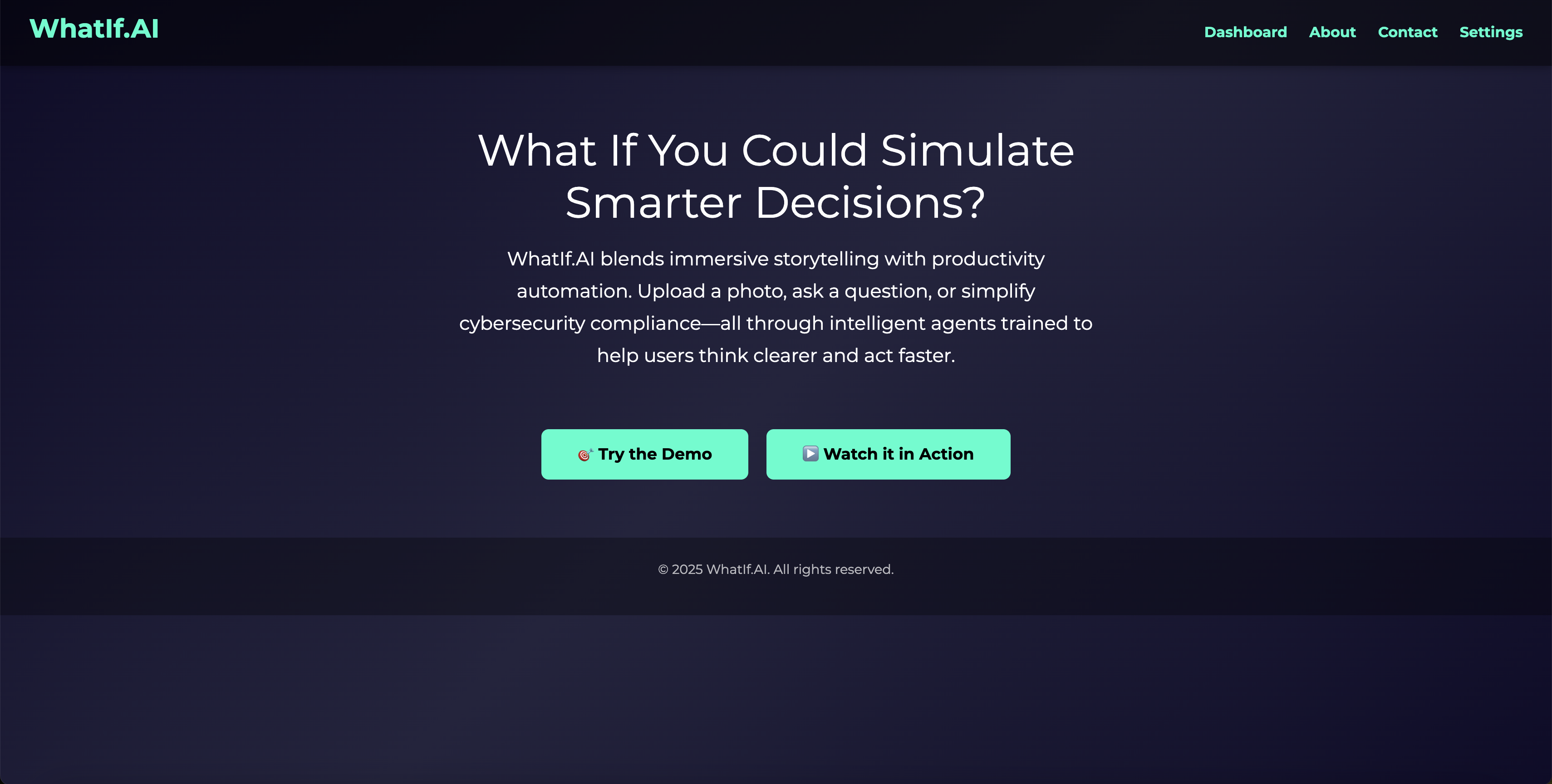
WhatIf.AI began as a simulator that lets users upload a photo, ask a “what if” question, and explore alternate versions of their lives—narrated in their own voice.
The goal? To help people reflect more deeply, think more creatively, and make smarter decisions through emotionally engaging, AI-powered storytelling.
As former physical science majors, we were trained to constantly consider alternative pathways.
What if we could harness pluripotent cells to regenerate damaged organs before symptoms even appear?
What if a metabolic pathway failed—would apoptosis trigger or chaos unfold?
What if telomeres shortened too quickly—could we model aging in reverse?
That habit of simulating outcomes, anticipating anomalies, and thinking in systems is exactly what inspired us to build WhatIf.AI.
Whether it’s biological systems, HIPAA policy gaps, cybersecurity compliance, or personal crossroads, the question “What if…?” is a powerful lens for exploration.
But we also realized that “what if” isn’t just a scientific prompt—it’s a deeply human one. One of our team members was inspired by her grandmother’s struggle with dementia. As her condition progressed, she began to forget the moments that made her who she was. This personal experience sparked the idea for our memory reconstruction feature—using AI to help preserve and relive cherished memories.
"My grandmother suffered from dementia and had a difficult time recalling the precious life events with loved ones. The important memories faded away as her dementia staging progressed. I hope that utilizing memory reconstruction can help strengthen those memories so that the beautiful moments stay in her mind a little longer."
Her story reminded us that AI isn’t just about speed and automation—it can also support emotional wellness and human connection.
Why We Built It
WhatIf.AI was born from two core motivations:
1. Storytelling & Reflection
We wanted a platform where users could explore alternate realities in a way that’s visual, interactive, and personal. Whether it’s imagining a life decision, reliving an old memory, or supporting someone with cognitive decline, our simulator helps people find clarity and emotional resonance.
By combining face-based uploads, generative prompts, and narration in the user’s own voice, WhatIf.AI creates personalized stories that feel both speculative and real. Especially for those impacted by memory loss, the ability to reconstruct a meaningful moment can be powerful.
2. Frustration with Compliance Overload
The STIG AI Clarifier was inspired by a friend who quit his job after being asked to STIG (secure) 40 laptops—manually—in a single day. That pain point revealed how much time and energy are lost due to complex, inefficient compliance documentation. We built a solution that lets AI do the heavy lifting, translating dense cybersecurity requirements into plain English with actionable insight.
What It Does
WhatIf.AI combines storytelling with productivity-enhancing automation:
- Scenario Generator – Upload a photo, ask a question, and receive an AI-generated narrative with visuals, prompts, and voice playback. Users can ask questions like "What if I never left this city?" to explore emotionally resonant decision paths.
- Memory Reconstruction Tool – Inspired by real stories of dementia, this feature recreates personal moments based on user input and photo uploads, offering comfort and emotional connection.
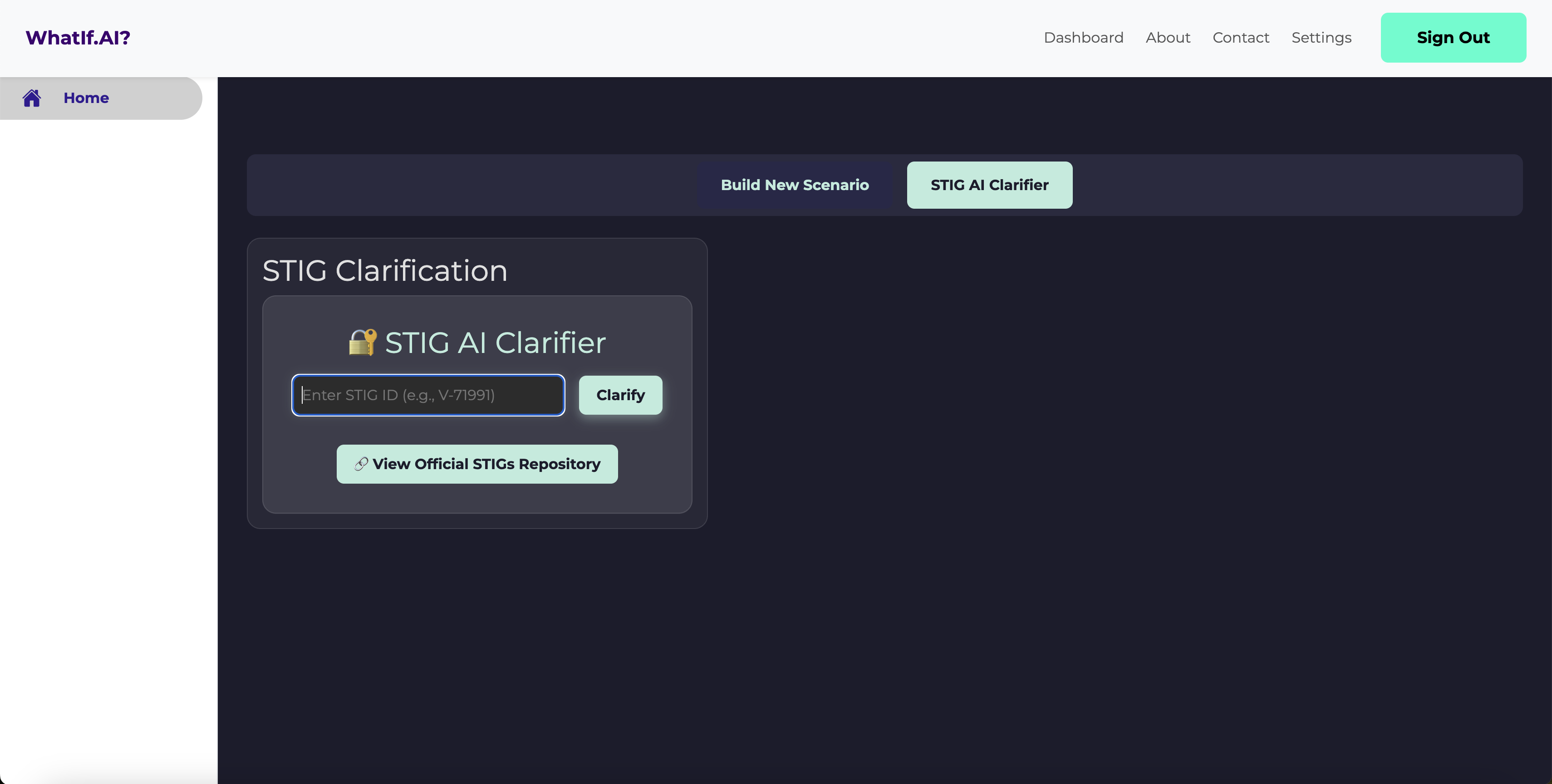
- STIG AI Clarifier – Translates complex cybersecurity STIGs into plain English, helping engineers and compliance officers reclaim hours of lost time.
- Multi-Agent Architecture – Uses vision, TTS, NLU, and STT agents working together to generate personalized insights for both individuals and organizations.
How We Built It
- Frontend – React with custom CSS, deployed via Firebase Hosting
- Backend – FastAPI for serving scenario endpoints and handling file uploads
- AI/ML Integration:
- Vertex AI – Orchestrates our multi-agent LLM workflows
- Gemini API – Enables advanced natural language understanding
- Google Cloud Vision API – For image analysis
- Google Cloud TTS – For voice synthesis
- Custom prompt engineering for scenario generation
- Vertex AI – Orchestrates our multi-agent LLM workflows
- Authentication – Firebase Auth with secure token validation
- Storage – Firestore and Firebase Cloud Storage
Challenges We Ran Into
- Token Authentication Debugging – Syncing Firebase ID tokens between frontend and backend required in-depth troubleshooting
- Version Control Issues – Merge conflicts and working across multiple branches created friction during development
- Mocking vs. Live API Testing – Balancing fast UI iteration with backend availability was tricky
- Security Rule Design – Writing and testing Firestore/Cloud Storage security rules took longer than expected
- API Routing – Conflicts during development sometimes caused endpoints to return HTML instead of JSON
- Complex Orchestration Logic – Managing multiple agents in parallel, especially with async communication and data dependencies, pushed us to rethink our API design and data flow strategies
Accomplishments That We're Proud Of
- Built a functional multi-agent AI app that supports photo uploads, TTS narration, and smart scenario generation
- Integrated intelligent agents that communicate in parallel
- Designed and presented a full-stack architecture tailored for Google Cloud
- Deployed a live, production-ready version on a custom domain
- Built and tested the STIG Clarifier to automate cybersecurity compliance
- Developed a memory reconstruction demo with emotional impact
- Created a clean, intuitive UI that blends creative simulation with enterprise-grade tools
What We Learned
We learned that AI isn't just about creativity—it’s also a productivity engine and decision support tool. WhatIf.AI evolved from a simulator into a platform that blends emotional insight with enterprise power. Whether you're a student imagining the future, a doctor planning for edge cases, or an engineer buried under compliance documentation, AI agents can help lighten the load and boost clarity.
We also learned:
- How to troubleshoot across different agents (vision, text, TTS, STT) in a multi-agent system
- How difficult version control can be during active collaboration
- Gemini offers more contextual debugging; ChatGPT is better for fast iteration and documentation
- The value of auth-first security design with Firebase
- Real-world pain points like STIG overload can spark powerful innovation
- Agent orchestration (not just chaining LLMs) is the future of decision support
- Firebase token handling can be a major blocker if not clearly documented
- Keeping things simple—even in complex systems—is essential for demo success
- Emotional and narrative design (like memory simulation) adds huge value to AI tools
What’s Next for The Autonomates GC-ADK
During the hackathon, we successfully delivered the STIG Clarification AI Module as our core MVP. Several planned features were deferred due to time spent troubleshooting authentication and orchestration issues. Here's what’s ahead for our platform:
1. Immediate Post-Demo Priorities
Production Launch at WhatIf-App.com
Finalize and maintain our live deployment on a permanent custom domain to support ongoing access, testing, and feedback collection.Chuck the ChatBot (AI Onboarding Assistant)
A personalized AI guide who interacts with users on the dashboard, explains how WhatIf.AI works, and helps tailor the platform to specific business or personal needs.STIG (Security Technical Implementation Guide) AI Clarifier
Translates complex cybersecurity STIGs into plain English, helping engineers and compliance officers reclaim hours of lost time.
We plan to enhance the compliance experience with:
- A secure prompt + response chat interface for natural language STIG questions
- Configurable STIG-to-Remediation suggestions (e.g., shell commands, config paths, registry edits)
- A Baseline Diff Viewer to visually compare secure vs. insecure system configs
- A local
stig_remediations.jsonfile for quick mocked data responses
2. Near-Term Feature Roadmap
STIG Analyzer & Propagation Agent (New Feature – Not Yet Implemented)
• Scan a compliant machine and extract STIG-based configuration settings
• Generate secure profiles that can be applied to other non-compliant systems
• Build command-line automation and shell script generation featuresHIPAA AI Agent
Extend our compliance support by building an agent that interprets complex healthcare documentation into actionable insights.Voice-to-Scenario Input
Integrate Google Cloud Speech-to-Text to allow users to speak “what if” prompts instead of typing.Data Export & Deletion Tools
Add support for CCPA/GDPR compliance to empower users with full data control and increase platform trust.
3. Long-Term Vision
Enterprise Pilots
Partner with organizations in finance, healthcare, and cybersecurity to customize AI agent workflows for internal use.Mobile App Expansion
Extend the platform’s usability into mobile-first environments for students, field techs, and remote workers.(Under Exploration) Calendar Integration for Memory Reconstruction
A potential enhancement allowing users to pull from past calendar events to improve the accuracy and emotional richness of memory simulations. This feature would be optional and user-permissioned.AI for Education & Innovation
We envision WhatIf.AI being used in educational settings to help students think more deeply and critically—especially in science and math classes. As a built-in assistant on classroom devices, it can guide exploratory thinking and fuel innovation.Customizable Government & Enterprise Tooling
Our long-term goal is to offer a secure, modular version of WhatIf.AI that can be embedded within federal agencies and banks—giving employees access to decision-support tools, automated documentation interpreters, and AI-driven productivity workflows.


Log in or sign up for Devpost to join the conversation.