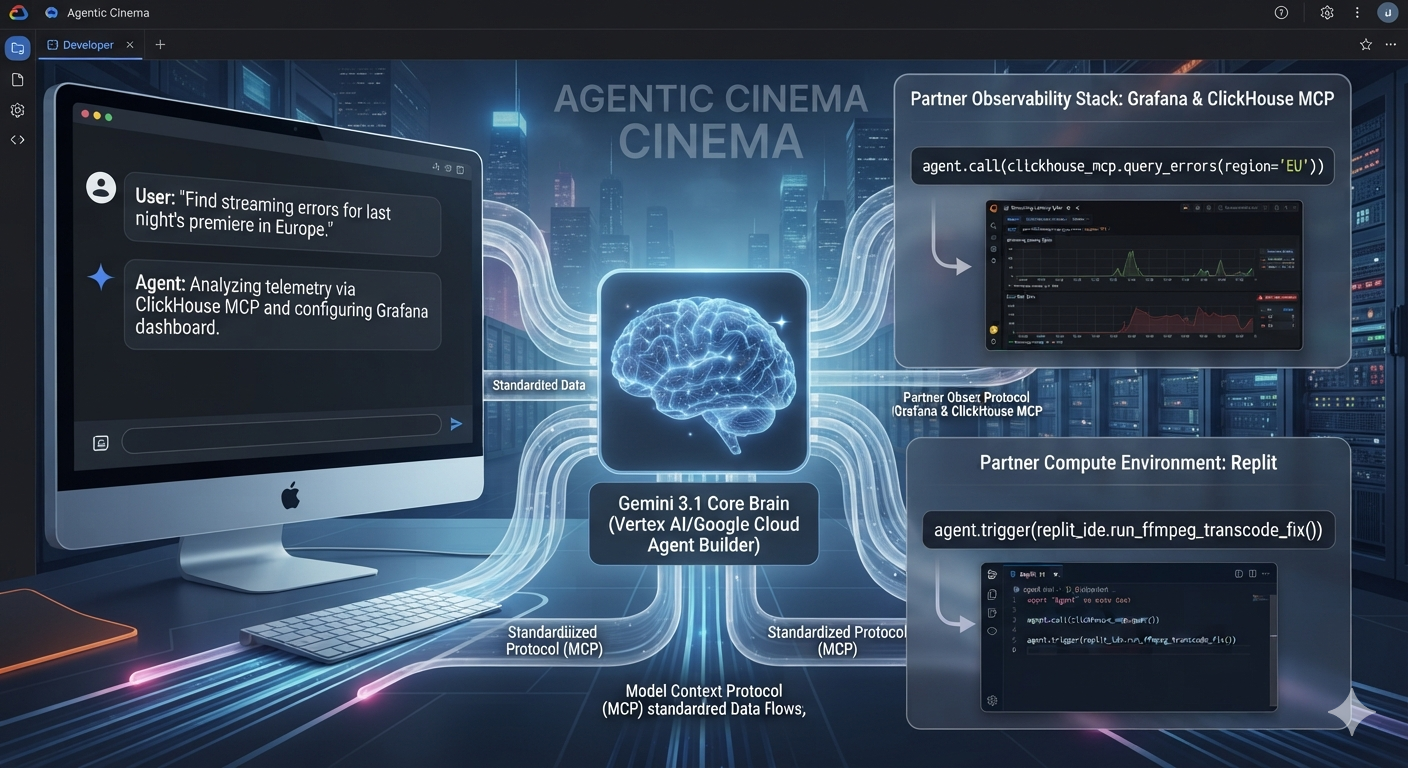
Project Story: Agentic Cinema InspirationModern media pipelines handle petabytes of streaming data every single second. When a global streaming service drops video frames or hits a rendering error, engineers are forced to manually dig through disjointed log files across disparate servers. This manual delay costs thousands of dollars per minute in user churn.We were inspired to build this project to see if a Gemini-powered supervisor agent could act as an autonomous, self-healing technical producer. By connecting Google Cloud Agent Builder with industrial-grade data layers, we wanted to turn plain-language engineering requests ("Fix the streaming lag in Europe") into instant, automated diagnostic actions.How We Built ItWe built our solution using a modular, cloud-native agentic architecture:The Intelligence Core: Powered by the Gemini 3.1 engine via Google Cloud Agent Builder. This serves as our master reasoning orchestrator.The Data Storage Layer: Integrated via an advanced Model Context Protocol (MCP) server, allows the agent to execute real-time, high-throughput queries against billions of telemetry rows.The Observability Hub: Connected via an orchestration layer to automatically spawn dynamic monitoring dashboards, giving human engineers instant visual feedback.The Compute Interface: Hosted completely on Google Cloud Run with a frontend interface for real-time interaction.The Math Behind the Agent's Decision EngineTo prevent the agent from spamming databases with redundant queries, we implemented an optimized Confidence-Scoring Token Window. The agent calculates an internal confidence index ((C)) before calling any partner tool:(C=\omega {1}\cdot P(\text{Intent})+\omega _{2}\cdot \left(1-\frac{\Delta T}{T{\text{max}}}\right))Where:(P(\text{Intent})) is the semantic probability of a matching tool route.(\Delta T) is the elapsed time since the last system telemetry pulse.(\omega_1, \omega_2) are weights balancing semantic intent against data freshness ((\omega_1 + \omega_2 = 1)).If (C < 0.75), the agent safely falls back to asking the user for clarifying details instead of executing blind backend actions.Challenges We FacedLatency Mitigation: Interfacing an LLM reasoning loop with a massive live data pipeline can create execution lag. We solved this by using response streaming and aggressive data indexing.Context Window Overflows: Raw media server logs are incredibly dense. Feeding thousands of unparsed log rows directly into the prompt window triggered token limits. We solved this by building an intermediate log aggregator function to pre-summarize error statistics before passing them back to Gemini.Securing Tool Callbacks: Preventing the autonomous agent from running unchecked queries required strict parameterization and validation boundaries around our tool execution environment. What We LearnedThe Power of MCP: Standardizing tool schemas using Model Context Protocols drastically cuts down development time when hooking up AI models to external enterprise systems.Hybrid Workflows Win: Autonomous agents work best not when trying to replace human engineers, but when operating as a high-speed assistant that handles the tedious data collection and sets up the workspace for human decision-making.Deterministic Guardrails are Mandatory: LLMs are highly creative, but database operations must be deterministic. Balancing agent flexibility with strict API payload validation is the secret to building enterprise-ready tools.
Built With
- docker
- fastapi
- ffmpeg
- github-actions
- google-cloud-agent-builder
- gradio
- ibm-watsonx
- javascript
- misleading
- pandas
- postgresql
- python
- replit
- streamlit


Log in or sign up for Devpost to join the conversation.