-
-
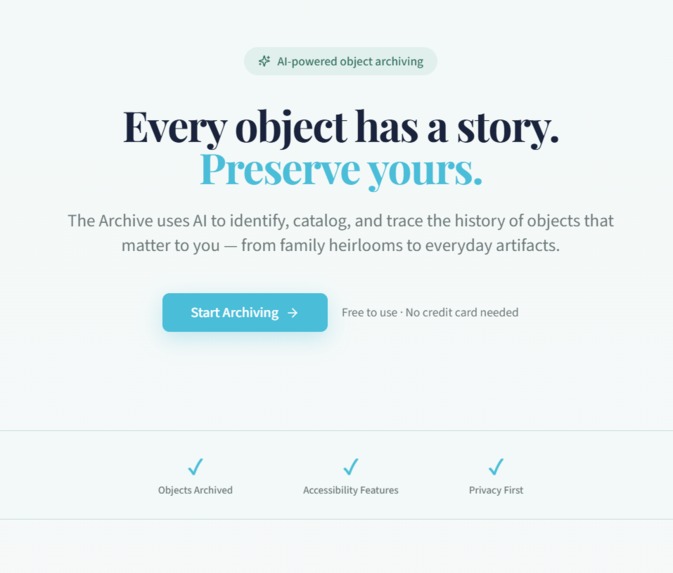
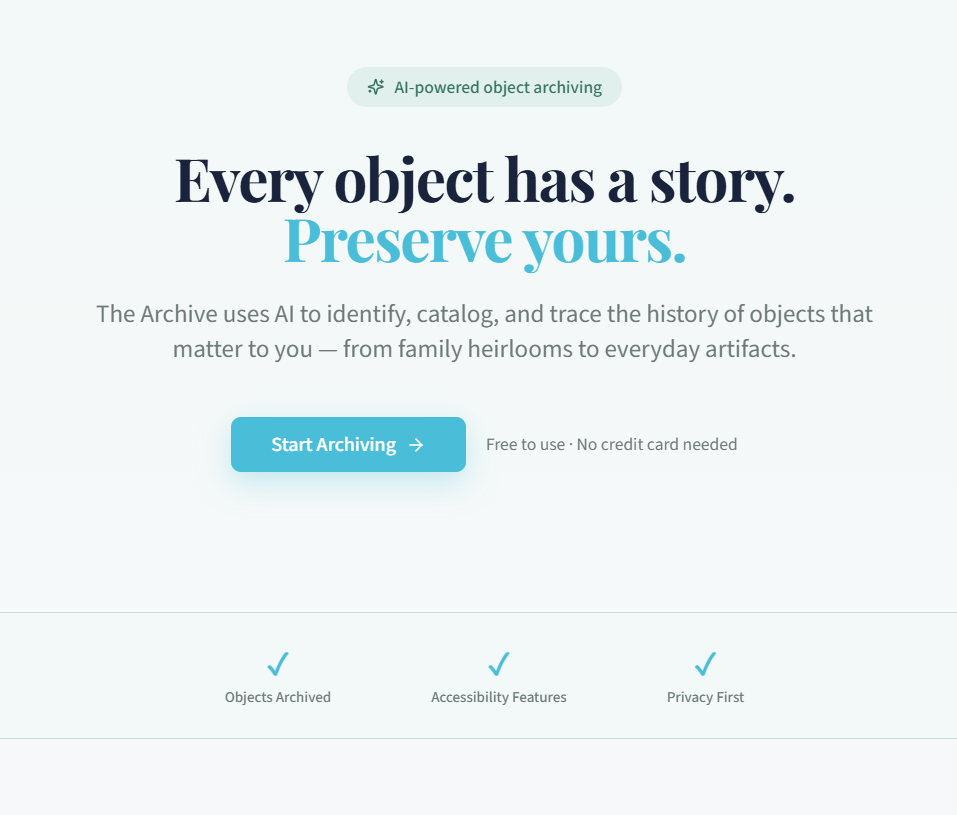
Landing Page
-
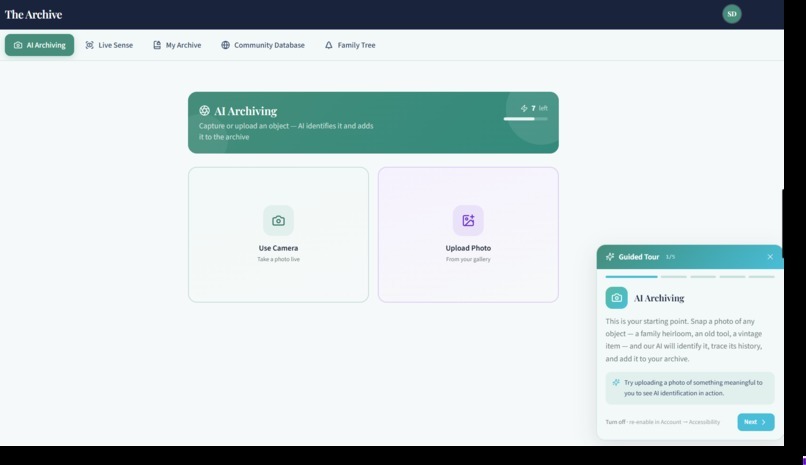
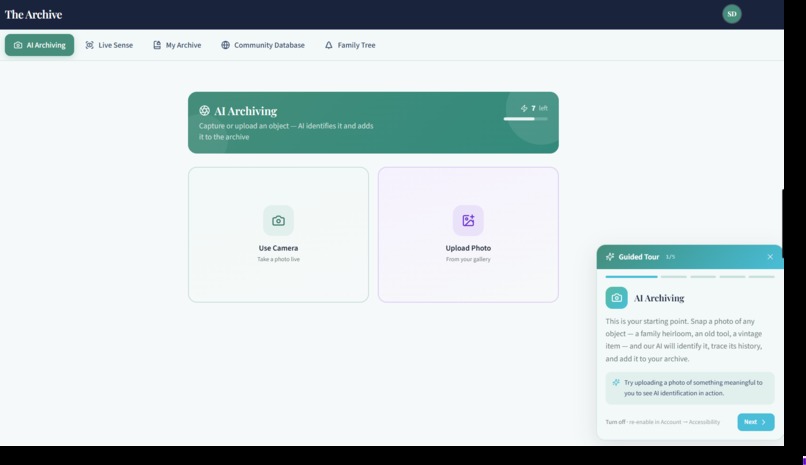
AI Archiving Tab
-
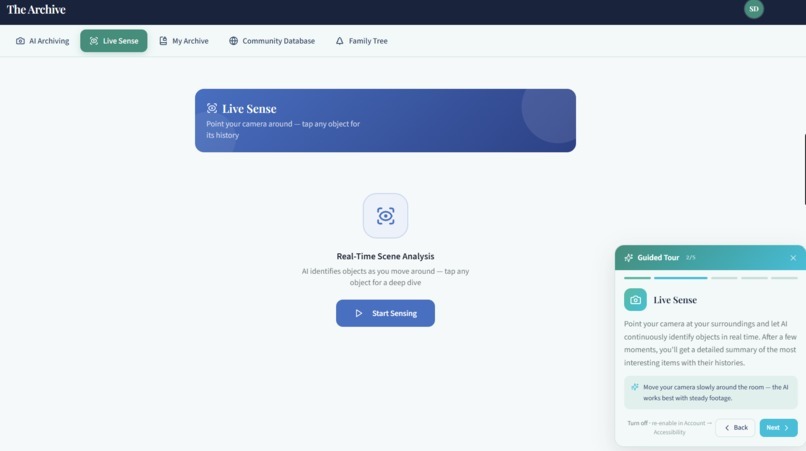
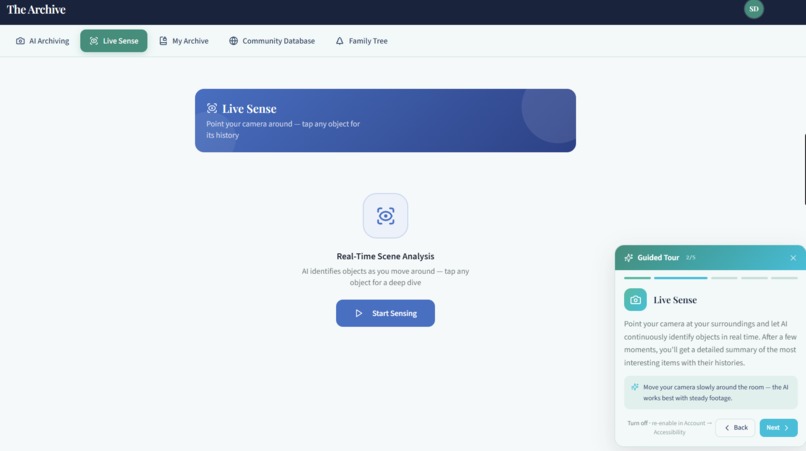
Live Sense Tab
-
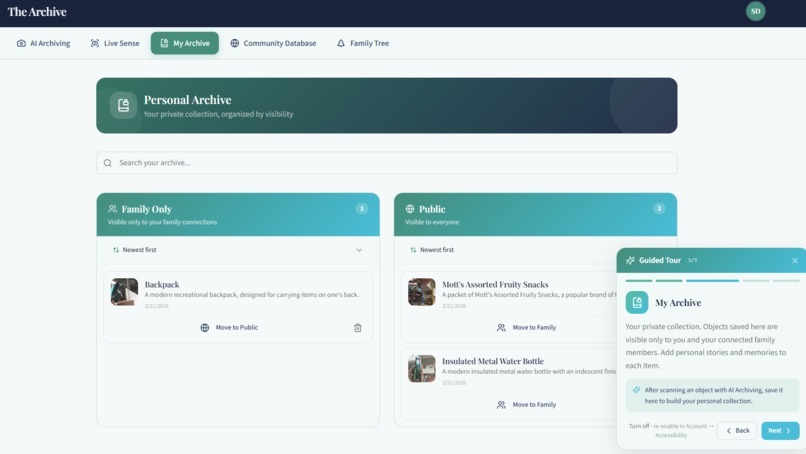
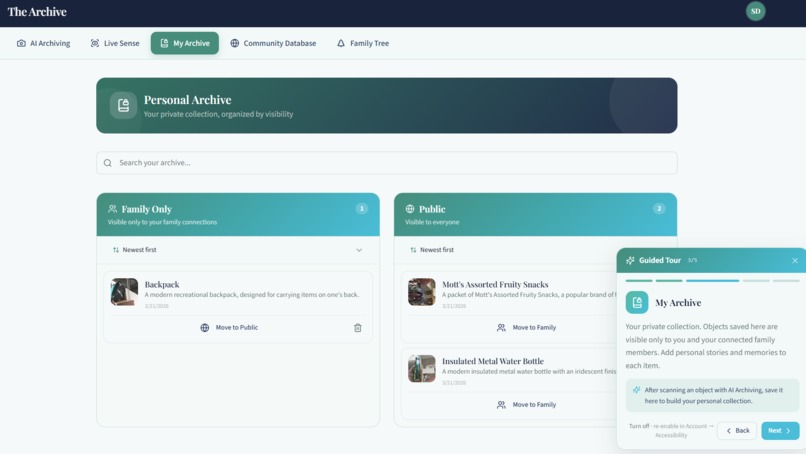
My Archive Tab
-
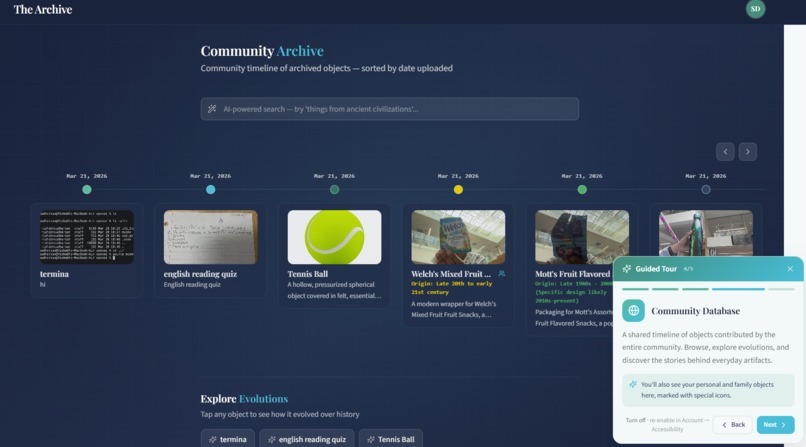
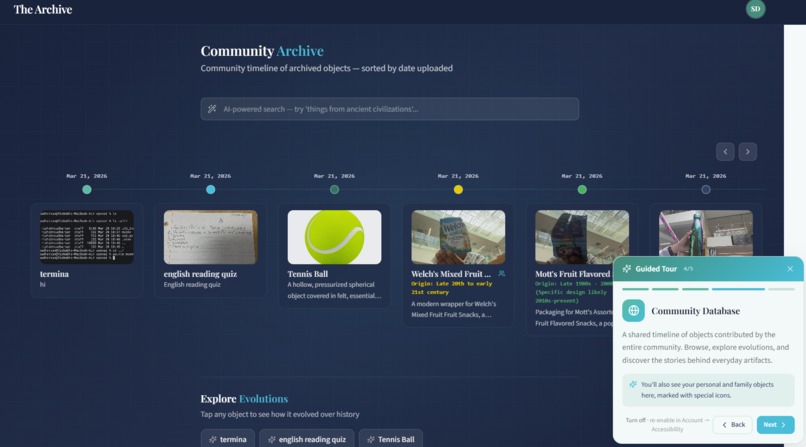
Community Database Tab
-
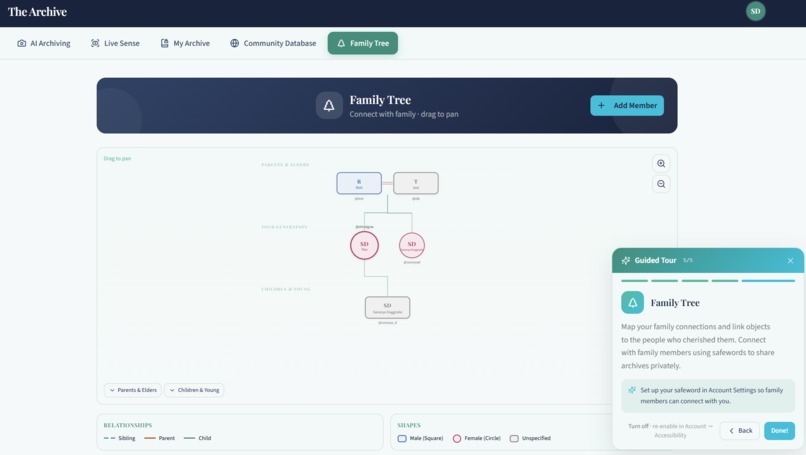
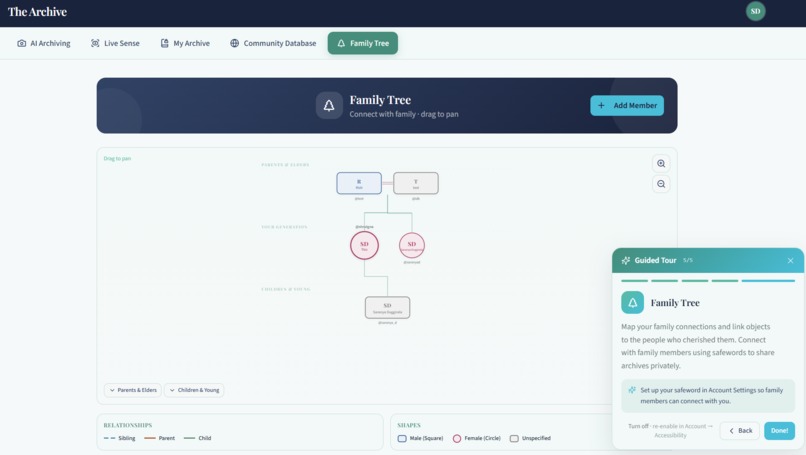
Family Tree Tab
Inspiration
Every day, pieces of human history disappear.
Family heirlooms are passed down without their stories. Cultural traditions fade as generations grow apart. Community memories remain undocumented and are often lost when the people who carry them are gone.
While technology has made it easier than ever to store photos and documents, it has not solved a deeper problem: preserving the meaning behind them.
We asked ourselves a simple question: What if every object could tell its story?
That question became The Archive.
What it does
The Archive is an AI-powered living memory network that preserves and connects human stories through the objects around us.
Using a camera, users can scan an object and instantly access:
- Historical context and significance
- Community-contributed stories
- Personal and family connections
- Related artifacts and memories
Users can contribute their own stories, build family archives, and connect objects to people, places, and events.
Rather than acting as a static database, The Archive continuously grows as more knowledge is added, creating a living, searchable record of collective memory.
How we built it
We developed The Archive using Lovable for rapid frontend development, TypeScript and JavaScript for application logic, Python services for backend processing, and Google’s Gemini 2.5 Flash API for understanding, contextual analysis, and intelligent retrieval.
Our system combines computer vision, AI-powered semantic search, family relationship mapping, and community storytelling to connect users with meaningful information about the objects they encounter. We used Chat GPT 4.0 mini to help build the computer vision system and tuned it to output results in the structure we wanted it in.
Challenges we ran into
One of our biggest challenges was creating an experience that felt instant and intuitive while relying on asynchronous AI processing behind the scenes.
We also needed to balance multiple layers of information: personal archives, family histories, community knowledge, and AI-generated context, without overwhelming the user.
Finally, integrating AI services (while maintaining API limits), databases, authentication systems, and frontend interactions (such as the guided tour and several accessibility features) into a seamless experience required significant iteration and testing
Accomplishments that we're proud of
We’re proud that The Archive goes beyond simple object detection and recognition.
We built a platform capable of connecting physical objects to human stories, historical knowledge, and personal memories in real time.
We are also proud of creating an experience that feels accessible and engaging while tackling a meaningful problem with long-term societal impact.
What we learned
This project taught us how to combine AI-assisted development with traditional software engineering to rapidly prototype ambitious ideas.
We gained experience integrating large language models, designing scalable data structures, managing API workflows, and creating intuitive user experiences for complex information systems.
Most importantly, we learned that technology can be used not just to organize information, but to preserve human connection.
What's next for The Archive
Our vision is to evolve The Archive into the world’s largest living memory network.
Future development could include partnerships with libraries, historical societies, cultural organizations, local governments, and schools to preserve historical artifacts and to build community-level archives.
We would also partner with museums to power virtual tours where visitors scan exhibits and get AI-generated context. Expansion to cultural preservation efforts for endangered languages and traditions would also occur. Lastly, we would let developers use The Archive's object classification and storytelling engine into their own apps.
As AI continues to evolve and adapt, we believe preserving humanity’s collective memory will truly become one of its most meaningful applications.
Built With
- api
- chat-gpt-4.0-mini
- css
- google-2.5-gemini-flash
- javascript
- lovable
- python
- typescript

Log in or sign up for Devpost to join the conversation.